
HSE-246 · Lesson 11 of 12 · 25 min
Waste handling, transport and disposal
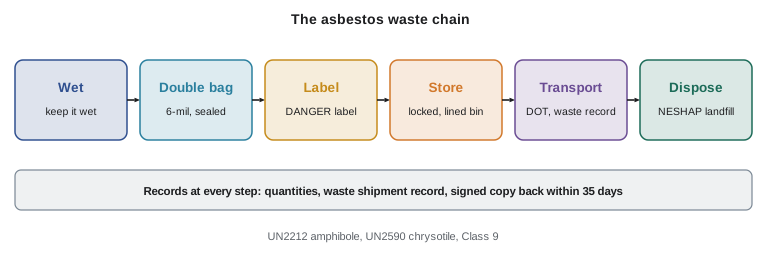
Asbestos does not stop being dangerous when it is removed. Waste bags that tear, debris left in a dumpster, or loose material dropped from a truck can expose waste handlers, drivers, landfill workers and the public. Asbestos waste is controlled from the moment it is created until it is buried, through a chain of steps: wetting, packaging, labeling, temporary storage, transport and disposal at an approved site, with records at each stage. This lesson explains each step and the rules that govern it.
What counts as asbestos waste
Asbestos waste includes the asbestos-containing material removed, debris and dust collected during clean-up, used polyethylene sheeting, disposable coveralls, gloves, footwear covers and respirator filters, used HEPA filters from vacuums and negative air units, glove bags, and contaminated items that cannot be cleaned. Water used for wetting and showering is filtered before it is discharged, and the filters become asbestos waste. Some non-friable materials removed intact, such as asbestos-cement products, may be handled under different rules in some jurisdictions, but they must still be kept intact and controlled.
Asbestos waste is regulated by EPA's NESHAP for demolition and renovation of facilities, by OSHA's construction and general industry standards for workplace handling, by Department of Transportation hazardous materials regulations for transport, and by state and local solid waste rules for disposal. Many states have stricter requirements, including manifests and approved transporters. Check the rules in the state where the waste is generated and disposed of.
Packaging
The basic principle is to keep waste wet and sealed so that fibers cannot escape. Typical requirements and good practice include:
- Wet the waste before packaging. NESHAP requires regulated asbestos-containing material to be adequately wet and kept wet until collected for disposal.
- Use leak-tight containers. NESHAP requires waste to be sealed in leak-tight containers while wet, or, for materials that will not fit, wrapped in leak-tight wrapping. Heavy polyethylene bags, commonly 6-mil, are used, and most specifications require double bagging. Drums or lined containers are used for sharp or heavy material.
- Do not overfill. Fill bags only partly so that they can be sealed by twisting and taping the neck and lifted without tearing.
- Remove air carefully. Use a HEPA vacuum to collapse a bag before sealing it.
- Wrap large items. Pipes, panels and sheets that will not fit in bags are wrapped in two layers of polyethylene sheeting and sealed.
- Clean the outside of each bag with damp wipes or a HEPA vacuum before it leaves the work area.
Labeling
OSHA requires containers of asbestos waste to carry labels with the hazard warning in its standards, beginning with the signal word DANGER, stating that the contents contain asbestos fibers, may cause cancer and cause damage to lungs, and telling people not to breathe dust and to avoid creating dust. For off-site transport, NESHAP requires each container to be labeled with the name of the waste generator and the location where the waste was generated. DOT rules add hazard class markings when the waste is shipped as a hazardous material.
Temporary storage on site
Waste should leave the work area promptly and be stored in a secure, lockable container, such as a lined, covered bin or a closed trailer, until it is collected. The container should be clearly marked, kept locked when not being loaded, and placed where it cannot be damaged by vehicles. Torn bags must be repaired immediately by placing them in a new bag. Asbestos waste must never be placed in general construction waste bins, where it will be crushed, broken and sent to a landfill or recycling site that is not prepared for it.
Transport
Asbestos is a hazardous material under DOT's Hazardous Materials Regulations, listed as UN2212, asbestos, amphibole, and UN2590, asbestos, chrysotile, in Class 9. The regulations include exceptions, for example for asbestos immersed or fixed in a binder so that fibers cannot escape. Where the regulations apply, shippers must prepare shipping papers, mark and label packages, and ensure employees are trained. NESHAP requires vehicles used to transport asbestos waste to be marked during loading and unloading with a sign warning of the asbestos dust hazard, and requires a waste shipment record to travel with the waste. Vehicles should be enclosed or covered so that bags cannot fall out or be damaged.
Disposal
NESHAP requires asbestos waste from regulated demolition and renovation to be deposited as soon as practical at a waste disposal site operated in accordance with the NESHAP disposal requirements, which include covering the waste at the end of each operating day with at least 15 centimeters of compacted non-asbestos material or controlling emissions in other approved ways. The generator must receive a copy of the waste shipment record signed by the disposal site operator; if it is not received within 35 days, the generator must contact the transporter or site, and if it is not received within 45 days, the generator must report in writing to the regulating agency. Asbestos waste must never be recycled, burned or dumped.
Notification and records
Records prove that waste went where it should. NESHAP requires the owner or operator to notify the state or EPA at least 10 working days before demolition, and before renovation above the thresholds, and the notice includes the estimated quantity of asbestos, the work practices to be used and the disposal site. Waste shipment records must be kept for at least two years. OSHA records of exposure monitoring and medical surveillance must be kept for 30 years beyond employment. Many states require additional notifications and fees.
# Does a renovation trigger NESHAP notification? (thresholds for regulated ACM)
def neshap_renovation_notice(pipe_lf=0.0, area_ft2=0.0, volume_ft3=0.0):
    return pipe_lf >= 260 or area_ft2 >= 160 or volume_ft3 >= 35

jobs = [
    ("valve repairs, 40 lf pipe lagging",           dict(pipe_lf=40)),
    ("boiler room, 300 lf pipe lagging",            dict(pipe_lf=300)),
    ("ceiling patch, 120 ft2 sprayed material",     dict(area_ft2=120)),
    ("floor of gym, 1,800 ft2 friable backing",     dict(area_ft2=1800)),
    ("crawl space debris, 40 ft3",                  dict(volume_ft3=40)),
]
for name, kw in jobs:
    print(f"{name:42s} {'notify' if neshap_renovation_notice(**kw) else 'below threshold'}")

# Waste shipment record follow-up
for days in (30, 36, 46):
    if days > 45:
        step = "report in writing to the agency"
    elif days > 35:
        step = "contact the transporter or disposal site"
    else:
        step = "wait for the signed record"
print(f"{days} days without signed record: {step}")valve repairs, 40 lf pipe lagging below threshold boiler room, 300 lf pipe lagging notify ceiling patch, 120 ft2 sprayed material below threshold floor of gym, 1,800 ft2 friable backing notify crawl space debris, 40 ft3 notify 30 days without signed record: wait for the signed record 36 days without signed record: contact the transporter or disposal site 46 days without signed record: report in writing to the agency
Notification depends on the amount of regulated asbestos-containing material disturbed, not on the size of the job overall, and below-threshold work still has to follow OSHA, NESHAP work practices where they apply, and state rules. The follow-up timeline shows why someone must be responsible for tracking every waste shipment record.
Spills and damaged containers
If a bag tears or a container is damaged during handling or transport, stop, keep people away, wet the spilled material if it is safe to do so, put on the appropriate respirator and protective clothing, collect the material and the damaged bag into new bags, clean the area with a HEPA vacuum or wet methods, and report the incident. On public roads, follow the emergency instructions in the shipping documents and notify the authorities required by transport and environmental rules.
Worked problem
Checking a waste plan
A renovation contractor plans to put bagged asbestos floor tile and mastic waste into the general construction waste dumpster at the end of each day 'because it is non-friable'. What is wrong with the plan, and what should it be?
Show solution
- General waste bins are compacted and emptied without precautions, so bags will be broken and the waste will go to a site not prepared for asbestos.
- Non-friable material can become friable when crushed; the waste must stay intact and sealed.
- The waste should be wetted, double bagged, labeled as asbestos waste and stored in a separate locked, lined bin.
- It should be transported in compliance with DOT and state rules, with a waste shipment record if NESHAP applies, to a landfill approved for asbestos.
Answer: Asbestos waste must be kept separate, packaged, labeled, transported and disposed of as asbestos waste, with records, whether or not it was non-friable when removed.
Special cases
Some asbestos wastes need particular care:
- Asbestos-cement pipe. Buried water and sewer pipe removed during repairs should be removed in sections by snapping or cutting with wetted hand tools or a pipe cutter, not with abrasive saws, and wrapped in polyethylene for disposal. Pipe left in the ground may be abandoned in place where rules allow.
- Vermiculite. Loose vermiculite is removed by trained workers using HEPA vacuum systems inside an enclosure, never dug out dry with shovels; the vacuum waste is bagged as asbestos waste.
- Contaminated soil and debris. Soil contaminated with asbestos debris, for example after an uncontrolled demolition, is kept wet, covered and removed as asbestos waste or managed under a site remediation plan.
- Water. Shower and wetting water is filtered, commonly to 5 micrometers or finer, before discharge, and the used filters are disposed of as asbestos waste.
- Small quantities from homeowners. Many municipalities have rules or depots for small amounts of asbestos waste from homes; contractors working in homes must follow the same packaging and disposal rules as on commercial jobs.
Choosing a hauler and disposal site
Before removal begins, confirm in writing that a hauler and a disposal site meeting NESHAP requirements will accept the waste, what packaging and paperwork they require, whether appointments are needed, and the cost. Some landfills accept asbestos only on certain days or in limited quantities, and some states require licensed transporters or state manifests. Disposal costs are a real part of the project and should be estimated with the quantities in the work plan.
Waste that cannot be disposed of promptly must stay secured on site, which adds risk and cost. Arranging disposal before the first bag is filled is part of good planning.
Who handles the waste
Every person in the waste chain needs to know what they are handling. Workers who bag and carry waste inside the work area wear the same respirators and protective clothing as the removal crew. Workers who move sealed, cleaned bags from the load-out to the storage bin need training in what the labels mean, how to lift bags without tearing them, and what to do if a bag breaks. Drivers need the shipping documents, the emergency instructions and the contact numbers for the project. Landfill staff need advance notice so that they can prepare a cell and cover the waste promptly. A break in this chain, such as a laborer who does not know why the bags matter, is how sealed waste ends up torn open in a general bin.
Common mistakes
MistakePutting asbestos waste in general construction bins.
InsteadStore asbestos waste separately in a locked, lined, labeled container.
MistakeOverfilling bags so they cannot be sealed.
InsteadFill bags only partly and seal them by twisting and taping the neck.
MistakeSqueezing air out of bags by hand.
InsteadCollapse bags with a HEPA vacuum before sealing.
MistakeCarrying bags through clean areas without cleaning them.
InsteadWipe or HEPA vacuum each bag and double bag it before it leaves the work area.
MistakeNot keeping disposal records.
InsteadKeep shipping documents, manifests or waste shipment records and disposal receipts.
Summary and key terms
- Asbestos waste includes removed material, debris, sheeting, protective clothing, filters and glove bags.
- Waste is kept wet, sealed in heavy polyethylene bags, usually double bagged, and wrapped if too large for bags.
- Containers carry the OSHA DANGER label and, for off-site transport, the generator name and location.
- Waste is stored in a secure, separate container on site and never mixed with general waste.
- Transport is regulated by DOT (UN2212 and UN2590, Class 9), with NESHAP vehicle marking and waste shipment records.
- Disposal must be at a site meeting NESHAP requirements; the signed waste shipment record must come back within 35 days or be followed up.
- Torn bags and spills are handled immediately with wetting, rebagging, HEPA clean-up and reporting.
- Asbestos waste
- Removed asbestos-containing material and anything contaminated by it during the work.
- Double bagging
- Sealing waste in one bag and placing it in a second sealed bag.
- 6-mil bag
- A polyethylene bag about 0.15 mm thick commonly used for asbestos waste.
- Leak-tight container
- A container that prevents solids or liquids from escaping.
- UN2212
- The UN number for asbestos, amphibole, a Class 9 dangerous good.
- UN2590
- The UN number for asbestos, chrysotile, a Class 9 dangerous good.
- Class 9
- The dangerous goods class for miscellaneous products, which includes asbestos.
- Waste shipment record
- A NESHAP form that travels with asbestos waste from the generator to the disposal site.
- Approved landfill
- A disposal site authorized to accept asbestos waste and cover it promptly.
- Manifest
- A document tracking hazardous or special waste from generator to disposal.
Practice problems
Work each problem on paper first, then reveal the answer to check.
List five things that count as asbestos waste.
Show answer
Removed ACM, debris, polyethylene sheeting, coveralls, respirator filters, HEPA filters, glove bags (any five).
Why is asbestos waste wetted before packaging?
Show answer
To keep fibers from becoming airborne.
Why should bags be only partly filled?
Show answer
So they can be sealed properly and lifted without tearing.
How should large items that do not fit in bags be packaged?
Show answer
Wrapped in two layers of polyethylene sheeting and sealed.
What are the UN numbers for asbestos?
Show answer
UN2212 for amphibole and UN2590 for chrysotile, both Class 9.
Why must asbestos waste never go into general construction bins?
Show answer
It will be crushed and sent to a site not prepared for asbestos.
What should an approved landfill do with asbestos waste?
Show answer
Place it without breaking containers and cover it promptly.
When must a generator report a missing signed waste shipment record?
Show answer
If it has not been received within 45 days.
What should happen if a bag tears during handling?
Show answer
Stop, keep people away, wet the material, put on protection, rebag, HEPA clean and report.
How should air be removed from a bag before sealing?
Show answer
With a HEPA vacuum.
Lesson quiz · 5 questions
Score 60% or more to complete this lesson.
Create a free account to save your progress, take quizzes and earn a certificate.