
HSE-246 · Lesson 2 of 12 · 26 min
Health effects of asbestos
Asbestos causes disease only when its fibers are breathed in or, much less commonly, swallowed. Intact material that is never disturbed releases very few fibers. Once fibers are airborne, however, they are invisible, they can stay suspended for hours, and the smallest are carried deep into the lungs. This lesson explains how fibers reach the lungs, why the body cannot clear them, the diseases they cause, the long latency that hides the harm, and why smoking makes the risk so much worse. It also covers what workers can do about past exposure.
How fibers enter and stay in the body
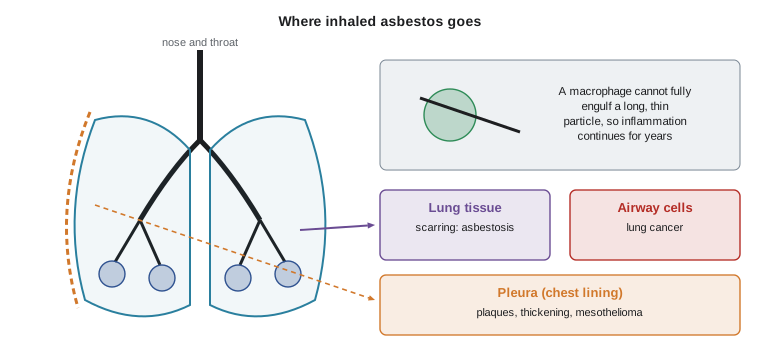
When a material containing asbestos is cut, broken, sanded or crumbled, it releases bundles of fibers that split lengthwise into thinner and thinner fibrils. Fibers that are long and very thin behave aerodynamically like much smaller particles, so they can pass the nose and upper airways and travel down to the small airways and air sacs (alveoli) where gas exchange happens.
The lungs have defenses. Larger particles are trapped in mucus and moved up and out by tiny beating hairs called cilia. Particles that reach the alveoli are normally engulfed by immune cells called macrophages and removed. Long asbestos fibers defeat this system: a macrophage cannot fully engulf a fiber longer than itself, so it becomes chronically activated and releases inflammatory chemicals and reactive oxygen species. Some fibers migrate through the lung tissue to the pleura, the thin lining around the lungs and inside the chest wall. Amphibole fibers in particular can remain in the body for decades.
Asbestos-related diseases
Asbestos causes several distinct diseases. Some are cancers, some are scarring diseases, and some are markers of exposure that are not usually disabling on their own.
| Disease | What happens | Typical latency | Dose relationship |
|---|---|---|---|
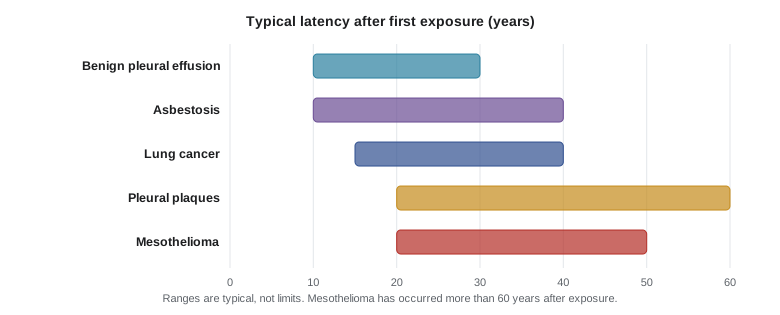
| Asbestosis | Diffuse scarring (fibrosis) of the lung tissue causing stiff lungs, breathlessness and reduced oxygen transfer | 10 to 20 years or more | Usually needs heavy or prolonged exposure; risk rises with dose |
| Lung cancer | Cancer of the airways or lung tissue, indistinguishable from lung cancer caused by smoking | 15 to 40 years | Risk rises roughly in proportion to cumulative dose; strongly multiplied by smoking |
| Mesothelioma | Cancer of the pleura (chest lining) or, less often, the peritoneum (abdominal lining); almost always fatal | 20 to 50 years or more | Can follow relatively low or brief exposure; no safe level known |
| Pleural plaques | Patches of thickened, sometimes calcified, tissue on the pleura | 20 years or more | Marker of past exposure; usually no symptoms |
| Diffuse pleural thickening | Widespread thickening of the pleura that can restrict breathing | 15 years or more | Can cause breathlessness |
| Benign pleural effusion | Fluid around the lung, sometimes the earliest sign of exposure | 10 years or more | May come and go |
| Other cancers | IARC also links asbestos to cancers of the larynx and ovary | Decades | Evidence considered sufficient by IARC |
Asbestosis
Asbestosis develops when fibers in the lung cause repeated inflammation that leads to scarring. The scar tissue makes the lungs stiff and reduces their ability to transfer oxygen to the blood. People with asbestosis become short of breath, first during exertion and later at rest; they may have a dry cough, crackling sounds in the lungs and clubbing of the fingers. There is no cure, and the disease can progress after exposure stops. Asbestosis was common among insulators, shipyard workers and asbestos product manufacturers who had heavy exposure for years. It is less common in workers with modern controls, but cases still occur among people who did unprotected work in the past.
Lung cancer
Asbestos causes lung cancer in the same parts of the lung as smoking does, and the tumors look the same under the microscope. Because most lung cancer is caused by smoking, asbestos-related lung cancers are often not recognized as work-related. The risk rises with cumulative exposure. Workers' compensation boards in Canada and many US states use criteria based on the amount and duration of exposure, the time since first exposure, and evidence such as asbestosis or pleural plaques to decide whether a lung cancer is work-related.
Mesothelioma
Mesothelioma is a cancer of the mesothelium, the thin layer of cells that lines the chest and abdominal cavities. Pleural mesothelioma, in the chest, is the most common form. It usually appears 20 to 50 years after first exposure, it is difficult to treat, and median survival after diagnosis is around one year, although newer treatments have improved survival for some patients. Mesothelioma is almost uniquely linked to asbestos: most cases in men can be traced to occupational exposure. Because it can follow relatively low or brief exposures, including exposure of family members to dust brought home on work clothing, it is the clearest reason why there is no known safe level of asbestos exposure.
Pleural plaques and thickening
Pleural plaques are the most common sign of asbestos exposure. They are patches of thickened tissue on the pleura that often calcify and show up on chest X-rays or CT scans. Plaques usually cause no symptoms and do not turn into cancer, but they show that the person has been exposed enough to carry fibers to the pleura, which means they share the increased risk of the cancers. Diffuse pleural thickening is more extensive and can restrict breathing.
Latency: the hidden harm
Asbestos diseases appear long after exposure. A worker exposed in their twenties may not develop disease until their fifties, sixties or later. Long latency has several consequences:
- Workers do not feel harm at the time of exposure. Asbestos dust does not irritate the eyes or throat the way many dusts do, so there is no warning.
- By the time disease appears, the worker may have changed employers or retired, and the link to work may be missed.
- Today's disease reflects exposures from decades ago, so case numbers fall slowly even after bans.
- Today's exposures, if uncontrolled, will produce disease in the 2050s and 2060s.
Smoking and asbestos
Smoking and asbestos together are far more dangerous than either alone. Classic studies of insulation workers found that asbestos exposure alone increased the risk of lung cancer about five-fold, smoking alone about ten-fold, and the two together about fifty-fold compared with people who neither smoked nor were exposed. The effects multiply rather than add. Smoking does not appear to increase the risk of mesothelioma, but it greatly increases the risk of lung cancer in exposed workers. Quitting smoking reduces lung cancer risk over time, even after asbestos exposure, which makes smoking cessation one of the most useful things an exposed worker can do.
# Illustrative relative risks of lung cancer (classic insulation worker studies)
baseline = 1.0
asbestos_only = 5.0
smoking_only = 10.0

additive = baseline + (asbestos_only - 1) + (smoking_only - 1)
multiplicative = asbestos_only * smoking_only

print(f"neither exposure:            {baseline:5.1f}")
print(f"asbestos only:               {asbestos_only:5.1f}")
print(f"smoking only:                {smoking_only:5.1f}")
print(f"both, if effects added:      {additive:5.1f}")
print(f"both, if effects multiplied: {multiplicative:5.1f} (close to what was observed)")neither exposure: 1.0 asbestos only: 5.0 smoking only: 10.0 both, if effects added: 14.0 both, if effects multiplied: 50.0 (close to what was observed)
The output shows why the multiplicative pattern matters. If the effects simply added, a smoker exposed to asbestos would have about 14 times the baseline risk. Because they multiply, the risk is closer to 50 times. Employers can support exposed workers through smoking cessation programs, and supervisors should never treat smoking as a reason to downplay asbestos controls.
Take-home exposure and bystanders
Asbestos harms people beyond the workers who handle it. Spouses and children of asbestos workers have developed mesothelioma from fibers carried home on clothing, hair, tools and vehicles. People living near asbestos mines and factories, and occupants of buildings where asbestos was disturbed carelessly, have also been harmed. On today's sites, other trades working nearby, building occupants, tenants and the public can be exposed if asbestos work is not contained. This is why controls aim not only to protect the person doing the work but also to keep fibers inside the work area and off clothing and equipment that leave it.
What exposed workers can do
A worker who learns that they disturbed asbestos without protection often wants to know what to do. Practical steps include:
- Stop and report. Stop the work, keep others out of the area, and report to the supervisor so that the area can be assessed and cleaned properly. Lesson 12 covers this response in detail.
- Record the exposure. Write down the date, location, material, task, duration and any air monitoring results, and ask the employer to record the incident. Records can matter decades later for diagnosis and compensation.
- Tell your doctor. Let your physician know about past asbestos exposure so that symptoms such as breathlessness, persistent cough or chest pain are investigated with this history in mind. OSHA requires medical surveillance for workers who meet the exposure criteria in the asbestos standards, which Lesson 4 explains.
- Stop smoking. This reduces lung cancer risk more than any other personal action.
- Do not panic. A single exposure increases risk, but most people with a single brief exposure will not develop disease. The goal is to prevent further exposure and to make sure the history is known.
Worked problem
Estimating a worker's timeline
A retired pipefitter, now 68, worked around asbestos pipe insulation from age 20 to 32 in a refinery. He has developed breathlessness. Which diseases should his doctor consider, and why does the timing fit?
Show solution
- His first exposure was 48 years ago and his last was 36 years ago.
- Asbestosis typically appears 10 to 20 years or more after heavy exposure and can progress after exposure stops, so it fits.
- Mesothelioma typically appears 20 to 50 years after first exposure; 48 years fits.
- Lung cancer typically appears 15 to 40 years after exposure; it also fits, especially if he smoked.
- Pleural plaques or diffuse pleural thickening may also be present and would support the exposure history.
Answer: All the major asbestos diseases are possible. The doctor needs the occupational history to consider them and to support any compensation claim.
Medical surveillance and diagnosis
Medical examinations cannot prevent asbestos disease, but they can document exposure, detect disease earlier, and support compensation. Doctors use several tools. A detailed occupational history is the starting point, because many asbestos diseases look like other conditions. Chest X-rays, read by physicians trained in the International Labor Office classification, can show pleural plaques and the small irregular opacities of asbestosis. Computed tomography (CT) scans are more sensitive and are used to investigate symptoms and abnormal X-rays. Pulmonary function tests measure lung volumes and gas transfer, which fall as asbestosis progresses.
OSHA requires medical surveillance for workers who do Class I, II or III work, or who are exposed at or above the PEL or excursion limit, for a combined 30 or more days a year, and for workers who wear negative-pressure respirators. The examination includes a medical and work history, a standardized respiratory questionnaire, a physical examination focused on the lungs, and pulmonary function tests, with chest X-rays at the physician's discretion. Low-dose CT screening for lung cancer is recommended for some people at high risk, usually based on age and smoking history; workers with significant asbestos exposure should ask their doctor whether they qualify.
Common mistakes
MistakeAssuming no irritation means no harm.
InsteadAsbestos dust gives no warning; harm appears decades later.
MistakeBelieving only heavy, long-term exposure matters.
InsteadMesothelioma can follow relatively low or brief exposure; there is no known safe level.
MistakeTreating lung cancer in a smoker as unrelated to work.
InsteadAsbestos and smoking multiply each other's effects; asbestos may be a major contributor.
MistakeWearing dusty work clothes home.
InsteadDecontaminate and leave work clothing at work to protect family members.
MistakeIgnoring a past unprotected exposure.
InsteadReport it, record it and tell your doctor so the history is known.
Summary and key terms
- Asbestos harms people when fibers are inhaled; long thin fibers reach the deep lung and resist clearance.
- Asbestosis is lung scarring from heavy exposure; it causes breathlessness and has no cure.
- Asbestos causes lung cancer, with risk rising with cumulative dose and multiplied by smoking.
- Mesothelioma is a cancer of the chest or abdominal lining almost uniquely caused by asbestos, and it can follow low exposure.
- Pleural plaques are markers of exposure; diffuse pleural thickening can restrict breathing.
- Latency of 10 to 50 years hides the harm and means current exposures will cause disease decades from now.
- Take-home exposure can harm families, and exposed workers should report, record, tell their doctor and stop smoking.
- Asbestosis
- Diffuse scarring of the lung tissue caused by asbestos fibers.
- Mesothelioma
- A cancer of the mesothelium lining the chest or abdomen, almost always caused by asbestos.
- Pleura
- The thin membrane covering the lungs and lining the inside of the chest wall.
- Pleural plaque
- A patch of thickened, often calcified, tissue on the pleura that marks past exposure.
- Alveoli
- The tiny air sacs in the lungs where oxygen enters the blood.
- Macrophage
- An immune cell that engulfs and removes particles from the lungs.
- Fibrosis
- Scarring of tissue that makes it stiff and less functional.
- Synergy
- An interaction in which two exposures together cause more harm than the sum of their separate effects.
- Take-home exposure
- Exposure of family members to fibers carried home on clothing, hair, tools or vehicles.
- Latency period
- The interval between first exposure and the diagnosis of disease.
Practice problems
Work each problem on paper first, then reveal the answer to check.
Why can long asbestos fibers not be cleared by macrophages?
Show answer
A macrophage cannot fully engulf a fiber longer than itself, so it stays activated and causes inflammation.
What is the typical latency of mesothelioma?
Show answer
20 to 50 years or more after first exposure.
Which asbestos disease usually requires heavy or prolonged exposure?
Show answer
Asbestosis.
Do pleural plaques usually cause symptoms?
Show answer
No; they are markers of exposure.
Asbestos alone gives a relative risk of 5 and smoking alone 10. What is the expected combined risk if the effects multiply?
Show answer
50 times baseline.
Does smoking increase the risk of mesothelioma?
Show answer
It does not appear to; it greatly increases lung cancer risk.
Name two cancers other than lung cancer and mesothelioma that IARC links to asbestos.
Show answer
Cancers of the larynx and ovary.
How can family members of a worker be exposed?
Show answer
Through fibers carried home on clothing, hair, tools or vehicles.
Why does asbestos dust give no warning?
Show answer
It does not irritate the eyes or throat at harmful levels, and disease appears decades later.
List three steps a worker should take after an unprotected exposure.
Show answer
Stop and report, record the details, tell their doctor and stop smoking (any three).
Lesson quiz · 5 questions
Score 60% or more to complete this lesson.
Create a free account to save your progress, take quizzes and earn a certificate.