
HSE-246 · Lesson 6 of 12 · 25 min
Risk levels of asbestos work
Canadian asbestos regulations do not treat all asbestos work the same. They sort tasks into risk levels according to how many fibres the work is likely to release, and they set precautions, respirators and training to match. Ontario calls these Type 1, Type 2 and Type 3 operations; British Columbia and several other provinces use low-, moderate- and high-risk work; Quebec uses low, moderate and high-risk construction work. The names differ, but the logic is the same. This lesson uses Ontario's scheme as the main example, compares it with the low, moderate and high-risk approach, and explains how to classify a task.
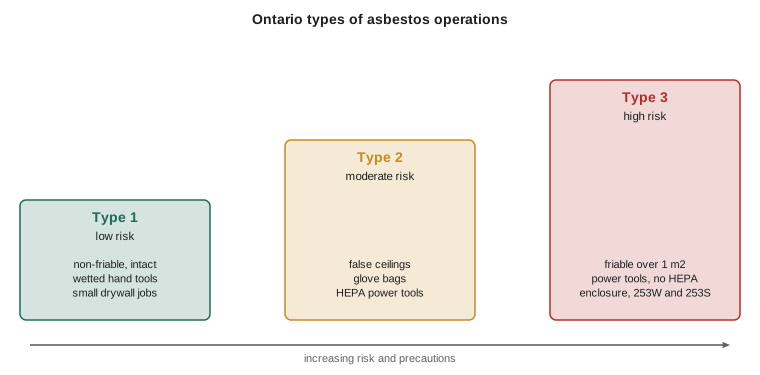
Type 1 operations
Type 1 operations are low-risk tasks that release few fibres when done properly. Ontario's regulation lists them, and they include installing or removing non-friable asbestos-containing material without breaking, cutting, drilling, abrading, grinding, sanding or vibrating it; installing or removing ceiling tiles containing asbestos covering less than 7.5 square metres without breaking or cutting them; breaking, cutting, drilling or similar work on non-friable material using non-powered hand tools while wetting the material, where workers wear protective equipment; and removing less than one square metre of drywall with asbestos-containing joint compound. Precautions include wetting where practicable, using non-powered hand tools, keeping the work area clear, cleaning up dust and waste with a HEPA vacuum or damp methods, and providing a half-facepiece respirator with N-100, R-100 or P-100 filters if the worker requests one.
Type 2 operations
Type 2 operations are moderate-risk tasks. They include removing all or part of a false ceiling to gain access to a work area where asbestos-containing material is likely to be present; removing or disturbing one square metre or less of friable material; enclosing friable material; applying tape, sealant or other covering to pipe or boiler insulation; removing ceiling tiles of 7.5 square metres or more without breaking or cutting them; breaking, cutting, drilling or similar work on non-friable material with non-powered hand tools without wetting; removing one square metre or more of drywall with asbestos joint compound; using power tools fitted with dust collectors and HEPA filters on non-friable material; glove bag removal of insulation; and cleaning or removing filters in air handling equipment in buildings with sprayed fireproofing containing asbestos. Precautions include restricting the work area with signs, wetting friable material, using drop sheets and HEPA vacuums, sealing waste in containers, decontaminating clothing and washing hands and face, and wearing the respirator Table 2 specifies, at least a half-facepiece with a 100-series filter and a full-facepiece or powered respirator for false ceiling work.
Type 3 operations
Type 3 operations are high-risk tasks. They include removing or disturbing more than one square metre of friable asbestos-containing material; spraying sealant onto friable material; cleaning or removing air handling equipment, other than filters, in buildings with sprayed fireproofing containing asbestos; repairing, altering or demolishing kilns, metallurgical furnaces or similar structures made partly of refractory materials containing asbestos; breaking, cutting, drilling or similar work on non-friable material with power tools that are not fitted with dust collectors and HEPA filters; and repairing, altering or demolishing buildings that were used to manufacture asbestos products, unless the asbestos was cleaned up. Type 3 work requires notice to the Ministry, a separated work area, usually a full enclosure under negative pressure maintained at 0.02 inches of water with HEPA-filtered exhaust when indoors, a three-room decontamination facility, wetting, supplied-air or powered respirators as Table 2 requires, daily air monitoring outside the enclosure in some situations, clearance air testing before the enclosure is removed, and workers and supervisors certified as 253W and 253S.
Low, moderate and high-risk work in other provinces
BC, Alberta, Quebec and several other jurisdictions classify work as low, moderate or high risk rather than by type. WorkSafeBC guidance, for example, describes low-risk work as work with non-friable material that releases few fibres using hand tools and wetting; moderate-risk work as work that can release more fibres, such as removing non-friable material with methods that break it, or small amounts of friable material using local containment; and high-risk work as removal of friable material or work that releases large amounts of fibres, requiring full enclosures, negative air and decontamination. Classification in these provinces is often part of the exposure control plan and is made by a qualified person. The boundaries and specific precautions differ, so check your province's regulation and guidelines.
| Feature | Type 1 | Type 2 | Type 3 |
|---|---|---|---|
| Typical material | Non-friable, intact or wet hand work | Small amounts of friable; non-friable with more aggressive methods | Large amounts of friable; power tools without HEPA collection |
| Work area | Clear of others; drop sheets as needed | Restricted with signs; drop sheets; HEPA clean-up | Enclosure under negative pressure, signs, controlled entry |
| Decontamination | Clean-up of clothing and tools | Decontaminate clothing; wash hands and face | Three-room decontamination facility with shower |
| Respirator | Half-facepiece with 100-series filter on request | Half-facepiece with 100-series filter, or more for false ceiling work | Full-facepiece, PAPR or supplied air as Table 2 requires |
| Ministry notice required | No | Only for glove bag removal of one square metre or more of insulation | Yes, written and oral before starting |
| Training | Instruction and training on hazards and procedures | Instruction and training on hazards and procedures | 253W workers and 253S supervisors |
| Clearance air test | No | No | Yes, for friable material removal inside a building |
Why the type depends on method as well as material
The same material can fall into different types depending on how it is handled. Cutting asbestos-cement board with a non-powered hand tool while wetting it is Type 1; cutting it with hand tools without wetting is Type 2; cutting it with a power saw without a HEPA dust collector is Type 3. The regulation rewards low-fibre methods with lighter precautions. This gives supervisors a powerful planning tool: choosing a better method can reduce the risk level, the precautions and the cost.
Classifying a task
Classification is the job of a competent person who knows the regulation, the material and the method. A simple decision function shows the logic, but real classification must follow the full regulation, including the special cases this sketch leaves out.
# Simplified sketch of Ontario-style classification (not a substitute for O. Reg. 278/05)
def ontario_type(friable, area_m2=0.0, method="hand", wetted=True, hepa_collector=False):
    if friable:
        return "Type 3" if area_m2 > 1.0 else "Type 2"
    # non-friable material
    if method == "intact":
        return "Type 1"
    if method == "hand":
        return "Type 1" if wetted else "Type 2"
    if method == "power":
        return "Type 2" if hepa_collector else "Type 3"
    return "assess"

tasks = [
    ("remove floor tiles intact",            dict(friable=False, method="intact")),
    ("wet hand-cut cement board",            dict(friable=False, method="hand", wetted=True)),
    ("dry hand-cut cement board",            dict(friable=False, method="hand", wetted=False)),
    ("drill cement board, HEPA shroud",      dict(friable=False, method="power", hepa_collector=True)),
    ("drill cement board, no collector",     dict(friable=False, method="power", hepa_collector=False)),
    ("repair 0.5 m2 of pipe lagging",        dict(friable=True, area_m2=0.5)),
    ("strip 12 m2 of sprayed fireproofing",  dict(friable=True, area_m2=12)),
]
for name, kw in tasks:
print(f"{name:38s} {ontario_type(**kw)}")remove floor tiles intact Type 1 wet hand-cut cement board Type 1 dry hand-cut cement board Type 2 drill cement board, HEPA shroud Type 2 drill cement board, no collector Type 3 repair 0.5 m2 of pipe lagging Type 2 strip 12 m2 of sprayed fireproofing Type 3
The output shows how the method changes the type for the same cement board. A supervisor planning to drill a few holes through cement board can keep the work at Type 2 by using a drill with a shroud connected to a HEPA dust collector, or at Type 1 by using wetted hand tools where practicable, instead of creating a Type 3 operation with an uncontrolled power drill.
The role of the competent person and supervisor
Whatever the scheme, someone must make the call before work starts. In Ontario, the employer must classify the operation, and supervisors of Type 3 work must hold 253S certification. In BC, a qualified person classifies work in the exposure control plan. A supervisor who is not qualified to classify should know enough to recognize that classification is needed and to stop work until it is done. Reclassification is needed whenever the method, material or quantity changes, for example when a planned intact removal starts breaking the material.
Worked problem
Choosing a method to lower the risk
An electrician must run new cable through a washroom wall lined with asbestos-cement board. The plan calls for three holes of 50 mm each. What are the options, and how do they affect the operation type?
Show solution
- Option 1: drill with an ordinary power drill. This is power-tool work on non-friable material without HEPA collection, a Type 3 operation.
- Option 2: use a drill with a shroud connected to a HEPA dust collector. This is a Type 2 operation.
- Option 3: wet the board and cut the holes with a non-powered hand tool. This is a Type 1 operation if it can be done properly.
- In every case, clean up with a HEPA vacuum or damp wipes and dispose of debris as asbestos waste.
Answer: Choosing a shrouded HEPA drill or wetted hand tools keeps the job at Type 2 or Type 1 and avoids a full Type 3 enclosure.
Common classification questions
Do the areas of separate small jobs add up? Ontario's regulation classifies work in the same room or enclosed area by the total area, so several small patches of friable material in one room can together exceed one square metre and make the work Type 3. Splitting a job into small pieces to stay under a threshold is not acceptable.
What if the material is assumed rather than tested? Assumed material is treated as asbestos-containing, and the work is classified as if the material were friable or non-friable according to its nature. Testing first can sometimes show that no precautions are needed.
Who decides when the answer is unclear? The employer, advised by a competent person or consultant. When in doubt, choose the higher risk level until the question is resolved.
Working with consultants and specifications
On larger projects, an asbestos consultant usually prepares specifications that set out the classification of each task, the enclosure design, the respirators, the monitoring and clearance criteria and the waste arrangements. Specifications often go further than the regulation, for example requiring higher air change rates, full enclosures for some Type 2 work or more frequent air sampling. The contractor must meet both the regulation and the specification. Supervisors should read the specification before work starts, raise any conflict with the regulation, and never assume that the minimum legal requirement is all that the contract demands.
Specifications also define who has authority to stop the work and what happens when results exceed a trigger. Knowing these rules before the job starts avoids arguments in the middle of an abatement.
Common mistakes
MistakeClassifying by material alone.
InsteadConsider the method too; the same material can be Type 1, 2 or 3.
MistakeKeeping the original classification when the method changes.
InsteadReclassify whenever the method, material or quantity changes.
MistakeLetting an uncertified crew do Type 3 work.
InsteadType 3 work in Ontario requires 253W workers and 253S supervisors.
MistakeAssuming low-risk work needs no precautions.
InsteadEven the lowest level requires wetting, controlled methods and proper clean-up.
MistakeRelying on a contractor from another province to know local rules.
InsteadCheck the classification and precautions of the jurisdiction where the work is done.
Summary and key terms
- Ontario classifies asbestos work as Type 1, 2 or 3 operations; other provinces use low, moderate and high risk.
- Type 1 covers non-friable material handled intact or with wetted hand tools, and small amounts of drywall.
- Type 2 covers small amounts of friable material, false ceiling work, glove bags and power tools with HEPA collection.
- Type 3 covers more than one square metre of friable material and power tools without HEPA collection, with enclosures, notices and certification.
- The method affects the type, so choosing low-fibre methods can reduce the precautions needed.
- BC and others classify work in an exposure control plan prepared by a qualified person.
- A competent or qualified person must classify work before it starts and reclassify when conditions change.
- Type 1 operation
- A low-risk asbestos operation under Ontario's regulation.
- Type 2 operation
- A moderate-risk asbestos operation under Ontario's regulation.
- Type 3 operation
- A high-risk asbestos operation under Ontario's regulation, requiring enclosures, notices and certified workers.
- Low-risk work
- The lowest classification of asbestos work used in BC and several other provinces.
- High-risk work
- The highest classification of asbestos work used in BC and several other provinces.
- Glove bag
- A plastic bag with built-in gloves sealed around a pipe to remove small amounts of insulation.
- HEPA dust collector
- A vacuum or collector with a high-efficiency particulate air filter attached to a tool.
- 253W and 253S
- Ontario's asbestos abatement worker and supervisor certifications for Type 3 work.
- Qualified person
- In BC, a person with the knowledge and experience to identify asbestos hazards and specify controls.
- Reclassification
- Changing the risk level of a task when its method, material or quantity changes.
Practice problems
Work each problem on paper first, then reveal the answer to check.
Give two examples of Type 1 operations.
Show answer
Removing intact floor tiles; wet hand-cutting of asbestos-cement board; removing under 7.5 m² of ceiling tiles intact; removing less than 1 m² of drywall with asbestos joint compound.
Give two examples of Type 2 operations.
Show answer
Removing a false ceiling where ACM is likely above; glove bag removal; drilling with a HEPA-shrouded tool; disturbing 1 m² or less of friable material.
Give two examples of Type 3 operations.
Show answer
Removing more than 1 m² of friable material; power tools on non-friable ACM without HEPA collection; work on asbestos refractory in kilns.
Which operation type needs a three-room decontamination facility?
Show answer
Type 3.
What pressure differential must a Type 3 indoor enclosure maintain?
Show answer
0.02 inches of water relative to outside, where the enclosure is not in a building being demolished.
How can the choice of method reduce the risk level?
Show answer
Wetting and hand tools, or HEPA-collected power tools, release fewer fibres and move the work into a lower type.
When must a task be reclassified?
Show answer
When its method, material or quantity changes.
Who must be certified for Type 3 work in Ontario?
Show answer
Workers (253W) and supervisors (253S).
What do BC and several other provinces call their risk levels?
Show answer
Low-, moderate- and high-risk work.
Why must even low-risk work use controls?
Show answer
Any disturbance releases some fibres and asbestos has no known safe level.
Lesson quiz · 5 questions
Score 60% or more to complete this lesson.
Create a free account to save your progress, take quizzes and earn a certificate.