
HSE-220 · Lesson 10 of 12 · 31 min
Loads, tools and special applications
A MEWP is designed to put people at height with the tools and materials they need, not to move materials around a site. Many incidents begin when a platform is used as a small crane, overloaded with materials, fitted with improvised racks, or used for a job its designers never imagined. This lesson covers how to account for loads, how to control dropped objects, and what to consider for special applications such as glazing, welding, carrying long materials and leaving the platform at height.
Accounting for the load
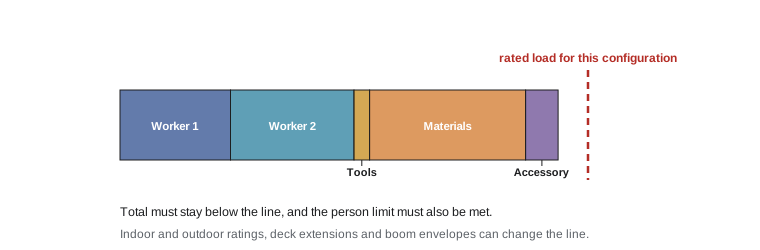
The rated load on the decal is the total weight of everything on the platform: people, their clothing and personal protective equipment, tools, materials and any accessories. It also states how many people may be on the platform, which is a separate limit. Both must be respected, and both may change with configuration: indoor versus outdoor, extended deck versus retracted, restricted versus full envelope on a boom.
Worked problem
Will the drywall fit on the platform?
A crew wants to use an electric scissor lift rated 700 lb indoors, 2 persons, to install drywall on a ceiling. Two workers weigh 185 lb and 210 lb with their gear, the tool bag weighs 25 lb, and each sheet of 5/8 in gypsum board, 4 ft by 8 ft, weighs about 70 lb (illustrative). How many sheets can they carry per trip?
Show solution
- People and tools: \( 185 + 210 + 25 = 420 \) lb.
- Remaining capacity: \( 700 - 420 = 280 \) lb.
- Sheets: \( 280 / 70 = 4 \), so at most 4 sheets.
- Check that the sheets fit within the guardrails without overhanging and that the manufacturer allows sheet materials on the deck.
Answer: At most 4 sheets per trip, provided they sit flat inside the guardrails. Indoors only: outdoors, the rating would likely be lower and sheets would catch the wind.
Weights are often underestimated. Workers rarely know their weight with tools and gear, and material weights should come from the supplier's data rather than guesswork. Current machines with load sensing will stop if the platform is overloaded, but that is a last line of defense, and older machines may not have it.
Materials and accessories
Materials must be carried within the platform, evenly distributed, and must not extend beyond the guardrails unless the manufacturer specifically allows it. Long materials such as pipe, conduit and lumber are a particular problem: they overhang, they increase wind area, they can strike structure or power lines, and workers tend to tie them to the guardrails.
Manufacturers offer accessories for common tasks, such as pipe racks, panel carriers, glazing cradles and tool trays. These are approved for specific models and come with their own load limits and often a reduced platform rating. Using an accessory designed for a different machine, or building a homemade rack, is a modification that needs the manufacturer's written approval.
| Practice | Acceptable? | Why |
|---|---|---|
| Carrying a box of fittings on the deck | Yes, within the rated load | Load is inside the guardrails and evenly placed |
| Tying a 6 m length of pipe along the guardrail | No, unless the manufacturer allows it | Overhang, side loading, wind area and contact with structure or lines |
| Using the manufacturer's pipe rack for that model | Yes, within its limits | Approved accessory with stated ratings |
| Hanging a hoist from the platform to lift materials | No | The platform is not designed as a crane |
| Standing materials against the gate | No | Can force the gate open and fall |
| Carrying a large glass panel outdoors on a standard platform | Only with an approved glazing accessory and within wind limits | Panels act as sails and add side force |
Dropped objects
Tools and materials that fall from a platform injure people below, and the energy involved is larger than most people expect. Toeboards help, but they do not stop items knocked over the rail or dropped while being passed up.
Worked problem
The energy of a dropped wrench
A 2.6 lb (1.2 kg) wrench falls from a platform 40 ft (12 m) above a walkway. How much energy does it carry and how fast is it moving at impact?
Show solution
- Work in SI units: \( E = m g h = 1.2 \times 9.81 \times 12 = 141 \) J.
- Impact speed: \( v = \sqrt{2 \times 9.81 \times 12} = 15.3 \) m/s, about 34 mph.
- Hard hat impact tests use roughly a third to a half of that energy, and a falling tool can strike the shoulders or face.
Answer: About 140 J at roughly 15 m/s. Exclusion zones and tool tethering are the controls that work; hard hats are the last line of defense.
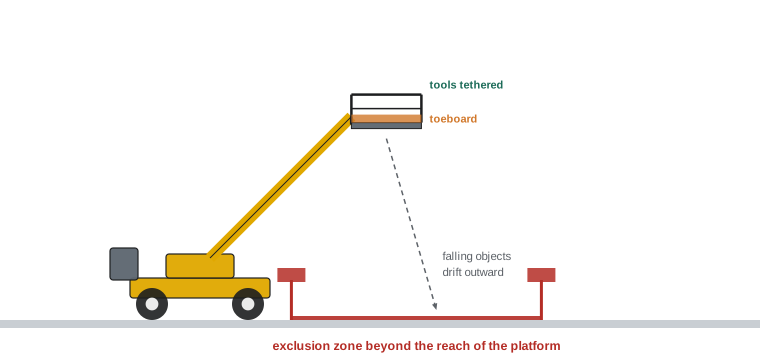
- Tether hand tools to the worker or to a designated point on the platform using tool lanyards rated for the tool's weight, as described in ANSI/ISEA 121 for dropped object prevention.
- Use buckets or bags with closures for small parts, and keep materials below the top of the toeboard where possible.
- Set up an exclusion zone beneath and around the platform, extended for the platform's reach and swing and for the height of work, since objects deflect as they fall. Use barriers and signs, not just tape, in busy areas.
- Pass tools and materials to the platform only when it is lowered, or use an approved method; do not throw tools up to workers.
Welding and hot work
Welding, cutting and grinding from a platform add fire, electrical and fume hazards. Hot work permits and fire watches apply as they would on the ground. The manufacturer's manual usually has specific instructions: attach the welding ground clamp to the workpiece as close as possible to the weld, never to the platform, so that welding current cannot pass through the machine's bearings, cylinders, wiring or hoses; protect hoses and electrical cables on the boom from spatter and sparks; keep gas cylinders off the platform unless an approved holder is fitted; and keep a fire extinguisher on the platform.
Leaving the platform at height
Sometimes workers need to step from a platform onto a roof, a structure or another work surface. This is one of the most dangerous moments in MEWP work: the worker passes through the guardrail line, may be connected to neither the platform nor the structure, and the platform can move as their weight leaves it. The current safe use standards allow exiting at height only when the manufacturer permits it for that machine, the safe use plan covers it, the platform is positioned against the landing as the manual directs, and the worker maintains continuous fall protection, connecting to an anchorage on the landing before disconnecting from the platform. Where the law, the manufacturer or the plan does not allow it, workers must not leave the platform at height.
OSHA's construction rule says workers must stand firmly on the basket floor and not climb on its edge (1926.453(b)(2)(iv)), and Ontario's regulation requires attachment to the platform at all times on boom-type machines. Exiting at height therefore needs careful planning under the law where you work. Often a stair tower, a fixed ladder or a hoist is a safer way to reach the landing.
Worked problem
Two occupants and a gate
A crew of three wants to use a boom rated 500 lb, 2 persons, to reach a roof-mounted unit. One worker weighs 165 lb and they plan to carry 65 lb of tools. A foreman suggests that three people at a combined 485 lb plus tools is close enough to the rating. What is wrong with the suggestion?
Show solution
- The platform is rated for 2 persons. Three people break the person limit regardless of weight.
- Three people at 485 lb plus 65 lb of tools is 550 lb, which also exceeds 500 lb.
- Crowding three people into a platform designed for two also limits movement and makes restraint harder to use.
Answer: The plan breaks both the person limit and the rated load. Make two trips or use a larger platform. Close is not acceptable for a rated load.
Glazing, panels and heavy items
Glazing and cladding contractors often need to place panels at height. MEWP manufacturers offer glazing kits, panel cradles and material lifting attachments for some models; these come with their own rated loads, wind limits and often a reduced platform rating, and they may only be used on the models listed. Where the panels are large or heavy, a vacuum lifter on a crane or telehandler with a qualified rigger is often a better method, with the MEWP used only to position the installers.
Worked problem
Rated load with a manufacturer accessory
A boom has a platform rating of 750 lb. Its approved glazing cradle weighs 55 lb, carries a maximum of 220 lb of glass, and reduces the platform rating to 550 lb including the cradle and glass. Two installers weigh 185 lb each with gear. Can they install a 200 lb pane together?
Show solution
- With the cradle fitted, the rating is 550 lb in total.
- Load: \( 55 + 200 + 2 \times 185 = 625 \) lb.
- 625 lb exceeds 550 lb, even though the glass is within the cradle's 220 lb limit.
- With one installer: \( 55 + 200 + 185 = 440 \) lb, within the 550 lb rating.
Answer: Not with two installers. Either one installer works from the platform with the pane while another guides from a second platform or the ground, or a different method is used. Every limit on the accessory and the platform must be met at once.
The example shows why accessories need careful reading: they add their own weight and often change the platform's rating, so the arithmetic must start from the reduced figure.
Supervising materials on platforms
Supervisors can prevent most materials problems with a few habits. Ask the crew how much they plan to carry per trip and compare it with the rating before work starts. Look at the platform as it goes up: materials should sit inside the guardrails, nothing should be tied to the rails, and tools should be tethered. Watch for the gradual creep that happens over a day, when a crew starts with a few items and ends up carrying a full load of fittings, a tool bag, a cordless saw and a box of fixtures. When the job needs more material than the platform can carry, plan a separate way to get it to height, such as a material hoist, a telehandler with a suitable attachment, or staging on the floor above.
Common mistakes
MistakeCounting only the workers when checking the rated load.
InsteadInclude clothing, tools, materials and accessories.
MistakeTying long pipe or lumber to the guardrails.
InsteadUse an approved accessory or another method of getting materials to height.
MistakeAttaching the welding ground clamp to the platform.
InsteadClamp to the workpiece close to the weld, as the manual directs.
MistakeStepping off the platform onto a roof without a plan.
InsteadExit at height only where the manufacturer, law and plan allow it, with continuous fall protection.
MistakeRelying on toeboards alone for dropped objects.
InsteadTether tools and set up an exclusion zone beneath and around the platform.
Summary and key terms
- The rated load covers everything on the platform, and the person limit is separate; both vary with configuration.
- Materials must stay inside the guardrails unless an approved accessory or the manufacturer allows otherwise.
- Homemade racks and accessories for other models are modifications that need written approval.
- A 1.2 kg tool falling 12 m carries about 140 J; tethering and exclusion zones are the main controls.
- For welding, ground to the workpiece, protect hoses and cables, and follow hot work rules.
- Leaving the platform at height requires manufacturer permission, a plan and continuous fall protection.
- Rated load
- The maximum total weight of people, tools, materials and accessories on the platform.
- Person limit
- The maximum number of people allowed on the platform.
- Accessory
- Equipment approved by the manufacturer for a specific model, such as a pipe rack or glazing cradle.
- Toeboard
- A low barrier around the deck edge that helps prevent items from sliding off.
- Tool tether
- A lanyard connecting a hand tool to a worker or anchor point to prevent drops.
- Exiting at height
- Leaving the platform while elevated to step onto another surface.
- Hot work
- Welding, cutting, grinding or other work that produces sparks, flame or heat.
Practice problems
Work each problem on paper first, then reveal the answer to check.
What does the rated load include?
Show answer
People, their clothing and PPE, tools, materials and accessories.
A platform is rated 500 lb. Two workers weigh 200 lb each with gear. How much can tools and materials weigh?
Show answer
100 lb.
Why are long materials on a platform a problem?
Show answer
They overhang, increase wind area, can strike structure or power lines and tempt workers to tie them to the guardrails.
When may an accessory such as a pipe rack be used?
Show answer
When it is approved by the manufacturer for that model and used within its limits.
Find the energy of a 1.1 lb (0.5 kg) tool falling 50 ft (15 m).
Show answer
\( 0.5 \times 9.81 \times 15 = 74 \) J.
Name three controls for dropped objects.
Show answer
Tool tethers, closed buckets or bags, toeboards and exclusion zones with barriers.
Where should the welding ground clamp go?
Show answer
On the workpiece, close to the weld, never on the platform.
What conditions apply to leaving the platform at height?
Show answer
Manufacturer permission, a plan, positioning per the manual and continuous fall protection.
A platform rated for 2 persons has three workers whose total weight is under the rated load. Is that acceptable?
Show answer
No; the person limit is separate from the weight limit.
Why might an outdoor rating be lower than an indoor rating?
Show answer
Wind adds force on people and materials.
Lesson quiz · 5 questions
Score 60% or more to complete this lesson.
Create a free account to save your progress, take quizzes and earn a certificate.