
HSE-220 · Lesson 12 of 12 · 30 min
Capstone: a MEWP safe use plan
This capstone brings the course together. You will review a draft safe use plan for an invented job, find its weaknesses, work the numbers that matter and decide what the final plan must say. The company, site and figures are invented for teaching; the method is what you will use on real jobs.
The job
Lakeside Logistics is retrofitting a single-story distribution warehouse. The work has two parts. Inside, an electrical contractor will replace high-bay lights 30 ft above a level concrete floor, between racking aisles 10 ft wide, with steel roof joists 3 ft above the fixtures. Outside, a sign contractor will remove and replace a 4 ft by 10 ft fascia sign along the street side of the building, 23 ft above a paved parking lot. A 25 kV distribution line runs along the street, 30 ft horizontally from the building face. A storm sewer was replaced last year along part of the lot, and the trench has been backfilled and paved.
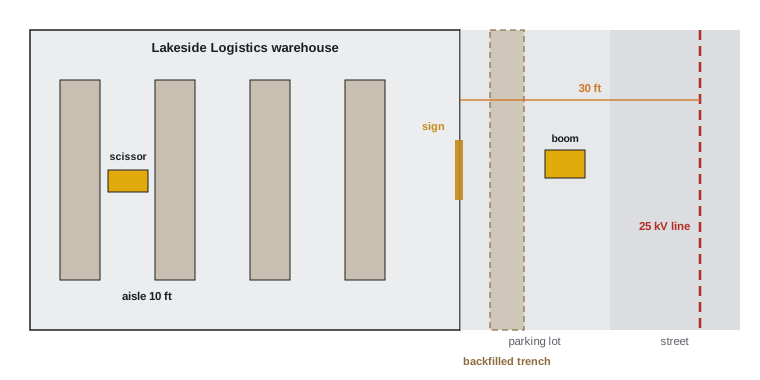
The draft plan
The draft plan submitted by the contractors' supervisors reads, in summary:
- Indoor: a 32 ft platform-height diesel rough-terrain scissor lift, already on site from another job. Two electricians on the platform. Raise to reach fixtures; drive elevated between aisles to save time. Fall protection: guardrails. Rescue: call 911.
- Outdoor: a 45 ft articulating boom set up over the paved trench line because it is closest to the sign. Two workers with standard 6 ft shock-absorbing lanyards clipped to the guardrail. The old sign weighs 210 lb and will be lowered on the platform. Wind: proceed unless it is raining. Power line: stay away from it.
Finding the problems
Work through the draft as a supervisor would, element by element. Each problem connects to a lesson in this course.
| Draft item | Problem | Lesson |
|---|---|---|
| Diesel scissor lift indoors | Exhaust in an enclosed warehouse; large rough-terrain chassis in narrow aisles | 1, 4, 9 |
| Raise to reach fixtures under joists | Joists only 1.0 m (3 ft) above fixtures: high entrapment risk; no stop height, no secondary guarding | 8 |
| Drive elevated between aisles | Travel elevated near racking and under structure multiplies strike and entrapment risk; no spotter | 6, 8 |
| Rescue: call 911 | No trained ground person or ground-control plan; emergency services too slow as the primary method | 11 |
| Boom over the backfilled trench | Fill may settle; outrigger or wheel loads on paving over fill could break through | 6 |
| Long lanyards clipped to guardrail | Guardrail is not an anchorage; long lanyards allow ejection; breaks restraint principle | 7 |
| Old sign lowered on the platform | Weight and size must be checked against rated load and wind; the sign acts as a sail | 9, 10 |
| Wind: proceed unless raining | No wind limit; no measurement at height | 9 |
| Power line: stay away | No voltage, no distance, no clearance calculation, no spotter | 9 |
Working the numbers
Worked problem
Indoor: will the platform reach, and how close to the joists?
The fixtures are 30 ft above the floor and the joists 33 ft. A worker of average height on the platform can work comfortably with hands about 6 ft above the deck. What platform height is needed, and how much clearance will there be between a worker's head (about 5 ft 9 in above the deck) and the joists?
Show solution
- Platform height to reach fixtures: \( 30 - 6 = 24 \) ft.
- Head height at that platform height: \( 24 + 5.75 = 29.75 \) ft.
- Clearance to joists: \( 33 - 29.75 = 3.25 \) ft.
- The 3.25 ft clearance is workable, but over-raising by even 3 ft would bring the worker's head to the joists. A machine with a 32 ft platform height can raise the worker's head to almost 38 ft, well above the joists.
Answer: Set a working platform height of about 24 ft, mark or set a height limit on the machine if it has one, raise slowly while looking up, and choose a machine with secondary guarding. An electric slab scissor lift with a platform height of about 26 ft would reach the work without the extra 6 ft of over-travel the 32 ft machine offers.
Worked problem
Outdoor: the power line
The sign is on the building face, 30 ft from the 25 kV line. The boom platform will be about 3 ft out from the face while workers handle the sign, which is 10 ft long and could swing outward by 1.5 ft on its rigging. Allow 1.5 ft for sway of line and platform. Is the work outside the 10 ft minimum clearance?
Show solution
- Closest platform point to the line: \( 30 - 3 = 27 \) ft.
- If the sign swings outward 1.5 ft beyond the platform edge: \( 27 - 1.5 = 25.5 \) ft.
- Allow for sway: \( 25.5 - 1.5 = 24 \) ft.
- 24 ft is well outside the 10 ft clearance. But the boom's reach toward the street must also be checked: if the machine is set up between the building and the line, swinging the boom the wrong way could bring it much closer.
Answer: The planned work position is clear of the limit, but the plan must state the line's voltage and limit, mark a no-go zone toward the street, use a spotter during swings and set up so the boom cannot reach the limit if possible.
Worked problem
Outdoor: platform load and wind
The articulating boom is rated 500 lb, 2 persons, at all positions. Two workers weigh 195 lb and 205 lb with gear and carry 30 lb of tools. The old sign weighs 210 lb. The forecast gives 19 mph average wind with gusts to 28 mph at 33 ft. Can the plan to lower the old sign on the platform with two workers aboard go ahead?
Show solution
- Load: \( 195 + 205 + 30 + 210 = 640 \) lb, which exceeds 500 lb.
- Even with one worker: \( 205 + 30 + 210 = 445 \) lb, within the load, but a 4 ft by 10 ft sign on the platform is a large sail.
- Gusts of 28 mph at 33 ft are already at the typical limit before carrying a sign.
- The manual must be checked for whether panels may be carried at all.
Answer: No. Lower the sign by another method, such as a small crane or telehandler with a qualified rigger (HSE-219 and HSE-218), with the boom used only to position workers, and schedule the work for a calmer day with a firm wind limit and an anemometer at height.
Worked problem
Outdoor: the backfilled trench
The boom's maximum wheel load is 11,500 lb on a tire contact patch of about 125 square inches. The paving over the backfilled trench is thin asphalt over fill that a competent person estimates can carry only 2,000 psf (illustrative). Can a wheel stand on the trench line?
Show solution
- Pressure: \( 11\,500 / 125 = 92 \) psi.
- Convert: \( 92 \times 144 = 13\,250 \) psf.
- That is more than six times the 2,000 psf estimate.
- A mat large enough would need \( 11\,500 / 2000 = 5.75 \) square feet, but setting a boom over uncertain fill is better avoided.
Answer: No. Set up off the trench line on undisturbed paving, using the boom's reach, and keep all wheels clear of the backfilled area; mark it on the ground as a no-go zone.
The final plan
With the problems found and the numbers worked, the revised safe use plan reads as follows.
| Element | Revised plan |
|---|---|
| Indoor machine | Electric slab scissor lift, about 26 ft platform height, with secondary guarding, sized for 10 ft aisles; rated load checked for two workers, tools and fixtures |
| Indoor controls | Working height limit marked; raise slowly while looking up; lower before moving between fixtures unless the aisle is clear and level and a spotter is used; forklifts excluded from the aisle; restraint on the manufacturer's anchorage while moving |
| Outdoor machine | Articulating boom set up on undisturbed paving clear of the trench; outdoor wind rating confirmed; manufacturer's anchorages for restraint |
| Outdoor controls | Line voltage confirmed with the utility; 10 ft clearance; no-go zone toward the street; dedicated spotter during swings; exclusion zone below the work; old and new signs moved by a separate lifting device with a qualified rigger |
| Fall protection | Full-body harness and short restraint lanyard (about 3 ft) on the boom anchorage at all times; restraint on the scissor lift where site rules require |
| Wind | Stop and lower at an average or gust speed approaching the machine's rating, measured with an anemometer at platform height; no panels carried on the platform |
| People | Operators trained for 3a and 3b and familiarized on each model; occupants instructed; supervisors trained; a trained ground person at each machine |
| Rescue | Ground person lowers the platform using ground controls; manual descent and auxiliary power procedures from each manual posted; emergency services called in parallel; drill before work starts |
| Review | Daily review at the pre-job briefing; stop and replan for changes in wind, layout, crew or machine |
What the capstone shows
None of the problems in the draft required unusual knowledge to spot. Each came from skipping a step this course has covered: selecting the machine for the environment, measuring overhead clearance, checking the ground, using designated anchorages and short lanyards, counting the whole load, setting a wind limit, calculating the distance to the line and planning a real rescue. A supervisor who asks these questions on every job prevents the five events that kill MEWP workers.
Keep the habit simple: before any MEWP job, walk the site, read the machine's plate and manual, check the people's training and familiarization, work the numbers that matter, and make sure someone on the ground can bring the platform down.
Using the capstone method on your own jobs
To use this method on a real job, start with the draft plan or, if there is none, with the task description. List the elements of the plan in a column, and next to each write what the plan says and what you saw on site. Wherever the plan is silent or disagrees with the site, you have found a problem. Then work the few numbers that decide whether the job is safe, usually the load, the distance to power lines, the ground pressure and the clearance to overhead structure, and write the result into the plan.
Common mistakes
MistakeApproving a plan because the machine is already on site.
InsteadSelect the machine for the task, environment and hazards.
MistakeWriting "stay away from the power line" without a distance.
InsteadConfirm the voltage, state the limit and calculate the closest approach.
MistakeUsing the platform to lower a heavy sign.
InsteadMove loads with a lifting device and use the platform to position workers.
MistakeSetting up over backfilled ground to save reach.
InsteadSet up on firm, undisturbed ground and use the machine's reach.
MistakeLeaving rescue to emergency services.
InsteadPlan ground lowering by a trained person, with emergency services in parallel.
Summary and key terms
- A safe use plan review works element by element: machine, ground, overhead, people, fall protection, load, wind, power lines and rescue.
- Indoor work under joists needs a height limit, careful raising and secondary guarding to control entrapment.
- Outdoor work near lines needs the voltage, the limit, a clearance calculation, a no-go zone and a spotter.
- Platform loads must include every person and item; signs and panels should be moved by lifting devices, not on the platform.
- Set up on firm, undisturbed ground; a wheel load on backfill can exceed its capacity many times over.
- Rescue must rely on a trained ground person and the machine's emergency controls, with emergency services called in parallel.
- Plan review
- A structured check of a safe use plan against the hazards and requirements of the job.
- No-go zone
- A marked area the machine, platform or boom must not enter, such as near a power line or over backfill.
- Working platform height
- The platform height needed for the task, set to avoid over-travel toward structure.
- Over-travel
- Raising the platform beyond what the task needs, which reduces clearance to overhead structure.
- Dedicated spotter
- A spotter with no other duties during the movement they are watching.
- Separate lifting device
- A crane, hoist or telehandler used to move materials instead of carrying them on the platform.
- Drill
- A practice run of an emergency procedure with no one at risk.
Practice problems
Work each problem on paper first, then reveal the answer to check.
Why was the diesel scissor lift a poor choice indoors?
Show answer
It produces exhaust in an enclosed space and its rough-terrain chassis is large for narrow aisles.
If fixtures are at 20 ft and a worker reaches 6 ft above the deck, what platform height is needed?
Show answer
14 ft.
What was wrong with clipping long lanyards to the guardrail?
Show answer
The guardrail is not an anchorage and long lanyards allow ejection.
Find the load of two workers at 175 lb and 190 lb with 40 lb of tools.
Show answer
405 lb.
Why should the sign be moved by a separate lifting device?
Show answer
It exceeds the platform load with two workers and acts as a sail in wind.
What four things must a power line section of the plan include?
Show answer
The voltage, the required distance, a clearance calculation and controls such as a no-go zone and spotter.
A wheel load of 9,000 lb sits on 150 square inches. What is the pressure?
Show answer
60 psi, about 8,640 psf.
What should the rescue section of the plan say?
Show answer
Who lowers the platform, how, with which controls and manual procedures, and that emergency services are called in parallel; and that a drill will be run.
When should the plan be reviewed?
Show answer
Daily at the briefing and whenever wind, layout, crew or machine changes.
What simple habit summarizes the course?
Show answer
Walk the site, read the plate and manual, check training and familiarization, work the numbers and make sure someone on the ground can bring the platform down.
Lesson quiz · 5 questions
Score 60% or more to complete this lesson.
Create a free account to save your progress, take quizzes and earn a certificate.