
HSE-220 · Lesson 1 of 12 · 27 min
Why aerial work platforms hurt people
Mobile elevating work platforms, usually called MEWPs in the ANSI standards and aerial lifts in OSHA's rules, have replaced ladders and much scaffolding for short-duration work at height. Scissor lifts, vertical mast lifts and boom lifts let a worker rise to a ceiling, a façade or a light pole in seconds, inside guardrails, with tools and materials close at hand. Used well, they are one of the safest ways to work at height. Used badly, they fail in a small number of predictable ways, and when they fail the result is often a death.
This course is awareness and supervisor training. It explains how MEWPs hurt people, what the law and standards expect from owners, employers, supervisors, operators and occupants, and how to plan, inspect, set up and use a platform so that those failures do not happen. It is written for site supervisors, foremen, facility managers, safety coordinators and workers who use or work around MEWPs.
It does not qualify anyone to operate a MEWP. OSHA allows only authorized persons to operate an aerial lift (29 CFR 1926.453(b)(2)(ii)), its scaffold rules require training by a qualified person for scissor lift users (1926.454), and ANSI/SAIA A92.22 and A92.24 require operator training, familiarization on the specific model and a safe use program run by the user. Completing this course is one part of that picture, not a substitute for it.
How MEWPs fail
Investigations of MEWP deaths around the world keep finding the same five events. Learning to recognize them is the first step to preventing them, because almost every control in this course is aimed at one or more of them.
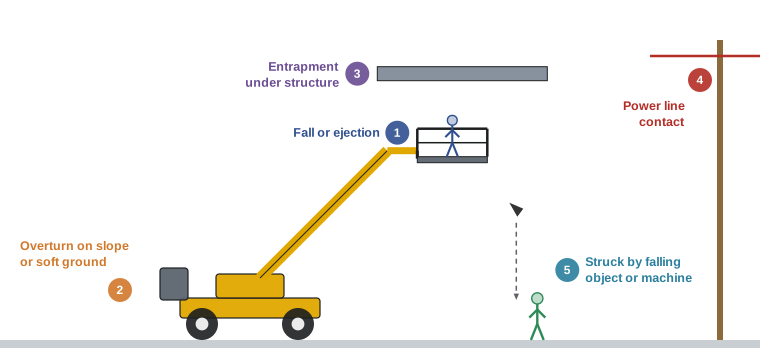
| Event | What happens | Typical causes |
|---|---|---|
| Fall or ejection from the platform | A worker falls over the guardrail, through an open gate, or is thrown out when the platform jolts | Climbing on rails, leaning out, gate tied open, no restraint on a boom, catapult effect when a wheel drops into a hole |
| Overturn or collapse | The machine tips over or the structure fails | Slopes, soft ground, potholes, curbs, overload, high wind, driving elevated on rough ground, outriggers not set, structural defects |
| Entrapment or crushing | A worker is pinned between the platform and an overhead object, or between the machine and a fixed structure | Driving or raising under beams, joists or ductwork; leaning over the controls; reversing near walls |
| Electrocution | The platform, boom or a conductive object contacts or arcs to an energized line | Work near overhead lines, misjudged distance, no spotter, wind sway, long tools or materials |
| Struck by | Objects fall from the platform, or the moving machine strikes a person | Unsecured tools, materials over the rail, no exclusion zone, poor visibility while traveling |
Note that very few of these events are caused by a machine suddenly breaking. Most come from where the machine was used, how it was set up and what the people on it did. That is why supervisors, who decide where and how platforms are used, have as much influence on MEWP safety as operators do.
What the numbers show
The International Powered Access Federation (IPAF) collects reports of fatal and serious MEWP incidents from member companies and authorities in more than 20 countries and publishes an annual global safety report. The reports undercount, because reporting is voluntary and some countries contribute little data, but they show the pattern clearly.
| Year of incidents | Deaths reported to IPAF | Leading causes noted in the report |
|---|---|---|
| 2023 | 135 | Falls from the platform, overturns, electrocution, entrapment |
| 2024 | 100 | Overturns first, then entrapment, then falls from the platform |
| 2025 | 76 | Electrocution and electric shock first (28 reports, 20 deaths), with the United States accounting for most electrocution reports |
Earlier research in the United States found the same mix. A NIOSH analysis of aerial lift deaths from 1992 to 2003 found more than 300 deaths across all industries. For scissor lifts, tip-overs and collapses caused more than half of the falls; for boom lifts, tip-overs and collapses, falls from the basket and ejections each accounted for roughly a quarter to a half of the deaths, and many of the people who died were not using fall protection.
The Bureau of Labor Statistics does not publish an annual table of MEWP deaths alone, but OSHA investigation summaries, NIOSH FACE investigation reports and the Center for Construction Research and Training (CPWR) all show the same events: workers crushed against ceiling structure, platforms overturned on slopes and soft ground, and booms contacting power lines.
The energy behind a fall or overturn
People sometimes think of a scissor lift as a small, slow machine, and at ground level it is. Elevated, it is a heavy mass on a narrow base with a worker standing several meters in the air. When it tips, the platform swings through an arc and the worker hits the ground at high speed, often with the machine landing on top.
Worked problem
How fast does a worker hit the ground?
A worker falls from a scissor lift platform 20 ft (about 6 m) above a concrete floor. Ignoring air resistance, how fast is the worker moving at impact, and how does that compare with a car crash?
Show solution
- Work the physics in SI units: \( h = 6 \) m and \( g = 9.81 \) m/s².
- \( v = \sqrt{2 \times 9.81 \times 6} = \sqrt{117.7} = 10.8 \) m/s.
- Convert: \( 10.8 \) m/s is about 24 mph.
- That is like being thrown from a car at about 24 mph onto concrete, with no airbag or seatbelt.
Answer: About 11 m/s, or roughly 24 mph. Falls from this height are often fatal, especially headfirst or onto equipment.
In an overturn the worker does not simply fall from the platform height. The platform rotates about the tipping line, so its speed at the moment it hits the ground can be higher than a straight drop from the same height, and the worker is often flung outward. This is one reason the standards put so much weight on stability controls, tilt alarms and staying within the manufacturer's limits, rather than relying on guardrails alone.
Applying the hierarchy of controls
The hierarchy of controls from HSE-103 applies to work at height on platforms. A MEWP is itself a control: it replaces ladders with a guarded platform. But the choice of platform, and how it is used, still follows the hierarchy.
| Level | MEWP examples |
|---|---|
| Elimination | Do the work at ground level: prefabricate, lower light fixtures on winches, use pole tools or drones for inspection |
| Substitution | Choose a scissor lift instead of a boom where reach allows; choose a platform with more capacity, lower ground pressure or an insulated boom; use a fixed scaffold for long tasks |
| Engineering controls | Load sensing, tilt alarms with motion cut-out, secondary guarding (anti-entrapment) devices, pothole protection, guardrails and self-closing gates, insulated booms |
| Administrative controls | Safe use plan, site assessment, trained and familiarized operators, pre-use inspection, exclusion zones, spotters, wind limits, rescue plan |
| Personal protective equipment | Full-body harness with a short restraint lanyard on booms, hard hat with chin strap, gloves and high-visibility clothing |
Worked problem
Choosing the right platform for a task
A maintenance crew must replace 40 light fixtures 25 ft above a level warehouse floor, between racking aisles 10 ft 6 in wide. Steel roof joists run 4 ft above the fixtures. Options are an extension ladder, a 26 ft electric scissor lift 4 ft wide, or a 40 ft diesel articulating boom. Which is the best choice, and what hazard remains?
Show solution
- The ladder is the least protective choice: 40 fixtures at 25 ft means hours of work with no guardrail and both hands busy.
- The diesel boom would put exhaust into an enclosed warehouse and has a large footprint for narrow aisles.
- The electric scissor lift fits the aisle, has no exhaust, and its 26 ft rating refers to platform height; with a worker standing on the deck it gives a working height of about 32 ft, enough to reach fixtures at 25 ft.
- Remaining hazard: the roof joists 4 ft above the fixtures. As the operator raises the platform to reach the fixtures, his or her head and shoulders approach the joists, creating an entrapment risk.
Answer: Use the electric scissor lift, and control the entrapment hazard: set a maximum platform height in the plan, raise slowly while looking up, consider a machine with secondary guarding, and never lean over the control box while raising.
The example shows a common pattern. Choosing the right platform removes some hazards and leaves others. A supervisor's job is to see the hazards that remain and put controls on them before the work starts.
What this course covers
The lessons follow the life of a MEWP job. Lesson 2 sets out the law, standards and roles. Lesson 3 describes the types of platforms and the features that keep them safe. Lessons 4 to 6 cover planning, inspection and set-up. Lessons 7 to 10 cover fall protection, safe operation, electrical and weather hazards, and special applications. Lesson 11 covers emergency lowering and rescue, and lesson 12 brings everything together in a safe use plan for a real-world job.
Related HSE courses cover topics that overlap with MEWPs: HSE-212 for fall protection theory, anchors, clearance and suspension trauma; HSE-218 for forklifts, including work platforms lifted on powered industrial trucks; HSE-219 for cranes and the full power line clearance tables; and HSE-224 for the electrical background to arc and shock hazards. Where those topics come up, this course gives what you need for platforms and points you to the deeper treatment.
A note on words
Different documents use different names for the same machines. OSHA's rules say aerial lift and treat scissor lifts as mobile scaffolds, the ANSI standards say mobile elevating work platform or MEWP, and many workers say scissor lift, man lift or boom lift. This course uses MEWP for the machines in general and names the specific type when it matters.
Common mistakes
MistakeTreating a scissor lift as harmless because it moves slowly.
InsteadRemember that an elevated platform on a narrow base can tip or eject a worker with fatal force.
MistakeBlaming MEWP incidents on machine failure by default.
InsteadLook first at site conditions, set-up, overhead hazards and how the platform was used.
MistakeAssuming awareness training lets a worker operate any MEWP.
InsteadOperators need the training, familiarization and authorization required by law and the standards.
MistakeChoosing the platform that happens to be on site.
InsteadSelect the platform for the task, the ground, the overhead structure and the environment.
MistakeRelying on guardrails alone on every type of platform.
InsteadUse the fall protection the manufacturer and the law require, such as restraint on boom-type platforms.
Summary and key terms
- MEWPs are among the safest ways to work at height when they are selected, set up and used correctly.
- Most MEWP deaths come from five events: falls or ejection, overturns, entrapment, electrocution and being struck by objects or the machine.
- IPAF's global reports recorded 135, 100 and 76 fatalities for 2023, 2024 and 2025, with electrocution the leading cause in 2025.
- A fall from 6 m reaches about 11 m/s; an overturn can be worse because the platform swings in an arc.
- The hierarchy of controls guides platform selection and the controls that remain, such as entrapment and electrical controls.
- This course builds awareness and supervision skills; it does not qualify anyone to operate a MEWP.
- MEWP
- Mobile elevating work platform: a machine with a work platform, an extending structure and a chassis that moves people, tools and materials to a working position.
- Scissor lift
- A MEWP whose platform rises vertically on a folding scissor mechanism and stays within the chassis footprint.
- Boom lift
- A MEWP whose platform is carried on a telescopic or articulating boom that can reach up and out beyond the chassis.
- Overturn
- A MEWP tipping over because its stability limits were exceeded.
- Entrapment
- A worker being trapped or crushed between the platform and an overhead or adjacent object.
- Catapult effect
- The whip of a boom when the chassis jolts, which can throw a worker out of the platform.
- Familiarization
- Instruction on the specific make and model of MEWP, its controls, safety devices and limits, given to a trained operator before use.
Practice problems
Work each problem on paper first, then reveal the answer to check.
Name the five main events that cause MEWP deaths.
Show answer
Falls or ejection from the platform, overturns or collapse, entrapment or crushing, electrocution, and being struck by objects or the machine.
Calculate the impact speed of a worker falling 30 ft (about 9 m).
Show answer
\( v = \sqrt{2 \times 9.81 \times 9} = 13.3 \) m/s, about 48 km/h (30 mph).
Why are supervisors as important as operators to MEWP safety?
Show answer
Supervisors decide where platforms are used, which machine is chosen, how the site is prepared and whether controls such as exclusion zones and spotters are in place.
Give one example of elimination for work at height on a MEWP.
Show answer
Lowering fixtures to the floor on winches, prefabricating at ground level, or using pole tools or drones for inspection.
Why might an electric scissor lift be preferred over a diesel boom indoors?
Show answer
It produces no exhaust and usually has a smaller footprint suited to aisles.
What did IPAF's report for 2025 identify as the leading cause of MEWP deaths?
Show answer
Electrocution and electric shock.
Why can an overturn be worse than a straight fall from the same height?
Show answer
The platform swings in an arc about the tipping line and can throw the worker outward at higher speed, often with the machine landing on top.
What is familiarization?
Show answer
Instruction on the specific model of MEWP, its controls, safety devices and limits, given to an already trained operator before use.
Does completing this course allow you to operate a boom lift?
Show answer
No. Operators need training on the class of platform, familiarization on the model and authorization from their employer.
Why are IPAF figures described as an undercount?
Show answer
Reporting is voluntary and some countries and companies contribute little data.
Lesson quiz · 5 questions
Score 60% or more to complete this lesson.
Create a free account to save your progress, take quizzes and earn a certificate.