
HSE-220 · Lesson 9 of 12 · 28 min
Electrical, weather and environmental hazards
MEWPs take workers up into the space where power lines run, wind blows harder and lightning strikes. In IPAF's report on 2025 incidents, electrocution and electric shock were the leading cause of MEWP deaths, and most electrocution reports came from the United States, where overhead distribution lines run along streets, parking lots and building edges. Wind causes overturns that crews often do not see coming. This lesson covers these hazards and the controls that prevent them.
Overhead power lines
Electricity does not need contact to kill. At higher voltages, current can arc across an air gap to a boom, a platform or a tool held by a worker. Once the machine is energized, everyone touching it, and people on the ground near it, are at risk from touch and step potential. HSE-224 explains the electrical background; HSE-219 gives the full tables for cranes. For MEWPs, the rules are similar, and the most important control is distance.
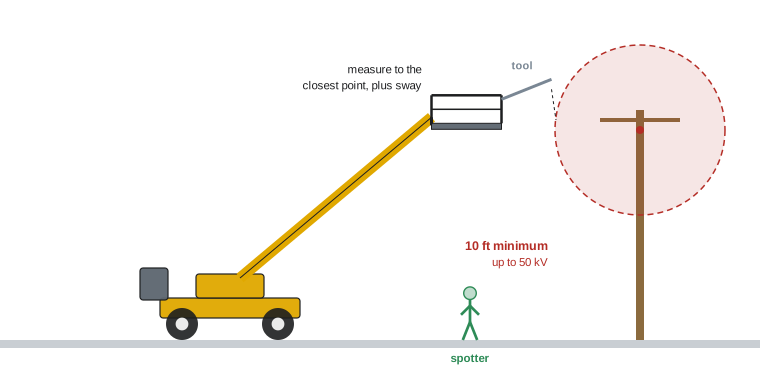
| Voltage | Minimum clearance (unqualified workers and equipment) |
|---|---|
| Up to 50 kV | 10 ft |
| Over 50 kV | 10 ft plus 0.4 in for each kV over 50 kV (1926.451(f)(6)), or 4 in for each 10 kV over 50 kV (1910.333(c)(3)), which give the same result |
| Insulated lines under 300 V (scaffolds, including scissor lifts) | 3 ft |
These are minimums. The clearance must be kept between the line and the closest part of the platform, boom, workers and any conductive object they handle, allowing for sway of the line and the boom, wind, and the reach of tools. Where work must come closer, the employer must arrange with the utility to de-energize, relocate or insulate the line; only qualified electrical workers using approved methods may work closer.
Worked problem
Is the planned position far enough from the line?
A crew plans to replace a sign using a boom lift. At the planned position, the closest point of the platform guardrail will be 13 ft horizontally from a 25 kV distribution line. The workers will use a 4 ft metal pole to guide the sign, and the line and platform could sway together by up to 1.5 ft in the expected wind. Is the plan acceptable under the 10 ft minimum clearance?
Show solution
- Required clearance for 25 kV: 10 ft.
- Closest approach of the pole if held out toward the line: \( 13 - 4 = 9 \) ft.
- Allow for sway: \( 9 - 1.5 = 7.5 \) ft.
- 7.5 ft is less than 10 ft, so the plan breaks the clearance.
Answer: No. Reposition the machine further from the line, use a non-conductive guide or a shorter tool, mark a limit with a spotter or range-limiting device, or arrange with the utility to de-energize or cover the line.
Controls near power lines
- Identify every overhead line during the site assessment and find out its voltage from the utility. Do not guess from the size of the poles.
- Position the machine so that the platform cannot reach the limit of approach, if possible. A machine whose maximum reach cannot get there is the strongest control.
- Use a dedicated spotter whose only job is to watch the distance and warn the operator.
- Use barriers, flags or range-limiting devices to mark where the platform must not go.
- Never assume a line is insulated or de-energized. Covers installed by the utility reduce the risk of brief contact; they do not make a line safe to touch.
- Carry long conductive objects, such as pipes, conduit and aluminum ladders, horizontally and keep them inside the platform.
Insulated aerial devices, such as the bucket trucks used by utilities, are designed and tested for work near energized lines, but only qualified electrical workers trained in utility work methods may use them for that purpose. A standard boom lift or scissor lift has no electrical insulation, even if it has fiberglass covers or rubber tires.
If contact happens
If a MEWP contacts a power line, the people on the platform are usually safest staying where they are, not touching anything conductive, while the operator tries to move the platform away from the line if it can be done safely. People on the ground must stay well back, at least 10 m (about 33 ft), because the ground around the machine may be energized. Call the utility and emergency services. No one should approach until the utility confirms the line is de-energized and grounded. HSE-219 describes the same response for cranes, including how to jump clear if a fire forces evacuation.
Wind
Wind pushes on the platform, the workers and any material they carry. Because the force acts high above the ground, it creates a large overturning moment, and gusts arrive without warning. Outdoor-rated MEWPs are designed for winds up to a stated limit, typically 12.5 m/s (45 km/h or 28 mph). Indoor-only machines are rated for zero wind.
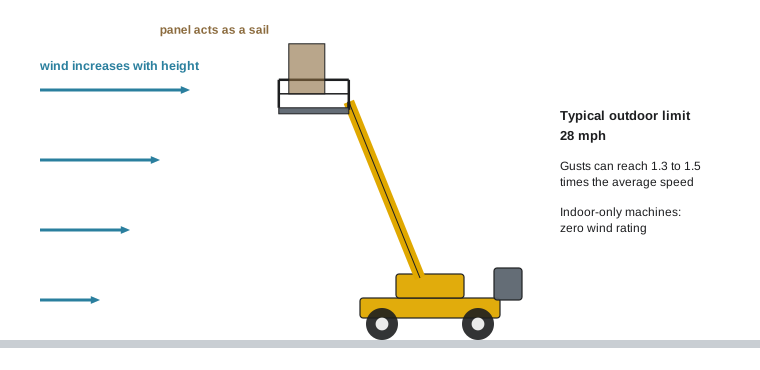
Three things make wind more dangerous than a forecast suggests. First, wind is stronger at height than at ground level. Second, gusts can be 30 to 50 percent stronger than the average wind speed. Third, buildings channel wind into gaps and around corners, so local wind can be much stronger than the general forecast.
Worked problem
Wind at height
The forecast gives an average wind of 22 mph at the standard measuring height of 33 ft (10 m), with gusts 40 percent higher. The crew will work at 82 ft (25 m). A common estimate for how wind increases with height in open terrain is \( v_h = v_{10} (h/10)^{1/7} \), with heights in meters. Will the wind at the platform stay below a 28 mph limit?
Show solution
- Height factor: \( (25/10)^{1/7} = 2.5^{0.143} = 1.14 \).
- Average wind at 82 ft: \( 22 \times 1.14 = 25 \) mph.
- Gusts: \( 25 \times 1.4 = 35 \) mph.
- 35 mph exceeds 28 mph. The formula is a rough illustrative estimate; on site, measure with an anemometer at platform height.
Answer: No. Gusts at platform height would likely exceed the limit. Postpone the work, or measure the wind at height and stop if it approaches the limit.
Worked problem
A panel acting as a sail
A worker holds a 4 ft by 8 ft sheet of plywood (about 1.2 m by 2.4 m) on the platform in a 28 mph (12.5 m/s) wind. The wind pressure is about \( q = \tfrac{1}{2} \rho v^2 \) with air density 1.2 kg/m³, and a flat plate has a drag coefficient of about 1.5 (illustrative). What force does the wind put on the sheet, and how does it compare with a manufacturer's manual side force limit of 90 lb (400 N)?
Show solution
- Wind pressure: \( q = 0.5 \times 1.2 \times 12.5^2 = 94 \) Pa.
- Area: \( 1.2 \times 2.4 = 2.88 \) m².
- Force: \( F = q \times A \times C_d = 94 \times 2.88 \times 1.5 = 406 \) N, about 91 lb.
- That alone reaches the side force limit before the wind on the workers and machine is counted.
Answer: About 400 N (90 lb), as much as the whole allowed side force. Many manufacturers prohibit carrying large panels outdoors or reduce the wind limit when they are carried. Check the manual.
Practical wind controls are simple. Check the forecast in the safe use plan, measure the wind at height with an anemometer when it is close to the limit, lower the platform when wind approaches the limit or gusts become strong, and do not carry large sheets outdoors unless the manufacturer permits it.
Lightning, cold, heat and air quality
Lightning: a raised MEWP is often the tallest object around. When thunder is heard or lightning is seen, lower the platform and move workers to shelter; a common rule is to wait 30 minutes after the last thunder before resuming.
Cold: cold reduces battery capacity, thickens hydraulic oil, makes decks and rails icy and stiffens harness webbing. Clear ice and snow from the platform and chassis; check that functions work normally before raising; dress for wind chill at height, which is colder than at ground level.
Heat: hot surfaces, sun exposure and limited shade on a platform contribute to heat stress. Plan water and breaks, and rotate workers.
Air quality: engine-powered MEWPs produce carbon monoxide and other exhaust; indoor use needs ventilation and monitoring, or an electric machine. HSE-218 covers carbon monoxide from fuel-powered equipment. Machines used in locations with flammable gases, vapors or dusts must be specifically rated for those locations.
Working near traffic and the public
Outdoor MEWP work often happens beside roads, parking lots and walkways. A vehicle striking the chassis can overturn the machine or throw the occupant out, and members of the public may walk beneath the platform. Plan traffic control as part of the safe use plan: cones, barriers or vehicle-mounted attenuators where traffic is fast, a flagger where needed, and a closed sidewalk with a safe detour for pedestrians. Work beside public roads usually needs a permit from the road authority and must follow its temporary traffic control rules.
In the United States, Part 6 of the Manual on Uniform Traffic Control Devices sets the rules for temporary traffic control, and states may add their own requirements.
Hazardous locations
Some workplaces have areas where flammable gases, vapors or combustible dusts may be present, such as fuel facilities, paint booths, grain handling and some chemical plants. A standard MEWP has electrical components and hot engine surfaces that can ignite these atmospheres. Only machines specifically built and certified for the classified location may be used there, or the area must be made safe under a hot work or equipment permit with gas testing. Check with the facility before bringing any MEWP into such an area.
Keeping watch on the weather
Weather changes during a shift. Assign someone, usually the operator or the supervisor, to check the forecast before work and to watch for changes, such as rising wind, approaching storms or freezing rain. Agree the stop criteria in advance, so that stopping is a routine decision rather than an argument at height.
Common mistakes
MistakeGuessing a power line's voltage from the size of the poles.
InsteadGet the voltage from the utility and apply the correct limit.
MistakeMeasuring clearance from the platform but forgetting tools and sway.
InsteadInclude long tools, materials, sway and wind in the distance.
MistakeTreating a standard boom lift as insulated because of its rubber tires.
InsteadOnly insulated aerial devices used by qualified electrical workers are designed for energized work.
MistakeRelying on the ground-level forecast for work at height.
InsteadAllow for higher wind and gusts at height, and measure at the platform.
MistakeCarrying large panels on the platform in wind.
InsteadFollow the manufacturer's limits; panels act as sails.
Summary and key terms
- Electrocution was the leading cause of MEWP deaths reported to IPAF for 2025.
- Common US clearances are 10 ft for lines up to 50 kV, with more for higher voltages.
- Distances must include the platform, people, tools and sway; spotters, positioning and utility arrangements are key controls.
- If contact occurs, stay on the platform unless fire forces evacuation and keep people on the ground well back.
- Outdoor MEWPs are typically rated for 12.5 m/s; wind is stronger at height and gusts can be 30 to 50 percent higher.
- Panels carried on the platform act as sails; lightning, cold, heat and exhaust need their own controls.
- Limit of approach
- The minimum distance that must be kept between an energized line and equipment, people and objects.
- Step potential
- A voltage difference between a person's feet on energized ground.
- Insulated aerial device
- A vehicle-mounted aerial device designed and tested to insulate workers from energized lines.
- Anemometer
- An instrument that measures wind speed.
- Gust
- A brief increase in wind speed above the average.
- Drag coefficient
- A number describing how strongly an object is pushed by moving air for its size.
- Spotter (power lines)
- A person whose sole task is to watch the distance between equipment and a power line and warn the operator.
Practice problems
Work each problem on paper first, then reveal the answer to check.
What is the minimum clearance for a 34.5 kV line under the 10 ft rule?
Show answer
10 ft.
What is the minimum clearance for a 115 kV line using 1926.451(f)(6)?
Show answer
\( 10 \) ft plus \( 0.4 \times 65 = 26 \) in, about 12.2 ft.
Why must tools and sway be included in clearance calculations?
Show answer
The distance must be kept from anything that could come close to the line, including tools, materials and moving equipment.
What should people on the ground do if a MEWP contacts a power line?
Show answer
Stay well back, at least 10 m (33 ft), call the utility and emergency services and not approach until the line is de-energized.
Who may use an insulated aerial device near energized lines?
Show answer
Only qualified electrical workers trained in utility work methods.
Convert 12.5 m/s to km/h.
Show answer
\( 12.5 \times 3.6 = 45 \) km/h.
Why is wind at platform height often stronger than the forecast?
Show answer
Wind increases with height, gusts exceed the average, and buildings channel wind.
Find the wind force on a 3 ft by 6 ft panel (about 1 m by 2 m) at 22 mph (10 m/s) with a drag coefficient of 1.5.
Show answer
\( q = 0.5 \times 1.2 \times 100 = 60 \) Pa; \( F = 60 \times 2 \times 1.5 = 180 \) N, about 40 lb.
What should happen when thunder is heard?
Show answer
Lower the platform and move workers to shelter, waiting about 30 minutes after the last thunder before resuming.
Name two effects of cold on MEWPs.
Show answer
Reduced battery capacity, thicker hydraulic oil, icy decks and rails, stiff harness webbing.
Lesson quiz · 5 questions
Score 60% or more to complete this lesson.
Create a free account to save your progress, take quizzes and earn a certificate.