
HSE-220 · Lesson 6 of 12 · 29 min
Set-up, ground conditions and stability
Overturns are among the deadliest MEWP events, and almost all of them begin at ground level. A wheel drops into a hole, an outrigger sinks into soft fill, the machine is raised on a slope beyond its limit, or the platform is pushed outward by wind or by a worker pulling on a structure. This lesson explains why MEWPs tip, how to read ground conditions and the manufacturer's ground pressure data, and how to set a machine up so it stays upright.
Why MEWPs tip over
A MEWP stays upright as long as the combined center of gravity of the machine, the platform and everything on it stays inside the tipping lines. Anything that moves the center of gravity outward, or moves the tipping line inward, reduces stability.
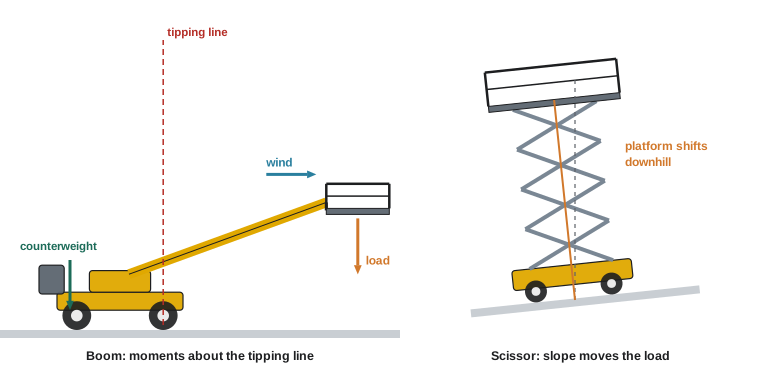
- Load and reach: on a boom, the overturning moment is the weight of the platform and its load times the horizontal distance beyond the tipping line. Doubling the reach roughly doubles the moment. That is why booms have load charts or envelopes and why many have a lower rated load at full extension.
- Slope: tilting the chassis moves the center of gravity toward the downhill side. On a tall scissor lift, a small slope at the chassis becomes a large sideways shift at the platform. A 3 degree tilt shifts the platform of a lift raised 10 m by about 0.5 m.
- Wind: wind pushes on the platform, people, materials and structure, adding a sideways force high up where it has the greatest leverage.
- Side forces: pulling on a cable, pushing on a wall, or using a drill against a structure applies a horizontal force at the platform. Manufacturers state a maximum manual side force, often about 200 to 400 N (45 to 90 lb). Working against a structure can easily exceed it.
- Dynamic effects: driving elevated, braking, hitting a curb or bump, or swinging the boom quickly all add forces beyond the static load.
- Ground failure: a wheel, outrigger or mat that sinks suddenly tilts the whole machine and can start an overturn in a fraction of a second.
Worked problem
How much does a small slope shift the platform?
A scissor lift is raised so that its platform deck is 33 ft (about 10 m) above the ground. The chassis sits on a surface tilted 3 degrees to one side. How far sideways is the platform displaced compared with level ground, ignoring flex in the structure?
Show solution
- Horizontal shift is height times the sine of the tilt angle: \( d = h \sin\theta \).
- \( d = 33 \times \sin 3^\circ = 33 \times 0.0523 = 1.7 \) ft (about 0.52 m).
- Flex in the scissor stack and tires usually adds more.
Answer: About 1.7 ft. On a machine whose wheels are only about 4 ft apart, that is a large share of the margin, which is why tilt limits for elevating are only a few degrees.
Ground conditions
The ground must carry the machine's wheel or outrigger loads without sinking, cracking or collapsing, and it must stay that way for the whole job. Ground that is fine in the morning can soften after rain or thaw, and asphalt softens on hot afternoons.
| Condition | Why it matters | Control |
|---|---|---|
| Backfilled trenches and excavations | Fill settles; a wheel can break through | Locate from drawings and markings; keep wheels off or bridge with engineered plates |
| Manholes, drains and vaults | Covers may not be rated for wheel loads | Route around; confirm ratings |
| Suspended slabs and mezzanines | Floor loading limits may be lower than wheel loads | Check with the building engineer; spread loads; choose a lighter machine |
| Floor openings and plywood covers | Plywood cannot carry a wheel | Barricade and route around; treat covers as openings |
| Soft ground, mud, snow and frost | Bearing capacity drops; frost can thaw during the day | Use mats; reassess after weather changes |
| Curbs, ramps, edges and loading docks | A wheel dropping off an edge tips the machine instantly | Barriers, set-back distances, spotters; never drive elevated near edges |
| Hot asphalt and interlocking pavers | Outrigger pads and wheels can punch through | Use mats under outriggers and pads |
Reading ground pressure data
Manufacturers publish the maximum wheel load and often the ground pressure for each machine, sometimes as a local concentrated pressure under one tire or pad and an overall pressure under the whole machine. Comparing these with what the ground can carry tells you whether the machine is suitable or whether mats are needed. The bearing capacity of the ground should come from a competent person, such as a geotechnical engineer for critical locations; the values in the example are illustrative.
Worked problem
Sizing a mat for an outrigger
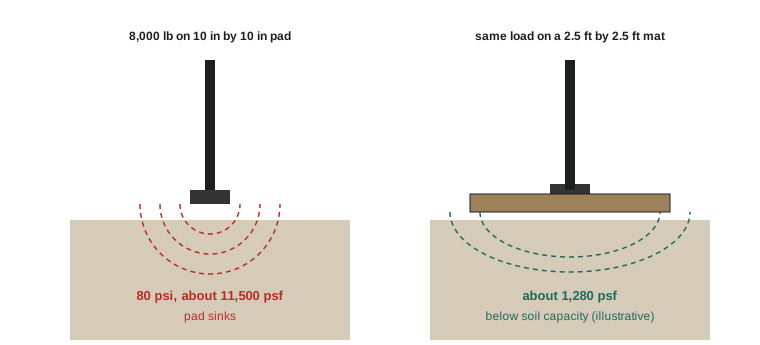
A rough-terrain scissor lift with outriggers has a maximum outrigger load of 8,000 lb according to the manufacturer. Each outrigger foot is 10 in by 10 in. The crew will set up on a compacted gravel yard over clay that a competent person estimates can safely carry 1,500 psf (illustrative). Is a mat needed, and if so, how large?
Show solution
- Pressure under the bare foot: \( p = \tfrac{8000}{10 \times 10} = 80 \) psi.
- Convert to psf: \( 80 \times 144 = 11\,520 \) psf.
- That is more than seven times the 1,500 psf the ground can carry, so a mat is needed.
- Required mat area: \( A = \tfrac{8000}{1500} = 5.3 \) square feet.
- A square mat \( \sqrt{5.3} = 2.3 \) ft on a side is the minimum; choose a mat at least 2.5 ft by 2.5 ft that is stiff enough to spread the load across its whole area, and center the foot on it.
Answer: Yes. Use a stiff mat of at least 2.5 ft by 2.5 ft under each outrigger, giving a pressure of about 1,280 psf. Thin plywood that bends under the foot does not spread the load over its whole area.
Mats only work if they are stiff enough. A sheet of plywood under an outrigger bends, so the load goes into the ground through a small patch directly under the foot. Use purpose-made outrigger pads or timber or composite crane mats sized for the load, as HSE-219 describes for cranes.
Setting up the machine
The manual gives the exact set-up sequence. The common steps are:
- position the machine as close as possible to the work, so the platform does not need to reach out further than necessary;
- check the ground under each wheel or outrigger and place mats where needed;
- deploy outriggers or stabilizers fully, as the manual requires, and level the machine within the indicated limits before raising;
- confirm the tilt indicator or level bubble shows level;
- set up the exclusion zone and barriers around the machine and the area beneath the platform;
- check overhead clearance once more before raising.
Worked problem
Checking a boom's reach against its envelope
A 60 ft telescopic boom has a dual rating: 1,000 lb anywhere in the restricted envelope and 500 lb in the full envelope. The task is to install a 90 lb sign bracket at a horizontal reach of 50 ft with two workers weighing 200 lb each, plus 30 lb of tools. The manual's envelope shows that a 50 ft reach at that height is only in the full envelope. Is the lift within its rating?
Show solution
- Total platform load: \( 2 \times 200 + 30 + 90 = 520 \) lb.
- At 50 ft reach the platform is in the full envelope, where the rating is 500 lb.
- 520 lb exceeds 500 lb, so the lift is over its rating at that reach.
- On current machines the load sensing system should stop the lift, but planning must not rely on it.
Answer: No. Reduce the load, for example one worker with tools and the bracket, or reposition the machine closer so the work is in the restricted envelope with the higher rating.
Dual-rated and multi-rated booms are common. Their envelope charts work like a crane load chart in miniature: the rated load depends on where the platform is. Lesson 10 returns to loading and how to account for materials.
Driving elevated
Many Type 3 machines may be driven with the platform raised, but only within the manufacturer's limits: on a firm, level surface, at reduced speed, with the operator looking in the direction of travel. Driving elevated over rough ground, across ramps, near edges or over cables and hoses multiplies the risk of a jolt, and a jolt is what causes the catapult effect on booms and overturns on tall scissors. The safest rule for supervisors is to allow elevated travel only where the plan says the route has been checked and is clear and level.
Suspended slabs and building floors
Indoor work raises a different ground question: can the floor carry the machine? A slab-on-grade warehouse floor usually can. A suspended slab, such as a mezzanine, a parking deck or an upper floor of an office building, may not, especially for heavy booms or for machines whose wheel loads concentrate on small areas. Building engineers express floor capacity in kilopascals or pounds per square foot of uniform load, and a MEWP's concentrated wheel loads can exceed the local capacity of a slab even when the machine's overall weight looks modest compared with the floor's total capacity.
Before using a MEWP on a suspended slab, ask the building owner or a structural engineer to confirm that the slab can carry the machine's maximum wheel loads and overall weight along the route and at the work location. Give them the manufacturer's data: machine weight, maximum wheel load and tire contact area. The engineer may restrict the route to areas over beams, require load-spreading plates, or recommend a lighter machine.
Similar care applies to elevators and ramps used to move a MEWP between floors. Check the rated capacity of a freight elevator against the machine's weight, and make sure ramps can carry the wheel loads.
Outriggers and stabilizers in practice
Machines with outriggers or stabilizers, such as trailer booms, truck-mounted units and some rough-terrain scissors, rely on them completely for stability when elevated. Interlocks on current machines usually prevent raising until all outriggers are deployed and the chassis is level, but older machines may not have them. Watch for outriggers set on the edge of a curb or a slab, pads placed on top of loose blocking, and outriggers left partly retracted because of a nearby obstruction. Each of these reduces the base the machine depends on.
Common mistakes
MistakePlacing a thin sheet of plywood under an outrigger as a mat.
InsteadUse stiff, purpose-made pads or mats sized for the load and ground.
MistakeRaising the platform on a gentle slope because the machine can drive on it.
InsteadRaise only within the tilt limit for elevating, which is usually a few degrees.
MistakePushing or pulling hard on a structure from the platform.
InsteadStay within the manufacturer's maximum manual side force.
MistakeAssuming a boom's highest rating applies at full reach.
InsteadCheck the envelope chart for the rating where the platform will be.
MistakeDriving elevated across a yard to save time.
InsteadLower before traveling unless the route is firm, level and clear as the plan requires.
Summary and key terms
- A MEWP overturns when its combined center of gravity moves outside the tipping lines.
- Load, reach, slope, wind, side forces, dynamic effects and ground failure all reduce stability.
- A 3 degree tilt shifts a platform raised 10 m about 0.5 m sideways.
- Ground pressure equals force divided by area; mats lower pressure only if stiff enough to spread the load.
- Set up close to the work, on firm level ground, with outriggers fully deployed and the machine leveled.
- Dual-rated booms have lower rated loads in the outer envelope; check the chart for the actual reach.
- Overturning moment
- The tendency to tip, equal to a force times its horizontal distance from the tipping line.
- Manual side force
- The maximum horizontal force workers may apply from the platform, stated by the manufacturer.
- Bearing capacity
- The pressure the ground can safely carry without excessive settlement or failure.
- Outrigger mat
- A stiff pad placed under an outrigger foot to spread its load over a larger area.
- Dual rating
- Two rated loads for different parts of a boom's working envelope.
- Working envelope
- The range of positions the platform can reach, shown on the manufacturer's chart.
- Leveling
- Adjusting outriggers or jacks so the chassis is within the tilt limit before raising.
Practice problems
Work each problem on paper first, then reveal the answer to check.
What must stay inside the tipping lines for a MEWP to remain upright?
Show answer
The combined center of gravity of the machine, platform and load.
How far does a platform raised 26 ft shift on a 2 degree slope?
Show answer
\( 26 \times \sin 2^\circ = 0.91 \) ft.
An outrigger load of 6,000 lb sits on an 8 in by 8 in foot. What is the pressure?
Show answer
\( 6000 / 64 = 94 \) psi, about 13,500 psf.
What mat area is needed for 6,000 lb on ground rated at 2,000 psf?
Show answer
3 square feet, for example about 1.75 ft by 1.75 ft.
Why is plywood a poor outrigger mat?
Show answer
It bends, so the load goes into the ground through a small area under the foot.
Give three ground hazards that cause overturns.
Show answer
Backfilled trenches, manhole covers, floor openings under plywood, soft ground, curbs and edges, hot asphalt.
Why do many booms have a lower rated load at full reach?
Show answer
The overturning moment grows with reach, so less load can be carried further out.
What is the manual side force limit?
Show answer
The maximum horizontal force workers may apply from the platform, set by the manufacturer.
When may a Type 3 machine be driven elevated?
Show answer
Only within the manufacturer's limits, on firm, level, clear surfaces at reduced speed, and where the plan allows it.
Who should provide the bearing capacity of the ground for critical set-ups?
Show answer
A competent person, such as a geotechnical engineer.
Lesson quiz · 5 questions
Score 60% or more to complete this lesson.
Create a free account to save your progress, take quizzes and earn a certificate.