
HSE-220 · Lesson 11 of 12 · 29 min
Emergency lowering and rescue planning
Every MEWP job needs an answer to a simple question: if the person on the platform cannot bring it down, how will they get down, and how fast? The answer belongs in the safe use plan before the platform is raised. Workers have died on platforms not because the original event was fatal, but because no one on the ground knew how to lower the platform, the key was in a pocket on the platform, or the auxiliary battery was flat.
What can go wrong
Rescue situations fall into a few groups, and the plan should address each one that is realistic for the job.
| Situation | Example | Typical response |
|---|---|---|
| Operator incapacitated | Medical event, heat stroke, struck by an object, electric shock | Trained ground person lowers the platform with the ground controls; first aid and emergency services |
| Machine failure | Loss of power, hydraulic fault, control failure, stalled engine | Use auxiliary power or the manual descent system following the manual; call the owner's service line |
| Entrapment | Operator pinned against overhead structure | Stop all motion; carefully reverse the motion that caused it, usually from the ground controls; call emergency services |
| Worker suspended in harness | Worker fell or was ejected and hangs from the lanyard | Lower the platform so the worker reaches the ground or a safe surface, or reach them with a second platform if planned; treat for suspension intolerance |
| Contact with power lines | Boom touches or arcs to a line | Do not approach; call the utility and emergency services; follow the contact procedure from lesson 9 |
| Fire or fuel leak | Engine fire, battery thermal event | Lower immediately if safe; use the extinguisher; evacuate the area |
Emergency controls on the machine
Every MEWP has controls that let someone on the ground take over. The details differ by model, which is one reason familiarization matters for ground persons as well as operators.
- Ground controls: a control station at the chassis or turntable that can operate the platform functions and usually overrides the platform controls. A selector switch or key chooses between platform and ground control.
- Emergency stop: on both the platform and the ground control station, stopping all powered functions.
- Auxiliary power: on many booms, a battery-powered auxiliary pump that can lower or retract the boom if the engine or main pump fails. It is designed for short use and may have a limited run time.
- Manual descent: on most scissor lifts, a manual lowering valve, often a pull cable or knob at the chassis, that lets the platform descend by gravity. On booms, manual descent may involve valves at the turntable and a specific sequence.
- Platform override: some machines allow an occupant to lower the platform if the operator collapses, using the platform controls once the operator is moved clear.
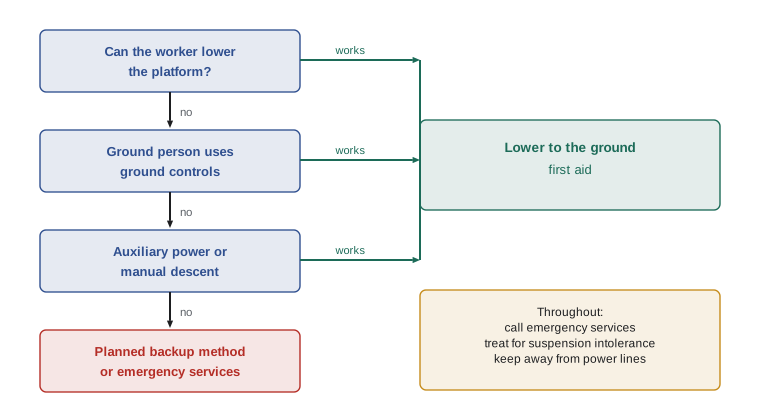
The trained ground person
The safe use standards and many employers require that someone on the ground be trained and familiarized to operate the ground controls and emergency systems whenever the platform is in use. This person should be within sight and earshot of the platform, know where the ground controls and keys are, be able to call for help, and stay out of the hazards around the machine. On small jobs, the ground person might be a co-worker doing other work nearby; the point is that someone is there who can act.
Worked problem
Time matters: a suspended worker
A worker is ejected from a boom basket 30 ft above a parking lot and hangs from a restraint lanyard that was too long. The site's rescue plan relies on calling the fire department, which is about 12 minutes away, and a ground person who has not been shown the ground controls. Guidance in HSE-212 on suspension trauma stresses rescue within minutes. Evaluate the plan.
Show solution
- Suspension intolerance can cause loss of consciousness within minutes in some people; prompt rescue is the goal.
- Waiting 12 minutes or more for the fire department, then for them to set up, is too long as the primary method.
- The fastest rescue is to lower the platform from the ground controls until the worker's feet reach the ground or a safe surface, then lift the worker's weight off the harness.
- That requires a ground person trained on this machine's ground controls and emergency lowering.
- Calling emergency services is still needed, but as a parallel step, not the only plan.
Answer: The plan is inadequate. Train and familiarize the ground person on the ground controls before work starts, make lowering the platform the primary rescue, and call emergency services at the same time. Fix the lanyard length so ejection cannot happen.
Planning for entrapment
Entrapment rescue needs care. The instinct is to move the platform away from the object, but moving it in the wrong direction increases the crushing force. The ground person should first stop all motion, then identify which function caused the entrapment, and reverse only that function slowly, ideally from the ground controls and with someone watching the operator. If the cause is unclear, or reversing seems likely to cause more harm, wait for emergency services with the machine stopped. Some current machines with secondary guarding stop or reverse automatically when triggered.
Worked problem
Which way to move?
An operator raising an articulating boom with the jib angled up is pinned between the guardrail and a steel beam above. The ground person arrives at the ground controls. Which actions are appropriate?
Show solution
- Stop all motion with the emergency stop if anything is still moving.
- The operator was raising the platform, so the movement that caused entrapment was boom lift or jib up.
- Switch to ground control and, after resetting the stop, lower the boom or jib slowly, the reverse of the motion that caused the entrapment, watching the operator throughout.
- Do not slew, extend or drive, which could drag the operator along the beam.
- Call emergency services immediately, whether or not the operator seems unhurt; crush injuries can be serious even when not visible.
Answer: Stop motion, then slowly reverse only the function that caused the entrapment from the ground controls, watching the operator, and call emergency services.
Planning for machine failure
Machine failure at height is less common than operator emergencies but must be planned for. Auxiliary power systems run on a battery that must be charged and tested; manual descent valves must be accessible and their location known. The plan should state the sequence from the manual and who will perform it, and what to do if it fails, such as using a second MEWP, a fixed ladder or emergency services.
Worked problem
Is the auxiliary power enough?
A boom's auxiliary pump is rated for 30 seconds of continuous operation followed by a cool-down period, according to the manual (illustrative). With the auxiliary pump, the boom lowers at about 0.5 ft/s. The platform is 46 ft above the ground when the engine fails. Can the auxiliary pump bring it down in one cycle?
Show solution
- Time needed at 0.5 ft/s: \( 46 / 0.5 = 92 \) seconds.
- That is more than three 30-second cycles, plus cool-down periods between them.
- The battery must hold enough charge for the whole sequence.
- On many booms, lowering by gravity through manual valves is also available and may be faster.
Answer: Not in one cycle. The ground person needs to know the full procedure from the manual, including cool-down periods and alternative manual descent, and the auxiliary battery must be checked during the pre-use inspection.
After an incident
After any emergency, secure the scene, care for the injured and preserve evidence. Under 29 CFR 1904.39, employers must report a work-related fatality to OSHA within 8 hours, and an inpatient hospitalization, amputation or loss of an eye within 24 hours. State plans may have their own reporting rules. Near misses, such as a tilt alarm on a slope or a brush with a power line, should be reported and investigated too.
Machines involved in incidents must be taken out of service and inspected by a qualified person before use. Harnesses and lanyards that arrested a fall or ejection must be removed from service.
Drills
A rescue plan that has never been practiced is a guess. Run short drills when a crew starts on a machine: have the ground person bring the platform down using the ground controls and the emergency lowering system, with no one at risk. Drills reveal problems such as a key that cannot be found, a manual descent cable behind a locked panel, or a ground person who was never shown the controls.
What to write in the rescue section
A rescue plan does not need to be long, but it must be specific to the machine and site. Vague phrases such as 'lower the platform' or 'call for help' are not enough. Good rescue sections answer these questions:
| Question | Example answer |
|---|---|
| Who is the trained ground person for each shift? | C. Ng (days), R. Diaz (evenings); both familiarized on the ground controls of this model |
| Where are the keys and ground controls? | Key stays in the ground control panel; panel on the turntable, left side |
| What is the manual descent procedure? | Pull the red descent knob at the rear of the chassis; copy of the manual page in the plan |
| How is help called? | Radio channel 4 to site office; site address posted at the gate for emergency services |
| What first aid is available? | First aid kit and trained first aider at the site office; AED at the main entrance |
| What if lowering fails? | Second MEWP on site can reach the work area; emergency services called at the same time |
Write the plan in the same language the crew speaks and post the key facts on or near the machine, such as the ground person's name and the location of the manual descent control. In an emergency, people do what they have practiced and what they can see, not what is in a binder in the office.
Medical emergencies at height
Medical emergencies, such as cardiac events, diabetic episodes, heat stroke and allergic reactions, happen on platforms just as they do on the ground, but help is harder to reach. Workers with known medical conditions may choose to tell the supervisor so the rescue plan can account for them, and first aiders should know how to reach and treat someone once the platform is lowered. Heat stress is a particular risk on platforms in summer, where workers are exposed to the sun and cannot easily take shelter; plan water, shade and breaks, and watch for the early signs.
Common mistakes
MistakeRelying only on calling emergency services for rescue.
InsteadMake lowering by a trained ground person the primary method and call emergency services in parallel.
MistakeLeaving the key on the platform with the operator.
InsteadMake sure the ground person can access and operate the ground controls.
MistakeMoving the platform in any direction to free an entrapped worker.
InsteadStop motion, then slowly reverse only the function that caused the entrapment.
MistakeAssuming the auxiliary pump will bring the platform down in one go.
InsteadKnow the manual's full procedure, including cool-down and manual descent.
MistakeNever practicing the rescue plan.
InsteadDrill the ground lowering procedure when crews start on a machine.
Summary and key terms
- The safe use plan must say how a worker will be brought down if they cannot lower the platform themselves.
- Ground controls, emergency stops, auxiliary power and manual descent let someone on the ground take over.
- A trained and familiarized ground person should be present whenever the platform is in use.
- Lowering the platform is usually the fastest rescue; emergency services are a parallel step.
- For entrapment, stop motion and slowly reverse only the function that caused it.
- Report fatalities within 8 hours and hospitalizations, amputations and eye losses within 24 hours under 1904.39, and remove involved equipment from service.
- Ground controls
- A control station at the chassis or turntable that can operate and usually override the platform functions.
- Auxiliary power
- A backup power source, often a battery pump, used to lower or retract the platform if main power fails.
- Manual descent
- A valve or system that lets the platform lower by gravity without power.
- Ground person
- A trained person on the ground who can operate the emergency controls and call for help.
- Rescue plan
- The part of the safe use plan that sets out how to bring a worker down in an emergency.
- Self-rescue
- An operator bringing the platform down by themselves using the platform controls.
- Critical injury
- In Ontario, a serious injury defined in regulation that must be reported immediately with a death.
Practice problems
Work each problem on paper first, then reveal the answer to check.
Name four situations a MEWP rescue plan should address.
Show answer
Operator incapacitated, machine failure, entrapment, suspended worker, power line contact, fire.
What is the purpose of the ground controls?
Show answer
To let someone on the ground operate and usually override the platform functions.
Why should the ground person be familiarized on the machine?
Show answer
Emergency controls and procedures differ between models.
What is usually the fastest rescue for a suspended worker?
Show answer
Lowering the platform so the worker reaches the ground or a safe surface.
How should an entrapment be released?
Show answer
Stop all motion, then slowly reverse only the function that caused it, watching the operator.
A platform must descend 40 ft at 0.6 ft/s. How long does it take?
Show answer
About 67 seconds.
What should happen to a harness that arrested an ejection?
Show answer
Remove it from service.
Why run rescue drills?
Show answer
They reveal problems such as missing keys, locked panels and untrained ground persons.
How quickly must a work-related fatality be reported to OSHA?
Show answer
Within 8 hours.
Why should emergency services be called even if lowering works?
Show answer
Injuries such as crush injuries or suspension intolerance may be serious even if not obvious.
Lesson quiz · 5 questions
Score 60% or more to complete this lesson.
Create a free account to save your progress, take quizzes and earn a certificate.