
HSE-220 · Lesson 7 of 12 · 27 min
Fall protection in MEWPs
Guardrails are the primary fall protection on every MEWP. They keep workers inside the platform as long as the workers stand on the deck and the machine stays upright. The question supervisors face is when guardrails are enough and when workers must also wear a harness connected to the platform. The answer depends on the type of machine, the law where you work and the manufacturer's instructions, and it is one of the most misunderstood topics in MEWP safety.
HSE-212 covers the theory of fall protection in depth: the hierarchy of fall controls, travel restraint and fall arrest, harnesses, lanyards, energy absorbers and clearance. This lesson applies that theory to platforms.
Restraint first
On a MEWP, the aim is to keep the worker inside the platform, not to catch them after they leave it. That is travel restraint: a full-body harness connected by a short lanyard to an anchorage on the platform, adjusted so the worker cannot reach a position where they could fall over the guardrail or be thrown out. Restraint prevents the fall entirely, keeps the worker with the platform if it jolts, and avoids the large clearance and swing problems of fall arrest from a moving platform.
Fall arrest, by contrast, lets the worker leave the platform and then stops the fall. From a platform anchorage at floor level, a worker who goes over the guardrail falls the length of the lanyard plus the height of the harness attachment above the anchorage before the energy absorber even begins to work. That is often more free fall than a standard energy absorber is designed for, and the worker ends up hanging below the platform, possibly against the boom or structure, waiting for rescue.
What the law requires
| Rule | Requirement (as checked October 2026) |
|---|---|
| 29 CFR 1926.453(b)(2)(v) (construction aerial lifts) | A body belt shall be worn and a lanyard attached to the boom or basket. Since 1998 body belts may not be used for fall arrest, so in practice a full-body harness with a restraint or arrest lanyard is used |
| 29 CFR 1926.453(b)(2)(iii) | No belting off to an adjacent pole, structure or equipment while working from an aerial lift |
| 29 CFR 1910.67(c)(2)(v) (general industry) | Fall arrest or travel restraint worn and attached to the boom or basket when working from a vehicle-mounted aerial device |
| 29 CFR 1926.451(g) (scissor lifts as scaffolds) | Guardrails or personal fall arrest; scissor lifts with compliant guardrails do not require harnesses under OSHA, though many employers and manufacturers require restraint |
| ANSI A92.22 and manufacturers | Harness and lanyard connected to the designated anchorage on Group B machines; on Group A machines, follow the manufacturer and the employer's rules |
The common thread is clear. On boom-type machines, wear a harness connected to the manufacturer's anchorage on the platform. On scissor lifts, guardrails are the primary protection, and restraint is required or recommended in more situations than many crews assume. Many employers simply require restraint on every MEWP so that crews have one habit for all machines.
Anchorages
Only use anchorages that the manufacturer has designated and rated for the purpose. They are marked on the platform, usually with a decal, and the manual states whether each one is rated for restraint only or also for fall arrest, and how many workers may attach to each.
- Never attach to a guardrail, mid-rail, toeboard or the platform controls unless the manufacturer designates it as an anchorage.
- Never attach to a building, structure or adjacent pole while on the platform. If the platform moves or tips, the worker is pulled out, or the machine and the structure fight each other through the worker's body.
- Never attach two workers to an anchorage rated for one.
- Inspect anchorages during the pre-use inspection and take the machine out of service if one is damaged.
Choosing and adjusting the lanyard
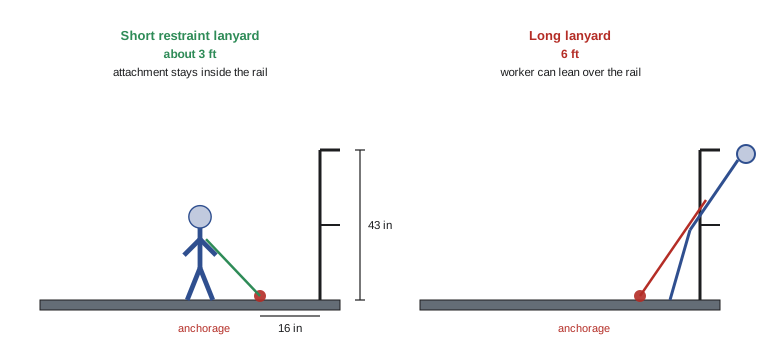
The lanyard is the part most often wrong. A standard 1.8 m (6 ft) shock-absorbing lanyard is designed for fall arrest from an overhead anchorage. Clipped to a floor anchorage in a small basket, it lets the worker lean over the rail or be thrown out. Many manufacturers and rental companies recommend or supply a short fixed or adjustable restraint lanyard, often about 1 m (3 ft), or a self-retracting device designed for leading-edge and platform use.
Worked problem
How short must a restraint lanyard be?
In a boom basket, the floor anchorage is 16 in inside the side guardrail, and the top rail is 43 in above the deck. The worker's harness has a back attachment. Treat the anchorage and the harness attachment as points, and ignore harness stretch. What is the longest lanyard that keeps the attachment from reaching the plane of the guardrail at the height of the top rail?
Show solution
- The attachment would reach the rail plane at rail height at a distance of \( \sqrt{16^2 + 43^2} \) inches from the anchorage.
- \( \sqrt{256 + 1849} = \sqrt{2105} = 45.9 \) in, just under 3.9 ft.
- So the lanyard plus connectors must be shorter than about 3.8 ft; a margin for stretch and body shape brings this to about 3 ft.
- A 6 ft lanyard would let the attachment pass well beyond the rail, allowing the worker to topple over it.
Answer: About 3 ft, including connectors. This simple geometry is illustrative; use the lanyard length and type the manufacturer specifies for the platform.
When fall arrest is used
Some laws, such as Alberta's for boom-supported platforms, call for a fall arrest system, and some manufacturers rate platform anchorages for arrest. Where arrest is required or chosen, the system must still be set up so that a fall is unlikely, and the clearance below the platform must be enough to stop the worker before they strike anything. HSE-212 explains clearance calculations; the example shows why they matter on a platform.
Worked problem
Clearance below a boom platform
A worker on a boom platform uses a 6 ft energy-absorbing lanyard on a floor anchorage rated for arrest. The harness attachment is about 4.5 ft above the anchorage. If the worker goes over the rail, estimate the free fall and the clearance needed below the platform deck. Assume a deceleration distance of 3.5 ft, harness stretch and attachment shift of 1 ft, the worker's feet 5 ft below the attachment, and a safety margin of 2 ft (illustrative values).
Show solution
- Free fall is the lanyard length plus the height of the attachment above the anchorage: \( 6 + 4.5 = 10.5 \) ft.
- That is well above the 6 ft of free fall that standard energy absorbers are usually designed for.
- The attachment ends up \( 6 + 3.5 + 1 = 10.5 \) ft below the deck.
- Add the distance to the feet and the margin: \( 10.5 + 5 + 2 = 17.5 \) ft of clear space below the deck, before allowing for boom bounce.
Answer: Fall arrest from a floor anchorage needs a lot of clearance and can exceed the design of standard energy absorbers. Use the equipment the manufacturer specifies, keep lanyards short, and treat restraint as the goal even when the system is rated for arrest.
The catapult effect and ejection
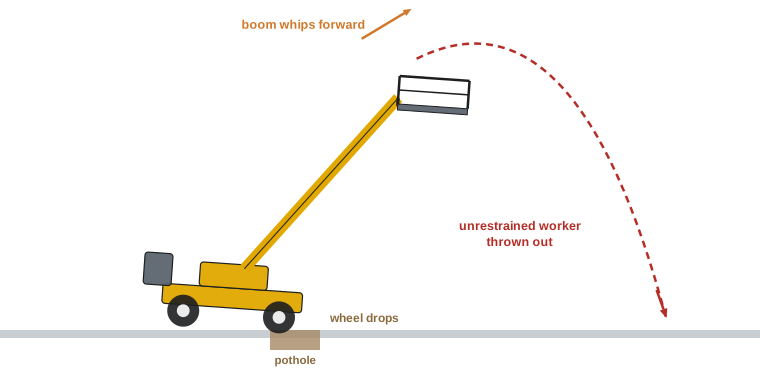
Ejection from boom lifts happens fast. A wheel drops into a pothole, the machine strikes a curb, or a passing vehicle hits the chassis; the boom amplifies the jolt and the platform snaps forward and back. Workers without restraint have been thrown out even with the gate closed. A short restraint lanyard is the control that works, together with avoiding elevated travel over uneven ground and protecting the machine from traffic.
Harnesses and inspection
Workers need a full-body harness that fits, inspected before each use, with a lanyard compatible with the platform anchorage. Harnesses involved in a fall or ejection must be removed from service. Training on fall protection equipment is required in every jurisdiction; in Ontario, construction workers who may use fall protection must have completed approved working at heights training. Remember too that a worker suspended in a harness after a fall needs prompt rescue because of suspension intolerance, covered in HSE-212 and in lesson 11.
Common questions from crews
Supervisors hear the same questions about fall protection on platforms again and again. Clear, consistent answers help crews follow the rules.
| Question | Answer |
|---|---|
| Can I use my roofing lanyard in the boom? | Only if it is the length and type the manufacturer specifies for the platform. Most roofing lanyards are too long for restraint in a basket. |
| Can two of us share one anchorage? | Only if the manufacturer rates it for two workers. Otherwise use separate anchorages. |
| Do I need a harness in a scissor lift? | It depends on the law, the manufacturer and site rules. Many sites require restraint on every MEWP; in Ontario, it is required whenever the platform moves. |
| Can I unclip to reach a far corner? | No. Reposition the platform instead. Unclipping removes the protection exactly when the risk is highest. |
| The gate is a chain. Is that acceptable? | Only if the manufacturer supplied it as the gate. It must be closed and secured while working. |
| Can I tie off to the structure while I work and to the basket while I move? | No. Never attach to a structure from the platform; if the platform moves, you are caught between the two. |
When answers depend on the machine, the best reference is the manual and the anchorage decals. Encourage operators to read them during familiarization and to ask when they are unsure. A short toolbox talk using one machine's decals and a harness, showing how to adjust a restraint lanyard so the worker cannot reach over the rail, is more effective than a written rule alone.
Supervising fall protection
Supervisors should check fall protection at the start of work and during it, not just in the plan. A quick look tells you a great deal: is every worker in a boom wearing a harness, is the lanyard short and attached to a designated anchorage, is the gate closed, and is anyone standing on a rail? Correct problems on the spot and explain why. Where crews regularly arrive with the wrong lanyards, provide the right ones on site, attached to each machine, so the correct equipment is the easy choice.
Common mistakes
MistakeClipping a 1.8 m (6 ft) shock-absorbing lanyard to a floor anchorage in a boom basket.
InsteadUse a short restraint lanyard or device specified by the manufacturer.
MistakeTying off to the building or an adjacent structure from the platform.
InsteadAttach only to the manufacturer's designated anchorage on the platform.
MistakeUsing the guardrail as an anchorage.
InsteadUse designated anchorages only; guardrails are not rated as anchorages unless the manufacturer says so.
MistakeAssuming guardrails are always enough on scissor lifts.
InsteadCheck the law and manufacturer; restraint is required in some situations, such as moving the platform in Ontario.
MistakeTreating fall arrest from the platform as equivalent to restraint.
InsteadAim to prevent the fall; arrest from a floor anchorage needs large clearance and prompt rescue.
Summary and key terms
- Guardrails are the primary protection; restraint keeps workers inside the platform and is the goal.
- OSHA requires a lanyard attached to the boom or basket on aerial lifts; scissor lifts are treated as scaffolds with guardrails or fall arrest.
- Attach only to designated anchorages on the platform, never to guardrails, structures or adjacent poles.
- Restraint lanyards must be short enough that the harness attachment cannot reach beyond the guardrail.
- Fall arrest from a floor anchorage involves long free falls and large clearances.
- The catapult effect can eject unrestrained workers from boom lifts.
- Travel restraint
- A system that prevents a worker from reaching a position where a fall could occur.
- Fall arrest
- A system that stops a worker after a fall has begun.
- Designated anchorage
- An attachment point on the platform designed, rated and marked by the manufacturer.
- Restraint lanyard
- A short lanyard sized to keep the worker inside the platform.
- Free fall
- The distance a worker falls before the fall protection system begins to slow them.
- Ejection
- A worker being thrown out of the platform by sudden movement.
- Suspension intolerance
- The dangerous effects of hanging motionless in a harness after a fall.
Practice problems
Work each problem on paper first, then reveal the answer to check.
What is the primary fall protection on every MEWP?
Show answer
Guardrails.
Why is restraint preferred over fall arrest on a platform?
Show answer
It prevents the fall, keeps the worker with the platform if it jolts and avoids long free falls and rescue from below the platform.
Where may a worker on a boom lift attach a lanyard?
Show answer
Only to the manufacturer's designated anchorage on the platform.
An anchorage is 12 in inside a 42 in rail. What is the maximum restraint length to the rail plane?
Show answer
\( \sqrt{12^2 + 42^2} = 43.7 \) in, less a margin.
Why must workers never tie off to the building from a MEWP?
Show answer
If the platform moves or tips, the worker is pulled out or caught between the machine and the structure.
Estimate free fall for a 6 ft lanyard on a floor anchorage with the attachment 4.5 ft above it.
Show answer
10.5 ft.
What is the catapult effect?
Show answer
The whipping of a boom when the chassis jolts, which can throw a worker out.
What should happen to a harness involved in a fall?
Show answer
Remove it from service.
Name one situation where Ontario requires workers on a scissor lift to be attached.
Show answer
Whenever the platform is moved.
Why do many employers require restraint on every MEWP?
Show answer
It gives crews one consistent habit for all machines and meets the strictest requirements.
Lesson quiz · 5 questions
Score 60% or more to complete this lesson.
Create a free account to save your progress, take quizzes and earn a certificate.