
GAS-350 · Lesson 8 of 12 · 23 min
Review: propane
▶ Video coming soon A video version of this lesson is on the way.
Propane was Luis's own subject, and on the second half of November 10 Maureen handed him the marker. "You've set more tanks than anyone here," she said. "Teach it. Grant asks the questions." Luis started with the Vandermeer job from GAS-240, the underground tank in Ashville that he and Jonah had set in September, and drew the system on the whiteboard from the tank to the range: tank, first-stage regulator, the polyethylene line under the lawn, the second-stage regulator on the house wall, the furnace, the tankless water heater and the range. "Everything on the exam about propane," he said, "is on this drawing somewhere, or it's about the cylinder you bring the barbecue to fill."
This lesson reviews GAS-240, with the propane material of GAS-110, GAS-120 and GAS-210. It covers propane's properties and vapor pressure, cylinders and tanks, siting, regulation, vaporization, filling, underground tanks, construction heaters, vehicle fuel systems and emergencies. The Canadian separation distances, the vaporization chart and the line capacity table in GAS-240 were invented samples; the code's own tables apply on the exam.
Properties and vapor pressure
Propane is stored as a liquid under its own vapor pressure, which depends only on the temperature of the liquid, not on how full the container is. A cylinder on a warm day is at a higher pressure than the same cylinder on a cold day, whether it is nearly full or nearly empty. That is why a pressure gauge on a tank tells you the temperature, not the contents, and why contents are read from a float gauge or by weight.
| Liquid temperature | −40 °F | −20 °F | 0 °F | 20 °F | 40 °F | 60 °F | 70 °F | 80 °F | 100 °F |
|---|---|---|---|---|---|---|---|---|---|
| Vapor pressure, psig | 1 | 11 | 23 | 41 | 65 | 92 | 109 | 129 | 174 |
Several numbers from GAS-240 come up again and again: one volume of liquid makes about 270 volumes of vapor; propane's specific gravity as a vapor is about 1.52, so it sinks; its flammable range is 2.1 to 9.5 in 100; its heating value is about 91,500 Btu per gallon of liquid and about 2,500 Btu/ft³ of vapor; and its liquid expands strongly as it warms, which is why containers are never filled completely.
Cylinders and tanks
Cylinders are portable containers built to Department of Transportation specifications and marked with their specification, water capacity, tare weight and date of manufacture. A new cylinder must be requalified within 12 years of manufacture and then at intervals that depend on the method: 5 years after a visual inspection, 10 years after a proof-pressure test, 12 years after a volumetric expansion test. Vapor-withdrawal cylinders from 4 to 40 pounds have an overfilling prevention device (OPD), identified by the triangular handwheel. Tanks are larger containers built to the ASME pressure vessel code, filled on site, with a relief valve, a fill valve, a vapor service valve, a liquid level gauge and a float gauge.
Containers are filled to about 80 in 100 of their volume at normal temperatures, or by weight to the filling density, about 42 in 100 of the water capacity, so that the liquid has room to expand. A cylinder filled to the top in a cool plant can become liquid-full as it warms, and its relief valve will open and release liquid, which makes a large flammable cloud.
Worked problem
How much gas is in the tank?
The Vandermeer tank holds 1,000 US gallons of water. It was filled to 80 in 100 in September. How many gallons of propane did it hold, and roughly how long would that run the 80,000 Btu/h furnace alone at full fire, using 91,500 Btu per gallon?
Show solution
- Propane in the tank:
- \[1{,}000 \times 0.80 = 800 \text{ gal}\]
- Energy:
- \[800 \times 91{,}500 = 73{,}200{,}000 \text{ Btu}\]
- Hours:
- \[\frac{73{,}200{,}000}{80{,}000} = 915 \text{ h}\]
Answer: 800 gallons, enough for about 915 hours of the furnace at full fire. In practice the tank also feeds the water heater and range, and the supplier refills it before it falls below about 20 in 100.
Siting
Where a tank or cylinder may go is set by NFPA 58: an aboveground tank of 125 to 500 gallons is at least 10 ft from a building and the property line, and one of 501 to 2,000 gallons at least 25 ft, with a reduction to 10 ft for a single tank of 1,200 gallons or less under stated conditions; an underground tank of up to 2,000 gallons is at least 10 ft away. The filling connection and the relief valve discharge have their own distances from building openings, air intakes and ignition sources. Siting also includes protection from vehicles, access for the delivery truck and hose, clearance from overhead power lines, and firm level support. Gwen Talbot's spot by the barn under a power line in GAS-240 failed on two of those.
Regulation and vaporization
Propane systems use two-stage regulation. The first-stage regulator at the tank reduces tank pressure, which may be over 150 psig on a hot day, to a typical 10 psig. The second-stage regulator at the building reduces that to appliance pressure, typically about 10.5 to 11 in. w.c.. The Vandermeer system commissioned at 10.5 in. w.c. flowing and 11.7 in. w.c. at lock-up. Two stages keep the appliance pressure steady as tank pressure changes with the weather, and they protect the house piping if one regulator fails. The codes require two-stage regulation for most fixed piping systems, which is why the Selkirk/Buckeye Lake cottage got a new pair.
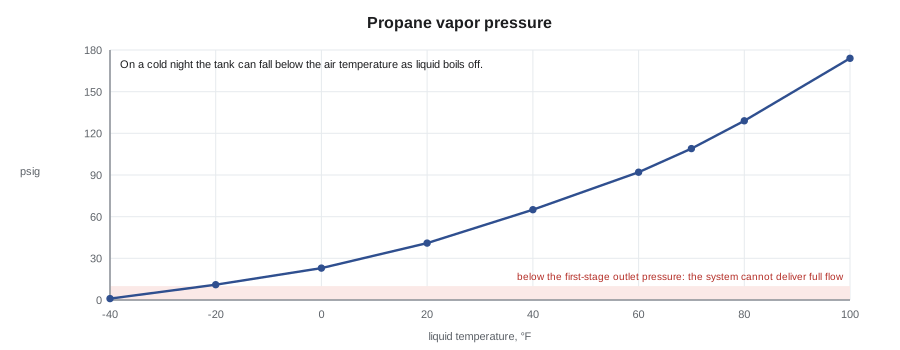
A tank delivers vapor only as fast as its liquid can boil, and boiling takes heat, which comes through the tank's wetted wall from the air or the ground. The vaporization rate therefore falls with the outdoor temperature and with the liquid level, because less wall is wetted. A small tank or a pair of cylinders that is ample in October can starve a large load on the coldest night, with frost on the container at the liquid line and appliances locking out on low pressure, as the greenhouse heater near Lockbourne did in January 2026. The fix is a larger tank, more containers drawing together, or a vaporizer, sized from the maker's and the code's data.
Underground tanks, construction heat and vehicles
Underground tanks are steel buried in soil, so they are protected from corrosion by their coating and by cathodic protection: magnesium anodes connected to the tank corrode instead of it. The protection is checked by measuring the tank-to-soil potential with a reference electrode; a reading that is not negative enough means the anodes are spent or disconnected, as at the golf clubhouse in GAS-240, where a broken anode wire left the tank at −0.62 V until new anodes brought it to −0.98 V. Under NFPA 58, people who transfer propane or install systems are trained, with refresher training at least every three years. Construction heaters burn propane in partly enclosed spaces, so they need the clearances, ventilation and CO monitoring the code and the maker require, and a torpedo heater in a closed basement, as at the Northvale site in GAS-240, produces carbon monoxide fast. Propane vehicle fuel systems, including forklift cylinders, follow NFPA 58's chapter on engine fuel systems, with the vehicle maker's and the converter's instructions.
Leak checks and emergencies
Every propane system is leak checked whenever it is opened or the gas has run out, because a run-out may mean an appliance pilot was left open. The usual method is a pressure test of the low-pressure piping: pressurize, close the supply, and watch a gauge or manometer for a drop over the test time, then find any leak with solution or a detector. The Brennans' farmhouse in GAS-240 failed its leak check at 9.0 dropping to 8.4 in. w.c. because of a cracked flare nut at the fireplace valve. In an emergency, a propane leak is treated as more dangerous than natural gas, because the vapor sinks into basements, drains and low ground and stays there. Shut off the container if it can be done safely, keep ignition sources away, get people out and upwind or uphill, and call emergency services and the supplier.
Converting appliances between gases
Conversion questions combine the propane facts with the appliance facts of GAS-210. An appliance built for natural gas has orifices sized to pass the right volume of a light, low-energy gas at a low manifold pressure. Propane carries about two and a half times the energy per volume, is heavier, and is supplied at a higher manifold pressure, so the same orifice on propane would badly overfire the burner. A conversion therefore changes the orifices, the regulator setting or spring and sometimes the pilot orifice and air shutters, all together, and only with the maker's conversion kit. The Wobbe index explains why: natural gas is about 48.4 MJ/m³ and propane about 75.8 MJ/m³ on the Wobbe scale used in GAS-210, a ratio of about 1.57, so a propane orifice must pass much less volume than the natural gas one for the same heat.
Worked problem
Why the orifice gets smaller
GAS-210's range conversion changed a natural gas orifice of 0.082 in. (No. 45) to a propane orifice of about 0.050 in. By what factor did the orifice area shrink?
Show solution
- Area is proportional to diameter squared:
- \[\frac{0.050^2}{0.082^2} = \frac{0.0025}{0.006724} \approx 0.37\]
Answer: The propane orifice has a little under four tenths of the natural gas orifice's area. That, together with the higher manifold pressure and propane's higher heating value, gives about the same input. A rough exam check: a propane orifice is always much smaller than the natural gas one for the same appliance.
Every conversion ends with the label the kit supplies, filled in and fixed to the appliance, showing the gas, the date and who did it, and with a full start-up: pressures, clocked input where possible, flame appearance and combustion readings. The IFGC and NFPA 54 require conversion according to the maker's instructions, with the maker's kit. A conversion with drilled orifices is not allowed, and an exam option that suggests drilling or tightening an orifice to change gases is always wrong.
Cylinder handling questions
Questions about cylinders tend to test a few practical rules. Cylinders are stored and used upright, valve up, with the relief valve in the vapor space, except cylinders designed for liquid withdrawal such as forklift cylinders, which have their own position. They are kept outdoors or in ventilated cabinets, away from building openings, heat and ignition sources, and never stored indoors in a house beyond the small sizes, about 2.7 lb each, that the code allows. They are transported secured, upright and with the valve closed and plugged where required. And a cylinder out of its requalification date is not refilled, as Bayline's cylinder cage audit in GAS-240 found with one of the farm's retired cylinders.
Questions this topic produces
Propane questions on the exam fall into a few patterns, and Luis's whiteboard drawing covered all of them:
- Pressure and temperature: what happens to tank pressure on a cold night, and why the float gauge, not the pressure gauge, shows the contents.
- Filling: why containers are filled to about 80 in 100, and what happens to an overfilled cylinder as it warms.
- Regulation: which regulator is at the tank and which at the building, and the typical pressure after each.
- Vaporization: why a system that works in October fails in January, and what fixes it.
- Siting and containers: distances, requalification dates, OPDs and which way up a cylinder is used.
- Hazards: why a propane leak is treated as more dangerous than a natural gas leak, and where the detector goes.
Common mistakes
MistakeReading a tank's contents from its pressure gauge.
InsteadPressure follows temperature; read contents from the float gauge or by weight.
MistakeFilling a container to the top.
InsteadFill to about 80 in 100 by volume, or by weight to the filling density.
MistakeUsing a single-stage regulator on a new system.
InsteadUse two-stage regulation.
MistakeExpecting a small tank to supply a large load on the coldest day.
InsteadSize containers for vaporization at the design low temperature.
MistakeSkipping the leak check after a run-out.
InsteadLeak check every time the gas has run out or the system was opened.
MistakeTreating a propane leak like a natural gas leak.
InsteadPropane sinks and pools; ventilate low places and keep ignition sources away.
Summary and key terms
- Propane is stored as a liquid under a vapor pressure that depends on temperature only, from about 1 psig at −40 °F to about 174 psig at 100 °F.
- One volume of liquid makes about 270 of vapor; the vapor sinks; containers are filled to about 80 in 100.
- DOT cylinders are requalified within 12 years of manufacture and then every 5, 10 or 12 years depending on the method; 4 to 40 lb vapor cylinders have an OPD.
- Tanks are ASME vessels.
- NFPA 58 sets 10 ft for 125 to 500 gallon tanks and 25 ft for 501 to 2,000 gallons.
- Two-stage regulation gives about 10 psig after the first stage and about 10.5 to 11 in. w.c. at the appliances.
- Vaporization falls with temperature and liquid level.
- Underground tanks need cathodic protection.
- Transfer workers are trained and refreshed at least every three years.
- Leak check after every run-out, and treat propane leaks as pooling hazards.
- Vapor pressure
- The pressure of propane vapor above its liquid in a closed container, set by the liquid's temperature.
- Requalification
- The periodic inspection or test a cylinder must pass before it may be refilled after its due date.
- Overfilling prevention device
- A float-operated valve in small vapor-withdrawal cylinders that stops filling at about 80 in 100.
- Two-stage regulation
- A first-stage regulator at the container and a second-stage regulator at the building, reducing pressure in two steps.
- Vaporization rate
- The rate at which a container can turn liquid propane into vapor, limited by heat flowing through its wetted wall.
- Cathodic protection
- Protecting buried steel from corrosion by connecting anodes that corrode in its place.
Practice problems
Work each problem on paper first, then reveal the answer to check.
Why does a tank's pressure gauge not show how much propane is left?
Show answer
Vapor pressure depends on temperature, not on the amount of liquid.
To about what fraction of their volume are propane containers filled?
Show answer
About 80 in 100.
What two pressures does two-stage regulation produce in a typical system?
Show answer
About 10 psig after the first stage and about 10.5 to 11 in. w.c. at the appliances.
Why can a propane system fail on the coldest night of the year?
Show answer
The container cannot vaporize liquid fast enough at low temperature and low liquid level.
What protects an underground steel tank from corrosion?
Show answer
Its coating and cathodic protection by sacrificial anodes.
Lesson quiz · 5 questions
Score 60% or more to complete this lesson.
Create a free account to save your progress, take quizzes and earn a certificate.