
GAS-350 · Lesson 10 of 12 · 41 min
Calculation practice
▶ Video coming soon A video version of this lesson is on the way.
On the Thursday after the last certification night, Maureen e-mailed Luis and Grant a single page: a formula sheet, followed by twenty problems with no answers. "Every one of these is a calculation from the program," she wrote. "Do them with a calculator and nothing else, against a clock, then check them against the worked answers in the course. For every one you get wrong, write down which trap caught you." Luis got sixteen. The four he missed were a unit conversion, a test pressure that ignored the minimum, an air-free CO calculated with the wrong oxygen, and a pipe size read from the shorter column. "Those are the four everyone misses," Maureen said. "Which is why they're on every exam."
This lesson is a workbook. It starts with the formula sheet, then works through problems from every part of the program, grouped by topic, each with the trap its wrong answers are usually built on. The sizing table is the program's invented practice table; the combustion air rate marked sample is invented too. Real work uses the code's tables and rates.
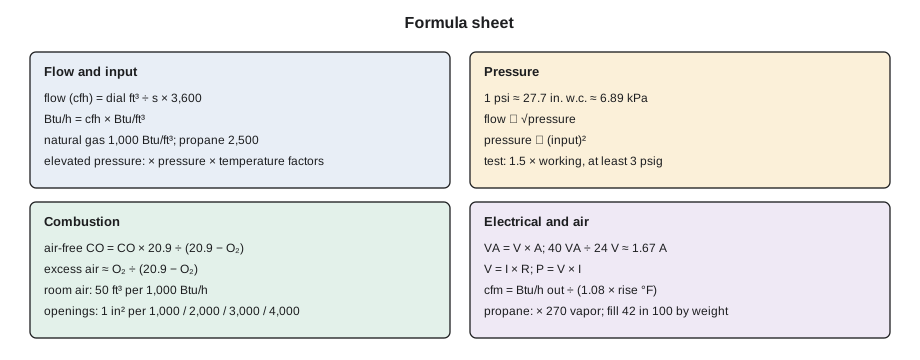
The formula sheet
Input and flow
Worked problem
1. Clocking a natural gas appliance
A boiler is the only appliance running. The meter's 2 ft³ test dial turns once in 48 s. Natural gas, 1,000 Btu/ft³. What is the input?
Show solution
- Flow:
- \[\frac{2}{48} \times 3{,}600 = 150 \text{ ft}^3/\text{h}\]
- Input:
- \[150 \times 1{,}000 = 150{,}000 \text{ Btu/h}\]
Answer: 150,000 Btu/h. The trap: forgetting the 3,600, or reading the 1/2 ft³ dial instead of the 2 ft³ dial.
Worked problem
2. Clocking a propane appliance
A propane appliance is the only one on the meter. The 1 ft³ dial turns once in 60 s. Propane vapor, 2,500 Btu/ft³. What is the input?
Show solution
- Flow:
- \[\frac{1}{60} \times 3{,}600 = 60 \text{ ft}^3/\text{h}\]
- Input:
- \[60 \times 2{,}500 = 150{,}000 \text{ Btu/h}\]
Answer: 150,000 Btu/h. The trap: using the natural gas heating value, which gives 60,000 Btu/h.
Worked problem
3. Correcting for an elevated-pressure meter
At Iron Kettle Brewing in GAS-330, the meter ran at 2 psig, with 14.4 psia atmospheric pressure and gas at 50 °F, giving a combined correction factor of 1.1352. The 10 ft³ dial turned in 36.0 s. What were the uncorrected and the real inputs?
Show solution
- Actual flow:
- \[\frac{10}{36.0} \times 3{,}600 = 1{,}000 \text{ ft}^3/\text{h}\]
- Uncorrected input:
- \[1{,}000 \times 1{,}000 = 1{,}000{,}000 \text{ Btu/h}\]
- Standard flow:
- \[1{,}000 \times 1.1352 = 1{,}135 \text{ ft}^3/\text{h}\]
- Real input:
- \[1{,}135 \times 1{,}000 = 1{,}135{,}000 \text{ Btu/h}\]
Answer: The kettle was really firing about 1,135,000 Btu/h against a plate of 1,000,000, overfired by about 13.5 in 100. The trap: forgetting the correction, which makes an overfired appliance look right.
Pressure
Worked problem
4. Overfiring by manifold pressure
A church hall boiler's manifold pressure is found at 4.2 in. w.c. against a rating plate of 3.5 in. w.c. Flow varies as the square root of pressure. By roughly how much is it overfired?
Show solution
- Flow ratio:
- \[\sqrt{\frac{4.2}{3.5}} \approx 1.095\]
Answer: About 9.5 in 100 overfired, roughly 10 as in GAS-230. The trap: taking the pressure ratio itself, 1.2, as the flow ratio, which gives 20 in 100.
Worked problem
5. Unit conversion
A service delivers gas at 5 psig. Express it in inches of water column and in kilopascals.
Show solution
- In inches of water column:
- \[5 \times 27.7 = 138.5 \text{ in. w.c.}\]
- In kilopascals:
- \[5 \times 6.89 \approx 34.5 \text{ kPa}\]
Answer: 138.5 in. w.c. or about 34.5 kPa. The trap: dividing by 27.7 instead of multiplying.
Worked problem
6. Test pressure
New piping will run at 5 psig. What is the minimum test pressure under the IFGC's rule, and what is it for piping running at 1/2 psig?
Show solution
- 5 psig:
- \[1.5 \times 5 = 7.5 \text{ psig}\]
- 1/2 psig:
- \[1.5 \times 0.5 = 0.75 \text{ psig, less than the 3 psig minimum}\]
Answer: 7.5 psig for the 5 psig piping and 3 psig for the 1/2 psig piping. The trap: forgetting the 3 psig minimum.
Combustion
Worked problem
7. Air-free CO
A fan-assisted furnace reads 8.2 in 100 O₂ and 38 ppm CO as measured. What is the air-free CO?
Show solution
- \[38 \times \frac{20.9}{20.9 - 8.2} = 38 \times \frac{20.9}{12.7} \approx 63 \text{ ppm}\]
Answer: About 63 ppm, the Mountview/Clintonville furnace from GAS-230. The trap: dividing by 20.9 minus the CO₂ reading, or using 21 instead of 20.9, which changes the answer slightly and can matter on a question with close options.
Worked problem
8. Excess air
A power burner reads 4.5 in 100 O₂. Roughly how much excess air is it running?
Show solution
- \[\frac{4.5}{20.9 - 4.5} = \frac{4.5}{16.4} \approx 0.27\]
Answer: About 27 in 100 excess air, a little above the typical power burner range of 15 to 25. The trap: answering 4.5, the oxygen reading itself.
Worked problem
9. Flue gas loss
A boiler's flue gas is 270 °F above the boiler room temperature and its CO₂ is 9.0 in 100. Using the rule of thumb from GAS-310, the dry flue gas loss is about 0.38 × ΔT ÷ CO₂ with ΔT in °C. What is the loss?
Show solution
- Convert the temperature difference:
- \[270 \times \frac{5}{9} = 150\ ^\circ\text{C}\]
- \[\frac{0.38 \times 150}{9.0} \approx 6.3\]
Answer: About 6.3 in 100 of the fuel's heat lost as dry flue gas. The trap: using 270 directly, because the rule's 0.38 is for degrees Celsius.
Worked problem
10. A worker's exposure
A technician's CO monitor logs 120 minutes at 18 ppm, 30 minutes at 70 ppm and 330 minutes at 3 ppm in an 8-hour shift. What is the time-weighted average?
Show solution
- \[\frac{120 \times 18 + 30 \times 70 + 330 \times 3}{480} = \frac{2{,}160 + 2{,}100 + 990}{480} \approx 10.9 \text{ ppm}\]
Answer: About 10.9 ppm, below OSHA's 50 ppm and NIOSH's 35 ppm limits. The trap: averaging the three readings without weighting them by time, which gives 30 ppm.
Piping and air supply
Worked problem
11. Sizing a main for a new load
A house has an 80,000 Btu/h furnace and a 199,000 Btu/h tankless water heater on a main whose longest length is 55 ft. Using the practice table, what size is the main from the meter?
Show solution
- Load:
- \[80 + 199 = 279 \text{ cfh}\]
- Column: next longer than 55 ft is 60 ft.
- In the 60 ft column, 1 in. carries 240 cfh, too little; 1-1/4 in. carries 500 cfh.
Answer: 1-1/4 in., as the Fairhaven house needed in GAS-120 once its tankless heater was counted. The trap: using the shorter column, or forgetting how large a tankless heater's input is.
Worked problem
12. Combustion air openings
A room has 200,000 Btu/h of appliances. What free area does each of two openings need if they connect to outdoors through vertical ducts, and if they connect to other indoor spaces instead?
Show solution
- To outdoors, vertical ducts, 1 in² per 4,000 Btu/h:
- \[\frac{200{,}000}{4{,}000} = 50 \text{ in}^2 \text{ each}\]
- To indoor spaces, 1 in² per 1,000 Btu/h, minimum 100:
- \[\frac{200{,}000}{1{,}000} = 200 \text{ in}^2 \text{ each}\]
Answer: 50 in² each to outdoors through vertical ducts; 200 in² each to indoor spaces. The trap: using the indoor rate for outdoor openings, or forgetting that louvers reduce free area.
Electrical, air and propane
| Problem | Working | Answer and trap |
|---|---|---|
| 13. Three zone valves at 0.30 A and a gas valve at 0.50 A on a 40 VA, 24 V transformer. Is it overloaded? What about a fourth zone? | (3 × 0.30 + 0.50) × 24 = 33.6 VA; with four zones, (4 × 0.30 + 0.50) × 24 = 40.8 VA | Three zones are within rating; four exceed 40 VA. Trap: forgetting to multiply by 24 V. |
| 14. A 120 V igniter measures 60 Ω hot. What current and power? | I = 120 ÷ 60 = 2.0 A; P = 120 × 2.0 = 240 W | 2.0 A and 240 W. Trap: using the cold resistance, which is different. |
| 15. A furnace delivers 57,600 Btu/h with a 54 °F rise. What is the airflow? | 57,600 ÷ (1.08 × 54) ≈ 988 cfm | About 988 cfm, the Okoye furnace in GAS-210. Trap: using input instead of output. |
| 16. A propane cylinder holds 239 lb of water. What weight of propane may it hold at a filling density of 42 in 100? | 239 × 0.42 ≈ 100 lb | About 100 lb, a standard 100 lb cylinder. Trap: using 80 in 100, which is a volume figure. |
| 17. Half a gallon of liquid propane leaks into a closed room 10 ft × 8 ft × 8 ft and vaporizes. What is the average concentration? | 0.5 × 270 = 135 gal of vapor ≈ 18.0 ft³; room 640 ft³; 18.0 ÷ 640 ≈ 0.028 | About 2.8 in 100, inside propane's 2.1 to 9.5 range. Trap: forgetting to convert gallons to cubic feet, 7.48 gal per ft³. |
| 18. A purge must give at least four volume changes, and the fan moves the chamber volume in 22 s. What is the shortest purge? | 4 × 22 = 88 s | 88 s, in this example. Trap: dividing instead of multiplying. Real purge times come from the burner's certification. |
| 19. A vent connector runs 14 ft. What minimum rise does it need? | 14 × 1/4 = 3.5 in. | 3.5 in. Trap: using 1/4 in. for the whole run. |
| 20. A boiler's output is 820,000 Btu/h. A relief valve rated 500,000 Btu/h is fitted. Is it acceptable? | The relief capacity must be at least the output | No, as at Riverdale in GAS-320. Trap: comparing the valve with the input instead of the output, or not checking at all. |
Working method
Maureen's advice for calculation questions on the exam is the same for every problem. Write the formula before the numbers. Write the units beside every number and cancel them as you go; a wrong unit at the end shows a wrong step. Estimate before you calculate: a house furnace is tens of kilowatts or tens of thousands of Btu per hour, not thousands; a manifold pressure is about 3.5 in. w.c., not 35. Then compare your answer with your estimate before choosing an option. If your answer is not among the options, do not choose the nearest one; look for the step you skipped, because the options are built from the steps people skip.
Three problems to try alone
Work these without looking at the answers, which follow each one.
- A. A furnace's plate says 80,000 Btu/h. You clock it at 2 ft³ in 80 s. Is it overfired, underfired or about right? Answer: 2 ÷ 80 × 3,600 = 90 cfh = 90,000 Btu/h, about 12.5 in 100 overfired.
- B. An appliance reads 7.5 in 100 O₂ and 90 ppm CO. Another reads 3.0 in 100 O₂ and 80 ppm CO. Which is producing more carbon monoxide relative to its fuel? Answer: 90 × 20.9 ÷ 13.4 ≈ 140 ppm air-free; 80 × 20.9 ÷ 17.9 ≈ 93 ppm air-free. The first.
- C. A section of the practice table's 100 ft column must carry 170 cfh. What size? Answer: 1/2 in. carries 46 cfh, 3/4 in. 98 cfh, 1 in. 180 cfh; 1 in.
If you got all three, the formula sheet is working for you. If you missed one, find which trap from this lesson caught you and add it to your error log.
Using the calculator well
Exam calculators are simple, and the mistakes made with them are predictable. Enter long expressions in pieces and write down each intermediate result, so that a slip can be found. Do not round until the last step: rounding 28.125 to 28 and then multiplying by 1.1450 and 10.4 gives a different answer from the one the options were built on. Keep the units of the question: if the question is in kilopascals, answer in kilopascals, and if the options are in kW, convert the MJ/h at the end. And check the answer against the estimate you made before you started.
Common mistakes
MistakeForgetting the 3,600 seconds in an hour when clocking.
InsteadFlow per hour is dial volume divided by seconds, times 3,600.
MistakeTaking the pressure ratio as the flow ratio.
InsteadFlow varies as the square root of pressure.
MistakeForgetting the correction at elevated pressure.
InsteadMultiply by the pressure and temperature factors.
MistakeAveraging exposures without weighting by time.
InsteadMultiply each reading by its minutes and divide by the shift length.
MistakeReading the sizing table at the shorter length.
InsteadAlways the exact or next longer length.
MistakeChoosing the nearest option when your answer is not listed.
InsteadFind the step you skipped; the options are built from skipped steps.
Summary and key terms
- Flow equals dial volume divided by seconds times 3,600; Btu/h equals cfh times heating value, 1,000 for natural gas and 2,500 for propane.
- At elevated pressure, multiply by the pressure and temperature factors. 1 psi is about 27.7 in. w.c. and 6.89 kPa.
- Flow varies as the square root of pressure, so pressure varies as the square of the input.
- Test pressure is 1.5 times working pressure and at least 3 psig.
- Air-free CO is CO × 20.9 ÷ (20.9 − O₂); excess air is about O₂ ÷ (20.9 − O₂).
- Time-weighted averages weight each reading by its minutes.
- Size pipe from the exact or next longer column.
- Combustion air openings are 1 in² per 4,000, 2,000 or 1,000 Btu/h depending on the method.
- VA = V × I.
- Airflow in cfm equals output divided by (1.08 × rise).
- Propane expands about 270 times, and cylinders are filled by weight to about 42 in 100 of water capacity.
- Write formulas and units, estimate first, and look for the skipped step.
- Correction factor
- The product of the pressure and temperature factors that converts a meter's actual volume to standard volume.
- Square-root rule
- The relationship that flow through an orifice varies as the square root of the pressure across it.
- Filling density
- The largest mass of propane a container may hold, as a fraction of the mass of water it could hold.
- Estimate
- A rough answer worked out first, used to check that the exact answer is reasonable.
Practice problems
Work each problem on paper first, then reveal the answer to check.
Why must you estimate before calculating on the exam?
Show answer
So that an answer with a wrong step, which will usually be among the options, stands out.
A 2 ft³ dial turns in 30 s. What is the flow?
Show answer
240 cfh.
By what factor must the manifold pressure change to cut input by a fifth?
Show answer
0.8² = 0.64, so to about 64 in 100 of the original pressure.
A reading is 5.0 in 100 O₂ and 30 ppm CO. What is the air-free CO?
Show answer
30 × 20.9 ÷ 15.9 ≈ 39 ppm.
What is the airflow trap in a temperature-rise problem?
Show answer
Using the input instead of the output.
Lesson quiz · 5 questions
Score 60% or more to complete this lesson.
Create a free account to save your progress, take quizzes and earn a certificate.