
GAS-350 · Lesson 12 of 12 · 19 min
Your career after certification
▶ Video coming soon A video version of this lesson is on the way.
Hank came to the third certification night, November 3, for the last half hour, as he had promised, and sat on the edge of the parts counter. He had held Bayline's license for twenty-six years. "The day you pass, nothing changes," he said. "You do the same jobs on Monday you did on Friday. What changes is that your name goes on the work, and if something goes wrong at three in the morning in a building you were the last one into, they'll come looking for you, not for me. So I want to talk about what you're signing up for, and about all the places this ticket can take you if you want to go somewhere other than a Bayline truck."
This last lesson looks past the exam: what the credential means, the responsibilities that come with it, the paths it opens, how to keep up with a trade whose codes change every few years, and the plans that Luis, Grant, Jonah and Ayesha made by the end of the fall.
What the credential means
In Ohio, passing the HVAC contractor exam means OCILB is satisfied that the candidate knows the codes, the trade theory and the business and law of contracting, and has five years of experience. With insurance and the license issued, the holder becomes a qualifying party: a contractor's permits, inspections and compliance rest on that person's license. The holder is accountable to OCILB, which can discipline or revoke a license, and to the cities that register contractors, which can refuse permits. Many states that license individual gas fitters, such as Massachusetts, give their journeyman and master licenses similar weight: the license holder's name is on the work.
Every credential also means something to customers and employers. It is the most visible sign of competence a technician can show, and it is often the condition of a better-paid job, a supervisory role or a contract. It does not, by itself, make anyone good at the work. Hank's point was the one Maureen made on the first night: the paper is necessary, and it is not enough.
Responsibilities that come with it
Responsibilities grow with the credential. A certified or licensed gas worker is expected to:
- Work within the scope of the certificate or license, and refuse work beyond it, whoever asks.
- Follow the codes and the makers' instructions on every job, including the ones that are inconvenient or that a customer does not want to pay for.
- Act on unsafe conditions: shut off, tag, notify and record, as lesson 4 reviewed, even when it costs a customer or a sale.
- Supervise properly. A journey-level technician who signs for an apprentice's work is responsible for it, which means being there, checking it and teaching.
- Keep records: start-up sheets, test results, readings as found and as left, notices given.
- Keep the credential current: renewals, insurance where required, continuing education where required, and updates when codes change.
Paths after certification
A gas credential opens more doors than most apprentices realize. The paths Hank listed, each taken by someone he knew:
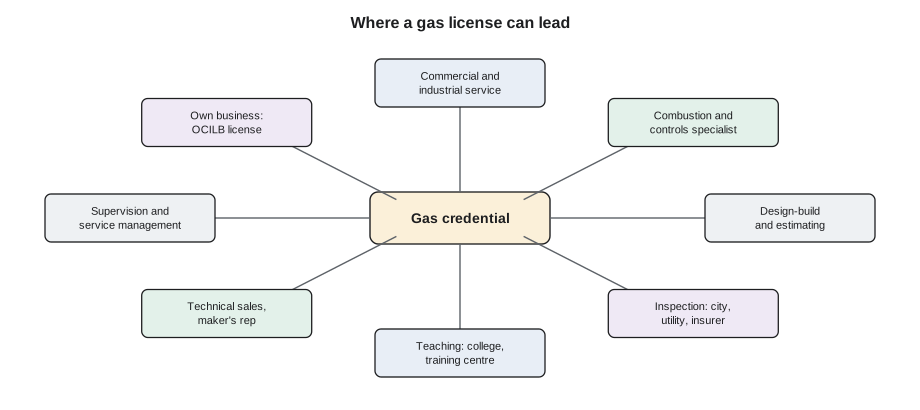
- Commercial and industrial service, the path Luis and Grant are on: boilers, process equipment, burner tuning, plant maintenance contracts.
- Combustion and controls specialist: burner management, linkageless controls, combustion tuning and emissions, often after factory training with a burner maker, as Maureen had.
- Design-build and estimating: sizing systems, preparing bids and managing installations.
- Inspection: city mechanical inspectors, utility field staff and insurance inspectors are usually experienced tradespeople, often with code certifications from the ICC.
- Teaching, at a college, a union training center or a manufacturer's training department.
- Technical sales for a manufacturer or a distributor, where field experience is what customers trust.
- Supervision and service management, running crews and dispatch.
- Running a business, which in Ohio needs an OCILB license, insurance and the city registrations where the work is done.
Moving to work somewhere else
Gas and contractor licenses are state or city credentials, and there is no national license to carry across state lines. Some states have reciprocity agreements that recognize each other's contractor licenses or exams, often for the trade exam only, with a local business and law exam still required; others require the full process. A gas fitter moving to a state that licenses individuals, such as Massachusetts, will usually need that state's own apprenticeship hours, theory hours and exams recognized or completed. Anyone planning a move should contact the licensing board in the new state before they go.
Keeping up
The codes change. The ICC publishes a new International Fuel Gas Code every three years and NFPA a new NFPA 54 every three years too, with the 2027 edition in revision; Ohio adopts editions on its own schedule, as it did with the 2021 IFGC in the 2024 Ohio Mechanical Code. Each new edition brings changes in materials, venting, testing and safety. A license holder is expected to work to the code in force, not the one they learned. Ways to keep up include OCILB-approved continuing education, makers' factory training, ICC and NFPA publications and seminars, voluntary certifications such as those offered by industry certification bodies for HVAC technicians, and the trade press. Bayline buys every technician the new code book when Ohio adopts an edition and runs an evening on the changes.
Keeping up is also about equipment. Condensing appliances, modulating boilers, communicating controls, linkageless burners and hydrogen-blend fuels have all arrived within one working life. The technicians who do best are the ones who stay curious about the next thing and treat every new model's installation instructions as worth reading in full.
Passing it on
Every journey-level gas worker was taught by someone, and most of them teach in turn. Supervising an apprentice is part of the credential's responsibility and one of the best parts of the work. Rosa's way of doing it, which Jonah saw all fall, is simple to describe: explain what you are about to do and why; let the apprentice do it while you watch; ask them to explain it back; check the work; and sign only for what you have seen. Maureen added her own rule for the certification nights: the person who asks the question at the back of the room is often learning more than the people at the front.
The business side
Hank finished with the part of the job nobody teaches in a gas course. A credential holder who becomes a supervisor or starts a business needs to understand pricing, insurance, warranties, contracts, permits and cash flow, and to know that a cheap job done badly costs more in callbacks and reputation than it ever earned. Ohio's business and law exam exists for exactly this reason, and OCILB requires a contractor to carry at least 500,000 dollars of liability insurance. "Nobody should start a business to get away from a boss," Hank said. "Start one because you want to be responsible for everything, including the parts that aren't gas."
The plans
By the end of the fall the plans were set. Luis would write the OCILB HVAC contractor exam and the business and law exam in February 2027, after Saturday mornings on refrigeration with Grant and a second practice paper in late January, with Maureen keeping him off on-call for the two weeks before. If he passed, he would become Bayline's second qualifying person for the license, so the company would not depend on Hank alone. Grant would spend the winter on the fuel gas and residential topics with Rosa and apply later in 2027. Ayesha and Jonah would carry on in their apprenticeships under Bayline's sign-offs. And Maureen pencilled in the next round of certification nights for the following October, with Luis, she hoped, at the front of the room teaching propane.
Jonah had sat at the back of every one of the four nights. On the last one, as the others packed up, he asked Rosa how long it had taken her to feel like she knew what she was doing. "About ten years," she said. "And then a new kind of furnace came out and I didn't again. That's the job. You'll like it."
Looking after the body that does the work
A gas career can run forty years, and the body that does the work has to last that long. The hazards are familiar from GAS-110 and every course since: carbon monoxide and flue gas, cramped crawlspaces and attics, roofs in all weathers, heavy appliances, noise in boiler rooms, and long hours in winter. The habits that protect a long career are simple and easy to skip: lift with help or with a dolly and stair climber, wear hearing protection in plant rooms, kneel on pads, wear a CO monitor every day, stay fed and hydrated on long calls, and take the on-call rest days the schedule gives. Hank's own knees were his warning to every apprentice he hired.
Mental load matters too. Service work means difficult customers, emergencies at night and decisions with safety riding on them. Talking through a hard call with a colleague afterwards, as Rosa and Jonah did after the Haddad family's night in GAS-230, is part of the job, and so is asking for help when a call is beyond you.
Union and open shop
Gas fitters in the United States work in both union and open shops. In union shops, such as those whose workers belong to the pipe trades locals of the United Association, the union and contractors' joint apprenticeship committees run registered apprenticeships and training centers, and the collective agreement sets wages and conditions. In open shops, such as Bayline, the company sets them and training comes through registered apprenticeship programs, colleges and makers. Licenses, where a state or city issues them, belong to the person, not the employer or the union.
What employers look for
Hank's list of what he looks for when he hires someone certified, in his order: honest records, because the paperwork tells him whether the work was done; safety habits he can see on the first ride-along; how they talk to a customer; whether they read the installation instructions; and only then how fast they work. "I can teach speed," he said. "I can't teach someone to write down the reading they actually got."
A development plan of your own
Maureen asked Luis and Grant to write one more plan before the end of the fall: not a study plan for the exam but a plan for the five years after it. It had three parts. First, what they wanted to be doing in five years, in one sentence: Luis wrote "running Bayline's commercial service with Maureen, and teaching the certification nights"; Grant wrote "combustion and controls on plant boilers". Second, what they would need to get there: the credential, factory training on two makes of burner management system, more hours on process equipment, and in Luis's case some training in supervising people. Third, who could help: Maureen, Hank, the makers' training departments and the college.
A plan like that is worth reviewing every year with whoever supervises you. The trade changes, and so do people's lives, and the plan should change with them. What matters is having one, so that the next course, the next certification night or the next job offer can be judged against something more than the paycheque.
Mentors and references
Every certification application, every job application and many license applications ask for references: people who have supervised the candidate's work and will vouch for it. Those references are built over years, one job at a time, by doing the work properly when the supervisor is watching and when they are not. Luis's G.1 hours carried Maureen's initials because she had seen every job; Jonah's first sign-offs carried Rosa's for the same reason. A good mentor is worth staying close to long after the certificate is on the wall: they know the trade's people, they hear about the jobs and courses worth taking, and they will tell you the truth about your work when nobody else will.
Common mistakes
MistakeThinking the credential changes the work.
InsteadIt changes the responsibility: your name goes on the work.
MistakeSigning for an apprentice's work you did not see.
InsteadSupervise, check and sign only for what you have seen.
MistakeWorking to the code you learned instead of the code in force.
InsteadKeep up with new editions, adoption documents and advisories.
MistakeLetting the credential lapse.
InsteadRenew on time and keep insurance and continuing education current where required.
MistakeAssuming a credential carries over to another province or state.
InsteadContact the regulator in the new jurisdiction before moving.
MistakeStarting a business without understanding its business side.
InsteadLearn pricing, insurance, contracts and permits before you need them.
Summary and key terms
- An OCILB license makes the holder a contractor's qualifying party, accountable to OCILB and to the cities that register contractors; some states license individual journeyman and master gas fitters.
- Responsibilities include working within scope, following codes and instructions, acting on unsafe conditions, supervising properly, keeping records and keeping the license current with insurance and continuing education.
- Paths include commercial and industrial service, combustion and controls, design and estimating, inspection, teaching, technical sales, management and running a business.
- Licenses are state or city credentials; reciprocity varies.
- The IFGC and NFPA 54 change every three years and Ohio adopts editions on its own schedule; keeping up is part of the job.
- Teaching apprentices follows a simple pattern: explain, watch, ask back, check, sign only what you saw.
- Qualifying party
- The individual whose license qualifies a contracting company to do licensed work and take out permits.
- Scope of a certificate
- The kinds and sizes of work a certificate or license allows its holder to do.
- Labor mobility
- Rules that let a worker certified in one jurisdiction have that certification recognized in another.
- Reciprocity
- An agreement between jurisdictions to recognize each other's licenses or exams.
- Continuing education
- Training a license holder must complete to renew or keep a credential current.
Practice problems
Work each problem on paper first, then reveal the answer to check.
What changes for a technician on the day they pass?
Show answer
Not the jobs, but the responsibility: their name goes on the work.
What makes an Ohio license holder a qualifying party?
Show answer
The company's permits and compliance rest on their license.
Name four career paths a gas credential opens.
Show answer
Any four of: commercial service, combustion specialist, design and estimating, inspection, teaching, technical sales, management, own business.
What should a technician do before moving to work in another jurisdiction?
Show answer
Contact the regulator there about recognition of their credential.
What is Rosa's pattern for teaching an apprentice?
Show answer
Explain, let them do it while watching, ask them to explain back, check, and sign only for what was seen.
Lesson quiz · 5 questions
Score 60% or more to complete this lesson.
Create a free account to save your progress, take quizzes and earn a certificate.