
GAS-350 · Lesson 3 of 12 · 23 min
Review: gas properties and combustion
▶ Video coming soon A video version of this lesson is on the way.
Rosa took the second Tuesday, October 27. She started without notes, walking along the front bench and firing questions at Luis and Grant. "Specific gravity of propane? Heating value of natural gas? How many volumes of air to burn one of methane? What's the flammable range of propane? What reading on your analyzer tells you the burner has too little air?" Luis got four out of five. Grant got three and argued about the fifth until Rosa showed him the number in his own GAS-110 notes. "These are the questions you answer in ten seconds on the exam," she said, "and every ten seconds you save there is time you can spend on a sizing problem. Tonight we go through the fuel and the fire, the stuff every other topic sits on."
This lesson reviews GAS-110, with the combustion analysis of GAS-230 and the combustion numbers used in GAS-310. It covers the properties of natural gas and propane, pressure and its units, the chemistry of combustion, the products of complete and incomplete combustion, carbon monoxide and its health effects, and the readings an analyzer gives. Every number here is the one the earlier courses used.
The fuels
Natural gas is mostly methane, with small amounts of ethane, propane, nitrogen and carbon dioxide; its exact composition varies with the source, which is why the utility reports its heating value. Propane is a liquefied petroleum gas, stored as a liquid under its own vapor pressure and used as a vapor. Both are colorless and odorless as produced. An odorant, a sulfur compound such as a mercaptan, is added so that a leak can be smelled well below the lower flammable limit. Odorant can fade, a problem called odor fade, when it is absorbed by new steel pipe, rust or soil or oxidized in a propane tank. A technician never relies on smell alone: a detector and a leak test decide.
| Property | Natural gas | Propane | What it means |
|---|---|---|---|
| Specific gravity (air = 1) | About 0.60 | About 1.52 | Natural gas rises; propane sinks and pools in low places |
| Higher heating value | About 1,000 Btu/ft³ | About 2,500 Btu/ft³ | Propane carries about two and a half times the energy per volume |
| Air to burn one volume | 9.57 volumes | 23.9 volumes | Propane needs much more air per volume of gas |
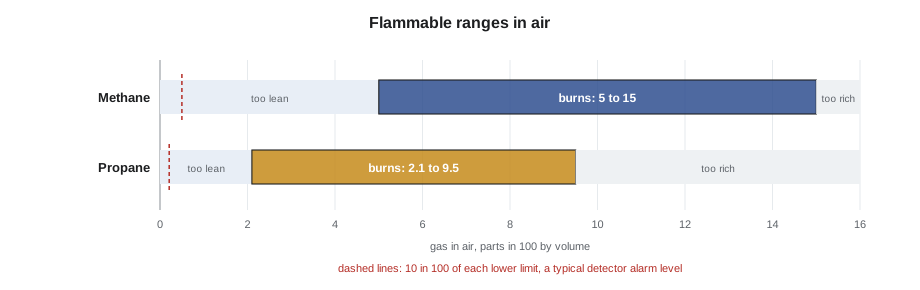
| Flammable range in air | 5 to 15 in 100 | 2.1 to 9.5 in 100 | Propane becomes flammable at a lower concentration |
| Ignition temperature | About 1,000 to 1,170 °F | About 840 to 930 °F | Ordinary sparks and flames ignite either |
| Maximum CO₂ in dry flue gas | 11.7 in 100 | 13.7 in 100 | The reading at perfect combustion with no excess air |
| Liquid to vapor | Not stored as a liquid in this work | About 270 volumes of vapor per volume of liquid | A small liquid leak makes a large vapor cloud |
A few relationships tie the table together. A gas with a higher specific gravity flows more slowly through the same orifice at the same pressure, which is one reason propane orifices are smaller and its appliance pressure is higher, about 10 to 11 in. w.c. against 3.5 in. w.c. at the manifold of a typical appliance. A gas with a higher heating value needs less volume for the same input. The Wobbe index, the heating value divided by the square root of the specific gravity, combines the two and is the number that tells whether two gases will give the same heat through the same orifice. GAS-210 used it to explain why a conversion needs a new orifice and a new regulator setting, never just one of them.
Pressure and its units
Gas pressure at appliance level is measured in inches of water column (in. w.c.), and at higher pressures in pounds per square inch gauge (psig). The conversions you need: 1 psi is about 27.7 in. w.c.; 1 in. w.c. is about 0.036 psi; 1 kPa is about 4.0 in. w.c., useful for imported appliances. Gauge pressure is measured above the atmosphere; absolute pressure adds the atmosphere, about 14.7 psia at sea level. A typical natural gas house supply is about 7 in. w.c.; a typical appliance manifold is 3.5 in. w.c. at high fire on natural gas.
A U-tube manometer reads pressure as the difference in height between its two columns; a digital manometer reads it directly and can log it. A manometer reads the pressure at the point where it is connected. That is why every reading in a service record says where it was taken, static or running, and on which appliance.
Worked problem
Converting pressures
A two-pound system delivers gas at 2 psig to a line regulator, which supplies an appliance at 7 in. w.c. Express the 2 psig in inches of water column, and the 7 in. w.c. in psi.
Show solution
- 2 psig in inches of water column:
- \[2 \times 27.7 = 55.4 \text{ in. w.c.}\]
- 7 in. w.c. in psi:
- \[\frac{7}{27.7} \approx 0.25 \text{ psi}\]
Answer: 2 psig is about 55 in. w.c.; 7 in. w.c. is about a quarter of a psi. Exam questions mix units on purpose. Convert everything to one unit before comparing.
Combustion chemistry
Complete combustion of methane needs two volumes of oxygen for each volume of gas and produces one volume of carbon dioxide and two volumes of water vapor. Air is about 20.9 parts in 100 oxygen by volume, so supplying two volumes of oxygen takes about 9.57 volumes of air. Propane needs five volumes of oxygen, about 23.9 volumes of air, and produces three volumes of carbon dioxide and four of water vapor:
The exact amount of air that burns the fuel completely with nothing left over is the theoretical air or stoichiometric air. Real burners need excess air, because the gas and air never mix perfectly. Too little excess air and some fuel does not find its oxygen: carbon monoxide rises sharply. Too much and the extra air carries heat up the flue: efficiency falls. GAS-230 and GAS-310 gave the typical ranges: atmospheric burners commonly run at about 6 to 9 parts in 100 oxygen in the flue gas, and power burners at about 3 to 4.5, but the appliance maker's figures govern.
Each part of the combustion has a job. Primary air is mixed with the gas before the burner port; secondary air reaches the flame around it; in an atmospheric appliance, dilution air enters at the draft hood and mixes with the flue gas. A flame with too little primary air is lazy and yellow and may soot; one with too much may lift off the ports or flash back. A blue flame with a well-defined inner cone is the usual sign of a natural gas burner set correctly, but a flame's appearance is never proof of clean combustion: the analyzer is.
Incomplete combustion and carbon monoxide
Incomplete combustion produces carbon monoxide (CO), a colorless, odorless, poisonous gas, together with soot and aldehydes that cause the sharp smell of a badly burning appliance. The usual causes are the ones GAS-110 listed and GAS-340 met on service calls: too little air from a blocked vent, a dirty burner or a room under negative pressure; a flame chilled by touching a cool surface; overfiring; and flue gas recirculated back into the combustion air. Any of them can turn a safe appliance into a dangerous one, which is why the analyzer is used at every start-up and service.
Carbon monoxide binds to the hemoglobin in blood far more strongly than oxygen does and starves the body of oxygen. Early symptoms are headache, dizziness, nausea and tiredness, which ease away from the source; higher exposure brings confusion, collapse and death. The exposure limits used in the program: OSHA's permissible exposure limit of 50 ppm averaged over eight hours, NIOSH's recommended limit of 35 ppm and its ceiling of 200 ppm; and the level NIOSH treats as immediately dangerous to life and health, 1,200 ppm. A carbon monoxide alarm is an occupant's last line of defense, not a replacement for a correct installation.
Reading the analyzer
A combustion analyzer samples the flue gas and reads oxygen, carbon monoxide and temperature directly; carbon dioxide, excess air and efficiency are calculated from those readings and the fuel chosen on the instrument. GAS-230 explained the routine: zero the instrument in fresh outdoor air, bump-test it against a known gas regularly, put the probe where the maker says, in the flue before any dilution air, and wait for the readings to settle at steady state.
Because the flue gas of an atmospheric appliance is diluted by air from the draft hood, a raw CO reading can be made to look small by dilution. Air-free CO corrects the reading to what it would be with no excess air, so that readings can be compared fairly:
Excess air can be estimated from the oxygen reading in the same way, as a fraction of the theoretical air:
Worked problem
Air-free CO and excess air
An atmospheric water heater reads 9.0 in 100 oxygen and 60 ppm carbon monoxide. A power burner reads 3.5 in 100 oxygen and 22 ppm. Find the air-free CO and the excess air for each.
Show solution
- Water heater, air-free CO:
- \[60 \times \frac{20.9}{20.9 - 9.0} = 60 \times \frac{20.9}{11.9} \approx 105 \text{ ppm}\]
- Water heater, excess air:
- \[\frac{9.0}{11.9} \approx 0.76, \text{ about 76 in 100}\]
- Power burner, air-free CO:
- \[22 \times \frac{20.9}{17.4} \approx 26 \text{ ppm}\]
- Power burner, excess air:
- \[\frac{3.5}{17.4} \approx 0.20, \text{ about 20 in 100}\]
Answer: The water heater's 105 ppm air-free is worth investigating; the power burner's 26 ppm is clean, with about 20 in 100 excess air, in the typical range for a power burner. Exam questions often give the measured CO and ask for the air-free figure, or ask which of two readings is worse: always compare air-free values.
The flue temperature and the CO₂ or O₂ reading together tell the analyzer the combustion efficiency: high stack temperature or high excess air both mean heat going up the flue. GAS-310 used the rule of thumb that a dry flue gas loss is about 0.38 times the temperature rise of the flue gas above the room, in degrees Celsius, divided by the CO₂ reading. Exam questions ask the direction more often than the number: cleaning a sooted heat exchanger lowers the stack temperature and raises the efficiency; cutting excess air raises the CO₂ and raises the efficiency, until CO begins to climb.
Questions this topic produces
Exam questions on this material tend to come in a few patterns, and seeing the pattern is half of the answer:
- Which way does it go? Propane sinks, natural gas rises, so where does the detector go? Low for propane, high for natural gas.
- Which is more dangerous? A room at 3 in 100 propane is in the flammable range; a room at 3 in 100 natural gas is below the lower limit but still a hazard because it can reach the range as more gas leaks in.
- What does the reading mean? High O₂ and low CO₂ mean too much excess air; low O₂ with rising CO means too little air.
- Air-free or measured? If two readings are compared, correct both to air-free first.
- What causes it? Yellow tipping, soot and rising CO on a burner that was clean last year point to a change in air supply, a dirty burner or a venting problem.
Flame problems in one table
Rosa ended her quick-fire round by asking for the cause of each flame fault she described. The answers come from GAS-110, GAS-220 and GAS-340, and an exam question about a flame usually expects one of them:
| What the flame does | Usual causes |
|---|---|
| Yellow tips, soot | Too little primary air: dirty burner, lint, misadjusted shutter, wrong orifice; on propane, a natural gas orifice |
| Lifts off the ports | Too much primary air or overfiring; draft too strong on some appliances |
| Flashes back, burns inside the burner | Too little gas pressure for the port size, or an orifice too small; damaged burner |
| Floats, rolls or wavers | Flue gas recirculated into the combustion air, blocked vent or heat exchanger, or a breach letting circulating air in |
| Changes when the blower starts | A heat exchanger breach; confirm with readings, not the eye alone |
Common mistakes
MistakeComparing measured CO readings from appliances with different oxygen readings.
InsteadCorrect each to air-free CO before comparing.
MistakeJudging combustion by the color of the flame.
InsteadUse an analyzer at steady state, with the probe where the maker says.
MistakeAssuming a gas above its upper flammable limit is safe.
InsteadAs air mixes in, part of the mixture falls into the flammable range.
MistakeMixing pressure units in a comparison.
InsteadConvert to one unit first: 1 psi is about 27.7 in. w.c. and 6.9 kPa; 1 kPa is about 4.0 in. w.c.
MistakeRelying on smell to find a leak.
InsteadOdorant can fade; use a detector and a leak test.
MistakeTreating a CO alarm as a substitute for a correct installation.
InsteadThe alarm is the last line of defense; venting, air supply and clean combustion come first.
Summary and key terms
- Natural gas, mostly methane, has a specific gravity of about 0.60 and a heating value of about 1,000 Btu/ft³; propane has about 1.52 and about 2,500 Btu/ft³.
- Methane burns between 5 and 15 in 100 in air, propane between 2.1 and 9.5.
- One volume of methane needs 9.57 volumes of air and one of propane 23.9.
- Maximum CO₂ is 11.7 in 100 for natural gas and 13.7 for propane. 1 psi is about 27.7 in. w.c. and 6.9 kPa; 1 kPa is about 4.0 in. w.c.
- Real burners need excess air; too little gives CO and too much wastes heat.
- Carbon monoxide comes from too little air, chilled flames, overfiring and recirculation.
- Air-free CO equals measured CO times 20.9 over (20.9 minus O₂), and excess air is about O₂ over (20.9 minus O₂).
- Compare air-free values, and use the analyzer, not the flame's color.
- Wobbe index
- Heating value divided by the square root of specific gravity; gases with the same Wobbe index give the same heat through the same orifice.
- Theoretical air
- The exact volume of air needed to burn a fuel completely with no oxygen left over.
- Excess air
- Air supplied beyond the theoretical amount, needed because gas and air never mix perfectly.
- Air-free CO
- A carbon monoxide reading corrected to what it would be in flue gas with no excess air.
- Odor fade
- Loss of the odorant in gas by absorption or oxidation, so that a leak may not be smelled.
- Dilution air
- Room air that enters an atmospheric appliance's draft hood and mixes with the flue gas.
Practice problems
Work each problem on paper first, then reveal the answer to check.
Where should a propane detector be mounted, and why?
Show answer
Low, because propane is heavier than air and pools near the floor.
How many volumes of air does one volume of methane need to burn completely?
Show answer
About 9.57.
An appliance reads 6.0 in 100 O₂ and 45 ppm CO. What is the air-free CO?
Show answer
45 × 20.9 ÷ 14.9 ≈ 63 ppm.
What does a high O₂ and low CO₂ reading mean?
Show answer
Too much excess air, so heat is being wasted up the flue.
What is 1.5 psi in inches of water column?
Show answer
About 41.6 in. w.c.
Lesson quiz · 5 questions
Score 60% or more to complete this lesson.
Create a free account to save your progress, take quizzes and earn a certificate.