
GAS-350 · Lesson 2 of 12 · 23 min
A study plan that works
▶ Video coming soon A video version of this lesson is on the way.
At the end of the first Tuesday, Maureen gave Luis and Grant a sheet with three columns: topic, how sure you are, how many questions you expect. "Fill it in tonight," she said, "honestly. Then bring it back next week and we'll build your plan from it." Luis filled it in at his kitchen table and was surprised. He had marked himself very sure on residential appliances, propane and venting, which he worked on every week, and unsure on large-boiler controls, flame safeguards, elevated-pressure piping and the refrigeration and air distribution parts of the HVAC exam, which he met only on Maureen's jobs. "That's normal," Maureen said the next Tuesday. "People study what they already know, because it feels good. The plan's job is to stop you doing that."
This lesson sets out a way to plan the weeks before a certification exam: start from what the exam covers, find out what you do not know, spread the work over time, practice under exam conditions, and prepare the code book. It ends with the habits that help on the day and the support that makes the difference for many candidates.
Start from what the exam covers
Start from the content outline in the PSI bulletin, because the exam is built from it. Luis copied the outline's topic areas down the left side of a page, with the number of questions the bulletin gives for each, and against each wrote where he had met it: the fuel gas topics in GAS-120 to GAS-340 and PLB-230, the mechanical code topics partly in GAS-320 and partly nowhere, and the refrigeration topics nowhere in this program. A third of his page had no course beside it. That third became the biggest part of his plan, and Grant, who had serviced rooftop units for eleven years, agreed to teach him the refrigeration cycle on two Saturdays.
Next, rate each topic honestly. A simple scale works: 3 if you could teach it, 2 if you could answer most questions on it, 1 if you would be guessing. Then multiply each rating's gap, 3 minus the rating, by the topic's share of the exam. The result tells you where study time buys the most marks. A topic with many questions and a low rating comes first; a topic you could teach comes last, however much you enjoy it.
Worked problem
Where does study time buy the most marks?
Suppose a candidate's sheet shows four topic areas. Venting and air supply is expected to be 15 of 100 questions and rated 3. Commercial burners and controls is 20 questions and rated 1. Piping, regulators and meters is 20 questions and rated 2. Codes and regulations is 25 questions and rated 2. Rank the topics by priority.
Show solution
- Priority is the gap times the number of questions:
- Venting: (3 − 3) × 15 = 0.
- Burners and controls: (3 − 1) × 20 = 40.
- Piping, regulators and meters: (3 − 2) × 20 = 20.
- Codes and regulations: (3 − 2) × 25 = 25.
Answer: Burners and controls first (40), then codes (25), then piping (20). Venting, the topic the candidate likes best, needs only a quick review near the end. The arithmetic is rough, but it turns a feeling into a plan.
Spread it out
Ten hours of study spread over ten days teaches more than ten hours in one weekend. Memory researchers call it the spacing effect: information that is reviewed several times with gaps in between is kept far longer than information crammed in one session. The practical rule is to study a little most days, return to each topic several times, and leave the last week for practice tests and review rather than new material.
A realistic plan counts the hours that are actually available. Luis works full days, often with an on-call week in the rotation, and has two young children. He decided on about six hours a week: an hour on four weekday evenings and two hours on Saturday mornings, with the Tuesday certification nights counted as study. Over twelve weeks that is about 72 hours, which is enough for a candidate who has already finished the training and works in the trade every day. A candidate starting with weaker foundations needs more, or more weeks.
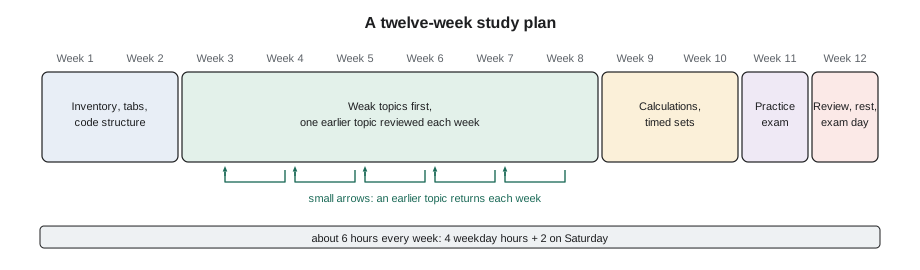
| Weeks | What happens | How Luis did it |
|---|---|---|
| 1 to 2 | Inventory, rate topics, set up the code book | Rated the outline topics, tabbed the IFGC and Ohio Mechanical Code, read each book's contents pages |
| 3 to 8 | Weakest topics first; one earlier topic reviewed each week | Refrigeration with Grant, mechanical code ventilation and ducts, then fuel gas sizing and venting |
| 9 to 10 | Calculations and timed question sets | Lesson 10 problems, 25-question sets in 45 minutes |
| 11 | Full practice exam, marked, error log | Maureen's practice exam on a Saturday morning |
| 12 | Review the error log, rest | Light review, early nights, exam day |
Active study beats rereading
Rereading notes feels productive and is not. The methods that work all make the brain retrieve the information instead of just recognizing it:
- Practice questions. Answer questions, check them and work out why each wrong answer was wrong. This course's quizzes and the practice set in lesson 11 are a start; writing your own questions, as Maureen made her group do, is even better.
- Explaining aloud. Explain a topic to someone else, or to the dashboard of the truck, without notes. Where you stumble is where you do not know it.
- Flash cards for numbers and definitions that must be recalled quickly: specific gravities, heating values, flammable limits, the theoretical air volumes, the certificate scopes, typical pressures.
- Drawing from memory. Sketch a gas train, a ladder diagram or a two-stage propane system from memory, then compare it with the figure.
- Mixing topics. A set of questions that jumps between venting, controls and propane is harder than a set on one topic, and that is the point: the exam mixes them.
The code book is a tool, so learn to use it
On an open-book exam, the book is the most important tool in the room. Luis spent his first two weeks learning the structure of each book: how the IFGC is divided into chapters for general regulations, gas piping, chimneys and vents, specific appliances and gaseous hydrogen systems, where its definitions and sizing tables are, and how the Ohio Mechanical Code mirrors the International Mechanical Code with Ohio changes. He put permanent tabs on the chapter starts, the definitions, the index, the combustion air sections, the pipe sizing tables and the vent sizing tables. He also practiced answering questions from memory first and looking up only to confirm, because looking everything up is too slow.
A good way to practice lookups is a ten-minute drill. Take ten questions that need a number from the code, set a timer, and find each one. Record how long each took. Questions that took more than a minute show where another tab, or more familiarity, is needed. By the end of his drills Luis could find most answers in under 40 seconds.
Reading a multiple-choice question
Most marks lost on multiple-choice exams are not lost through ignorance. They are lost by misreading. A routine helps:
- Read the last sentence first. It is the actual question. Then read the whole stem with the question in mind.
- Underline the qualifiers: not, except, first, most likely, minimum, maximum, always, never. "Which is NOT a cause" reverses the question.
- Answer before looking at the options, if you can. Then find your answer among them. This protects you from a distractor that looks right.
- Eliminate. If you are unsure, cross out the options you know are wrong. Two left gives a fifty-fifty chance; one left is the answer.
- Check the units. A question in kilopascals with an answer in inches of water column, or in Btu per hour with an answer in cubic feet per hour, is a common trap.
- Mark and move. If a question is taking too long, choose the best answer you have, mark it and come back at the end. Never leave a blank.
Be careful with answers that use absolute words such as always, never, only and all. In a trade governed by exceptions they are often wrong, but not always: "always shut off the gas before replacing a gas valve" is correct. Judge each option on its content, not on its wording.
Practice under real conditions
At least once, and preferably twice, before the exam, write a full-length practice exam under the same conditions: the same number of questions, the same time, the same books, no phone, in one sitting. A full-length test shows things that short sets do not: whether your pace holds for three or four hours, when your concentration fades, whether you need to eat or stretch at the halfway point, and whether your book is set up the way you need it. Maureen scheduled hers for Saturday, November 14, four days after the last certification night, so that Luis and Grant would have their results in time to build the last weeks of their plans around them. Lesson 11 describes what happened.
Looking after the candidate
Sleep, food and stress affect exam scores as much as an extra week of study. The week before the exam is the wrong time to change your sleep pattern or stay up late cramming. Plan the route to the exam center and do it once in advance if it is unfamiliar. Eat before you go, and take water if it is allowed. If anxiety is a problem, practice tests help, because the exam room becomes familiar; slow breathing for a minute at the start helps too. A candidate with a learning disability or another condition that affects exams can ask OCILB and PSI for an accommodation such as extra time, and must ask well before booking, with the documentation they require.
Family and work matter as well. Luis told his manager and his family what the next twelve weeks would look like, and Maureen kept him off the on-call rotation for the two weeks before his exam date. A study plan that depends on nobody needing you is a plan that will fail.
Studying with other people
Maureen's certification nights were a study group with a teacher. A study group of two or three candidates works well if it has a plan: each person prepares one topic each week and teaches it to the others, and the group finishes by answering questions the others wrote. Explaining a topic is the best test of understanding, and writing questions forces you to think about what could be asked and what the wrong answers would be. Groups work badly when they become social evenings, or when one person does all the work. Jonah and Ayesha, who sat in at the back, found that the questions Luis and Grant asked taught them more than the answers did.
Getting the most from each practice question
A practice question is worth far more than the mark it carries, if you use it properly. After answering a set, go back to every question, not just the ones you got wrong, and ask three things. Why is the right answer right, in one sentence? Why is each wrong option wrong, and what mistake would lead someone to choose it? Could the question have been asked another way? A question answered correctly by a lucky guess counts as wrong for study purposes.
Worked problem
Reviewing one practice question
A practice question asks: "A furnace locks out after three tries. The flame lights each time and goes out after about six seconds. What is the most likely cause?" The options are a cracked heat exchanger, a dirty flame rod, a stuck-open pressure switch and a failed blower capacitor. Luis chose the flame rod and was right. How should he review it?
Show solution
- Why it is right: the flame lights, so gas and ignition work; the valve closes at the end of the trial, so the flame is not being proven; a dirty rod gives a weak signal.
- Why the others are wrong: a cracked heat exchanger usually shows when the blower starts, after the flame is proven; a stuck pressure switch stops the sequence before ignition; the blower is not involved until after the blower-on delay.
- Another way to ask it: "Which reading would confirm the cause?" A flame signal below the board's minimum.
Answer: Three minutes spent on one question he got right taught him the sequence of operation better than ten more questions would have. Maureen asked the group to review every practice set this way.
Common mistakes
MistakeStudying the topics you enjoy most.
InsteadRate each topic and spend time where the gap times the number of questions is largest.
MistakeCramming in the last week.
InsteadSpread study over weeks and return to each topic several times.
MistakeRereading notes and calling it study.
InsteadRetrieve: answer questions, explain aloud, draw from memory.
MistakeLooking up every answer on an open-book exam.
InsteadKnow most answers; use the book to confirm, and practice lookups against a timer.
MistakeMissing a NOT or an EXCEPT in the stem.
InsteadRead the question first and underline the qualifiers.
MistakeNever writing a full-length practice exam.
InsteadWrite at least one under real conditions, in one sitting.
Summary and key terms
- A study plan starts from what the exam covers: the curriculum modules or the bulletin's content outline.
- Rate each topic honestly and give most time to topics with many questions and low ratings.
- Spread study over weeks, about six hours a week for twelve weeks for a working candidate who has finished the training, and return to earlier topics each week.
- Study actively with practice questions, explaining aloud, flash cards, drawing from memory and mixed question sets.
- Learn the code book's structure, tab it as the rules allow and practice lookups against a timer.
- Read the question first, underline qualifiers, answer before looking at the options, eliminate, check units, and mark and move.
- Write at least one full-length practice exam under real conditions.
- Sleep, food, family and accommodation requests are part of the plan.
- Spacing effect
- The finding that study spread over several sessions with gaps is remembered better than the same study in one session.
- Active recall
- Studying by retrieving information from memory, for example by answering questions, instead of rereading.
- Qualifier
- A word in a question, such as not, except, first or minimum, that changes what is being asked.
- Lookup drill
- Timed practice at finding answers in a code book.
- Accommodation
- A change to exam conditions, such as extra time, granted to a candidate with a documented need.
Practice problems
Work each problem on paper first, then reveal the answer to check.
Why does a topic you rate 3 come last in the plan?
Show answer
Its gap is zero, so study time there buys the fewest marks.
What is the spacing effect?
Show answer
Information reviewed several times with gaps is remembered better than information crammed in one session.
What should you do first when reading a multiple-choice question?
Show answer
Read the last sentence, the actual question, then the stem with the question in mind.
Why write a full-length practice exam?
Show answer
To test pace, concentration and book set-up over the whole sitting.
Name three active study methods.
Show answer
Practice questions, explaining aloud, flash cards, drawing from memory or mixed sets.
Lesson quiz · 5 questions
Score 60% or more to complete this lesson.
Create a free account to save your progress, take quizzes and earn a certificate.