
GAS-320 · Lesson 8 of 12 · 23 min
Commercial cooking appliances
▶ Video coming soon A video version of this lesson is on the way.
On Friday, October 16, Grant and Ayesha took a service call at Bella Notte, a busy pizzeria and pasta restaurant on Sawmill Road on the northwest side of Columbus. The owner, Sal Ferraro, had a list. One of the two fryers kept losing its pilot during the dinner rush, and the cooks were relighting it with a long lighter. The new conveyor pizza oven, delivered and connected by an equipment dealer three weeks earlier, baked well at lunch but turned out pale, underdone pizzas on busy evenings. And the charbroiler, which had been pulled out for cleaning the night before, "smelled a bit like gas" when it was pushed back. "Three appliances," Grant said. "We start with the one that smells like gas. Then the one the cooks are lighting by hand. The oven can wait twenty minutes."
This lesson describes the gas appliances in commercial kitchens: ranges, fryers, griddles, broilers, ovens and kettles. It covers their ratings and controls, how they are connected with movable connectors and restraints, how to check their gas supply and pressures, and the faults that most often bring a technician to a kitchen. Lesson 5 covered the hood and makeup air above them; lesson 12 follows a complete restaurant installation.
The appliances on a cooking line
A commercial cooking line is a row of heavy appliances under one hood, often pushed tightly together and moved out every night for cleaning. Each is built for long hours at high input, and each is certified for commercial food service use, to ANSI Z83.11/CSA 1.8 for most gas food service equipment. The common ones, with typical inputs, are:
- Ranges, with open burners of about 30,000 Btu/h each and an oven below of 30,000 to 40,000 Btu/h.
- Fryers, with a deep pot of oil heated by burners in tubes through the pot or below it, 90,000 to 120,000 Btu/h, with a thermostat, a high limit and a flue riser at the back.
- Griddles, flat steel plates heated from below, about 30,000 Btu/h per 12 in. of width.
- Charbroilers, with burners under radiants and a grate, 15,000 to 20,000 Btu/h per burner, and salamanders and upright broilers that cook from above.
- Ovens: convection ovens with fans, deck ovens with stone or steel decks, conveyor ovens that carry food through on a moving belt, and combination steam-convection ovens, from 50,000 to 170,000 Btu/h.
- Kettles, tilting skillets and pasta cookers, and specialty appliances such as woks, which may have burners of 100,000 Btu/h or more each.
Some appliances, such as open range burners and charbroilers, have no flame safeguard on their burners, because a cook lights and watches them. Ovens, fryers, griddles with thermostats and other appliances whose burners are out of sight have flame safeguards, usually a thermocouple or thermopile pilot with a 100 in 100 shutoff valve on older appliances or electronic ignition on newer ones, and often a high limit as well, which on a fryer shuts off the gas before the oil reaches a dangerous temperature. Appliances under a hood usually discharge their flue gases into the hood rather than into a vent, and their flue outlets must never be covered by pans, foil or the hood's filters.
Connectors, quick disconnects and restraints
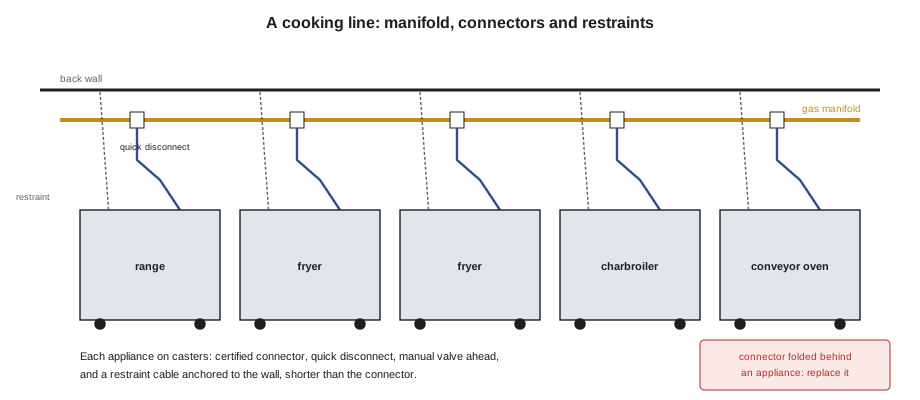
Because cooking appliances are moved for cleaning, most are connected with a movable appliance connector: a flexible, coated stainless steel connector made and certified for commercial cooking appliances, usually with a quick-disconnect fitting at the gas outlet that shuts off automatically when it is uncoupled. The connector is a certified assembly with a rated capacity for its size and length, and it must be used only as its certification and the codes allow. It must not be kinked, twisted, run through a wall, floor or appliance body, or stretched; it must be the right length for the appliance to be pulled out without straining it; and it must be protected from heat and grease. A manual shutoff valve must be ahead of it.
Any appliance on casters or wheels must also have a restraint, a short steel cable or chain anchored to the wall or floor and to the appliance, shorter than the connector. The restraint stops the appliance from being pulled out farther than the connector can reach, so that the connector, not a cook's back, takes no strain. The restraint is often the first thing removed by a cleaning crew and the last thing anyone remembers to put back.
The charbroiler: a gas smell
Grant and Ayesha pulled the charbroiler out, with its gas shut off at the manual valve and its quick disconnect uncoupled. Its connector had been folded tight behind the appliance when it was pushed back against the wall, and the coating had split at the fold, where the stainless corrugations had begun to crack. A leak test with solution on the connector, with the gas turned on and the appliance's controls off, produced a steady stream of bubbles at the fold. There was no restraint cable; Sal thought the cleaning company had unclipped it months ago. Grant replaced the connector with a new certified one of the same diameter and the correct length, installed a restraint cable anchored to the wall stud, sized so that the appliance could come out far enough to clean behind but not so far as to stretch the connector, and leak tested the new connection and the quick disconnect. Then he showed the closing cook how to unclip and reclip the restraint, and wrote on the report that the cleaning crew needed the same lesson.
The fryer: losing its pilot
The fryer that lost its pilot was a standing-pilot fryer with a thermopile and a millivolt gas valve, the arrangement GAS-220 described. With the fryer cool and its gas off, Ayesha removed the pilot assembly. The pilot orifice was partly blocked with a varnish of cooked oil, and the pilot flame, when relit, was small, yellow-tipped and barely touching the thermopile. She cleaned the orifice with the method the valve maker allows, never by reaming it larger, and the flame came back blue and full around the thermopile. But Grant noticed something else: when the hood exhaust was running at full speed, the pilot flame leaned away from the thermopile toward the hood, and every time the back door opened the flame flickered. A strong, unsteady draft at the pilot can cool the thermopile enough to drop the valve out. With the makeup air unit's supply diffuser aimed straight across the top of the fryers, the air at the pilots was more turbulent than the fryer maker allowed. Grant adjusted the diffuser's vanes away from the cooking line, and the pilot stayed steady through the rest of the afternoon. He also noted that the fryer's high limit had not been tested in years, and tested it by the maker's procedure; it shut off the gas at the oil temperature the maker specified.
Checking gas pressures on a cooking line
A commercial cooking appliance has its own appliance regulator, which reduces the supply pressure to the manifold pressure given on the rating plate, often about 4 to 5 in. w.c. for natural gas, depending on the appliance. To work properly the regulator needs an inlet pressure somewhat above its outlet setting, within the range on the plate. On a busy line, every appliance is drawing gas at once, so the true test of a kitchen's gas supply is the inlet pressure at the farthest appliance with every appliance on the line at full input. A pressure that is fine at lunch, with half the line on, may not be fine at dinner.
The supply to an appliance can fall short for three reasons: the building's supply pressure or meter cannot carry the whole kitchen's load, the kitchen manifold pipe is too small for the appliances added to it over the years, or the appliance's own connector or valve is too small for its input. The last is common when an appliance is replaced with a larger one and the old connector is reused.
| Connector inside diameter | Sample capacity for a 48 in. connector at the allowed pressure drop |
|---|---|
| 1/2 in. | 90,000 Btu/h |
| 3/4 in. | 200,000 Btu/h |
| 1 in. | 350,000 Btu/h |
| 1-1/4 in. | 600,000 Btu/h |
Worked problem
Is the oven connector big enough?
The new conveyor pizza oven has an input of 170,000 Btu/h. The dealer connected it with the 1/2 in. by 48 in. connector left from the old oven. Using the SAMPLE table, check the connector, and choose a suitable size.
Show solution
- Capacity of the existing connector:
- 90,000 Btu/h
- Ratio of load to capacity:
- \[\frac{170{,}000}{90{,}000} = 1.9\]
- Smallest SAMPLE size with capacity of at least 170,000 Btu/h:
- 3/4 in. (200,000 Btu/h)
Answer: The old connector was being asked to carry almost twice its capacity. At part fire, at lunch, the oven drew less and the connector coped; at full fire in the evening, the pressure drop across it was far more than allowed, the oven's inlet pressure fell below its regulator's minimum, and the oven underfired. A connector of the next size up, from the connector maker's table, is the fix.
Ayesha confirmed it with a manometer. With only the oven running, its inlet pressure was 6.8 in. w.c., within its plate range. With the whole line firing at dinner-rush settings, the pressure at the kitchen manifold held at 6.4 in. w.c., but at the oven's inlet, past the small connector, it fell to 3.6 in. w.c., below the oven's manifold setting. The manifold pipe was fine; the connector was not. Grant installed a 3/4 in. certified connector and quick disconnect, with a restraint, and with the line firing again the oven's inlet held at 6.0 in. w.c. and its manifold pressure at the plate value. The evening's pizzas came out of the oven golden.
Worked problem
The kitchen's total load
Bella Notte's line has a six-burner range with oven at 215,000 Btu/h, two fryers at 120,000 Btu/h each, a charbroiler at 120,000 Btu/h and the conveyor oven at 170,000 Btu/h. Find the line's total input and the gas flow at full input, using 1,000 Btu per cubic foot.
Show solution
- Total input:
- \[215{,}000 + 2 \times 120{,}000 + 120{,}000 + 170{,}000 = 745{,}000 \text{ Btu/h}\]
- Gas flow:
- \[\frac{745{,}000}{1{,}000} = 745 \text{ ft}^3/\text{h}\]
Answer: The line alone is 745,000 Btu/h, about 745 cubic feet of gas an hour, before counting the water heater, the makeup air unit and the dining room's rooftop unit. When the dealer swapped a smaller oven for this one, nobody rechecked the kitchen's supply. This time the manifold had enough capacity; at another restaurant it might not.
Certified equipment, conversions and imported appliances
Every gas appliance connected in a commercial kitchen must be certified for the country it is installed in and for the gas it burns. An appliance converted from natural gas to propane, or the reverse, must be converted with the maker's kit, its orifices and regulator changed, and a conversion label attached, as GAS-210 described for residential appliances. Kitchens are where uncertified appliances most often turn up: an imported wok range, a used oven bought at auction from another country, a tandoor built for a different gas. GAS-120 told how Luis refused to connect Marigold Kitchen's imported wok range until it had a field evaluation. The rule does not change because a restaurant is opening on Friday.
A cooking line service checklist
When Bayline services a cooking line, its technicians work through the same list for each appliance, and the list is a good summary of this lesson:
- Leak test the connector, the quick disconnect and the appliance's gas train, with the appliance pulled out and its restraint in place.
- Check that the connector is certified, the right size for the input, not kinked and not stretched, and that the restraint is shorter than the connector.
- Light each burner and pilot and check the flames; clean pilots and burner ports of grease.
- Check the inlet pressure with the whole line firing, and the manifold pressure against the plate.
- Test flame safeguards and, on fryers, the high limit, by the maker's procedure.
- Check that flue outlets are clear and that the hood's interlocks and the fire suppression gas valve work, as lesson 5 described.
At Bella Notte, Grant and Ayesha finished the list on every appliance before leaving, and found one more small thing: the range's oven pilot was lit but its thermocouple was loose in its bracket. Ayesha tightened it. "Ten seconds of work," Grant said. "And it's the kind of thing that turns into a call at nine on a Saturday night."
Common mistakes
MistakeReusing an old connector when an appliance is replaced with a larger one.
InsteadCheck the connector's rated capacity against the new input.
MistakeLeaving an appliance on casters without its restraint.
InsteadReinstall the restraint so it is shorter than the connector.
MistakePushing an appliance back so the connector folds behind it.
InsteadRoute the connector so it can move freely without kinking.
MistakeChecking a kitchen's gas pressure with only one appliance on.
InsteadCheck at the farthest appliance with the whole line firing.
MistakeReaming a clogged pilot orifice larger.
InsteadClean it by the maker's method or replace it.
Summary and key terms
- Commercial cooking lines combine ranges, fryers, griddles, broilers, ovens and kettles of high input, certified to ANSI Z83.11/CSA 1.8, under a hood.
- Burners out of sight have flame safeguards, and fryers have high limits; flue outlets must stay clear.
- Appliances that move are connected with certified movable connectors and quick disconnects, with a manual valve ahead, and restrained by a cable shorter than the connector.
- Each appliance's regulator needs enough inlet pressure, checked at the farthest appliance with the whole line firing, and each connector must be rated for its appliance's input.
- Converted appliances need the maker's kit and label, and uncertified appliances need a field evaluation before connection.
- Cooking line
- A row of commercial cooking appliances under one hood.
- Movable appliance connector
- A flexible connector certified for connecting commercial appliances that are moved.
- Quick disconnect
- A fitting that lets a connector be uncoupled and shuts off the gas automatically when it is.
- Restraint
- A cable or chain that limits how far an appliance on casters can move.
- Appliance regulator
- A regulator on an appliance that sets its manifold pressure.
- Manifold pressure
- The gas pressure at an appliance's burner manifold, given on its rating plate.
- Conveyor oven
- An oven that carries food through its heated chamber on a moving belt.
Practice problems
Work each problem on paper first, then reveal the answer to check.
Why must a restraint be shorter than the connector?
Show answer
So the appliance's movement is stopped by the restraint before the connector is strained.
Why did Bella Notte's fryer lose its pilot?
Show answer
A partly blocked pilot orifice and turbulent air from a makeup air diffuser aimed across the fryers.
Why did the conveyor oven underfire only at busy times?
Show answer
Its connector was too small for its input, so at full fire the pressure drop across it starved the oven.
Using the SAMPLE table, what is the smallest connector for a 300,000 Btu/h appliance?
Show answer
1 in. (350,000 Btu/h).
What must be done before connecting an imported appliance not certified for the country?
Show answer
It must have a field evaluation.
Lesson quiz · 5 questions
Score 60% or more to complete this lesson.
Create a free account to save your progress, take quizzes and earn a certificate.