
GAS-320 · Lesson 7 of 12 · 26 min
Commercial water heaters and booster heaters
▶ Video coming soon A video version of this lesson is on the way.
On Wednesday, October 14, Maureen and Ayesha went to the Lakeshore Inn, a 120-room hotel with a restaurant on Polaris Parkway on the north side of Columbus. The general manager had two problems, and she had them in writing. Guests on the early shift of business travelers had complained for a week that the showers ran lukewarm between seven and eight in the morning. And the public health inspector, on a routine visit to the restaurant, had measured the dish machine's final rinse at 174 °F and written an order to bring it up to the required temperature within a week. "One problem is comfort and the other is food safety," Maureen told Ayesha in the parking lot. "Both of them are about hot water, and they share a plant room. We'll start there."
This lesson describes the water heating equipment in commercial buildings: commercial storage water heaters, tankless and modular systems, hot water supply boilers and indirect heaters, and the booster heaters that raise water to sanitizing temperature for dishwashers. It explains how water heaters are rated and sized, the temperatures that matter for health and for scald safety, the relief valves and other safety devices, and how to work out whether a plant can meet a building's peak demand.
Commercial water heating equipment
A residential water heater serves one household with a modest input and a small tank. Commercial buildings, hotels, restaurants, schools, hospitals, laundries and apartment blocks, need far more hot water, often all at once, and they use several kinds of equipment.
- Commercial storage water heaters look like large residential tanks but have inputs above about 75,000 Btu/h, often 199,900 Btu/h or more, with tanks of 80 to 100 gallons or larger. They are certified to ANSI Z21.10.3/CSA 4.3, and may be atmospheric, power-vented or condensing.
- Tankless and modular systems use several high-input tankless heaters piped in parallel, staged by a controller, often with a small buffer tank.
- Hot water supply boilers heat water for washing and drinking, usually circulating it through one or more separate storage tanks. Larger ones fall under the boiler rules as well as the gas code.
- Indirect water heaters use boiler water through a coil to heat a storage tank, so the space heating boilers also make the hot water.
- Booster heaters raise water that is already hot to the much higher temperature a dishwasher needs for sanitizing. They may be gas or electric, and they sit beside or under the dish machine.
Whatever the type, the gas technician is responsible for the gas supply, combustion, venting and the appliance's controls, and usually shares the water side with a plumber. Both need to understand how the whole hot water system works.
Temperatures that matter
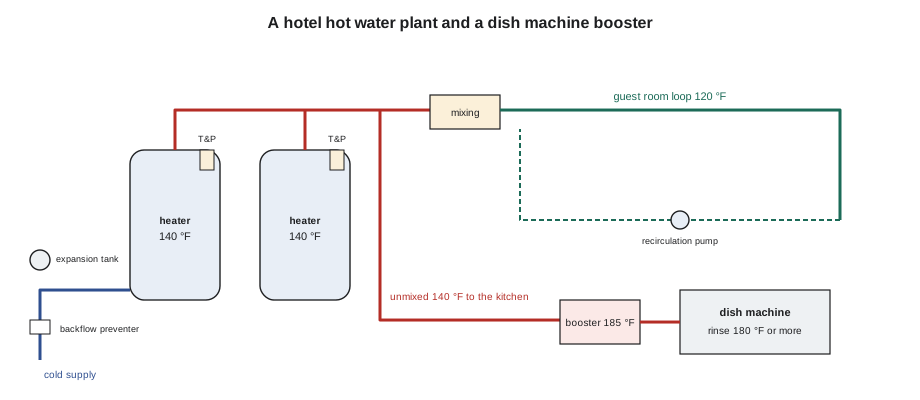
Hot water in a commercial building has to satisfy two opposite requirements. To control Legionella bacteria, which grow in warm water and can cause a serious pneumonia when inhaled in shower spray, water is stored hot, commonly at 140 °F or above, and kept circulating so that it does not sit lukewarm in long pipes. But water at that temperature scalds skin in seconds, so the water delivered to showers and basins is lowered to a safe temperature, often about 120 °F or less where the plumbing code requires, by a thermostatic mixing valve certified to ASSE 1017 that blends hot and cold water. In a hotel the arrangement is usually: heaters storing at 140 °F, a master mixing valve, a distribution loop at about 120 °F, and a recirculation pump returning water from the far end of the loop to the mixing valve and heaters so that hot water is always at the fixtures.
Dishwashing needs hotter water still. A high-temperature dish machine sanitizes with its final rinse, which must reach 180 °F at the rinse manifold, the temperature that the food premises rules and the machine standard, NSF/ANSI 3, set for hot-water sanitizing. Ohio's food code, like the FDA Food Code it follows, requires at least 180 °F at the manifold and no more than 194 °F. No building's general hot water is stored that hot, so a booster heater raises the water just before it reaches the machine.
Relief valves and other safety devices
Every storage water heater and storage tank needs a temperature and pressure relief valve, a T&P valve, with its temperature probe in the top of the tank, where the water is hottest. It opens if the water temperature reaches about 210 °F, before the water could flash to steam if the pressure suddenly dropped, or if the pressure reaches the valve's setting, which must not exceed the tank's rated working pressure. Its capacity must be at least the heater's input. Its discharge pipe must be full size, must not be reduced or valved, and must end where the discharge is visible and safe. Where the water supply has a check valve or backflow preventer, water heated in the tank has nowhere to expand, so a thermal expansion tank is fitted, or the relief valve will drip every time the heater fires.
Gas water heaters also have an energy cut-off or high limit that shuts off the gas if the water overheats, separate from the operating thermostat. Commercial heaters have a controller that may also stage the burner, run the recirculation pump and report faults. Condensing heaters have a condensate drain, often through a neutralizer, and a condensate trap; a blocked trap lets condensate back up into the heat exchanger and the heater shuts down.
Rating and sizing
A water heater's recovery rate is the amount of water it can heat per hour through a given temperature rise, and it depends on the input and the efficiency. The heat needed to warm water is 8.33 Btu per gallon per °F. A commercial plant is sized so that, during the building's peak hour, the usable stored hot water plus the heaters' recovery in that hour meets the demand. Only part of a tank's volume is usable before cold water entering at the bottom mixes enough to cool the outlet; a common allowance is about 70 in 100 of the tank volume.
Worked problem
Recovery rate of one heater
Each Lakeshore Inn heater has an input of 199,900 Btu/h and a thermal efficiency of 95 in 100. The cold water enters at 40 °F and is heated to 140 °F. Find the recovery in gallons per hour.
Show solution
- Output:
- \[199{,}900 \times 0.95 = 189{,}905 \text{ Btu/h}\]
- Temperature rise:
- \[140 - 40 = 100 \text{ °F}\]
- Recovery:
- \[\frac{189{,}905}{8.33 \times 100} = \frac{189{,}905}{833} = 228 \text{ gal/h}\]
Answer: Each heater can heat about 228 gallons an hour from cold, so the pair can heat about 456 gallons an hour when both are running.
Worked problem
Can the plant meet the morning peak?
The hotel's peak hour, from seven to eight on weekday mornings, uses about 470 gallons of water at 140 °F. Each heater has a 100 gallon tank, and 70 in 100 of the stored water is usable. Check the plant with both heaters running and with one heater out of service.
Show solution
- Usable storage in both tanks:
- \[0.70 \times 2 \times 100 = 140 \text{ gal}\]
- Both heaters running:
- \[140 + 2 \times 228 = 140 + 456 = 596 \text{ gal} > 470 \text{ gal}\]
- One heater out (its tank still starts hot):
- \[140 + 228 = 368 \text{ gal} < 470 \text{ gal}\]
Answer: With both heaters working the plant has a comfortable margin; with one out it falls about 100 gallons short in the peak hour, and the showers run lukewarm by the end of it. That is the pattern the guests had described.
What Ayesha found in the plant room
The first heater was firing normally. The second was silent, with a fault code on its controller for a blocked condensate drain. Ayesha found the condensate trap packed with a white, gritty sludge, the product of the acidic condensate reacting with the limestone chips in the neutralizer, which had not been recharged since the heater was installed. The condensate had backed up into the heat exchanger's collector box until the controller's float switch shut the burner down. Nobody had noticed, because the first heater, running alone, kept the water hot all day except in the morning peak. Ayesha cleaned the trap and drain, and Maureen replaced the neutralizer's medium with the maker's kit and added it to the hotel's maintenance schedule. Then they checked the first heater's recovery, which seemed slow, and found that its tank had a heavy layer of scale and sediment from the hard water. They drained and flushed it the next week, and recommended that the hotel consider water softening for the hot water supply.
The booster heater
In the restaurant's dish room, the gas booster heater was a compact appliance of 50,000 Btu/h input under the dish machine's table, vented through a short power vent. Its thermostat was set to 176 °F, and the inspector's thermometer at the rinse manifold had shown 174 °F. Maureen first raised the booster's setting to 185 °F, the setting the dish machine maker recommended to allow for cooling between the booster and the manifold. During the next rush the manifold temperature reached 180 °F on the first rack, then sagged to 172 °F as racks went through one after another. The booster could not keep up. Ayesha put a thermometer on the booster's inlet and found the reason: 110 °F. The booster was fed from the mixed hotel loop, not from the heaters' unmixed outlet. A renovation two years earlier had repiped the kitchen from the nearest hot water line, which happened to be the mixed one.
Worked problem
Why the booster could not keep up
At peak the dish machine uses about 80 gallons of rinse water per hour, which the booster must raise to 185 °F. The booster has an input of 50,000 Btu/h and an efficiency of 80 in 100. Compare the input needed with inlet water at 140 °F and at 110 °F.
Show solution
- Inlet at 140 °F, rise 45 °F, heat needed:
- \[80 \times 8.33 \times 45 = 29{,}988 \text{ Btu/h} \to \text{input } \frac{29{,}988}{0.80} = 37{,}485 \text{ Btu/h}\]
- Inlet at 110 °F, rise 75 °F, heat needed:
- \[80 \times 8.33 \times 75 = 49{,}980 \text{ Btu/h} \to \text{input } \frac{49{,}980}{0.80} = 62{,}475 \text{ Btu/h}\]
Answer: Fed from the 140 °F line, the booster would need about 37,500 Btu/h of its 50,000 Btu/h rating and would keep up easily. Fed from the 110 °F mixed loop it would need 62,500 Btu/h, more than it has, so during a rush the rinse temperature falls. The cure is to feed the booster from the unmixed hot water, not to buy a bigger booster.
The repiping was plumbing work, so Maureen called the hotel's plumber, who ran a new line from the heaters' unmixed outlet to the booster the next morning. With 140 °F water at its inlet, the booster held the manifold at 181 to 183 °F through a full rush, and Ayesha recorded the readings on a sheet for the manager to show the inspector. Maureen checked the booster's combustion, its vent and its gas connection while she was there, and left the setting at 185 °F.
| Complaint | Check first |
|---|---|
| Lukewarm water at peak times | Is every heater firing? Recovery, storage and peak demand; scaled tanks |
| Water too hot at fixtures | Mixing valve setting and condition; a failed mixing valve is a scald hazard |
| Hot water slow to arrive | Recirculation pump, its timer or control, check valves in the loop |
| Relief valve dripping | Thermal expansion tank, supply pressure, overheating |
| Dish rinse below 180 °F | Booster setting, booster inlet temperature, booster input |
| Condensing heater locked out | Condensate trap and drain, neutralizer, vent and air intake |
Gas supply and venting for commercial water heaters
Commercial water heaters are often the forgotten gas load in a building. A pair of 199,900 Btu/h heaters needs as much gas as a small boiler, and a modular tankless array of four 199,900 Btu/h units needs more. When heaters are replaced with higher-input or tankless models, the piping and the meter must be checked for the new load, and the inlet pressure must be read with every heater firing at once, because tankless units in particular fire at full input the moment a large draw starts. A tankless array whose inlet pressure sags below the plate minimum when all its units fire will produce lukewarm water and fault codes that look like a heater problem but are really a gas supply problem.
Venting follows the heater's category and the maker's instructions. Atmospheric commercial heaters are Category I and often share a vent with other appliances, which lesson 9 covers. Power-vented and condensing heaters vent through the plastic or stainless vent materials the maker lists, with the maker's limits on length and fittings, and many condensing heaters may be common-vented only through a system the maker specifically lists for it. When a condensing heater replaces an atmospheric one on a shared vent, the remaining appliances on that vent must be checked, because the old vent may now be far too large for them.
Finally, water heater rooms in hotels and apartment buildings are often small closets added to the building long after it was designed. Check the combustion and ventilation air, the clearances on the heaters' labels and the service space in front of each heater. A heater that cannot be reached cannot be maintained, and a closet with its door gasketed shut cannot supply air to an atmospheric heater.
Common mistakes
MistakeRaising the storage temperature to fix lukewarm showers.
InsteadFind out why the plant cannot meet the peak: a heater out, scale, or a demand larger than the plant.
MistakeFeeding a booster heater from tempered water.
InsteadFeed it from the heaters' unmixed outlet.
MistakeIgnoring a condensing water heater's neutralizer.
InsteadRecharge it on schedule; a blocked condensate path shuts the heater down.
MistakePlugging or valving a T&P relief discharge.
InsteadLeave it full size, unvalved and discharging where it can be seen.
MistakeStoring water below the temperature needed to control Legionella.
InsteadStore hot and mix down for delivery, as the plumbing code and the building's water plan require.
Summary and key terms
- Commercial water heating uses commercial storage heaters (above about 75,000 Btu/h, certified to ANSI Z21.10.3/CSA 4.3), tankless arrays, hot water supply boilers with tanks, indirect heaters and booster heaters.
- Water is stored hot, commonly at 140 °F, to control Legionella, and mixed down to a safe delivery temperature by a certified thermostatic mixing valve, with a recirculation loop.
- High-temperature dish machines need a final rinse of 180 °F at the manifold, provided by a booster fed with unmixed hot water.
- Every tank needs a T&P relief valve and, with a backflow preventer, a thermal expansion tank.
- Recovery = output ÷ (8.33 × °F rise per gallon), and a plant must meet the peak hour from usable storage plus recovery.
- Recovery rate
- The amount of water a heater can heat per hour through a given rise.
- Peak hour
- The hour of greatest hot water demand in a building.
- Thermostatic mixing valve
- A valve that blends hot and cold water to a set delivery temperature.
- Booster heater
- A heater that raises hot water to sanitizing temperature for a dish machine.
- T&P relief valve
- A valve that relieves a tank on excessive temperature or pressure.
- Thermal expansion tank
- A tank that absorbs the expansion of heated water in a closed supply.
- Legionella
- Bacteria that grow in warm water and can cause severe pneumonia.
Practice problems
Work each problem on paper first, then reveal the answer to check.
Why is hot water stored hot and then mixed down?
Show answer
Storing hot controls Legionella; mixing down prevents scalding at the fixtures.
What final rinse temperature does a high-temperature dish machine need?
Show answer
180 °F at the manifold.
A heater delivers 150,000 Btu/h to water rising 100 °F. What is its recovery?
Show answer
150,000 ÷ 833 = 180 gal/h.
Why had the second Lakeshore heater shut down?
Show answer
Its condensate trap was blocked by sludge from an exhausted neutralizer, so condensate backed up.
Why could the booster not keep up?
Show answer
It was fed from the mixed loop at 110 °F, so it needed more input than it had.
Lesson quiz · 5 questions
Score 60% or more to complete this lesson.
Create a free account to save your progress, take quizzes and earn a certificate.