
GAS-320 · Lesson 2 of 12 · 24 min
Hot water and steam boilers
▶ Video coming soon A video version of this lesson is on the way.
On Thursday, September 17, Maureen and Grant did the fall start-up at Cannon Street Lofts, a 1920s knitting mill in Franklinton, just west of downtown Columbus that had been converted into forty loft apartments in 2008. The developer had kept the mill's original cast-iron radiators and its two-pipe low-pressure steam system, and had installed a new cast-iron sectional steam boiler in 2003, an atmospheric boiler rated 2,000,000 Btu/h. Over the summer, a plumbing contractor had replaced a corroded section of the condensate return piping in the basement. When Grant fired the boiler for the first time that season, the water in the gauge glass began to bounce up and down by several centimeters, the steam mains banged as if someone were hitting them with a hammer, and after ten minutes the low-water cutoff shut the burner off even though the glass had looked nearly full a moment earlier. "Rooftops never do that," Grant said. Maureen smiled. "Steam is a different animal. Let's learn how it's supposed to behave first."
This lesson describes how commercial hot water and steam boilers are built, the limits that make a boiler a low-pressure heating boiler, the parts of a hydronic system and a steam system that a gas technician must understand, and the calculations for steam output and system fill pressure. Lesson 3 covers the controls and limits that keep both kinds of boiler safe.
Kinds of boiler
Commercial boilers are classified by what they make, how the water and the hot gases are arranged, and whether they condense.
- Cast-iron sectional boilers are built from cast sections joined by push nipples, so they can be carried through a narrow doorway in pieces and assembled in place. They are rugged and tolerant of poor water conditions, and they are common in older steam and hot water plants. They must never condense, because the flue gas condensate attacks cast iron.
- Fire-tube boilers have hot combustion gases passing through tubes surrounded by water. Scotch marine boilers, with a large furnace tube and several passes of smaller tubes, are common in larger buildings and usually have power burners.
- Water-tube boilers have water inside tubes with the hot gases outside. Small copper-fin water-tube boilers, often called copper-fin or flexible water-tube boilers, are light and quick to heat, but need a steady minimum flow.
- Condensing boilers have a stainless steel or aluminum heat exchanger designed to cool the flue gases below their dew point, so the water vapor condenses and gives up its latent heat. They reach high efficiency only when the return water is cool enough, below about 130 °F for natural gas, and they need a condensate drain, usually with a neutralizer, and a vent rated for condensing flue gas.
A boiler that makes steam is a steam boiler; one that heats water for space heating is a hot water heating boiler; one that heats water for washing and drinking is a hot water supply boiler. The same casting may be sold in all three forms, with different trim and controls.
The low-pressure limits
Almost all building heating boilers are low-pressure boilers, built to the part of the boiler code that covers heating boilers, Section IV of the ASME Boiler and Pressure Vessel Code. A low-pressure steam boiler operates at no more than 15 psi. A low-pressure hot water boiler operates at no more than 160 psi and no more than 250 °F at or near the outlet. Above those limits a boiler is a power boiler, built to Section I, and it usually needs a licensed operating engineer or stationary engineer to attend it. The limits are stamped on the boiler's data plate as its maximum allowable working pressure, and the safety relief valve must be set no higher than that pressure. In Ohio, the state boiler rules adopt the ASME code; low-pressure boilers in houses and in apartment buildings of five or fewer units are exempt from state inspection, and others need a certificate of operation. Cannon Street Lofts, with forty apartments and a 2,000,000 Btu/h boiler, is well inside the rules.
A hydronic system
A hot water heating system is a closed loop filled with water, and a gas technician who works on the boiler must understand the rest of the loop, because most boiler problems that are not burner problems come from it.
- The circulator or pump moves water around the loop. In many commercial systems the boilers have their own pumps on a short primary loop or boiler loop, and separate system pumps move water through the building, the two connected by closely spaced tees so that each loop's flow does not disturb the other.
- The expansion tank absorbs the increase in volume as the water heats. Most are diaphragm or bladder tanks with an air charge set to the system's cold fill pressure. A waterlogged tank makes the pressure rise sharply as the system heats, and the relief valve weeps.
- The air separator and air vents remove the air that comes out of solution as water heats; trapped air makes noise, blocks flow through coils and corrodes the system.
- The fill valve, a pressure-reducing valve, keeps the system filled to its cold pressure, and a backflow preventer keeps boiler water out of the drinking water.
- The safety relief valve on the boiler opens if the pressure reaches its setting. It must have a capacity at least equal to the boiler's output, and its discharge pipe must be full size, run down to near the floor, and have no valve in it.
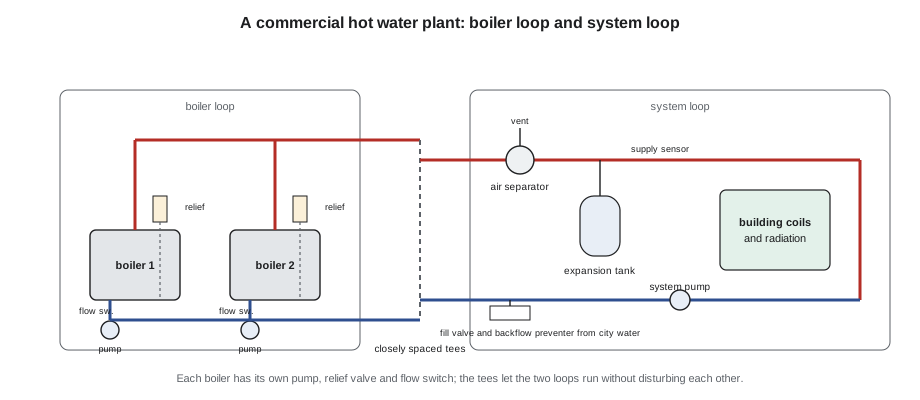
The water system's pressure has to be right before the boiler is fired. The cold fill pressure at the boiler must be high enough to lift water to the highest point in the system and leave a small positive pressure there, so that air vents at the top do not draw air in. The pressure due to a column of water is about 0.433 psi for each foot of height.
Worked problem
Fill pressure and the relief valve
A hot water boiler in the basement of a four-story building serves radiators whose highest point is 46 ft above the boiler. The designer wants 4 psi of pressure at the top. As the system heats, the pressure at the boiler rises a further 5 psi. The boiler's relief valve is set at 30 psi. Find the cold fill pressure at the boiler and the hot pressure, and decide whether the relief valve setting is suitable.
Show solution
- Static pressure from the height of water:
- \[46 \times 0.433 = 19.9 \text{ psi}\]
- Cold fill pressure:
- \[19.9 + 4 = 23.9 \text{ psi}\]
- Hot pressure:
- \[23.9 + 5 = 28.9 \text{ psi}\]
- Margin below the relief setting:
- \[30 - 28.9 = 1.1 \text{ psi}\]
Answer: The hot pressure comes within about 1 psi of the relief setting, so the valve will simmer and weep every cold morning. A relief valve must not be reset higher than the boiler's maximum allowable working pressure. The fix is a boiler and relief valve rated for a higher pressure, such as 50 psi, chosen when the plant is designed. Checking this before firing a new or altered system saves a callback.
A low-pressure steam system
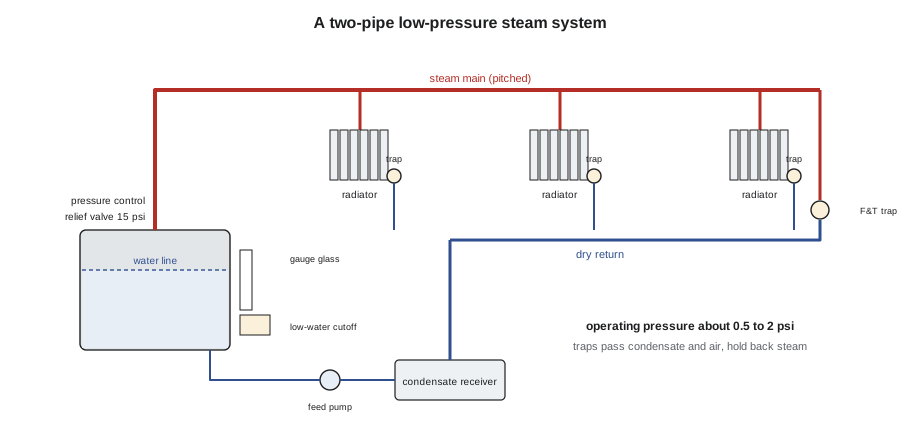
In a steam system the boiler is only partly full of water. The burner boils the water, and the steam rises through the steam mains and risers to the radiators, where it condenses, giving up its latent heat, the heat needed to turn water into steam. The condensate drains back through the return piping to the boiler, either by gravity or through a condensate pump or boiler feed pump with its receiver tank. Because steam carries most of its heat as latent heat, a small amount of steam carries a lot of heat, and a steam system needs no circulating pump for the heating loop. But it needs other things to work properly.
- The boiler must hold a steady water line, shown in the gauge glass and protected by the low-water cutoff. Most of the steam boiler's problems show up first at the water line.
- Steam traps on radiators and at the ends of mains let condensate and air pass into the returns but hold back steam. A failed-open trap lets steam into the return, where it heats the condensate receiver, makes the pump cavitate and wastes energy; a failed-closed trap lets the radiator or main fill with condensate.
- Air vents on one-pipe systems, and the traps and vented returns on two-pipe systems, let the air out as the steam arrives. Air that cannot escape stops the steam from reaching the radiators.
- A pressure control, often called a pressuretrol, cycles the burner to keep the steam pressure in its operating band, which in most buildings is only a fraction of the boiler's limit, commonly 0.5 to 2 psi. Running a heating system at higher steam pressure does not heat the building faster; it makes the traps leak steam and the condensate come back hot.
- Gravity-return boilers have a Hartford loop, a connection that keeps the boiler from being drained back into the returns if the return piping leaks.
Worked problem
How much steam does the boiler make?
The Cannon Street boiler has an input of 2,000,000 Btu/h and a gross efficiency of 80 in 100. The latent heat of steam at low pressure is about 970 Btu per pound. Find the gross output and the steam it can make per hour.
Show solution
- Gross output:
- \[2{,}000{,}000 \times 0.80 = 1{,}600{,}000 \text{ Btu/h}\]
- Steam per hour:
- \[\frac{1{,}600{,}000}{970} = 1{,}649 \text{ lb/h}\]
Answer: The boiler boils off about 1,650 pounds of water every hour at full fire, close to 200 gallons. All of it must come back as condensate. If the returns leak or a trap sends steam into the receiver, the boiler loses water faster than it gets it back, the feed valve adds cold fresh water, and fresh water brings oxygen and minerals that corrode and scale the boiler.
Steam systems are still sized by equivalent direct radiation, EDR, measured in square feet even in Canada: one square foot of EDR gives off 240 Btu/h, about 70 W, of steam heat. A building's radiators are added up in square feet of EDR, and the boiler is chosen with a net rating at least equal to that total. When a steam boiler is replaced, the replacement is sized from the connected radiation, not from the old boiler's nameplate, because old boilers were often oversized.
What went wrong at Cannon Street
Maureen shut the burner off and watched the gauge glass. As the boiling stopped, the water line settled several centimeters lower than it had appeared while the boiler was firing, and a greasy film was visible on the glass. "The water's dirty," she said. "Oil and flux from the summer's return piping went straight into the boiler. Oily water foams when it boils, the foam lifts the water line, and the steam carries water up into the mains with it. That water is what you heard banging, and when the foam collapses the low-water cutoff sees the real level and shuts the burner off." Water carried into the mains with the steam is called carryover, and the bouncing water line is called surging or priming.
The cure was not a burner adjustment. Grant and Maureen skimmed the boiler, slowly overflowing water from the skim tapping at the water line so that the floating oil went down the drain, refilled it, fired it to bring the water to a simmer, and repeated the process until the water in the glass stayed clear and steady. Then they checked the main traps. The float and thermostatic trap at the end of the long east main had failed open, and steam was blowing straight into the dry return, which was why the condensate receiver was too hot to touch. They replaced the trap's internals. By mid-afternoon the boiler held a steady water line, the mains were quiet, and the pressure cycled between 0.5 and 1.5 psi.
| Steam symptom | Likely cause | What to do |
|---|---|---|
| Water line bounces; glass looks oily | Oil, flux or treatment chemicals in boiler water | Skim the boiler until the water is clean |
| Banging in the mains | Water carried over or condensate trapped in sagging pipe | Clean the water; check pitch and drips |
| Condensate receiver very hot; pump noisy | A trap failed open, passing steam | Test and repair traps |
| Some radiators stay cold | Air not vented, or a trap failed closed | Check vents and traps on that branch |
| Boiler needs frequent make-up water | Leaking returns or steam loss | Find and repair leaks; fresh water damages boilers |
Water treatment and why the gas technician cares
Both hot water and steam boilers depend on clean, treated water. Hard water deposits scale on heat transfer surfaces; scale insulates the metal from the water, so the metal runs hotter and can crack or bulge, while the flue gas leaves hotter and efficiency falls. Dissolved oxygen in fresh make-up water causes corrosion. Closed hydronic systems are usually treated once with an inhibitor and then need little make-up water; steam systems lose some water and need regular attention. The water treatment is often done by a specialist company, but the gas technician sees the evidence: a rising stack temperature, frequent make-up, rusty water in the gauge glass, a hissing heat exchanger. When you see those, report them, because a burner adjustment cannot fix a water problem.
Common mistakes
MistakeAdjusting the burner when a steam boiler surges and bangs.
InsteadLook at the water first: oily or dirty water causes surging and carryover.
MistakeRaising steam pressure to heat a building faster.
InsteadKeep steam pressure low; higher pressure makes traps leak steam and wastes fuel.
MistakeSetting a hydronic system's fill pressure without checking the height of the system.
InsteadCalculate the static pressure to the highest point and add a small margin.
MistakeResetting a relief valve higher to stop it weeping.
InsteadFind the cause: a waterlogged expansion tank, overfilling or a boiler with too low a pressure rating.
MistakeLetting a cast-iron boiler condense on cold return water.
InsteadProtect non-condensing boilers with return temperature control or a bypass.
Summary and key terms
- Commercial boilers include cast-iron sectional, fire-tube, water-tube and condensing types, built as steam, hot water heating or hot water supply boilers.
- Low-pressure boilers are limited to 15 psi for steam and 160 psi and 250 °F for hot water; above that they are power boilers.
- A hydronic system needs pumps, an expansion tank, air removal, a fill valve, backflow protection and a properly sized relief valve, and its fill pressure must lift water to the highest point with a small margin.
- A steam system boils water, sends steam to radiators and returns condensate; it needs a steady water line, working traps and vents, and low operating pressure.
- Clean, treated water is essential for both: oil causes surging and carryover, scale causes overheating, and fresh water causes corrosion.
- Low-pressure boiler
- A boiler built for steam at no more than 15 psi or water at no more than 160 psi and 250 °F.
- Maximum allowable working pressure
- The highest pressure a boiler is built for, stamped on its data plate.
- Latent heat
- The heat needed to turn water into steam, given up again when the steam condenses.
- Steam trap
- A device that passes condensate and air but holds back steam.
- Carryover
- Water carried out of a boiler with the steam.
- Equivalent direct radiation
- A measure of steam radiation in square feet; one square foot gives off 240 Btu/h.
- Expansion tank
- A tank that absorbs the increase in water volume as a closed system heats.
Practice problems
Work each problem on paper first, then reveal the answer to check.
What are the pressure limits of a low-pressure steam boiler and a low-pressure hot water boiler?
Show answer
Steam: 15 psi. Hot water: 160 psi and 250 °F.
What is the static pressure of a 66 ft column of water?
Show answer
66 × 0.433 = 28.6 psi.
Why does oily boiler water make a steam boiler's water line bounce?
Show answer
Oily water foams when it boils, the foam lifts the water line, and water is carried into the mains with the steam.
What happens when a main's float and thermostatic trap fails open?
Show answer
Steam blows into the return, heating the condensate receiver and wasting energy.
Why must a cast-iron boiler not condense?
Show answer
The acidic flue gas condensate attacks cast iron.
Lesson quiz · 5 questions
Score 60% or more to complete this lesson.
Create a free account to save your progress, take quizzes and earn a certificate.