
GAS-320 · Lesson 4 of 12 · 26 min
Rooftop units and gas-fired air handlers
▶ Video coming soon A video version of this lesson is on the way.
On Friday, September 25, Grant and Ayesha spent the day on the roof of a single-story shopping plaza on Morse Road on the north side of Columbus. The plaza had eight tenants and six packaged rooftop units, each a 10 ton cooling unit with a gas heat section of 150,000 Btu/h input, and Bayline had the contract for their fall changeover from cooling to heating. Two tenants had already called. The pharmacy said its unit blew warm air for a few minutes, then cold, then warm again. The dental office said its staff had headaches on the first cool mornings, and its new carbon monoxide alarm in the treatment room had chirped once. "Two complaints, two very different jobs," Grant told Ayesha as they climbed the ladder. "One's probably a nuisance. The other one we treat as dangerous until we prove it isn't."
This lesson describes packaged rooftop units and gas-fired air handlers: how the gas heat section works, how it is staged, how to check its gas pressure and temperature rise, how outdoor air and economizers affect it, how to inspect the heat exchanger, and how gas is piped to equipment on a roof. Grant's years on rooftops make this the lesson where he teaches Ayesha.
What a rooftop unit is
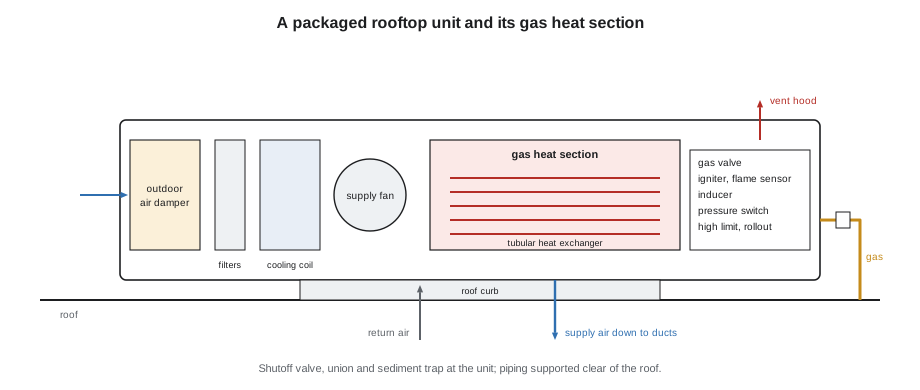
A packaged rooftop unit, often called an RTU, combines in one cabinet the equipment that a house splits between a furnace, an air conditioner and a fresh air system. Its supply fan blows air through a cooling coil and a gas heat section and down through the roof curb into the ducts; return air comes back up through the curb, mixes with outdoor air, passes through filters and starts again. Rooftops serve most single-story stores, restaurants, schools and offices in both countries, and a large building may have dozens. Because each one has its own gas heat section, a plaza roof like this one has six gas appliances, six gas connections and six vent terminals to look after, all outdoors in all weather.
The gas heat section is a close cousin of an induced-draft furnace, built for continuous outdoor service. A row of in-shot burners fires into tubular or clamshell heat exchanger tubes; an inducer or combustion fan draws the flue gases through the tubes and discharges them through a short vent hood on the side of the cabinet; a pressure switch proves the inducer; a hot surface or spark igniter lights the burners; a flame sensor proves the flame; and a high limit and rollout switches protect against overheating and flame rollout. The ignition and safety sequence is essentially the one GAS-220 described for furnaces. What differs is the scale, the exposure and the control: rooftop heat sections usually have two stages or modulate, and they are controlled by a unit controller or the building's control system rather than a simple thermostat.
Staging and gas pressures
Most rooftop heat sections have a two-stage gas valve. On first stage the valve opens to a lower manifold pressure, and the unit fires at perhaps 60 to 70 in 100 of its full input; on second stage the valve opens fully. Some units modulate, with a modulating valve and a variable-speed inducer. The maker gives the manifold pressures on the rating plate or in the instructions, and for natural gas they are typically about 3.5 in. w.c. on high fire and about 1.7 to 2.0 in. w.c. on low fire; propane units run higher. The inlet pressure must be within the range on the plate, with every other appliance on the same piping running, because a roof line serving six units can drop noticeably when they all start together on a cold morning.
To check the pressures, the technician connects a manometer to the valve's outlet and inlet test ports, calls for first stage and then second stage, and compares each reading with the plate. A unit that is set right but whose inlet pressure falls below the minimum when its neighbors fire has a piping or regulator problem, not a valve problem. Grant made a habit of calling heat on all six units at once at the end of each fall changeover and reading the inlet pressure at the farthest unit while they all fired.
Temperature rise
The most useful single check on a gas heat section is its temperature rise, the difference between the air temperature entering the heat section and leaving it. The rating plate gives an allowed range, for example 30 to 60 °F. If the rise is below the range, the air may be cooling the heat exchanger enough to condense flue gas inside it, which corrodes it; if it is above, the heat exchanger runs too hot, the limit trips, and the metal is stressed every cycle. The rise depends on the heat delivered and the airflow, so if you know the output and measure the rise, you can estimate the airflow, which is otherwise hard to measure on a rooftop.
The heat carried by air is about 1.08 × airflow in cfm × rise in °F, in Btu/h, for air near sea level and room temperature. The constant combines the density and the heat capacity of air.
Worked problem
Normal temperature rise
A rooftop heat section has an input of 150,000 Btu/h and a thermal efficiency of 81 in 100. The design airflow is 3,400 cfm. Find the output and the expected temperature rise, and compare it with the plate's range of 30 to 60 °F.
Show solution
- Output:
- \[150{,}000 \times 0.81 = 121{,}500 \text{ Btu/h}\]
- Temperature rise:
- \[\Delta T = \frac{121{,}500}{1.08 \times 3{,}400} = \frac{121{,}500}{3{,}672} = 33.1 \text{ °F}\]
Answer: At design airflow the rise should be about 33 °F, near the bottom of the allowed range. A rise well above that means the airflow is low.
The pharmacy unit
At the pharmacy's unit, Grant had Ayesha put one thermometer probe in the return air just before the heat section and another in the supply duct just past it, out of sight of the heat exchanger so that radiant heat would not fool the reading. With second-stage heat on and the unit at steady state, the rise was 62 °F, above the top of the range. A few minutes later the high limit opened, the burners went out while the fan kept running, and the supply air cooled. When the limit reset, the burners relit. That was the warm-cold-warm cycle the pharmacy had described.
Worked problem
Estimating airflow from the rise
The pharmacy's heat section delivers 121,500 Btu/h. With second stage firing, the measured rise is 62 °F. Estimate the actual airflow and compare it with the design 3,400 cfm.
Show solution
- Rearrange for airflow:
- \[\text{airflow} = \frac{\text{output}}{1.08 \times \Delta T}\]
- Substitute:
- \[\frac{121{,}500}{1.08 \times 62} = \frac{121{,}500}{66.96} = 1{,}815 \text{ cfm}\]
- Fraction of design:
- \[\frac{1{,}815}{3{,}400} = 0.53\]
Answer: The unit was moving only a little over half its design air. The gas side was fine; the air side was the problem. Grant could have spent an hour on the gas valve and found nothing wrong with it.
The cause was in plain sight once they opened the filter door: the pleated filters, which should have been changed in the spring, were gray and bowed inward, and the supply fan's belt was glazed and slipping on its pulley. Ayesha fitted new filters and Grant replaced the belt and set its tension. The rise settled at 34 °F, and the limit stopped tripping. Grant wrote on the service report that the filters should be changed every three months and suggested a filter pressure gauge so the pharmacy's maintenance person could see when they were loading.
Outdoor air and economizers
Every rooftop unit brings in some outdoor air for ventilation, usually through a damper set to a minimum position, and many have an economizer, a set of dampers that opens wide to cool the building with outdoor air when the weather allows. In winter, the outdoor air mixes with the return air before the heat section, so the mixed air entering the heat exchanger can be much colder than the room. Too much cold outdoor air makes the heat section's job harder and, if the mixed air is cold enough, can freeze a cooling coil or let water vapor condense on the outside of the heat exchanger. A stuck-open economizer damper is a common cause of cold complaints in winter.
Worked problem
Mixed air temperature in winter
A rooftop unit brings in 20 parts in 100 outdoor air at 5 °F and 80 parts in 100 return air at 70 °F. Find the mixed air temperature, and the supply air temperature with the 33 °F rise found earlier.
Show solution
- Mixed air:
- \[0.20 \times 5 + 0.80 \times 70 = 1 + 56 = 57 \text{ °F}\]
- Supply air:
- \[57 + 33 = 90 \text{ °F}\]
Answer: With the damper at its minimum, the supply air is a comfortable 90 °F. If the economizer stuck open at, say, 60 parts in 100 outdoor air, the mixed air would be 0.6 × 5 + 0.4 × 70 = 31 °F, and the supply air would be about 64 °F, cold enough for every tenant to complain.
The dental office unit: heat exchanger inspection
The dental office's unit was different. With heat on, Ayesha's combustion analyzer, sampling in the supply duct, read 12 ppm of carbon monoxide and rising slowly, where clean supply air should read the same as outdoor air, essentially zero. Grant shut the unit's gas off at its shutoff valve and turned the heat off at the controller. With the unit cool and its power locked out, they removed the burner assembly and the inducer and inspected the heat exchanger tubes with an inspection camera. The third tube from the left had a crack about 1½ in. long at the first bend, where the flame impinges and the metal is hottest. When they restarted the supply fan with the burners still out and held a smoke pencil near the crack from the burner side, the smoke was pushed away: air from the supply side was blowing in through the crack, and in operation flue gas would have been mixed into the supply air whenever the inducer pressure and the fan pressure allowed.
A cracked heat exchanger in a unit serving occupied space is an unsafe condition. Grant left the unit's gas shut off, tagged it as unsafe in the way Bayline's procedure requires, and wrote the finding on the service report with photographs from the camera. He explained it to the office manager in person, recommended that the staff with headaches see a doctor and mention possible carbon monoxide exposure, and arranged a temporary electric heater for the treatment rooms. The plaza's owner approved a replacement heat section the following week. "You don't argue a cracked heat exchanger," Grant said on the way down. "You prove it, you shut it off, you write it down, and you tell the people breathing the air."
| Sign | What it can mean | Next step |
|---|---|---|
| Carbon monoxide in the supply air | Flue gas entering the airstream, often through a crack | Shut off and inspect the heat exchanger |
| Flame moves or lifts when the supply fan starts | Supply air reaching the burner side through a hole | Shut off and inspect |
| Rust scale or soot on burners and in tubes | Condensation in tubes, poor combustion | Check rise, airflow and combustion |
| Rise above the plate range | Low airflow: filters, belt, dampers, ducts | Fix the air side before touching the gas |
| Rise below the plate range | Too much airflow or underfiring | Check manifold pressure and fan speed |
Gas-fired air handlers and duct furnaces
Not every gas-fired air system sits on a roof. Gas-fired air handlers and duct furnaces are installed indoors or outdoors with the heat section in a duct served by a separate fan. A duct furnace has no fan of its own, so it must be interlocked with the fan that serves it and usually has an airflow switch that proves air is moving before the burner can fire, and its rise must stay within its plate range just as a rooftop unit's must. Large air handlers and makeup air units are covered in lesson 5.
Gas piping on the roof
Rooftop gas piping is exposed to sun, rain, snow, ice and foot traffic, and it is often run by the last trade on the job with the least thought. The codes require that it be supported at proper intervals on supports made for the purpose, raised clear of the roof surface so that it does not sit in water or damage the membrane, protected against corrosion, usually by painting, and protected from physical damage where people walk or equipment is moved. At each unit the piping needs a manual shutoff valve that is readily accessible, within 6 ft of the unit under the IFGC, a union or flanged connection so the unit can be removed, and a sediment trap or drip as the code or the unit's instructions require. The piping must not block access to the unit's service panels, and it must not be fastened to the unit's cabinet, which moves.
Working on a roof brings its own hazards. Before going up, check the building's roof access procedure and the company's rooftop safety rules: stay away from the roof edge, skylights and roof hatches unless there is a guardrail or you are using fall protection, keep tools and parts from rolling off, and do not work on a roof in high wind, lightning or ice. Grant's rule for apprentices was simple: "If you can't see a guardrail between you and the edge, you don't go near the edge."
Common mistakes
MistakeAdjusting the gas valve when the rise is too high.
InsteadMeasure the rise first; a high rise almost always means low airflow.
MistakeReading the supply temperature in sight of the heat exchanger.
InsteadPlace the probe out of line of sight so radiant heat does not inflate the reading.
MistakeChecking inlet pressure with only one unit firing.
InsteadRead it at the farthest unit with every unit on the line firing.
MistakeLeaving a unit running after finding carbon monoxide in the supply air.
InsteadShut it off, inspect the heat exchanger, tag it and tell the occupants.
MistakeFastening the gas line to the unit cabinet or running it across the service door.
InsteadSupport the piping independently and keep service access clear.
Summary and key terms
- A packaged rooftop unit combines a supply fan, cooling coil, filters, outdoor air dampers and a gas heat section of in-shot burners, tubular heat exchangers, inducer and safety controls.
- Heat sections are usually two-stage or modulating, with manifold pressures set to the plate, typically about 3.5 in. w.c. on high fire for natural gas, and the inlet pressure must hold with every unit firing.
- The temperature rise must be within the plate range; heat delivered is about 1.08 × cfm × °F in Btu/h, so a high rise reveals low airflow.
- Economizers and outdoor air lower the mixed air temperature in winter.
- Carbon monoxide in the supply air or a flame disturbed by the fan means a possible cracked heat exchanger: shut off, inspect, tag and inform.
- Roof gas piping must be supported, raised, protected and fitted with an accessible shutoff, union and sediment trap at each unit.
- Rooftop unit
- A packaged heating, cooling and ventilating unit installed on a roof curb.
- Heat section
- The gas burners, heat exchanger, inducer and controls of a rooftop unit or air handler.
- Temperature rise
- The increase in air temperature across a heat section.
- Economizer
- Dampers and controls that use outdoor air for cooling when conditions allow.
- Mixed air
- The blend of outdoor and return air entering a unit's coils and heat section.
- Duct furnace
- A gas heat section installed in a duct and served by a separate fan.
- Two-stage gas valve
- A valve that opens to a lower and a higher manifold pressure for two firing rates.
Practice problems
Work each problem on paper first, then reveal the answer to check.
Why is a temperature rise above the plate range a concern?
Show answer
The heat exchanger runs too hot, the limit trips and the metal is stressed every cycle.
A heat section delivers 100,000 Btu/h and the rise is 45 °F. What is the airflow?
Show answer
100,000 ÷ (1.08 × 45) = 2,058 cfm.
What caused the pharmacy unit to cycle warm and cold?
Show answer
Clogged filters and a slipping belt cut the airflow, so the rise was too high and the high limit tripped.
What two tests suggested a cracked heat exchanger at the dental office?
Show answer
Carbon monoxide in the supply air, and smoke pushed away from the crack by the supply fan.
What must be at each rooftop unit's gas connection?
Show answer
An accessible manual shutoff valve, a union or flange, and a sediment trap where required.
Lesson quiz · 5 questions
Score 60% or more to complete this lesson.
Create a free account to save your progress, take quizzes and earn a certificate.