
GAS-320 · Lesson 12 of 12 · 25 min
Case study: a restaurant gas installation
▶ Video coming soon A video version of this lesson is on the way.
In July, Danielle Ostrowski signed a lease on a former hardware store on North High Street in the Short North, Columbus and hired Bayline to do the gas work for her new restaurant, Juniper Table. She had cooked in other people's kitchens for fifteen years, and she knew exactly what she wanted on her line. What she did not know was what it took to feed it. At the first meeting, on Tuesday, July 14, Maureen spread the mechanical designer's drawings on a table and asked for the equipment list with every rating plate. "Before anybody buys a pipe fitting," she said, "we add up what this kitchen burns, and we find out whether the street can give it to us." The restaurant was to open on Thursday, September 10.
This case study follows the gas installation from the first load calculation to a follow-up visit two months after opening. It brings together the ideas of this course: commercial appliance ratings and loads, cooking equipment and connectors, makeup air and hood interlocks, booster heaters, rooftop units, venting and building pressure, commissioning and maintenance. GAS-330 covers elevated-pressure piping in detail; here it appears as part of a real job.
The equipment and the load
The equipment list, with the input from each rating plate, made the table below. The makeup air unit, a direct-fired unit on the roof, had been chosen by the designer to replace the hood's exhaust; the rooftop unit heated and cooled the dining room; and the booster heater served a high-temperature dish machine.
| Appliance | Input |
|---|---|
| Six-burner range with oven | 215,000 Btu/h |
| Charbroiler, 36 in. | 120,000 Btu/h |
| Two fryers | 2 × 120,000 Btu/h |
| Griddle, 36 in. | 90,000 Btu/h |
| Salamander | 40,000 Btu/h |
| Double-stack convection oven | 100,000 Btu/h |
| Booster heater | 58,000 Btu/h |
| Storage water heater | 199,900 Btu/h |
| Direct-fired makeup air unit | 500,000 Btu/h |
| Dining room rooftop unit | 150,000 Btu/h |
Worked problem
Connected load and gas flow
Add up the Juniper Table connected load and find the gas flow at full input, using 1,000 Btu per cubic foot.
Show solution
- Cooking line:
- \[215{,}000 + 120{,}000 + 2 \times 120{,}000 + 90{,}000 + 40{,}000 + 100{,}000 = 805{,}000 \text{ Btu/h}\]
- Water heating:
- \[58{,}000 + 199{,}900 = 257{,}900 \text{ Btu/h}\]
- Roof units:
- \[500{,}000 + 150{,}000 = 650{,}000 \text{ Btu/h}\]
- Total:
- \[805{,}000 + 257{,}900 + 650{,}000 = 1{,}712{,}900 \text{ Btu/h}\]
- Gas flow:
- \[\frac{1{,}712{,}900}{1{,}000} = 1{,}713 \text{ ft}^3/\text{h}\]
Answer: The restaurant's connected load is about 1,713,000 Btu/h, about 1,713 cubic feet of gas an hour at full input. The old hardware store's meter, sized for two unit heaters, could deliver a small fraction of that. Priya sent the utility a load letter the same afternoon to request a new service and meter.
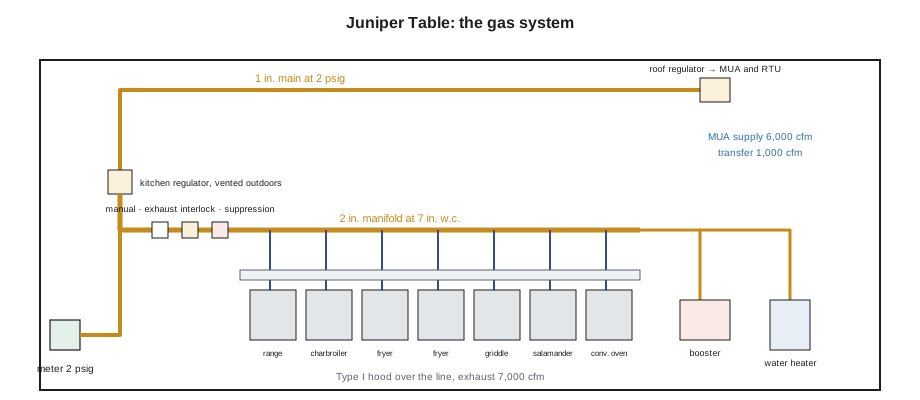
Columbia Gas of Ohio reviewed the load and agreed to a new meter delivering 2 psig. Elevated pressure let a smaller main carry the load the length of the building. Bayline would install line regulators: one in the kitchen reducing to 7 in. w.c. for the cooking line, the booster and the water heater, and one on the roof for the makeup air unit and the rooftop unit, each regulator's vent piped outdoors or fitted with a vent limiter as its listing and the code allow. Maureen chose the pipe sizes from the code's tables; the SAMPLE versions below show the method.
| Pipe size | SAMPLE capacity at 2 psig, 130 ft | SAMPLE capacity at 7 in. w.c., 50 ft |
|---|---|---|
| 3/4 in. | 1,000,000 Btu/h | 170,000 Btu/h |
| 1 in. | 2,000,000 Btu/h | 320,000 Btu/h |
| 1-1/4 in. | 4,100,000 Btu/h | 410,000 Btu/h |
| 1-1/2 in. | 6,100,000 Btu/h | 630,000 Btu/h |
| 2 in. | 12,000,000 Btu/h | 1,210,000 Btu/h |
Worked problem
Choosing the main and the kitchen manifold
The main runs about 130 ft at 2 psig and must carry the whole 1,712,900 Btu/h. The kitchen manifold runs about 50 ft at 7 in. w.c. and carries the cooking line's 805,000 Btu/h. Using the SAMPLE table, choose each size.
Show solution
- Main at 2 psig:
- 3/4 in. carries 1,000,000 < 1,712,900 Btu/h; 1 in. carries 2,000,000 ≥ 1,712,900 Btu/h, so 1 in.
- Manifold at 7 in. w.c.:
- 1-1/2 in. carries 630,000 < 805,000 Btu/h; 2 in. carries 1,210,000 ≥ 805,000 Btu/h, so 2 in.
Answer: At elevated pressure a 1 in. main carries the whole restaurant; at low pressure the kitchen manifold alone needs 2 in. That difference is why the utility and Bayline chose elevated pressure for a long building with a large load, and why the line regulators sit close to the loads they serve.
Air: exhaust, makeup and balance
The hood over the line was a 18 ft Type I hood listed to UL 710, exhausting 7,000 cfm. The makeup air unit supplied 6,000 cfm, and the dining room's rooftop unit brought in 1,000 cfm of outdoor air, which transferred into the kitchen through a grille, keeping the kitchen slightly negative to the dining room so that cooking smells stayed in the kitchen. Maureen checked that the makeup air unit was big enough for the winter.
Worked problem
Makeup air heat and building balance
The makeup air unit supplies 6,000 cfm and must heat outdoor air from 0 °F to 65 °F. Its burner delivers about 92 in 100 of the gas's heat to the air. Is its 500,000 Btu/h input enough? The washrooms exhaust a further 200 cfm. Find the building's overall air balance.
Show solution
- Heat needed:
- \[1.08 \times 6{,}000 \times 65 = 421{,}200 \text{ Btu/h}\]
- Input needed:
- \[\frac{421{,}200}{0.92} = 457{,}826 \text{ Btu/h} < 500{,}000 \text{ Btu/h}\]
- Total exhaust:
- \[7{,}000 + 200 = 7{,}200 \text{ cfm}\]
- Total outdoor air supplied:
- \[6{,}000 + 1{,}000 = 7{,}000 \text{ cfm}\]
- Shortfall:
- \[7{,}200 - 7{,}000 = 200 \text{ cfm}\]
Answer: The unit has enough burner for the design day. The building as a whole exhausts slightly more than it supplies, by about 200 cfm, less than 3 in 100 of the total, which should leave it only slightly negative, within the NFPA 96 limit. Maureen would measure it at commissioning rather than trust the arithmetic, because real fans rarely deliver exactly their design figures.
Installation
Grant and Maureen ran the piping from Tuesday, August 4 to Friday, August 7: the elevated-pressure main along the side wall, the two line regulators, the kitchen manifold behind the line at the height the hood maker's drawings showed, with a manual valve, then the automatic gas valve interlocked with the hood exhaust fan, then the fire suppression gas valve, a mechanical valve the suppression contractor would connect to the suppression system's release, then a manual valve and a quick-disconnect outlet for each appliance. They ran separate branches to the booster heater, the water heater and the roof. On Monday, August 10, they pressure tested the piping, at not less than one and a half times the working pressure and not less than 3 psig, as the IFGC requires, for the city's rough-in inspection, and the test held. The utility set the new meter on Tuesday, August 18, once Bayline's test record was in.
The equipment dealer set the cooking line in the week of August 24. Bayline connected each appliance with a certified movable connector of the size its input needed, checked against the connector maker's capacity table, a quick disconnect and a restraint cable shorter than the connector. They connected and started the water heater, the booster heater, the makeup air unit and the rooftop unit, checking each one's inlet and manifold pressures, combustion and venting.
Commissioning and the interlock tests
On Monday, August 31, Maureen ran the commissioning tests with the hood installer, the suppression contractor and Danielle watching. Every appliance was lit and checked with the whole line firing; the farthest appliance's inlet pressure held at 6.4 in. w.c.. Then they tested the interlocks, one at a time, in the order of the table below. The fire suppression test was done by the suppression contractor's procedure, using the system's test method without discharging the chemical; when the release was tripped, the mechanical gas valve snapped shut and every burner and pilot on the line went out, and the electric power to the line's equipment dropped. Nothing relit until the valve was reset by hand, after which Grant relit every pilot and burner and checked each one.
| Interlock test | Result required | Juniper Table result |
|---|---|---|
| Hood exhaust off | Cooking line automatic gas valve closes; makeup air unit stops | Both happened |
| Hood exhaust on | Makeup air unit starts and proves airflow; gas valve can open | Both happened |
| Makeup air low-airflow switch opened | Makeup air burner shuts down and locks out | Locked out |
| Fire suppression release tripped (test mode) | Gas and power to the line shut off; manual reset needed | Shut off; reset by hand |
| Building pressure with everything running | Slightly negative, within the NFPA 96 limit | −0.012 in. w.c. |
| Booster at full dish machine use | Final rinse 180 °F or more at the manifold | 182 °F |
The building pressure test was the one Maureen cared about most. With the hood, the makeup air unit, the rooftop unit, the washroom fans and the dish machine's vent hood all running, she measured the kitchen at −0.012 in. w.c. against outdoors, and the water heater, an atmospheric unit in a closet off the dish room, drafted within thirty seconds with no spillage. She left a copy of every reading with Danielle, in a binder that would become the restaurant's equipment log. The city's mechanical inspector gave the final approval on Thursday, September 3, and the Columbus Division of Fire accepted the suppression system the same day. Juniper Table opened on September 10.
Two months later
Maureen had told Danielle at commissioning that one part of the job could not be finished in August: the makeup air unit's heating. In summer the burner had been lit, tested and set at the maker's figures, but it could not be seen working against real cold air. So on Friday, November 13, after the first cold week, Maureen and Grant returned. Danielle reported one complaint: on cold mornings, the kitchen felt as if a cold draft blew across the pass for a few minutes after the hood came on.
With the outdoor temperature at 25 °F, Grant watched the unit start. The burner lit and held, but the discharge temperature took several minutes to reach its setting, because the unit's discharge controller had been left with a slow, summer-time start-up ramp that the commissioning had not exercised. Grant set the ramp and the burner's minimum firing to the maker's cold-weather recommendations, checked the burner's flame and the profile plates through the sight port, and confirmed the discharge temperature held within about 2 °F of its setting through a full start. He then measured the supply air for carbon monoxide at the diffuser, which read the same as outdoors.
There was one more finding, and it would not have surprised anyone who had read this course. The second fryer's restraint cable was hanging loose: the overnight cleaning crew had unclipped it to pull the fryer out and had not clipped it back. Grant reclipped it and showed the kitchen manager, and Maureen added a line to the closing checklist on the kitchen wall: "Restraints reclipped on every appliance moved." Before they left, Maureen wrote the visit up in the equipment log, scheduled the spring visit to switch the makeup air unit to summer operation, and booked the line's annual service for August, before the next cold season.
What the job shows
Juniper Table's installation went smoothly because each step was done in order and checked: the load was added up before any pipe was bought, the utility was asked early, pipe sizes came from the tables, every connector was sized for its appliance, every interlock was tested with the people who would rely on it, the building pressure was measured rather than assumed, and the parts of the job that could not be tested in summer were deliberately revisited in winter. Most of the problems in this course, from Ferguson Place's jumpered switch to Bella Notte's undersized connector, came from a step skipped by somebody in a hurry. Opening dates do not change what a safe installation needs.
Common mistakes
MistakeOrdering equipment and pipe before adding up the load.
InsteadTotal the connected load first and ask the utility early.
MistakeSizing a kitchen manifold for the appliances on the drawing only.
InsteadAllow for every appliance on the line firing together, from the tables.
MistakeTesting interlocks without the people who will rely on them.
InsteadTest with the owner, the hood installer and the suppression contractor present.
MistakeTrusting the air balance on paper.
InsteadMeasure the building pressure with every fan running and test atmospheric appliances for spillage.
MistakeTreating a makeup air unit set up in summer as finished.
InsteadRevisit it in the first cold weather to see its heating work.
Summary and key terms
- A restaurant installation starts with the connected load from every rating plate, about 1,713,000 Btu/h at Juniper Table, and an early request to the utility for a suitable meter and pressure.
- Elevated pressure with line regulators near the loads lets a small main carry a large load; pipe sizes come from the code's tables.
- The kitchen manifold carries a manual valve, an automatic valve interlocked with the exhaust fan and a fire suppression gas valve with manual reset, and each appliance is connected with a certified connector of adequate capacity, a quick disconnect and a restraint.
- The makeup air unit must have enough burner for the design day, and the building's air balance is measured with everything running.
- Commissioning tests every interlock, the line pressure with everything firing, the booster's rinse temperature and spillage of atmospheric appliances, and the makeup air heating is revisited in the first cold weather.
- Line regulator
- A regulator that reduces elevated piping pressure to the pressure a group of appliances needs.
- Elevated pressure
- A gas piping pressure above the usual low pressure supplied to appliances, such as 2 psig.
- Load letter
- A request to the gas utility listing a building's connected load for a new or larger service.
- Fire suppression gas valve
- A valve on a cooking line that closes when the hood suppression system releases and must be reset by hand.
- Commissioning
- Testing and adjusting a new installation to prove that it works as designed.
- Air balance
- The comparison of a building's total exhaust with its total outdoor air supply.
- Equipment log
- The record of readings, tests and service kept for a building's equipment.
Practice problems
Work each problem on paper first, then reveal the answer to check.
What was the first thing Maureen did at the July meeting?
Show answer
Added up the connected load from every rating plate to find out what the kitchen would burn.
Why did Juniper Table use elevated pressure?
Show answer
So that a small main could carry the large load the length of the building, with line regulators near the loads.
Using the SAMPLE low-pressure table, what manifold size carries 500,000 Btu/h over 50 ft?
Show answer
1-1/2 in. (630,000 Btu/h).
What happened when the suppression system's release was tripped at commissioning?
Show answer
The mechanical gas valve closed, every burner and pilot went out, the power dropped, and nothing relit until the valve was reset by hand.
Why did Maureen return in November?
Show answer
To see the makeup air unit's heating work in real cold weather, which could not be tested in August.
Lesson quiz · 5 questions
Score 60% or more to complete this lesson.
Create a free account to save your progress, take quizzes and earn a certificate.