
GAS-320 · Lesson 10 of 12 · 27 min
Mechanical rooms and ventilation
▶ Video coming soon A video version of this lesson is on the way.
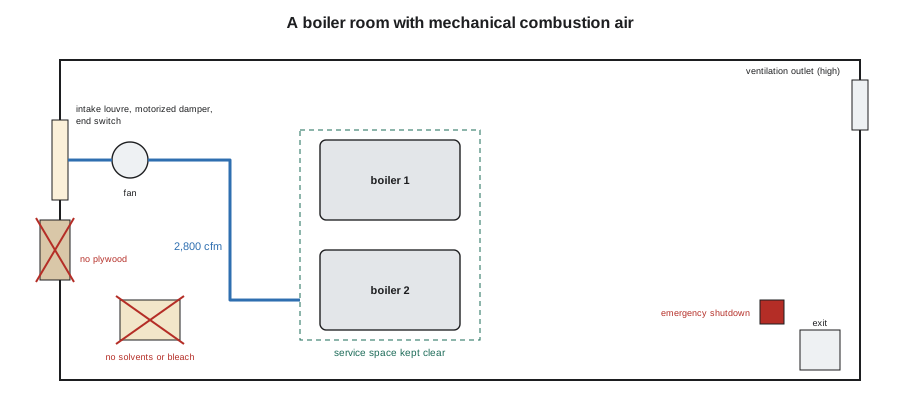
On Wednesday, October 28, Maureen, Grant and Ayesha returned to Ferguson Place, the office building from lesson 1, to deal with the penthouse boiler room before the cold weather arrived. Grant's inventory in September had noted a sheet of plywood screwed over part of the combustion air intake. Stan, the building operator, explained it without embarrassment. "Last January the room got so cold that the pipe to the expansion tank nearly froze," he said. "The fan pulls in minus twenty air all night. So I covered half the opening. The boilers still run." Maureen nodded slowly. "They run," she said. "Let's find out how well they breathe, and what else in this room needs attention. A boiler room is part of the appliance."
This lesson is about the rooms that hold large gas appliances: how they are supplied with air for combustion and ventilation, by openings or by fans, how the air supply is interlocked with the appliances, how to protect the room from freezing without starving the burners, and what else a mechanical room needs: clearances and service space, emergency shutoff, clean air free of corrosive vapors, and separation from refrigeration machinery. GAS-230 introduced combustion and ventilation air for single appliances; this lesson applies it to commercial plant rooms.
Air for combustion and ventilation
A burner needs about ten volumes of air for every volume of natural gas, as GAS-310 showed, and a boiler room full of large burners needs a great deal of air. It also needs ventilation air, air that flows through the room to carry away the heat lost from the boiler jackets, piping and motors, so that the room does not overheat and the controls do not cook. And it needs dilution air for draft-hood appliances, drawn in at the draft hood. If any of these is short, the burners run rich and make carbon monoxide, draft-hood appliances spill, and the room may go negative and pull flue gas back down idle boilers' stacks.
The codes give several ways to supply the air, and the designer chooses one; the technician's job is to recognize which one the room uses and make sure it still works.
- Indoor air, for small appliances in a large, leaky building, where the room connects to enough other indoor volume. This rarely suits a commercial plant room.
- Permanent openings to outdoors, directly through an outside wall or roof or through ducts, sized from the input of the appliances in the room. Louvers and screens reduce an opening's free area, so the opening's gross size must be larger than the free area the code requires.
- Mechanical combustion air, a fan that brings outdoor air into the room at a rate set by the code for the input served. The fan must be interlocked with the appliances, so that they cannot fire unless the fan is running and its airflow is proven.
- Direct-vent or sealed combustion appliances, whose combustion air is ducted to the burner from outdoors. They need no combustion air from the room, but the room still needs ventilation.
In Ohio, the fuel gas code adopted with the Ohio Mechanical Code sets out each method; for example, two permanent openings directly to outdoors must each have a free area of at least 1 square inch per 4,000 Btu/h of total input, and a mechanical supply must provide at least 0.35 cfm of outdoor air per 1,000 Btu/h. The worked examples below use the values of the site you are reading, and on the Canadian pages they are SAMPLE values for illustration only.
Worked problem
How much air does the penthouse fan have to supply?
The two Ferguson Place boilers have a total input of 8,000,000 Btu/h. Using the fuel gas code's mechanical combustion air rate of 0.35 cfm per 1,000 Btu/h, find the outdoor air the fan must supply.
Show solution
- Required air:
- \[\frac{8{,}000{,}000}{1{,}000} \times 0.35 = 8{,}000 \times 0.35 = 2{,}800 \text{ cfm}\]
Answer: The fan must bring in about 2,800 cubic feet of outdoor air every minute while the boilers fire. Covering half the intake with plywood roughly halves what the fan can deliver, so the room would be short about 1,400 cfm at full fire, and the fan's airflow switch should, if it is working, prevent the boilers from firing at all.
What the team found
The fan's airflow switch was not working, because someone had jumpered it. Grant found a short wire across its terminals in the fan's control box, neatly done, with a tag in a handwriting nobody recognized that said "temp, switch bad". The tag was undated. With the switch jumpered, the boilers would fire whether or not the fan ran, and the plywood had cut the fan's delivery to a little over half. Ayesha checked the boiler room pressure with a manometer, door closed, both boilers at high fire: −0.05 in. w.c. against outdoors. Maureen's analyzer showed both boilers' oxygen readings about 1.5 points lower than on Bayline's September start-up report, and carbon monoxide at boiler 2 had risen from 22 to 96 ppm air-free. When she switched the fan off, boiler 2's carbon monoxide climbed past 300 ppm within two minutes and its stack barometric damper began to flutter.
Maureen shut both boilers down to low fire, then off, and removed the jumper. The airflow switch itself was fine: its sensing tube was full of dust and insect debris, which had made it chatter on and off, and that was probably the "switch bad" that someone had once seen. Ayesha cleaned the tube and pickup, Grant tested the switch with the fan running and stopped, and it proved and dropped out cleanly. The plywood came off.
Keeping the room from freezing
Stan's problem was real. Outdoor air at −4 °F pouring into a room all night can freeze water lines, sprinkler piping and the condensate traps of condensing equipment, and it does not need to pour in when the boilers are off. The answer is never to block the air supply. It is to bring in air only when the burners need it, and to direct it where it will not freeze anything.
- A motorized damper on the intake opens when there is a call for heat and closes when the boilers are off. It must have an end switch that proves it is open before the burners can fire, wired into the boilers' safety circuits.
- The fan, where there is one, is interlocked the same way, and its airflow is proven before light-off.
- The air is discharged low in the room near the burners and away from water lines, and sensitive piping is insulated or heat-traced.
- Some rooms use a tempered air unit that preheats the combustion air slightly; others rely on the boilers' own jacket losses once they are firing.
Worked problem
Why the room got so cold
The fan brings in 2,800 cfm of outdoor air at 0 °F into a room that should stay at about 68 °F. How much heat does it take to warm that air to room temperature?
Show solution
- Temperature difference:
- \[68 - 0 = 68 \text{ °F}\]
- Heat:
- \[1.08 \times 2{,}800 \times 68 = 205{,}632 \text{ Btu/h}\]
Answer: Warming the combustion air takes about 205,000 Btu/h. When the boilers fire, their jacket and piping losses and the burners themselves supply much of that, and the air entering the burner is heated by combustion anyway. When the boilers are off but the fan keeps running, nothing supplies it, and the room cools rapidly. Interlocking the damper and fan to the call for heat removes the problem without starving the burners.
At Ferguson Place the fan had been wired to run continuously. Maureen wrote up a change for the building's controls contractor: a motorized damper with an end switch on the intake, the fan and damper started by either boiler's call for heat, the damper's end switch and the fan's airflow switch both wired into each boiler's limit circuit, and heat tracing on the expansion tank line. Until the change was made, the fan would keep running, and Stan agreed to call Bayline, not reach for plywood, if the room got cold.
Worked problem
Sizing permanent openings instead
Suppose the room used two permanent openings directly to outdoors instead of a fan. Each must have 1 square inch of free area per 4,000 Btu/h of total input, and the louvers have 75 in 100 free area. Find the free area and the gross size of each louver for 8,000,000 Btu/h of boilers.
Show solution
- Free area of each opening:
- \[\frac{8{,}000{,}000}{4{,}000} = 2{,}000 \text{ in}^2\]
- Gross louver area:
- \[\frac{2{,}000}{0.75} = 2{,}667 \text{ in}^2 \approx 18.5 \text{ ft}^2\]
Answer: Each opening would need a louver of about 18.5 square feet, for example about 52 inches square. That is a large hole in a wall, which is why plant rooms with big boilers often use a fan, and why openings are so often found partly blocked.
Clean air
The air a burner breathes becomes part of its combustion, and some substances in the air turn into acids in the flame. Chlorine and fluorine compounds, from bleach, pool chemicals, refrigerants, solvents, paint strippers, dry-cleaning fluid, some aerosol propellants and laundry products, form hydrochloric and hydrofluoric acids that attack heat exchangers, vents and burners, especially in condensing equipment, sometimes within a single season. Boiler rooms are often used as storerooms, and the store often includes exactly these products. At Ferguson Place, the cleaning contractor's drums of floor stripper and a stack of paint cans sat beside the combustion air intake. Maureen asked for them to be moved out of the boiler room altogether, and noted that combustion air intakes outdoors should also be kept away from exhaust outlets, pool vents and dryer vents. Lint and dust are a second problem: they block burner air inlets, fan wheels and airflow switch tubes, as the team had just seen.
Service space, clearances and safe access
A mechanical room must leave the space that each appliance's instructions and the codes require around it: clearances to combustible construction, and service clearances in front of burners, controls and access panels, behind boilers for tube cleaning, and above for venting. Storage must never use that space. The room must be lit well enough to work, its floor drained, its door self-closing where the building code requires, and it must be possible to reach every valve and control without climbing over equipment. Boiler rooms usually also have an emergency shutdown switch, a clearly marked switch at the room's exit that stops all the burners, so that in a gas leak or fire someone can shut the plant down without walking past the boilers. At Ferguson Place the switch was there, labeled and working, but a rolling tool cart had been parked in front of it; Ayesha moved it and Maureen added a floor marking.
Rooms shared with refrigeration equipment
Many mechanical rooms also hold chillers or other refrigeration machinery. Refrigerant leaking into a room with an open flame can decompose into toxic and corrosive products, and some modern refrigerants are mildly flammable. The refrigeration safety codes, ASHRAE 15 as adopted in the Ohio Mechanical Code, restrict combustion equipment in refrigerant machinery rooms: commonly the combustion air must be ducted from outdoors and sealed from the room, or the burners must shut down when the room's refrigerant detector alarms. When you service gas equipment in a room with refrigeration machinery, find out which arrangement the room uses and confirm that it works.
| Mechanical room check | What to look for |
|---|---|
| Combustion air | Openings clear and full size; fan running, interlocked and proven; damper end switch working |
| Room pressure | Not negative to outdoors with all equipment running |
| Clean air | No chlorine or fluorine products stored; intake away from exhausts |
| Service space | Clear in front of burners and controls; nothing stored in clearances |
| Emergency shutdown | Switch at the exit, labeled, reachable and tested |
| Freeze protection | Damper or fan interlocked to call for heat; sensitive piping protected |
| Refrigeration | Machinery room arrangement for combustion equipment understood and working |
Alarms and monitoring in plant rooms
Many commercial plant rooms now have detectors that watch for the conditions this lesson has described. A carbon monoxide detector in the boiler room alarms if flue gas spills into the room, and in some buildings the building code or the fire code requires carbon monoxide detection near fuel-burning appliances that serve occupied spaces. A combustible gas detector alarms on a gas leak, and in larger plants it may also close an automatic gas valve at the room's entry. A room pressure switch or differential pressure monitor alarms, or locks out the burners, if the room goes negative to outdoors beyond a set limit, which is the most direct protection against the depressurization that GAS-230 and this lesson have shown to be so dangerous. Where these devices exist, the gas technician tests them as part of the plant's service, by the makers' procedures, and records the results, because a detector that is never tested gives false confidence.
Detectors do not replace good design. A plant room whose air supply works, whose openings are clear and whose interlocks are proven will rarely set off any of them. But they catch the slow changes that nobody notices: a louver gradually clogging with leaves, a new exhaust fan installed by another trade on the floor below, a jumper left on a switch. At Ferguson Place, Maureen recommended adding a room pressure monitor alarmed to the building's control system, so that Stan would see a warning on his screen before the boilers' combustion suffered.
Keeping a boiler room log
Every commercial plant room should have a log: a binder or electronic record kept at the plant, in which operators and technicians record start-ups, shutdowns, readings, tests of safety controls, lockouts and their causes, and every change made to the equipment or its settings. The log is how the next person to arrive learns what has happened. The undated "temp, switch bad" tag at Ferguson Place was exactly what a log is meant to replace: a record that says who did what, when and why, and what still needs to be done. Ayesha wrote the day's findings in the Ferguson Place log before they left, including the removed jumper, the cleaned switch, the measured room pressure before and after, and the recommended changes.
Common mistakes
MistakeBlocking a combustion air opening to stop the room freezing.
InsteadInterlock a motorized damper or fan to the call for heat and protect the piping.
MistakeJumpering an air proving switch that chatters.
InsteadClean or repair the switch, its tube and its pickup, and prove it works.
MistakeStoring cleaning chemicals, paints or solvents in a boiler room.
InsteadKeep chlorine and fluorine products out of the room and away from intakes.
MistakeForgetting that louvers reduce free area.
InsteadSize the gross louver from the required free area and the louver's free area ratio.
MistakeParking carts or storing materials in front of burners or the emergency switch.
InsteadKeep service clearances and the shutdown switch clear.
Summary and key terms
- A boiler room needs combustion, ventilation and dilution air, supplied by indoor air, permanent openings to outdoors, a mechanical supply fan or direct-vent appliances, sized from the input by the fuel gas code (for example 1 in² per 4,000 Btu/h for each of two direct openings, or 0.35 cfm per 1,000 Btu/h mechanically).
- Louvers reduce free area.
- Mechanical air supplies and motorized dampers must be interlocked and proven before the burners fire; to prevent freezing, bring air in only on a call for heat, never by blocking openings.
- Chlorine and fluorine compounds in the air destroy heat exchangers, so keep them out of the room and away from intakes.
- Keep service clearances and the emergency shutdown switch clear, and know how combustion equipment is protected in rooms with refrigeration machinery.
- Ventilation air
- Air that flows through an appliance room to remove heat.
- Dilution air
- Room air drawn into a draft hood to mix with flue gas.
- Free area
- The open area of a louver or grille through which air can actually pass.
- Mechanical combustion air
- Outdoor air supplied to an appliance room by a fan.
- End switch
- A switch that proves a motorized damper is fully open.
- Emergency shutdown switch
- A marked switch at a boiler room exit that stops all the burners.
- Machinery room
- A room housing refrigeration machinery under the refrigeration safety code.
Practice problems
Work each problem on paper first, then reveal the answer to check.
What three kinds of air does a boiler room need?
Show answer
Combustion air, ventilation air and, for draft-hood appliances, dilution air.
Why must a mechanical combustion air fan be interlocked with the boilers?
Show answer
So that the boilers cannot fire unless the fan is running and its airflow is proven.
Using 0.35 cfm per 1,000 Btu/h, what air does 3,000,000 Btu/h of boilers need?
Show answer
3,000 × 0.35 = 1,050 cfm.
How should a boiler room be protected from freezing?
Show answer
Bring air in only on a call for heat with an interlocked, proven damper or fan, and protect sensitive piping.
Why are bleach and refrigerants a problem in a boiler room's air?
Show answer
Their chlorine and fluorine compounds form acids in the flame that attack heat exchangers and vents.
Lesson quiz · 5 questions
Score 60% or more to complete this lesson.
Create a free account to save your progress, take quizzes and earn a certificate.