
GAS-320 · Lesson 3 of 12 · 26 min
Boiler controls and operating limits
▶ Video coming soon A video version of this lesson is on the way.
On Tuesday, September 22, Maureen took Ayesha Rahman, a second-year apprentice who had just moved onto Bayline's commercial crew, to the Rymal Medical Center, a two-story medical office building in Westerville, north of Columbus. The building was heated by two condensing boilers of 1,500,000 Btu/h each, installed in 2017, with a cascade controller that staged them and set the supply water temperature from the outdoor temperature. The building manager's complaint was odd for September: on mild afternoons the waiting rooms were stuffy and too warm, and twice in the past week a boiler had shut down on its high limit and needed a manual reset. "A high limit trip in September," Maureen said as they parked. "When the building hardly needs any heat. That tells me something is asking for far more temperature than the weather calls for."
This lesson explains the controls on commercial hot water and steam boilers: the difference between operating controls and safety limits, high limits, low-water cutoffs, flow switches and pressure controls, how outdoor reset works and how to calculate a reset curve, and how to test the safety controls. Lesson 2 described the boilers themselves; GAS-310 covered the burner management systems on large power burners.
Operating controls and limit controls
Every boiler has two kinds of control, and keeping them separate in your mind is the most important idea in this lesson. An operating control runs the boiler in normal service: it starts and stops the burner, or changes its firing rate, to hold a temperature or pressure that someone has chosen. An outdoor reset controller, an aquastat set to 180 °F, and a steam pressure control set to cycle between 0.5 and 1.5 psi are all operating controls. They are expected to act many times a day.
A limit control or safety limit acts only when something has gone wrong: the water is too hot, the steam pressure too high, the water level too low, or the flow has stopped. It is set beyond the operating range, and in normal operation it should never act. On commercial boilers most limits are manual reset, so that once tripped the boiler stays off until a person investigates and resets it. That is deliberate. A boiler that trips its high limit and restarts by itself hides a problem; a boiler that stays off forces someone to look.
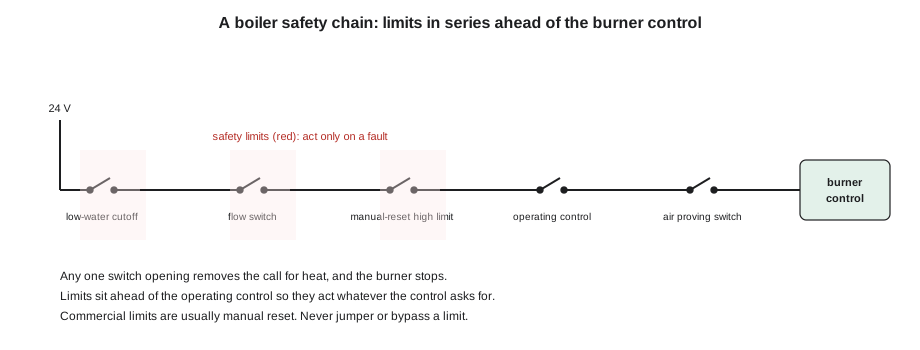
The limits are wired in series in the boiler's safety chain or limit string, ahead of the burner control, so that any one of them opening removes power from the burner's call for heat or from its safety circuit. A limit must never be jumpered, bypassed or set into the operating range to stop nuisance trips. If a limit keeps tripping, the job is to find out why the condition it protects against keeps occurring.
Temperature controls and high limits
A hot water boiler's operating temperature control may be a simple aquastat, the boiler's built-in controller, or a building management system output. Its setting depends on the system: about 180 °F for fin-tube baseboard on a cold day, much lower for radiant floors and for condensing boilers on reset. The high limit is a separate sensor and switch, usually manual reset on commercial boilers, set some distance above the highest operating temperature, typically 200 to 210 °F, and never above the limit marked on the boiler. Many boilers have both an automatic-reset high limit, which stops the burner if the temperature overshoots and restarts it when it falls, and a manual-reset high limit set a little higher.
High limits trip for three common reasons. The operating control is set too high or has failed, so the boiler heats until the limit stops it. The water flow through the boiler has dropped, because zone valves have closed, a pump has failed or a strainer is blocked, so the boiler's heat goes into too little water and the outlet temperature spikes. Or the sensor is in the wrong place or has drifted. The flow cause is the one most often missed, and it is easy to calculate.
Worked problem
Why low flow trips the high limit
A boiler is firing at an output of 1,020,000 Btu/h. Its return water is at 158 °F. Normally the flow through it is 96 gpm; on a mild afternoon most zone valves close and the flow falls to 48 gpm. The manual-reset high limit is set at 200 °F. Find the outlet temperature at each flow, using rise = output ÷ (500 × flow).
Show solution
- Rise at normal flow:
- \[\frac{1{,}020{,}000}{500 \times 96} = \frac{1{,}020{,}000}{48{,}000} = 21.3 \text{ °F} \to 158 + 21.3 = 179.3 \text{ °F}\]
- Rise at reduced flow:
- \[\frac{1{,}020{,}000}{500 \times 48} = \frac{1{,}020{,}000}{24{,}000} = 42.5 \text{ °F} \to 158 + 42.5 = 200.5 \text{ °F}\]
Answer: Halving the flow doubles the temperature rise. At normal flow the outlet is a comfortable 179 °F; at half flow, with the burner still firing hard, it reaches 200.5 °F and the high limit trips. The fix is to make the firing rate follow the load, lower the supply temperature in mild weather and keep a minimum flow through the boiler, not to raise the limit.
Low-water cutoffs and flow switches
A boiler fired with too little water in it can overheat its metal in minutes, and a dry-fired boiler can crack, bulge or, in the worst cases, fail violently when cold water is then fed onto red-hot metal. The low-water cutoff, LWCO, shuts the burner off if the water level falls below a safe point. Every automatically fired steam boiler needs one, and commercial steam boilers usually need two: a primary cutoff, often combined with the feed water control, and a secondary cutoff set slightly lower, with manual reset. Hot water boilers above a certain size, about 400,000 Btu/h under the common requirement, and hot water boilers installed above the radiation they serve, need a low-water cutoff too.
There are two main types. A float-type cutoff has a float in a chamber connected to the boiler; as the water falls, the float drops and opens a switch. Float chambers collect sludge and must be blown down regularly, by opening the chamber's drain valve while the boiler fires and confirming that the burner stops; a chamber that is never blown down can fill with sediment that holds the float up. A probe-type cutoff has an electrode in the boiler water and senses the water's conductivity; it needs its probe cleaned and its test function used, and in steam boilers it usually has a time delay so that surging does not cause nuisance trips. Some low-mass and water-tube hot water boilers are protected by a flow switch instead of, or as well as, a low-water cutoff, because what they need most is water moving through them.
| Safety control | What it protects against | How it is tested (by the maker's procedure) |
|---|---|---|
| Manual-reset high limit | Water too hot | Lower the setting below the actual temperature, or raise the water temperature with flow restricted, and confirm trip and lockout |
| Low-water cutoff, float | Low water level | Blow down the float chamber with the burner firing; for the full test, lower the boiler water level |
| Low-water cutoff, probe | Low water level | Use the test button, and periodically drain the water level down to the probe |
| Flow switch | Loss of flow | Stop the pump or close the isolating valve and confirm the burner stops |
| High-limit pressure control | Steam pressure too high | Lower the setting below operating pressure and confirm trip and lockout |
| Safety relief valve | Pressure beyond the vessel rating | Try lever test at the interval the maker and inspector require; replace on schedule |
Steam pressure controls
A steam boiler's operating pressure control cycles the burner between a cut-in pressure, where it starts, and a cut-out pressure, where it stops. The two settings are the main scale and the differential. On the most common type, the main scale sets the cut-out and the differential is subtracted from it to give the cut-in; on others the differential is added to a cut-in setting. Read the control's instructions before you set one. A high-limit pressure control, manual reset, is set above the operating range and below the relief valve setting. Both are mounted on a siphon or pigtail, a looped tube that holds water so that live steam does not reach the control's diaphragm.
Worked problem
Setting a steam pressure control
Maureen wants the Cannon Street boiler to cycle between 0.5 and 1.5 psi. The pressure control's main scale sets the cut-out and its differential is subtracted. What should each be set to? The high-limit pressure control is set at 5 psi; is that suitable with a relief valve set at 15 psi?
Show solution
- Main scale (cut-out):
- 1.5 psi
- Differential:
- \[1.5 - 0.5 = 1.0 \text{ psi}\]
- Check the order of settings:
- \[1.5 < 5 < 15\]
Answer: The operating control stops the burner first, the manual-reset high limit is well above the operating band, and the relief valve is above both. Each layer acts only if the one before it has failed, and that order is what makes the arrangement safe.
Outdoor reset
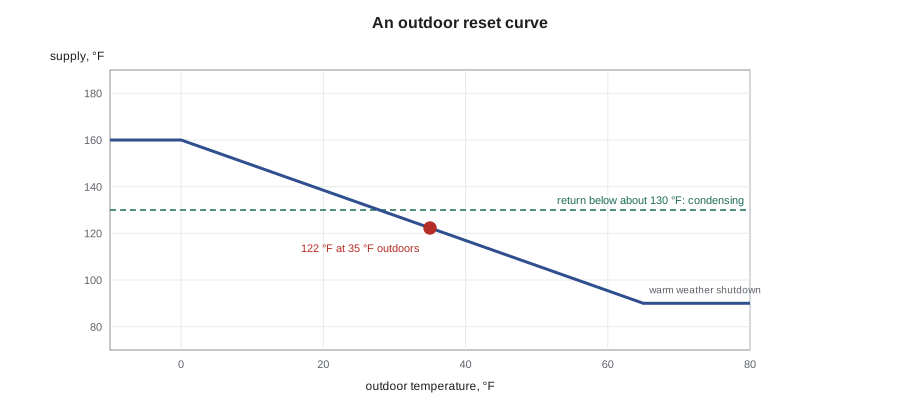
A building needs the most heat on the coldest day and very little on a mild one. Outdoor reset lowers the supply water temperature as the outdoor temperature rises, so the radiation delivers about the right amount of heat all the time instead of overheating the building in mild weather and cycling the boilers. The reset curve is a straight line set by two points: the supply temperature wanted at the coldest design outdoor temperature, and the supply temperature at the warmest outdoor temperature at which heat is still needed. Between them, the controller works out the supply temperature by proportion. Most controllers also have a warm weather shutdown above which the boilers do not run for heating at all. For condensing boilers, reset is what makes them condense: lower supply temperatures mean lower return temperatures and far more of the time below the flue gas dew point.
Worked problem
Working out the reset temperature
The Rymal reset curve runs from 160 °F supply at 0 °F outdoors to 90 °F supply at 65 °F outdoors. What supply temperature should the controller ask for when it is 35 °F outdoors?
Show solution
- Outdoor range of the curve:
- \[65 - 0 = 65 \text{ °F}\]
- Supply range of the curve:
- \[160 - 90 = 70 \text{ °F}\]
- Distance below the warm end at 35 °F outdoors:
- \[65 - 35 = 30 \text{ °F}\]
- Supply temperature:
- \[90 + \frac{30}{65} \times 70 = 90 + 32.3 = 122.3 \text{ °F}\]
Answer: At 35 °F outdoors the boilers should supply about 122 °F. With a temperature drop through the building, the return comes back well below 130 °F, so the boilers condense and run at their best efficiency.
What Ayesha found at Rymal
Maureen asked Ayesha to read the cascade controller's display before touching anything. It showed an outdoor temperature of −40 °F on a sunny afternoon of 70 °F, and a target supply temperature of 180 °F, the controller's maximum. "That's not the weather," Ayesha said. They walked around the building and found the outdoor sensor's wires dangling from the north wall; the sensor housing had been knocked off when the landscapers had trimmed the hedge. With its wires broken, the sensor read as an open circuit, which this controller interpreted as the coldest possible temperature, and it had been driving the boilers to full temperature on mild days. The building overheated, the zone valves closed, the flow through the boilers dropped, and the high limits tripped, exactly as in the worked example. The boilers had not condensed all week.
Ayesha replaced the sensor in a sheltered spot on the north wall, out of the sun and away from the exhaust vents, and spliced the wires with the connectors the controller maker specified. The display read 68 °F, within a degree of Maureen's thermometer, and the target supply dropped to the warm weather shutdown. Then, with the building manager's permission, they tested the safety controls on both boilers: they used the probe low-water cutoff's test function and watched each burner stop and lock out, stopped each boiler pump to confirm the flow switch opened, and lowered each manual-reset high limit below the water temperature to confirm it tripped and held the boiler off until reset. Ayesha recorded each test, with the time and the result, on the boiler room log sheet. "Write down the failures too," Maureen said. "A limit that works today and a sensor that failed last week are both part of the record."
Other boiler controls
Commercial boilers often carry several other controls. Low-fire hold keeps a modulating burner at low fire for a set time after light-off while the boiler warms, reducing thermal shock. Minimum run time and minimum off time settings stop short cycling. Return temperature protection, by a bypass, a mixing valve or a pump control, keeps non-condensing boilers from running with return water cold enough to condense. Sequencing or cascade controllers stage several boilers, as GAS-310 described. On steam boilers, the feed water control opens a feed valve or starts a feed pump when the level falls, and many are combined with the primary low-water cutoff. And most modern boiler controllers keep a history of starts, lockouts and limit trips, which is the first thing to read when a boiler misbehaves.
Common mistakes
MistakeRaising a high limit or jumpering a limit to stop nuisance trips.
InsteadFind out why the limit is tripping: setpoint, flow or sensor.
MistakeIgnoring low flow as a cause of high limit trips.
InsteadCheck pumps, strainers and zone valve behavior; halving the flow doubles the rise.
MistakeNever blowing down a float-type low-water cutoff.
InsteadBlow it down at the interval the maker requires and confirm the burner stops.
MistakeTrusting the controller's outdoor reading without checking it.
InsteadCompare it with a thermometer; a broken sensor can read as extreme cold.
MistakeSetting a steam pressure control without knowing whether the differential adds or subtracts.
InsteadRead the control's instructions and check the actual cut-in and cut-out.
Summary and key terms
- Operating controls run a boiler many times a day; limit controls act only when something is wrong and are usually manual reset on commercial boilers.
- Limits are wired in series in the safety chain ahead of the operating control and must never be bypassed.
- High limits trip from a high setpoint, low flow or a faulty sensor, and halving the flow doubles the temperature rise.
- Steam boilers need primary and secondary low-water cutoffs, and larger hot water boilers need a low-water cutoff or flow protection; float cutoffs must be blown down.
- Steam pressure controls cycle between cut-in and cut-out, set by a main scale and a differential, below a manual-reset high-limit pressure control and the relief valve.
- Outdoor reset lowers the supply temperature in a straight line as the outdoor temperature rises, which saves fuel and lets condensing boilers condense.
- Operating control
- A control that runs the boiler in normal service to hold a chosen temperature or pressure.
- Limit control
- A safety control that stops the burner only when a dangerous condition occurs.
- Safety chain
- The limit controls wired in series ahead of the burner control.
- Low-water cutoff
- A control that stops the burner if the boiler water level falls too low.
- Blowdown
- Draining water from a float chamber or boiler to remove sediment and test a low-water cutoff.
- Differential
- The difference between a control's cut-in and cut-out settings.
- Outdoor reset
- Control that lowers the supply water temperature as the outdoor temperature rises.
Practice problems
Work each problem on paper first, then reveal the answer to check.
What is the difference between an operating control and a limit control?
Show answer
An operating control runs the boiler in normal service; a limit control acts only when something has gone wrong.
Why are commercial high limits usually manual reset?
Show answer
So that the boiler stays off until a person investigates the cause.
A reset curve runs from 160 °F at 0 °F outdoors to 90 °F at 65 °F. What is the supply temperature at 50 °F outdoors?
Show answer
90 + (15 ÷ 65) × 70 = 90 + 16.2 = 106.2 °F.
How is a float-type low-water cutoff tested?
Show answer
By blowing down its float chamber while the burner fires and confirming that the burner stops.
What had caused the Rymal boilers to trip their high limits?
Show answer
A broken outdoor sensor read as extreme cold, the controller asked for full temperature, the building overheated, the zone valves closed and flow through the boilers fell.
Lesson quiz · 5 questions
Score 60% or more to complete this lesson.
Create a free account to save your progress, take quizzes and earn a certificate.