
GAS-320 · Lesson 5 of 12 · 26 min
Makeup air units and kitchen ventilation
▶ Video coming soon A video version of this lesson is on the way.
On Tuesday, October 6, the facilities office of the Columbus school district called Bayline about the cafeteria kitchen at Bellmont High School on the east side of Columbus. The kitchen staff started work at six, and for a week they had been complaining that the kitchen was freezing in the mornings, that smoke from the grill rolled out from under the hood instead of being drawn up into it, and that the back door to the loading dock was so hard to open that the cook had to brace a foot against the frame. The custodian had noticed one more thing: the small atmospheric water heater in the storeroom off the kitchen had a scorched patch on the wall above its draft hood. Maureen and Grant arrived at 6:15, while the kitchen was starting up. "Cold kitchen, smoky hood, heavy door, scorched draft hood," Maureen said. "Four symptoms, and I'd bet one cause. Let's go look at the makeup air unit."
This lesson explains why buildings with large exhaust systems need makeup air, how direct-fired and indirect-fired makeup air units work, what controls and safety devices they carry, how to calculate their heating load and what they add to the air, and how commercial kitchen hoods, fire suppression and makeup air are interlocked. GAS-110 met makeup air problems at Marigold Kitchen; this lesson goes into the equipment itself.
Why makeup air
Air cannot be exhausted from a building unless the same amount comes in somewhere. A commercial kitchen hood may exhaust 4,000 to 10,000 cfm, a laundry's dryers and a factory's process exhausts similar amounts. If nothing brings replacement air in deliberately, the building's pressure falls below outdoors until enough air leaks in through doors, cracks and, worst of all, down the vents and chimneys of atmospheric appliances. A makeup air unit, MUA, brings in outdoor air to replace the exhaust and heats it in cold weather so that the space stays comfortable. Without heat, nobody tolerates the cold air for long, and the unit gets switched off, which brings the problem back.
The consequences of not enough makeup air are the ones Bellmont's staff described: doors that are hard to open or slam, cold drafts at doors and windows, hoods that do not capture smoke because the fan cannot pull against the building's suction, and, the dangerous one, spillage and backdrafting of atmospheric appliances, which can put carbon monoxide into occupied rooms. NFPA 96, the standard for commercial kitchen ventilation that the building and fire codes reference, limits the negative pressure that a kitchen exhaust may create to about 0.02 in. w.c., which is a very small suction.
Direct-fired makeup air units
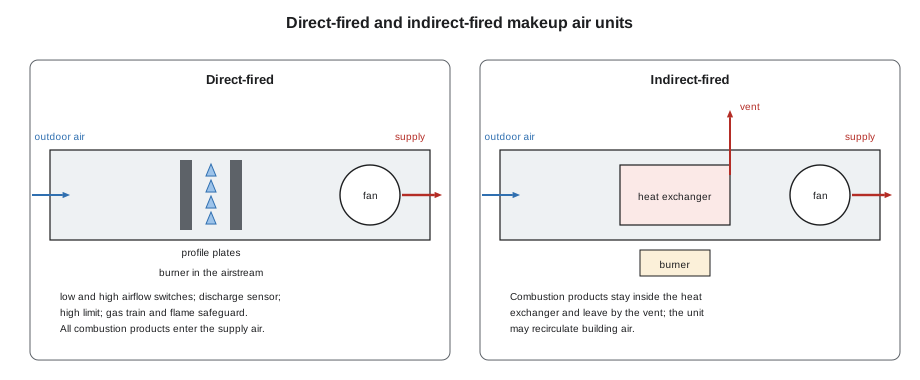
In a direct-fired unit the burner sits in the airstream. Outdoor air flows past a line or grid of burner sections, the gas burns in the air itself, and all the products of combustion, carbon dioxide, water vapor and small amounts of carbon monoxide and nitrogen dioxide, go into the supply air. Because none of the heat is lost up a vent, a direct-fired unit delivers almost all the gas's heat to the air, and the units are quick to respond and economical to run. The price is that the building's air receives the combustion products, so direct-fired units are built and certified to strict limits.
In both countries, direct-fired units are certified to the joint standards for direct gas-fired heating and ventilation appliances: ANSI Z83.4/CSA 3.7 for non-recirculating units, which supply only outdoor air, and ANSI Z83.18 for recirculating units, which may also take some air from the building. The standards limit what the burner may add to the airstream; the limits commonly quoted are about 5 ppm of carbon monoxide, 4,000 ppm of carbon dioxide and 0.5 ppm of nitrogen dioxide. A non-recirculating unit relies on the building exhausting at least as much air as it supplies, so that the combustion products leave with the exhaust. That is why a direct-fired unit is usually interlocked with the exhaust it serves.
A direct-fired burner needs the air crossing it to move at the right speed. Too little air and the flame is long and lazy and makes carbon monoxide; too much and the flame is blown out or burns incompletely. The burner sits in an opening framed by adjustable profile plates that set the air velocity across it, and two airflow switches, a low-airflow switch and a high-airflow switch, prove that the air across the burner is within the range the unit was set up for before the burner can light and while it runs. A discharge temperature sensor modulates the gas valve to hold a set supply temperature, and a high temperature limit shuts the burner off if the discharge gets too hot. The gas train, flame safeguard and purge are like those of a power burner, scaled to the unit's input.
Indirect-fired makeup air units
An indirect-fired unit heats the air through a heat exchanger, like a large furnace or rooftop heat section, and vents its flue gas outdoors. It is less efficient than a direct-fired unit, because some heat goes up the vent, but the supply air never receives combustion products, so indirect units can recirculate building air freely and are used where the supply air must be clean, as in some laboratories, or where the local authority prefers them. Their service is the service of any heat exchanger appliance: temperature rise, heat exchanger condition, venting and combustion.
Worked problem
How big a heater does the makeup air need?
Bellmont's makeup air unit supplies 5,000 cfm of outdoor air and is set to discharge at 65 °F. The design outdoor temperature is 0 °F. Find the heat needed, and the gas input if the direct-fired burner delivers 92 in 100 of the gas's heat to the air. The unit's rated input is 500,000 Btu/h.
Show solution
- Temperature rise:
- \[65 - 0 = 65 \text{ °F}\]
- Heat needed:
- \[1.08 \times 5{,}000 \times 65 = 351{,}000 \text{ Btu/h}\]
- Gas input:
- \[\frac{351{,}000}{0.92} = 381{,}500 \text{ Btu/h}\]
Answer: On the coldest design day the unit needs about 381,500 Btu/h of its 500,000 Btu/h rating, so it has some margin. It also needs that much gas while the kitchen is cooking, which matters when the gas piping for a kitchen is sized: the makeup air unit is often the biggest single load in a restaurant.
Worked problem
What a direct-fired burner adds to the air
At full input of 500,000 Btu/h, how much carbon dioxide does Bellmont's burner add to its 5,000 cfm of air? Use a heating value of 1,000 Btu per cubic foot and assume one volume of carbon dioxide for each volume of natural gas burned.
Show solution
- Gas burned:
- \[\frac{500{,}000}{1{,}000} = 500 \text{ ft}^3/\text{h}\]
- Air supplied per hour:
- \[5{,}000 \times 60 = 300{,}000 \text{ ft}^3/\text{h}\]
- Carbon dioxide added, in parts per million:
- \[\frac{500}{300{,}000} \times 1{,}000{,}000 = 1{,}667 \text{ ppm}\]
Answer: Even at full fire the burner adds well under the 4,000 ppm limit, because there is so much air for so little gas. The figure rises if the airflow falls while the burner keeps firing, which is exactly what the low-airflow switch is there to prevent.
Commercial kitchen hoods
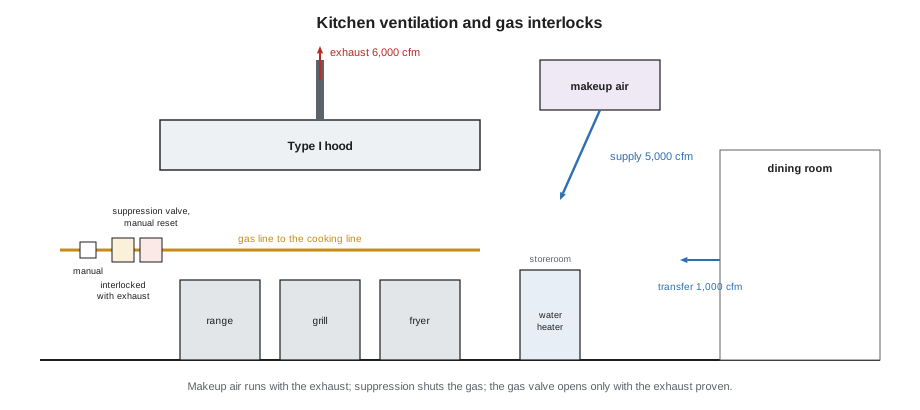
A commercial kitchen hood captures the heat, smoke, steam and grease from the cooking line and an exhaust fan carries it out of the building. A Type I hood, for appliances that produce grease and smoke, such as fryers, grills, ranges and woks, has grease filters or extractors, a welded grease duct and a fire suppression system. A Type II hood, for heat and steam only, from dishwashers and some ovens, is lighter. Hoods are listed to UL 710 and installed under NFPA 96 as referenced by the building and fire codes. The hood's exhaust rate is set by its listing or design, and the makeup air is designed to match it.
Three interlocks tie the hood, the cooking appliances and the makeup air together, and the gas technician is often the person who tests them.
- Makeup air with exhaust. The makeup air unit starts whenever the hood exhaust runs, so the kitchen is never exhausted without replacement air. Many kitchens also have a small, deliberate shortfall so that the kitchen stays slightly negative to the dining room and cooking smells do not drift out.
- Fire suppression shuts off the fuel. When the hood's fire suppression system discharges, it must automatically shut off the gas, and the electric power, to every appliance under the hood. The gas shutoff is usually a mechanical or electrically operated valve on the gas line to the cooking line that must be reset by hand after a discharge.
- Gas with exhaust. In many kitchens the gas valve on the cooking line also cannot open unless the exhaust fan is proven running, by a current switch on the fan motor or an airflow switch in the duct, so that nobody can cook with the hood off. Bellmont's school board requires this in all its kitchens.
What Maureen and Grant found at Bellmont
The makeup air unit, a direct-fired unit on the roof above the kitchen, was running its supply fan but its burner was off and its flame safeguard showed a lockout on low airflow. Grant traced the low-airflow switch's sensing tube from the switch to its pickup at the burner and found the plastic tube cracked through where it passed over a sharp sheet metal edge; with the tube open, the switch saw no pressure difference and reported no airflow. So every morning the unit tried to light, locked out, and blew 23 °F outdoor air straight into the kitchen. The staff, freezing, had found the makeup air switch on the hood's control panel and turned the unit off altogether.
With the makeup air off and the hood running, the kitchen was exhausting 6,000 cfm with only the dining room's transfer air and leakage to replace it. Maureen measured the kitchen at −0.09 in. w.c. against outdoors, more than four times the NFPA 96 limit. That suction slowed the hood's exhaust fan enough that the hood no longer captured the grill smoke, held the back door shut, and pulled flue gas down the storeroom water heater's vent and out of its draft hood, which was what had scorched the wall. Maureen's analyzer read 85 ppm of carbon monoxide at the water heater's draft hood with the hood exhaust running, and a spillage test with smoke confirmed that the heater was spilling continuously.
Worked problem
How much air was missing?
The hood exhausts 6,000 cfm. Normally the makeup air unit supplies 5,000 cfm and 1,000 cfm transfers from the dining room. With the makeup air unit off, what fraction of the exhaust has no planned replacement?
Show solution
- Planned replacement normally:
- \[5{,}000 + 1{,}000 = 6{,}000 \text{ cfm}\]
- With the makeup air off:
- \[6{,}000 - 1{,}000 = 5{,}000 \text{ cfm missing}\]
- Fraction:
- \[\frac{5{,}000}{6{,}000} = 0.83\]
Answer: More than four-fifths of the hood's exhaust had to come from leaks, doors and chimneys. In a tight modern building that produces a large negative pressure, and the easiest path for air to enter is often the vent of an atmospheric appliance.
Maureen shut off the water heater and tagged it until the building pressure problem was fixed. Grant replaced the airflow switch tubing with the maker's tubing, routed it away from the sharp edge with a grommet, and restarted the makeup air unit. The burner lit, proved, and modulated to hold the discharge temperature at 65 °F. With the unit running, the kitchen read −0.01 in. w.c., the hood captured the grill smoke, and the back door opened normally. They then retested the water heater: no spillage after the first minute and 12 ppm at the draft hood with the kitchen operating. Maureen returned it to service and left a written note to recheck it at the next visit.
Before leaving, Maureen tested the interlocks with the head cook watching. With the hood exhaust switched off, the makeup air unit stopped and the cooking line's gas valve closed; with the exhaust on, both came back. She wrote two recommendations for the school board: replace the separate makeup air switch on the hood panel with a single switch that runs both, so that the unit cannot be turned off while the hood runs, and replace the storeroom's atmospheric water heater with a direct-vent model that cannot spill into the building. "The staff weren't wrong to be cold," she told Grant. "The system gave them a switch that let them make it dangerous."
| Symptom in a kitchen | Likely makeup air cause |
|---|---|
| Cold drafts and complaints, unit blowing cold air | Burner locked out on airflow switch, flame failure or gas pressure |
| Hood does not capture smoke | Makeup air off or undersized; kitchen too negative |
| Doors hard to open or slamming | Large negative pressure from exhaust without makeup air |
| Spillage or scorching at draft hoods | Depressurization drawing flue gas into the building |
| Supply air too hot or burner cycling | Discharge sensor fault or wrong profile plate setting |
Common mistakes
MistakeLetting staff switch the makeup air off separately from the hood.
InsteadInterlock the makeup air with the exhaust, ideally on one switch.
MistakeTreating a direct-fired unit like an indirect one that can recirculate.
InsteadUse a non-recirculating unit only with exhaust at least equal to its supply.
MistakeBypassing an airflow switch because it keeps tripping.
InsteadFind the fault: tubing, pickup, filters, profile plates or fan.
MistakeTesting a kitchen's atmospheric appliances with the hood off.
InsteadTest spillage with the hood, makeup air and other exhausts in their worst real combination.
MistakeForgetting that the fire suppression gas valve needs a manual reset.
InsteadAfter a discharge or a test, reset it and confirm every appliance relights.
Summary and key terms
- Any building that exhausts large amounts of air needs makeup air, heated in cold weather, or it goes negative, doors stick, hoods fail to capture and atmospheric appliances spill.
- NFPA 96 limits kitchen depressurization to about 0.02 in. w.c..
- Direct-fired units burn gas in the airstream, deliver nearly all the heat to the air and are certified to ANSI Z83.4/CSA 3.7 (non-recirculating) or ANSI Z83.18 (recirculating), with limits on what they add to the air; they rely on profile plates, low and high airflow switches, discharge temperature control and a high limit.
- Indirect-fired units heat through a heat exchanger and vent their flue gas.
- Makeup air heat is about 1.08 × cfm × °F.
- Kitchen hoods are interlocked so that makeup air runs with the exhaust, fire suppression shuts off the gas and, in many kitchens, the gas cannot flow unless the exhaust is proven.
- Makeup air unit
- A unit that brings in and heats outdoor air to replace air exhausted from a building.
- Direct-fired
- Heated by a burner in the airstream, with combustion products entering the supply air.
- Indirect-fired
- Heated through a heat exchanger, with combustion products vented outdoors.
- Profile plate
- An adjustable plate that sets the air velocity across a direct-fired burner.
- Airflow switch
- A pressure switch that proves air movement across a burner or through a duct.
- Type I hood
- A kitchen hood for grease- and smoke-producing appliances, with grease removal and fire suppression.
- Transfer air
- Air that moves from one space to another, such as from a dining room into a kitchen.
Practice problems
Work each problem on paper first, then reveal the answer to check.
Why is a non-recirculating direct-fired makeup air unit interlocked with the exhaust?
Show answer
Because the combustion products in its supply air must leave with the exhaust.
What do a direct-fired unit's low and high airflow switches prove?
Show answer
That the air crossing the burner is within the range it was set up for.
A makeup air unit supplies 3,000 cfm with a rise of 55 °F. What heat does it deliver?
Show answer
1.08 × 3,000 × 55 = 178,200 Btu/h.
What must happen to the gas when a hood's fire suppression system discharges?
Show answer
The gas to every appliance under the hood must shut off automatically and stay off until reset by hand.
What had caused Bellmont's makeup air unit to lock out?
Show answer
A cracked airflow switch sensing tube made the low-airflow switch report no airflow.
Lesson quiz · 5 questions
Score 60% or more to complete this lesson.
Create a free account to save your progress, take quizzes and earn a certificate.