
GAS-120 · Lesson 5 of 12 · 21 min
Piping materials and joining methods in the code
▶ Video coming soon A video version of this lesson is on the way.
On a Saturday in November, Jonah helped Rosa run a gas line to an outdoor kitchen behind a house in Clintonville. The plan was simple on paper: a tee at the basement wall, a short run of black steel to the outside, then underground to a post beside the patio where the built-in grill would go. At the supplier's counter, Jonah reached for a coil of yellow plastic pipe and a box of brass compression fittings. Rosa put the fittings back. "The pipe's right for underground," she said. "Those fittings aren't approved for it, and the plastic doesn't come above ground except through a riser made for it. Let's look up what the code actually lets us use, joint by joint."
Earlier training introduced the common piping materials and their properties. This lesson looks at the same materials through the code: how the code decides which materials and fittings are permitted, which product standards they must meet, how joints must be made, which fittings are prohibited in concealed spaces, and the rules for protection, bonding and underground plastic. It is about reading the material clauses, not about sizing, which is the next lesson.
How the code approves materials
Gas codes do not usually name brands. They name product standards. A clause says, in effect, that steel pipe must meet one of a few named pipe standards, that tubing must meet another, and that plastic pipe must be certified or listed to a third. The product is acceptable if it is made, tested and marked to the named standard. That is why the marking printed or stamped on pipe, tubing and fittings matters: it tells the inspector which standard the product meets, its size and pressure class, and who made it.
The IFGC lists acceptable materials in its gas piping chapter and refers to standards such as ASTM A53 and A106 for steel pipe, ASTM B88 and B280 for copper tubing, ASTM D2513 for polyethylene gas pipe, ANSI LC 1 and CSA 6.26 for corrugated stainless steel tubing, and ANSI LC 4 for press-connect fittings. Valves, connectors and corrugated tubing must be listed for gas service. Where the code is silent on a material, the code official must approve it before it is used.
Materials are also limited by the gas. Copper and brass can be attacked by sulfur compounds, so the codes allow copper tubing only where the gas is not corrosive to it; the IFGC sets a limit on the hydrogen sulfide content of the gas and requires the supplier's information on it. Natural gas delivered by utilities in Ohio normally meets these limits, but check before using copper on a private or unusual supply.
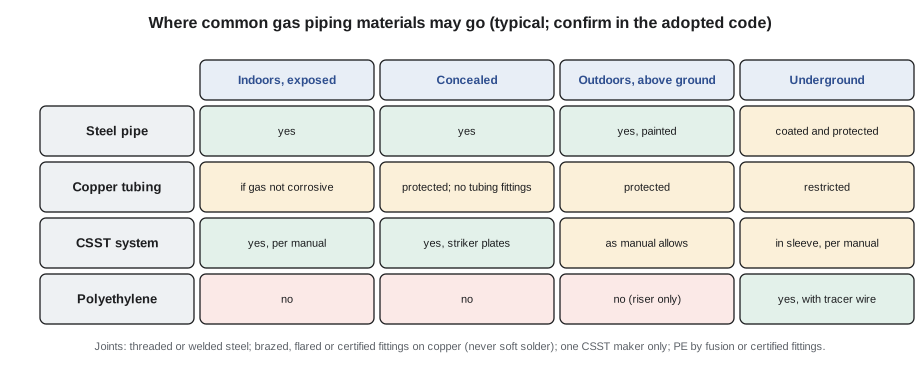
Steel pipe and threaded joints
Steel pipe is the reference material in every gas code. For building piping it must be at least the standard wall thickness, usually called Schedule 40, and may be black or galvanized. Joints are threaded, welded or made with fittings certified for gas. Threads must be tapered pipe threads cut cleanly to the proper length, so that enough threads engage and none are damaged. A thread that is too short, too long, crossed or torn will not seal reliably.
The code requires that the thread sealant, whether pipe joint compound or tape, be resistant to the action of the gas, and it is applied to the male threads only, so that no sealant is pushed into the pipe where it could block a regulator or orifice. Fittings must be malleable iron or steel, or another material the code permits. Welding of gas piping must be done by a welder qualified for the procedure, which is common in commercial work and less so in houses.
Copper tubing and its joints
Where copper is permitted, the code sets the tubing types and the joining methods. Copper tubing joints must be made with flared fittings, brazed joints, or fittings certified for gas, such as press fittings made for gas service. Joints made with ordinary soft solder are not permitted for gas, because soft solder has a low melting point and can fail in a fire, releasing gas just when it is most dangerous. Brazing alloys must meet the minimum melting temperature in the code. Compression fittings of the type used for water are generally not acceptable for gas unless certified for gas service.
Copper tubing is soft and must be protected where it could be damaged, such as where it passes through framing near the face of a stud, runs along a floor or is exposed to traffic. Flare joints must be made with the correct tool and the right flare nut, and must remain accessible unless the fitting is certified for concealed use.
Corrugated stainless steel tubing
Corrugated stainless steel tubing (CSST) is a flexible tubing system with a plastic jacket, sold with its own fittings, manifolds, striker plates and installation manual. The code allows it only as a certified or listed system: the tubing and fittings of one manufacturer, installed according to that manufacturer's instructions, usually by installers who have completed the manufacturer's training. Mixing one maker's fittings with another's tubing is not permitted.
The installation manual sets the rules for bends, supports, protection with striker plates where the tubing passes through framing near the surface, sleeves through masonry, and the use of the system outdoors. It also sets bonding requirements. CSST has been damaged by nearby lightning strikes, which can cause an electrical arc that perforates the thin wall. Bonding the system to the building's grounding electrode system reduces that risk. The IFGC requires CSST that does not have an arc-resistant jacket to be bonded with a copper conductor of at least 6 AWG, attached to a segment of rigid pipe or a fitting at the point where gas piping enters the building, and connected to the electrical service grounding system. The RCO has a matching requirement for houses. Some newer products have a conductive, arc-resistant jacket, and their instructions set their own bonding rules.
Fittings not allowed in concealed spaces
Some fittings are reliable when you can see and tighten them, but not when they are hidden and may loosen with vibration or temperature changes. The codes therefore prohibit certain fittings in concealed locations. The typical list includes unions, tubing fittings such as flare and compression fittings, running threads, right and left couplings, bushings and swing joints made of combinations of fittings. Fittings that are certified or listed for concealed use, such as the fittings of a CSST system or certain press fittings, are permitted. Threaded elbows, tees and couplings in steel pipe, properly made, are normally permitted in concealed spaces. Check the exact list in the adopted code.
| Fitting or joint | Exposed | Concealed |
|---|---|---|
| Threaded steel elbows, tees and couplings | Permitted | Permitted |
| Welded steel joints | Permitted | Permitted |
| Unions | Permitted | Not permitted |
| Flare or compression tubing fittings | Permitted if certified for gas | Not permitted unless certified for concealed use |
| Bushings | Permitted in some codes | Not permitted |
| Running threads, right and left couplings | Restricted | Not permitted |
| CSST fittings of the same system | Permitted | Permitted as the system instructions allow |
| Press fittings certified for gas | Permitted | Permitted if certified for concealed use |
Plastic pipe underground
Polyethylene (PE) gas pipe is permitted only underground and outdoors. It must be certified or listed for gas, joined by heat fusion or by mechanical fittings certified for PE gas pipe, and installed by people trained in those methods. It must not be used inside buildings or above ground, except where it enters a building or rises to an appliance through a factory-made riser, usually an anodeless riser with a steel or aluminum casing, that is certified for the purpose. The plastic pipe must not be exposed to sunlight, which degrades it.
Because plastic cannot be found with a metal detector, the code requires an electrically continuous tracer wire laid with the pipe, brought up at each end where it can be reached, so that the line can be located before anyone digs. Some installers also lay warning tape above the pipe. The trench must be free of rocks and debris that could damage the pipe, and the pipe must be laid in a bed of clean fill. The IFGC requires buried piping to have at least 12 inches of cover, with a shallower minimum allowed for individual lines to outdoor appliances such as grills and lights, and Columbus inspectors check the depth in the open trench.
Worked problem
Material list for the outdoor kitchen
The outdoor kitchen line runs 4 feet of steel inside the basement to the wall, then underground 46 feet to the grill post. The PE pipe enters the ground through a riser at the house and comes up through a second riser at the post. Each riser has 3 feet of vertical length. Rosa allows 2 feet of tracer wire at each end for the connection points. How much tracer wire is needed?
Show solution
- Tracer wire runs the underground length plus the two risers plus slack at each end:
- \[46 + 2(3) + 2(2)\]
- Work it out:
- \[46 + 6 + 4 = 56 \text{ ft}\]
- List the materials by code requirement:
- Steel pipe and malleable fittings inside, threaded with gas-rated sealant on male threads; a certified anodeless riser at each end; PE pipe certified for gas underground, joined by fusion or certified PE fittings; tracer wire; a shutoff valve at the grill.
Answer: Rosa buys 56 feet of tracer wire, rounded up to a full spool, and the brass compression fittings stay on the shelf. The inspector will want to see the trench depth, the tracer wire and the riser markings before the trench is backfilled.
Protection, sleeves and corrosion
Wherever piping might be damaged, the code requires protection. Piping that passes through masonry or concrete walls must be sleeved or otherwise protected, and the space between the pipe and sleeve sealed. Piping must not be embedded in concrete unless the code allows it and the pipe is protected. Steel pipe buried in soil corrodes unless it is coated with an approved coating and, where required, protected cathodically. Piping in contact with dissimilar metals or corrosive materials must be isolated. Outdoor steel piping should be painted to slow rust.
Physical damage is the other risk. Gas piping in a garage or a parking area must be placed or guarded where vehicles cannot strike it. Exposed piping near the floor in a workshop should be routed along a wall or protected. And piping must never be run through air ducts, chimneys, vents, dumbwaiter shafts or elevator shafts, where a leak would be carried through the building or the pipe would be exposed to heat.
Reading the markings
Before installing any pipe, tubing or fitting, read its marking and compare it with what the code requires. Steel pipe is usually stencilled along its length with the standard it meets, its size, its schedule or wall thickness and the mill. Copper tubing for gas is marked with its type and standard. CSST carries the manufacturer, the product name, the size and the certification mark on its jacket at regular intervals. PE gas pipe is printed with its standard, size, pressure rating, material designation and the date it was made, which matters because PE degrades in sunlight and old stock may not be accepted. Valves and connectors carry the mark of the body that certified them for gas.
An inspector who finds no marking, or the wrong one, can reject the material even if it looks identical to an approved product. Keep the packaging or labels for CSST fittings, connectors and press fittings until the inspection is complete, and photograph markings that will be hidden by finishes.
Common mistakes
MistakeUsing water-type compression fittings on gas tubing.
InsteadUse flared, brazed or certified gas fittings only.
MistakeSoldering copper gas tubing with soft solder.
InsteadBraze with an alloy that meets the code's minimum melting temperature, or use certified fittings.
MistakeHiding a union inside a wall.
InsteadKeep unions and tubing fittings exposed unless they are certified for concealed use.
MistakeMixing CSST brands.
InsteadUse one manufacturer's tubing and fittings and follow its manual, including bonding.
MistakeRunning PE pipe into a basement through a hole in the wall.
InsteadBring PE above ground only through a certified riser, and keep it outdoors and underground.
Summary and key terms
- The code approves materials by naming product standards, so markings matter.
- Steel pipe is threaded with gas-resistant sealant on male threads only, or welded by a qualified welder.
- Copper is allowed where the gas is not corrosive and must be flared, brazed or joined with certified gas fittings, never soft soldered.
- CSST is used only as a complete certified system, with striker plates and bonding as its instructions and the code require.
- Unions, tubing fittings, bushings and running threads are not allowed in concealed spaces unless certified for concealed use.
- PE is for outdoor underground use only, with tracer wire and certified risers.
- Piping must be protected from damage and corrosion and never run through ducts, chimneys or shafts.
- Product standard
- A standard that sets how a product is made, tested and marked; codes name these to approve materials.
- Thread sealant
- Pipe joint compound or tape resistant to gas, applied to male threads only.
- Brazing
- Joining metal with a filler that melts at a high temperature; required instead of soft solder on copper gas tubing.
- CSST bonding
- Connecting corrugated stainless steel tubing to the building grounding system to reduce lightning damage.
- Anodeless riser
- A factory-made fitting that brings underground plastic gas pipe above ground inside a metal casing.
- Tracer wire
- An electrically continuous wire buried with plastic pipe so that the pipe can be located.
Practice problems
Work each problem on paper first, then reveal the answer to check.
How does the code decide which pipe is acceptable?
Show answer
By naming product standards; the pipe must be made and marked to one of them.
Why is soft solder not allowed on gas tubing?
Show answer
It melts at a low temperature and can fail in a fire, releasing gas.
Name three fittings typically prohibited in concealed spaces.
Show answer
Any three of: unions, tubing fittings, running threads, bushings, right and left couplings, swing joints.
Where may PE gas pipe be used?
Show answer
Outdoors and underground only, coming above ground through a certified riser.
What reduces the risk of lightning damage to CSST?
Show answer
Bonding it to the building's grounding system as the code and manufacturer require.
Lesson quiz · 5 questions
Score 60% or more to complete this lesson.
Create a free account to save your progress, take quizzes and earn a certificate.