
GAS-120 · Lesson 3 of 12 · 21 min
Scope, approvals and certified equipment
▶ Video coming soon A video version of this lesson is on the way.
Luis Ferreira brought a problem back to the shop in early November. The owner of Marigold Kitchen had bought a second-hand wok range at an auction, imported from overseas, and wanted it hooked up before a busy weekend. Luis had looked for the certification label and found only a faded plate in another language with a pressure in millibars. "I told him I can't connect it," Luis said. "Not until somebody approves it." The owner had argued that a gas burner is a gas burner. Rosa used the story to start Jonah's next lesson. "Before you ask how to install something," she said, "ask two questions. Does this code apply to it? And is it allowed to be installed at all?"
This lesson covers the scope of the gas codes, meaning what they apply to and what they leave to other rules, and the approval of appliances, equipment and components. It explains what a certification or listing mark means, how to read a rating plate, what to do with equipment that is not certified, and why conversions and modifications need care.
What the code covers
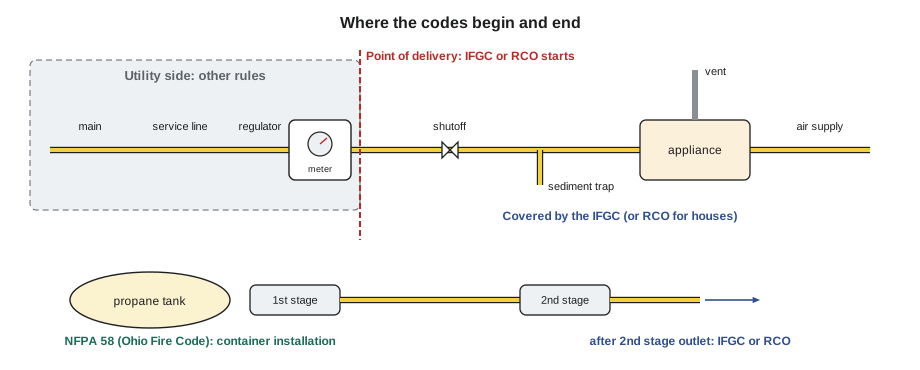
The scope section near the start of the IFGC says what it applies to. In broad terms, it covers fuel gas piping systems, fuel gas appliances, gaseous hydrogen systems and related accessories, and venting, from the point of delivery to the outlets of the appliance shutoff valves and to the appliances themselves. It also lists exclusions. Examples include the utility's own piping up to the point of delivery, LP-gas storage containers and the piping that is part of them, which are governed by NFPA 58 through the fire code, and certain industrial and process systems. In Ohio, one-, two- and three-family dwellings follow the scope of the Residential Code of Ohio instead. Read the scope section in full, because it decides whether everything that follows applies to your job.
Scope matters in the field. If a job sits outside the gas installation code, a different code and sometimes a different trade or regulator applies. A propane tank and its regulator at the tank are in one code, the piping from the second-stage regulator to the appliance in another. A utility's service regulator belongs to the utility; the piping after the meter belongs to the customer and the contractor. When you are not sure which side of a line you are on, ask before you touch it.
Approved, certified and listed
The IFGC requires appliances to be listed and labeled by an approved agency and installed according to the listing and the manufacturer's instructions. The listing agency tests a sample to the applicable product standard, such as an ANSI Z21 or Z83 standard for gas appliances or a UL standard, inspects the factory periodically and authorizes the manufacturer to apply its label. In the United States, testing laboratories are recognized by OSHA as Nationally Recognized Testing Laboratories; CSA Group, Intertek, UL Solutions and others list gas products. Products sold in both countries often carry a mark with indicators for both. A Canadian-only mark, or a foreign mark, is not enough for installation in Columbus.
A certification or listing applies to the product as built and as described in its instructions. It covers the gases, pressures, inputs, clearances, venting methods and installation conditions the manufacturer submitted for testing. Install the product outside those conditions, such as on the wrong gas, in a location the instructions prohibit, or with a vent the manufacturer did not specify, and the product is no longer installed as certified. That is why the manufacturer's instructions are treated as part of the code.
Components count too. Gas valves, regulators, flexible connectors, corrugated stainless steel tubing, press fittings, venting materials and controls must each be certified or listed for their use. A plumbing ball valve that looks like a gas valve is not one unless it carries the marking for gas service. A water-heater vent connector rated for a natural draft appliance cannot be used for a positive-pressure condensing appliance.
Reading a rating plate
Every certified or listed appliance has a rating plate, a permanent label with the information the installer and inspector need. It is the first thing to read on any job, before the instructions and before the code.
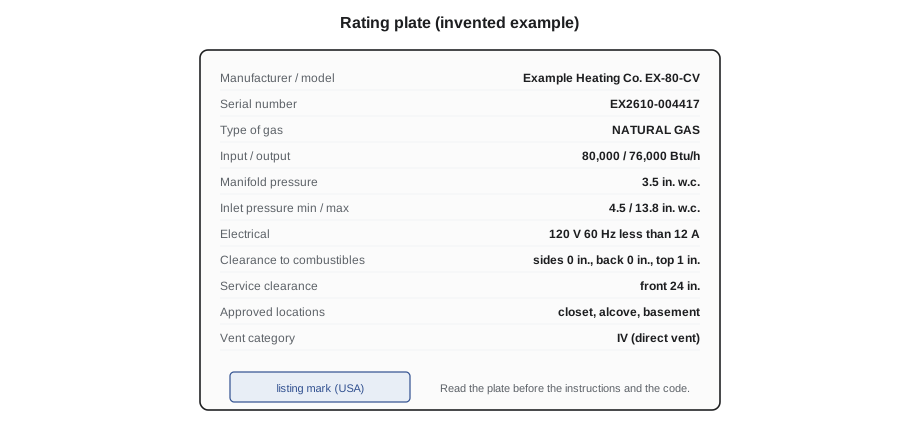
On the plate you should find the manufacturer, model and serial number; the type of gas the appliance is set up for; the input rating; the required manifold pressure and the minimum and maximum inlet pressures; electrical data; the clearances to combustibles; the locations the appliance is approved for, such as closet, alcove or garage; and the certification or listing mark. Many plates also show the vent category and the altitude range. If the plate is missing, damaged or unreadable, do not guess. Contact the manufacturer with the model and serial number, or treat the appliance as unapproved.
Worked problem
Checking a plate before connecting
A customer on Garfield Avenue bought a replacement furnace. The plate shows natural gas, 80,000 Btu/h input, minimum inlet pressure 4.5 in. w.c. and maximum 13.8 in. w.c. Rosa measures 7.0 in. w.c. static and 6.5 in. w.c. with the furnace running. The plate also shows a US listing mark. Can she proceed?
Show solution
- Check the gas type:
- Natural gas on the plate, natural gas at the house. It matches.
- Check the mark:
- A US listing mark is present, as the IFGC and RCO require.
- Check inlet pressure against the range, using the running value:
- \[4.5 \le 6.5 \le 13.8 \text{ in. w.c.}\]
- Check the margin above the minimum:
- \[6.5 - 4.5 = 2.0 \text{ in. w.c.}\]
Answer: The gas type, mark and inlet pressure all fit, with a comfortable margin above the minimum. Rosa can continue with the installation instructions and the code. She will still check the clearances, the vent and the air supply against the plate and the instructions.
Equipment that is not certified
Some equipment arrives without a recognized listing: imported appliances, custom industrial burners, older units, or listed appliances that have been modified. The IFGC allows the code official to approve an unlisted appliance only where the code permits it, usually after an evaluation by an approved agency, and Columbus may require the owner to provide documentation or a field evaluation by a recognized laboratory at the owner's cost. A field evaluation examines the particular unit at its site and, if it passes, the agency applies a field label. Until that is done, the equipment must not be connected. Commercial insurers and the fire department may also have requirements.
That is why Luis refused the wok range. Even if it burned well at the auction, nobody had checked its controls, its flame safeguard, its pressure regulation or whether its orifices suited the local gas. A restaurant range without a working flame failure device can fill a kitchen with unburned gas. The owner arranged a field evaluation, which found that the range needed a listed safety shutoff valve and new orifices before it could be labeled. Marigold Kitchen ran its weekend on the old range.
Conversions and modifications
Many appliances can be converted from natural gas to propane or the reverse. A conversion is allowed only when the manufacturer provides a conversion kit or instructions for that model, and it must be done exactly as the instructions say: new orifices, a changed or adjusted regulator spring, sometimes a different pilot. After conversion, the installer fixes the conversion label supplied with the kit to the appliance near the rating plate, records the work and checks the manifold pressure and combustion. Columbus may require a permit for a conversion, and the utility or propane supplier will want to know about it.
Modifying an appliance in any way the manufacturer does not authorize, such as drilling out orifices, bypassing a safety control, replacing a part with a non-equivalent one or adding a burner, voids its certification. A modified appliance is treated like uncertified equipment. Replacement parts should be the manufacturer's own or approved equivalents, and some parts, such as gas valves and flame safeguards, must be exact.
Damaged appliances need the same caution. An appliance that has been in a flood, a fire or a collision may have internal damage that is not visible: corroded controls, a cracked heat exchanger, a bent burner. Manufacturers generally require that an appliance whose controls have been under water be replaced or inspected by a qualified service agency before use. The safe default is to tag the appliance out of service and let the owner arrange a proper inspection or replacement.
| Situation | Can it be installed? | What is needed |
|---|---|---|
| Certified or listed appliance, correct gas, plate intact | Yes | Install to instructions and code |
| Certified appliance converted with manufacturer's kit | Yes | Follow kit instructions, fix the label, record and test |
| Imported appliance with no recognized mark | Not yet | Field evaluation by an approved agency, then code official approval |
| Certified appliance modified without authorization | No | Restore to certified condition or obtain approval |
| Appliance damaged by flood or fire | Not until checked | Inspection and repair or replacement as the manufacturer directs |
| Rating plate missing or unreadable | Not until identified | Contact the manufacturer; treat as unapproved until confirmed |
Product standards behind the marks
Each certification or listing is to a specific product standard. Most gas appliance standards are joint standards for both countries, published with an ANSI number and a CSA number, so that one test program can certify a product for the North American market with the country indicators each market needs. You do not need to memorize them, but you should recognize a few, because they appear on rating plates, in instructions and on supply house paperwork.
| Product | Joint North American standard |
|---|---|
| Gas-fired central furnaces | ANSI Z21.47 / CSA 2.3 |
| Gas water heaters (up to the residential size range) | ANSI Z21.10.1 / CSA 4.1 |
| Household cooking appliances | ANSI Z21.1 / CSA 1.1 |
| Vented gas fireplace heaters | ANSI Z21.88 / CSA 2.33 |
| Connectors for gas appliances | ANSI Z21.24 / CSA 6.10 |
| Manually operated gas valves | ANSI Z21.15 / CSA 9.1 |
A mark tells you a product met its standard when it left the factory. It does not tell you that the product is right for the job, that it was stored and handled properly, or that it has not been damaged since. A gas valve dropped off a truck, a connector kinked during installation or a furnace stored outdoors through a winter may no longer meet its standard. Inspect every product before you install it.
Used, relocated and replacement equipment
An appliance moved from one building to another, or bought second-hand, must still be certified or listed, undamaged, suited to the gas and pressure at the new site, and installed to the current code and its instructions. If the instructions are missing, get a copy from the manufacturer before installing. A used appliance that has been modified, converted without a kit or exposed to flood or fire is treated as unapproved until it is checked.
Replacement parts matter as much as whole appliances. A gas valve, pilot assembly, flame sensor, igniter, pressure switch or flame safeguard should be the manufacturer's part or a replacement the manufacturer or the certification allows. A universal part that fits physically may have a different pressure rating, timing or failure mode. When in doubt, use the original part and record what was installed.
Finally, remember that a rating plate describes the appliance for one gas. An appliance converted from natural gas to propane must carry its conversion label, and the plate and label together describe it. On an old appliance without a conversion label, never assume which gas it is set for; check the orifices and regulator against the manufacturer's data before lighting it.
Common mistakes
MistakeAssuming any gas product sold in a store is approved for the job.
InsteadCheck for a recognized certification or listing mark for the country and the use.
MistakeAccepting a mark from another country.
InsteadIn Columbus, look for a US listing by an approved agency.
MistakeConnecting an imported appliance because it seems to work.
InsteadArrange a field evaluation and the code official's approval before it is connected.
MistakeDrilling out orifices to get more heat.
InsteadNever modify an appliance outside the manufacturer's instructions; it voids the certification and can cause carbon monoxide or overheating.
Summary and key terms
- The scope clause says what the code applies to and what it leaves to other rules, such as the utility's piping and propane storage.
- Appliances and components must be approved, normally by listing and labeling by an approved agency.
- A certification applies to the product as built and installed according to its instructions.
- Read the rating plate first: gas type, input, pressures, clearances, approved locations and mark.
- Equipment without a recognized mark needs a field evaluation and the code official's approval before use.
- Conversions must use the manufacturer's kit and be labeled; unauthorized modifications void approval.
- Scope
- The part of a code that states what it applies to and what it does not.
- Certification
- Testing and marking of a product by an accredited body showing it meets a standard.
- Listed and labeled
- Appearing on an approved agency's list after evaluation, and carrying that agency's mark.
- Rating plate
- The permanent label on an appliance giving its gas type, input, pressures, clearances, approvals and mark.
- Field approval
- Inspection and labeling of one particular uncertified unit at its site by an authorized body.
- Conversion
- Changing an appliance from one gas to another using the manufacturer's kit and instructions.
Practice problems
Work each problem on paper first, then reveal the answer to check.
Why read the scope clause first?
Show answer
It decides whether the code applies to the job at all, and which other rules take over.
What does a certification mark tell you?
Show answer
A recognized body tested the product to a standard and checks its production.
Name four things to check on a rating plate.
Show answer
Any four of: gas type, input, manifold and inlet pressures, clearances, approved locations, mark, vent category.
What happens to an appliance's certification if it is modified without authorization?
Show answer
It is void; the appliance must be restored or approved again.
What must be added after converting an appliance to propane?
Show answer
The conversion label from the kit, fixed near the rating plate, plus a record of the work and checks.
Lesson quiz · 5 questions
Score 60% or more to complete this lesson.
Create a free account to save your progress, take quizzes and earn a certificate.