
GAS-120 · Lesson 11 of 12 · 22 min
Testing, purging and putting a system into service
▶ Video coming soon A video version of this lesson is on the way.
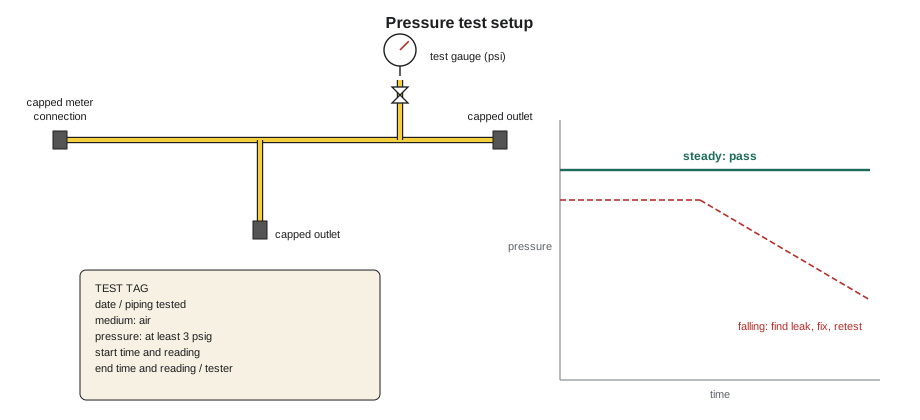
The new Garfield Avenue main went in on a Thursday: 1 inch black steel from the meter to the first tee, the old piping beyond it reused after a check. Before anything was covered, Rosa capped the open ends, closed the appliance valves, connected a test gauge and pumped the system up with air from a small hand pump. Then she wrote the time and the pressure on a tag and hung it on the gauge. "Now we wait," she said, and sent Jonah to the truck for the purge hose and the gas detector. "Testing tells you the pipe holds. Purging gets the air out and the gas in without filling the basement. Then you light things one at a time. Every step has a rule, and you write down every step."
Earlier training covered why piping is tested and how a test is run. This lesson looks at how the code sets out testing, purging and putting a system into service: what the test clauses require you to decide, how to read them, what records and tags are expected, and how the purging rules changed after serious incidents. It ends with the sequence for turning gas on and lighting appliances.
What the test clause requires
Every gas code requires new piping, and any piping that has been altered, to be pressure tested before it is covered, concealed or put into service. The test proves that the piping and every joint hold pressure without leaking. A test clause sets out five things: the test medium (what you pressurize with), the test pressure, the test duration, the gauge to be used, and what to do with appliances and components that cannot take the test pressure.
In the IFGC, the minimum test pressure is one and a half times the proposed maximum working pressure, but never less than 3 psig, whatever the design pressure. Systems at much higher pressures have their own, higher test requirements. The test duration in the IFGC depends on the volume of the piping, while the RCO, like the model residential code it is based on, sets a shorter fixed minimum for house piping. The City of Columbus inspector witnesses the test at rough-in and may set the gauge and duration to be used, so ask what the inspector expects before you book the inspection.
The test medium is air, nitrogen, carbon dioxide or another inert gas, as the code permits. Never use oxygen, which can react violently with oil or grease in the piping, and never use the fuel gas itself for a pressure test of new piping. Water is not used, because it is hard to remove from gas piping and causes corrosion and regulator problems.
Appliances and components that cannot withstand the test pressure, such as appliance gas valves, regulators and some meters, must be isolated from the test. Where the test pressure is higher than the component's rating, the code requires it to be disconnected and the opening capped, not just isolated by closing a valve, because a closed valve can leak through. Where the test pressure is low enough, closing the appliance shutoff valve may be permitted. The code clause and the component's rating decide which.
Gauges and readings
The gauge must be able to show a small loss. A gauge whose full scale is many times the test pressure, with coarse graduations, may hide a leak that drops the pressure by less than one graduation. The codes set requirements for the range and graduations of test gauges, and some inspectors require a gauge with a current calibration record or a digital gauge that logs readings. Electronic gauges are now common, but they must be zeroed and used within their rated range.
Worked problem
Working out the test pressure
What minimum test pressure does the IFGC require for (a) a low-pressure house system working at 7 in. w.c., (b) a 2 psi elevated-pressure system, and (c) a 5 psi elevated-pressure system?
Show solution
- Convert the low-pressure system to psi and apply one and a half times:
- \[\frac{7}{27.7} \approx 0.25 \text{ psi} \qquad 1.5 \times 0.25 \approx 0.38 \text{ psi}\]
- Compare with the 3 psig floor:
- 0.38 psi is less than 3 psig, so the test is at 3 psig.
- For the 2 psi system:
- \[1.5 \times 2 = 3 \text{ psi} \Rightarrow 3 \text{ psig}\]
- For the 5 psi system:
- \[1.5 \times 5 = 7.5 \text{ psi} \Rightarrow 7.5 \text{ psig}\]
Answer: Low-pressure and 2 psi systems test at a minimum of 3 psig; the 5 psi system tests at a minimum of 7.5 psig. The inspector, the RCO for houses, and the components' ratings may call for more, and appliances and regulators that cannot take the test pressure must be disconnected and capped.
Pressure in a sealed system changes with temperature. Piping that warms in the sun or cools as a basement door is left open can gain or lose pressure without any leak. Start and finish the test at stable temperatures, keep the piping out of direct sun, and treat any drop as a leak until you have found a cause. When a test fails, find the leak with a leak detection solution or an electronic detector, repair it, and repeat the full test. Never tighten a joint while the system is under test pressure.
Records and tags
A test that is not recorded did not happen, as far as an inspector or an investigator is concerned. Record the date, the piping tested, the test medium, the test pressure, the start and end times and readings, the gauge used, the result and who did it. In Columbus, the inspector records the rough-in approval, and Bayline keeps its own test record with the job file. Records matter years later, when someone needs to know what was tested and to what pressure.
Purging: why the rules tightened
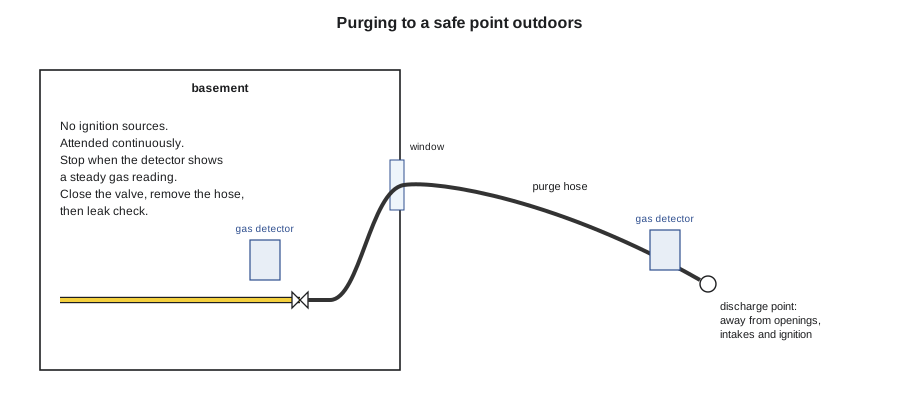
After a successful test, the piping is full of air or inert gas. Purging replaces it with fuel gas, so that appliances receive gas rather than air when they light. Purging is dangerous, because for a time the discharge contains a mixture of gas and air that passes through the flammable range. Released indoors, near an ignition source, it can explode.
Purging rules became much stricter after serious incidents. In February 2010, workers at the Kleen Energy power plant under construction in Middletown, Connecticut used natural gas at high pressure to blow debris out of new piping, releasing a large volume of gas outdoors near ignition sources. The explosion killed six people. That and other purging incidents led to changes in NFPA 54, the IFGC and other codes, and to a separate NFPA standard against using flammable gas to clean piping. Today, using fuel gas to clean or blow out piping is prohibited, and purging is a controlled procedure.
The IFGC sets out when piping must be purged directly to the outdoors and when it may be purged indoors, based on pipe size and length: larger piping, and smaller piping beyond set lengths, must be purged to the outdoors through a hose or pipe to a safe point away from openings, air intakes and ignition sources. Where purging indoors is allowed, the space must be ventilated, ignition sources eliminated, a person must attend continuously, and a combustible gas indicator must be used to watch the gas level and to tell when purging is complete. The purge must stop as soon as gas is detected at the discharge at a steady level.
Worked problem
How much gas is in the pipe?
Rosa will purge a run of 1-1/4 inch steel 100 feet long. The inside diameter of 1-1/4 inch Schedule 40 pipe is about 1.38 inches. What volume of air must be displaced, in cubic feet?
Show solution
- Find the inside cross-sectional area:
- \[\frac{\pi}{4} \times 1.38^2 \approx 1.50 \text{ in}^2\]
- Multiply by the length:
- \[1.50 \times 1{,}200 = 1{,}800 \text{ in}^3 \qquad \frac{1{,}800}{1{,}728} \approx 1.04 \text{ ft}^3\]
Answer: The pipe holds about 1 cubic foot of air. Purging must displace this and a little more, because gas and air mix at the boundary, which is why the purge ends when the detector shows a steady gas reading, not after a set time. A small volume like this still makes a flammable mixture if released into a closed room.
Putting the system into service
Once the piping is tested, inspected where required and purged, gas can be introduced to the appliances. The general sequence is the same in every code.
First, the gas supply is turned on: Columbia Gas sets or turns on the meter once the city has approved the piping, and the fitter opens the building valve. Second, with all appliance valves closed, every joint that was not under the test, such as the connection to the meter, is leak checked at operating pressure with a leak detection solution or an electronic detector. Third, each branch is purged up to its appliance valve as the code allows. Fourth, each appliance is lit one at a time, following its own instructions, and its gas pressure, input, ignition, flame, venting and safety controls are checked. Fifth, the appliance connectors and fittings are leak checked again with the appliance running.
Finally, the owner is shown the shutoff valves and given the instructions, and the work is recorded: what was installed, the test, the start-up readings and any problems found. Columbus requires a final inspection for permitted work, and the contractor must not leave an appliance operating if it fails its checks. If anything is unsafe, it is shut off, tagged and reported, as you learned in an earlier course.
| Stage | Code questions to answer |
|---|---|
| Before the test | Which test pressure and duration apply? Which components must be disconnected and capped? |
| During the test | Is the gauge suitable? Are temperatures stable? Is anyone working on the piping? |
| After the test | Is the result recorded and the piping tagged? Has the inspector seen it where required? |
| Purging | Must this piping be purged outdoors? Are ignition sources removed and a detector in use? |
| Putting into service | Are untested joints leak checked? Is each appliance lit and checked one at a time? |
| Closing out | Has the owner been shown the shutoffs? Are records complete? |
Additions, repairs and reconnections
Not every job needs a full pressure test of the whole system. When new piping is added to an existing system, the new section is pressure tested before it is connected, and the joint that connects it to the existing piping is leak checked at operating pressure after gas is turned on. When an appliance is replaced on an existing outlet, the new connector and fittings are leak checked. When gas has been shut off to a building, such as after a meter change, a fire or a long vacancy, the system must be checked for tightness before appliances are relit. Some utilities and inspectors require a full test of the existing piping in those cases, or a meter test showing no flow with all appliances off.
Whatever the job, the principle is the same: no gas goes into piping that has not been proven tight, and no appliance is left operating until it has been checked. If you are unsure which test applies to a repair or addition, ask your supervisor and check the clause before you open the gas.
Common mistakes
MistakePressure testing with oxygen or with the fuel gas.
InsteadUse air or an inert gas, as the code permits.
MistakeLeaving an appliance gas valve connected during a high-pressure test.
InsteadDisconnect and cap components that cannot take the test pressure.
MistakeUsing a gauge whose graduations are too coarse.
InsteadUse a gauge whose range and graduations can show a small loss.
MistakePurging into a basement with the water heater pilot lit.
InsteadPurge outdoors where required; indoors only with ventilation, no ignition sources and a gas detector.
MistakeLighting all the appliances at once.
InsteadLight and check each appliance one at a time, following its instructions.
Summary and key terms
- New and altered piping must be pressure tested before it is covered or used.
- The test clause sets the medium, pressure, duration, gauge and how to isolate components.
- The IFGC requires at least one and a half times the working pressure and never less than 3 psig; the RCO and the inspector set the duration for houses. Use air or inert gas, never oxygen or fuel gas, and disconnect components that cannot take the pressure.
- Record every test.
- After the 2010 Kleen Energy explosion and other incidents, purging rules tightened: purge outdoors where the code requires, indoors only with ventilation, no ignition sources, continuous attendance and a gas detector.
- Put the system into service in order: supply on, leak check untested joints, purge branches, light and check each appliance, record and instruct.
- Pressure test
- Pressurizing new or altered piping to prove it holds pressure without leaking.
- Test medium
- The gas used for a pressure test: air or an inert gas, never oxygen or fuel gas.
- Purging
- Displacing air or inert gas from piping with fuel gas, or fuel gas with air or inert gas, under control.
- Combustible gas detector
- An instrument that measures flammable gas in air, used to monitor purging.
- Leak check
- Checking joints at operating pressure with a detection solution or detector.
Practice problems
Work each problem on paper first, then reveal the answer to check.
Name the five things a test clause sets out.
Show answer
Test medium, test pressure, duration, gauge, and how to isolate appliances and components.
Why is oxygen never used to test gas piping?
Show answer
It can react violently with oil or grease in the piping.
Why must components rated below the test pressure be disconnected rather than just valved off?
Show answer
A closed valve can leak through and expose the component to the test pressure.
When is purging complete?
Show answer
When the gas detector at the discharge shows a steady gas reading.
Why are appliances lit one at a time?
Show answer
So each can be checked for pressure, ignition, flame, venting and controls, and problems traced to their source.
Lesson quiz · 5 questions
Score 60% or more to complete this lesson.
Create a free account to save your progress, take quizzes and earn a certificate.