
GAS-120 · Lesson 2 of 12 · 20 min
Definitions and the language of the code
▶ Video coming soon A video version of this lesson is on the way.
Jonah's first code quiz in evening class came back with a red circle around one answer. The question had asked whether a furnace shutoff valve had to be accessible, and Jonah had written that it had to be easy to reach. His instructor had written beside it: "Accessible and readily accessible are different defined terms. Look them up." Rosa read the note over his shoulder the next morning. "Every word in that book that matters has a definition," she said. "Half the arguments on job sites are two people using the same word for different things."
This lesson shows how a gas code is organized, how to read its numbering, and how the definitions section changes the meaning of ordinary words. It explains the difference between mandatory and advisory language, introduces the terms you will meet most often, and gives you a method for finding the answer to a question in a code book you have never opened before.
How the code is organized
The IFGC is divided into numbered chapters: administration, definitions, general regulations, combustion and ventilation air, gas piping installations, chimneys and vents, specific appliances, and so on. Sections are numbered by chapter, so section 406 is in chapter 4, and subsections add decimal places, such as 406.4.1. Items in a list are often numbered 1, 2, 3. Tables carry the section number, such as Table 402.4(1). At the back are appendices, which are not part of the code unless the jurisdiction adopts them specifically; the IFGC's pipe sizing worked examples are in an appendix. NFPA 54 uses chapters too, with its own numbering and with informative annexes at the back. The Residential Code of Ohio puts its fuel gas rules in one chapter based on the International Residential Code, whose fuel gas sections carry numbers beginning with G, such as G2417.
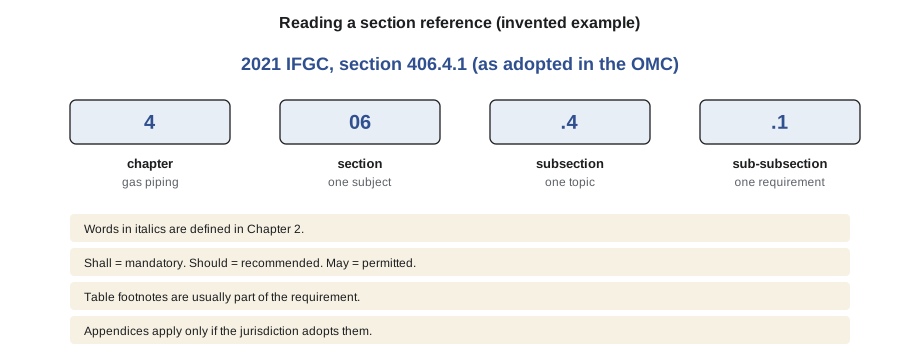
When you cite a requirement, give the code, the edition and the full number, for example 2021 IFGC, section 406.4.1, as adopted in the 2024 OMC. A bare number is not enough, because the same subject may carry a different number in another edition, and numbers move when clauses are added or removed.
Shall, should and may
Codes use a small set of words with fixed meanings. Shall expresses a mandatory requirement: the installation must do it to comply. Shall not is a prohibition. Should expresses a recommendation, something advisable but not required; it appears mostly in notes, annexes and commentary. May grants permission or describes an option: the installer is allowed to do it but does not have to. Can describes a possibility or capability, not a permission. Reading "may" as "must", or "should" as "shall", is one of the most common errors in apprentice exams and on job sites.
Notes deserve care. A note attached to a clause or table usually explains or gives an example; it is not a requirement unless the code says otherwise. In the IFGC and NFPA 54, explanatory material is placed in commentary, annexes or informational notes, which are not requirements, while table footnotes are often part of the requirement. When in doubt, treat a table footnote as part of the table.
| Word | Meaning | Example of use |
|---|---|---|
| shall | mandatory requirement | The piping shall be tested before it is covered. |
| shall not | prohibition | Unions shall not be installed in a concealed location. |
| should | recommendation only | The installer should keep a copy of the test record. |
| may | permission or option | The connector may be a listed flexible connector. |
| can | possibility | Condensate can freeze in an outdoor drain. |
The definitions section
Chapter 2 of the IFGC holds its definitions, and the code prints defined terms in *italics* in the text. A defined term has the meaning in chapter 2, not the everyday meaning. A term not defined in the IFGC takes the meaning given in the other International Codes, and failing that, its ordinary meaning in context. NFPA 54 places its definitions in chapter 3 and marks those taken from other NFPA documents. The Residential Code of Ohio has its own definitions chapter, plus definitions in its fuel gas chapter, and Ohio changes some of them.
Reading definitions is slow at first. It soon becomes a habit: when a clause turns on a word such as accessible, combustible, concealed, appliance or vent, flip to the definitions before deciding what the clause requires. The definitions often contain the real requirement. A clause may say only that a valve shall be accessible; the definition tells you what accessible means.
Terms you will use every day
Accessible means able to be reached for inspection, service or repair, but possibly only after removing a panel, door or similar cover. Readily accessible is stricter: able to be reached quickly, without removing anything and without climbing over obstacles or using a portable ladder. A shutoff valve behind a removable access panel is accessible; a valve in the open beside the appliance is readily accessible. Codes use the stricter term for things you must reach in a hurry.
Appliance means a device that uses gas as fuel to produce light, heat, power, refrigeration or air conditioning. Equipment in some codes covers devices that are not appliances, such as piping components, regulators or controls. The IFGC also uses equipment broadly for devices other than appliances, such as piping, regulators and controls. The difference matters because many clauses apply only to appliances.
Approved means acceptable to the authority having jurisdiction. It is not the same as certified or listed, although an AHJ normally accepts certified or listed products. Listed means a product appears on a list published by an approved testing agency that has evaluated it to a standard, and labeled means it carries that agency's label or mark. The IFGC usually requires appliances to be both listed and labeled.
Combustible material means material made of or surfaced with wood, paper, fiber, plastic or other material that can ignite and burn, whether or not it is flame-proofed or plastered. Noncombustible material means material that will not ignite and burn when exposed to fire, as defined by a recognized test. Drywall, often thought of as fireproof, has a paper face; codes treat it as combustible for clearance purposes unless the code says otherwise.
Concealed means hidden by the structure of a building, such as inside a wall, floor or ceiling, so that the piping or part cannot be reached without removing a permanent finish. The code restricts which fittings may be used in concealed locations, which you will study in lesson 5.
Input rating is the gas-burning capacity of an appliance in Btu per hour, as shown on its rating plate. Pressures in the code are gauge pressures unless stated otherwise. The IFGC uses point of delivery for the place where the utility's piping ends and the customer's piping begins, usually the outlet of the meter or of the service regulator. Qualified agency means a person or firm experienced in gas work, licensed where required. Licensing of contractors in Ohio is governed by state law through the Ohio Construction Industry Licensing Board, not by the IFGC.
Vent, vent connector and chimney are three different things. A vent is a listed passage for carrying flue gases from an appliance to the outdoors. A vent connector is the pipe that connects the appliance's flue outlet to the vent or chimney. A chimney is a structure, usually masonry or factory-built, meant to carry flue gases from solid, liquid or gas fuels. Direct-vent appliance means an appliance built so that all its combustion air comes directly from outdoors and all its flue gases go directly outdoors, through a sealed system. You will meet all of these again in lesson 9.
Worked problem
Accessible or readily accessible?
A clause requires a shutoff valve to be readily accessible. Rosa checks three proposed locations for the valve on a new gas fireplace: (1) in the open on the wall beside the fireplace; (2) inside the fireplace's lower louver panel, which lifts off by hand; (3) in the ceiling below, behind a screwed-on access hatch, reached with a stepladder.
Show solution
- Look up both terms in the definitions.
- Readily accessible means reachable quickly without removing panels and without a portable ladder.
- Check location 1:
- Nothing to remove and no ladder needed, so it is readily accessible.
- Check location 2:
- Many fireplace manufacturers place the valve behind the lower louver and the appliance's certification allows it there. The code wording and the manufacturer's instructions must be read together, and the AHJ's interpretation applies.
- Check location 3:
- A screwed-on hatch and a ladder: accessible, but not readily accessible.
Answer: Location 1 clearly meets a readily accessible requirement and location 3 clearly does not. Location 2 depends on the exact wording of the adopted code and the appliance's certification, so Rosa checks both and, if still unsure, asks the inspector. The point is that the answer comes from the definitions, not from what feels easy to reach.
A method for finding answers
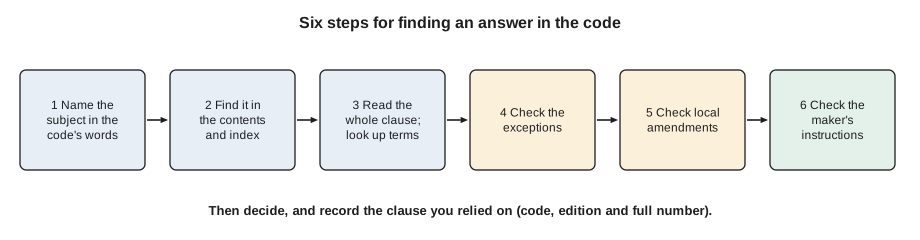
Experienced technicians find things in the code quickly because they follow the same steps each time. First, name the subject in the code's own words: not "the furnace pipe" but vent connector; not "gas line to the stove" but appliance connector. Second, look in the table of contents for the section on that subject, then in the index at the back. Third, read the whole clause, including its items, notes and any table it points to, and look up every defined term. Fourth, check for exceptions, which may sit in the same clause or in a later one. Fifth, check the Ohio amendments for changes to that clause. Sixth, check the manufacturer's instructions. Only then decide.
Mark up your own code book. Rosa uses tabs for the sections she opens most, highlights the clauses she cites often, and writes the local amendment beside each clause it changes. Most jurisdictions allow you to bring your own code book into a certification exam, provided it is free of loose notes, so a well-tabbed book is a real advantage. Many certification and licensing exams for gas work allow the code book, so check the current exam rules early. The exam tests whether you can find the answer, not whether you have memorized it.
Units, tables and footnotes
The IFGC gives values in US customary units, sometimes with metric equivalents in parentheses. Rating plates on imported equipment may show kilopascals, millibars or kilowatts, so a gas fitter must convert carefully. The code's own values in inches, feet, psi and Btu per hour are the ones that govern in Ohio; a rounded metric conversion is for information only.
Tables in the code are read the same way every time. Read the title, which states what the table applies to. Read the column and row headings, including their units. Read every footnote, because footnotes often limit the table to certain conditions or tell you how to adjust a value. Then read the value. Many errors on exams and on job sites come from a correct reading of the wrong table, or from a footnote that was skipped.
Handbooks and commentary
Alongside the code, the standards bodies publish handbooks and commentaries that explain the intent of each clause, give examples and show diagrams. ICC publishes a commentary on the IFGC, and NFPA publishes a handbook for NFPA 54. These are excellent study aids and often settle what a clause means, but they are not the code. An inspector enforces the adopted text. If the handbook and the code seem to disagree, the code governs.
Training materials, manufacturer bulletins, trade magazine articles and online forums are useful too, but they can be out of date, written for another jurisdiction or simply wrong. Treat them as pointers to the clause, and always read the clause itself before relying on them.
Common mistakes
MistakeReading may as must.
InsteadMay grants permission; only shall makes something mandatory.
MistakeTaking the everyday meaning of a word printed in italics.
InsteadItalic words are defined; read the definition before deciding.
MistakeCiting a clause by number only.
InsteadCite the code, the edition and the full number, and check the local amendments.
MistakeStopping at the first sentence of a clause.
InsteadRead the whole clause, its items, notes, tables and exceptions.
MistakeTreating drywall as noncombustible for clearance purposes.
InsteadTreat it as combustible unless the code specifically says otherwise.
Summary and key terms
- The IFGC is organized in chapters and sections, with appendices that apply only if adopted; the RCO keeps its fuel gas rules in one chapter. Shall is mandatory, shall not prohibits, should recommends and may permits.
- Defined terms appear in italics and take the meaning in the definitions section.
- Accessible allows removing a panel; readily accessible does not.
- Approved means acceptable to the AHJ; listed and labeled means tested to a standard by a recognized body.
- To find an answer, use code words, the contents and index, the whole clause, the definitions, exceptions, local amendments and the manufacturer's instructions.
- Shall
- Mandatory; the installation must do it to comply.
- May
- Permitted but not required.
- Accessible
- Reachable for service, possibly after removing a panel or door.
- Readily accessible
- Reachable quickly, without removing panels, climbing over obstacles or using a portable ladder.
- Approved
- Acceptable to the authority having jurisdiction.
- Concealed
- Hidden by building structure so that it cannot be reached without removing a permanent finish.
- Combustible material
- Material that can ignite and burn, including materials with combustible facings such as paper-faced drywall.
Practice problems
Work each problem on paper first, then reveal the answer to check.
What is the difference between shall and should?
Show answer
Shall is mandatory; should is a recommendation only.
How do you know a word in the code is defined?
Show answer
It is printed in italics; its meaning is in the definitions section.
Is a valve behind a removable panel readily accessible?
Show answer
No. It is accessible, because a panel must be removed to reach it.
Does approved mean the same as certified or listed?
Show answer
No. Approved means acceptable to the AHJ; certification or listing is evidence an AHJ usually accepts.
What should you check after reading a clause in the CSA or ICC code?
Show answer
The exceptions, the local amendments and the manufacturer's instructions.
Lesson quiz · 5 questions
Score 60% or more to complete this lesson.
Create a free account to save your progress, take quizzes and earn a certificate.