
GAS-120 · Lesson 1 of 12 · 22 min
How gas codes are written and adopted
▶ Video coming soon A video version of this lesson is on the way.
On the Monday after the Barton Street investigation, Hank Morrow put a new book on Jonah's desk in the Bayline shop. It was a bundle: the Ohio Mechanical Code with the International Fuel Gas Code inside it, the Residential Code of Ohio, and Bayline's reference copies of NFPA 54 and NFPA 58. Tabs from Rosa Delgado's own copy stuck out of the pages like feathers. "You've spent two months learning why gas is dangerous," Hank said. "This is the book that says what we do about it. Every job we sign off, we're signing that it meets this."
Jonah flipped through it and frowned. "Who decides what goes in here?" Rosa laughed. "That's the right first question. If you know who writes the code and how it becomes law, you'll know which edition applies, who can bend it and who you call when it isn't clear."
This lesson explains where gas codes come from, how a voluntary standard becomes a legal requirement, who enforces it in Ohio and in Columbus, and how a technician keeps up as editions change. The rest of the course teaches you to find and apply the rules inside.
Standards, model codes and law
Three ideas are easy to mix up. A standard is a document written by a standards organization that sets out minimum requirements for a product or an activity. A model code is a standard written so that a government can adopt it as its building or installation code. A regulation or statute is law made by a government. A standard or model code has no legal force on its own. It becomes mandatory only when a government with authority over the work adopts it, usually by naming it in a regulation and stating which edition applies and from what date.
In the United States, two organizations publish the model fuel gas codes. The National Fire Protection Association (NFPA) publishes NFPA 54, the National Fuel Gas Code, jointly with the American Gas Association, which publishes the same text as ANSI Z223.1. NFPA also publishes NFPA 58, the Liquefied Petroleum Gas Code, which covers propane storage, cylinders, tanks, transfer and LP-gas systems. The International Code Council (ICC) publishes the International Fuel Gas Code (IFGC) as part of its family of building codes, and much of the IFGC's technical content parallels NFPA 54. Neither organization makes law. A state, county or city decides which code, which edition and which amendments apply.
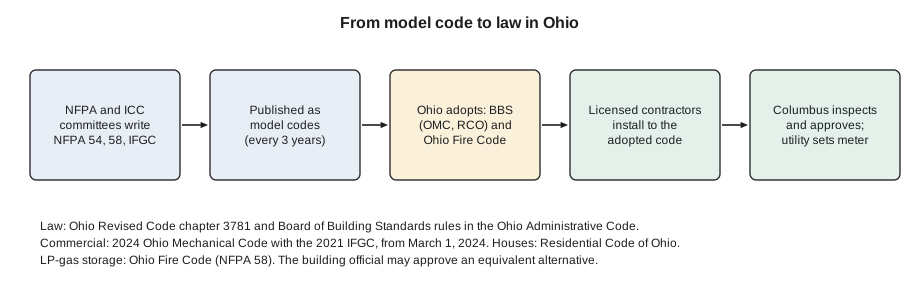
How a code is written
NFPA codes are written by technical committees of volunteers balanced among interests: manufacturers, users, installers, enforcers, insurers, utilities, labs and consumers. Anyone may submit public input online. The committee meets, acts on every input and publishes a first draft. The public then submits public comments on the draft, the committee acts again and publishes a second draft, and members can bring certain motions to the NFPA technical meeting before the Standards Council issues the new edition. NFPA 54 and NFPA 58 are revised on a three-year cycle. The ICC process is different: anyone may propose a change, committees hold public hearings, and final votes are cast by governmental members, the building officials who will enforce the code. The ICC codes are also on a three-year cycle.
The result is a document that reflects decades of field experience, incident investigations, laboratory testing and argument among people who do the work. Most clauses exist because something went wrong somewhere. When a requirement seems fussy, it is worth asking what failure it was written to prevent. You will usually find a fire, an explosion, a carbon monoxide poisoning or a leak behind it.
Codes are revised regularly because technology and experience change. New materials appear, such as corrugated stainless steel tubing and press-connect fittings. New appliance types arrive, such as condensing water heaters and high-efficiency boilers with plastic vents. Incidents reveal gaps, and research changes what is considered safe. The 2024 editions of NFPA 54 and NFPA 58 are current, and a 2027 edition of NFPA 54 was in revision as this course was written; Ohio's commercial code is based on the 2021 IFGC.
How Ohio adopts the codes
In Ohio, the Board of Building Standards (BBS), part of the Ohio Department of Commerce, adopts the state's building codes as rules in the Ohio Administrative Code. The Ohio Mechanical Code (OMC) covers mechanical systems in commercial buildings and multifamily buildings beyond the residential code's scope; the 2024 OMC took effect on March 1, 2024 and brings in the 2021 IFGC with Ohio changes. The Residential Code of Ohio (RCO) covers one-, two- and three-family dwellings and includes its own fuel gas chapter based on the International Residential Code. Storage of LP-gas is governed by the Ohio Fire Code, enforced by the State Fire Marshal and local fire departments, which brings in NFPA 58. Where Ohio adopts a model code, the Ohio text with its amendments is the law; the unamended model code is only a reference.
Ohio's approach means two buildings in Columbus can follow different fuel gas rules. A new single-family house follows the fuel gas chapter of the Residential Code of Ohio; a new restaurant or office follows the IFGC as adopted in the OMC. Ohio does not adopt NFPA 54 directly for building installations, but NFPA 54 remains a valuable reference, and many manufacturers' instructions, utility tariffs and training materials point to it. Other states adopt the IFGC, NFPA 54 or both, on their own schedules and with their own amendments, so a gas fitter who moves from Ohio to Pennsylvania or Indiana must learn a different set of local rules.
| Item | What to check |
|---|---|
| State law and administrative rules | Ohio Revised Code chapter 3781 and the BBS rules in the Ohio Administrative Code |
| Adopted codes | Ohio Mechanical Code (2021 IFGC) and Residential Code of Ohio; Ohio Fire Code for LP-gas storage (NFPA 58) |
| Effective dates | March 1, 2024 for the current OMC; check the BBS site for the current RCO edition |
| Local changes | Ohio amendments in the state codes; local rules only where state law allows |
| Who enforces | City of Columbus Building and Zoning Services; fire officials for LP-gas storage; the utility at meter set |
Authorities, inspectors and interpretations
Every code gives final say on its meaning to the authority having jurisdiction, usually shortened to the AHJ. The AHJ is the organization, office or person responsible for enforcing the code and approving installations. On most jobs it is the inspector or the office the inspector works for. When the wording is unclear, two reasonable technicians can read the same clause two ways. The AHJ decides which reading applies on that job.
In Columbus, the chief building official and the inspectors of Building and Zoning Services are the AHJ for fuel gas piping and appliance installations. They review permit drawings for larger projects, carry out rough-in and final inspections, and approve the piping for gas service. Columbia Gas of Ohio will not set a meter or turn on gas to new piping until the city has approved it. When a design does not fit the code's wording, the building official can approve an alternative material, design or method if the applicant shows it is at least equivalent, and Ohio has a process to appeal an official's decision. ICC and NFPA also publish formal and informal interpretations, but the local official decides how the adopted code applies to a particular job.
An inspector's interpretation is not a personal opinion. It is a judgment about what the code requires on that job. If you disagree, ask politely which clause the inspector is applying and how. Most disagreements end when both people look at the same text and the same field conditions. If the disagreement continues, every jurisdiction has a formal route for review or appeal, which the contractor, not the apprentice, normally takes.
Manufacturers' instructions and other documents
The installation code is not the only document that governs a job. Manufacturers' installation instructions carry great weight, because the appliance was tested and certified to be installed that way. The code itself requires installers to follow those instructions. When the code and the instructions differ, the general rule is that the more stringent requirement governs. The IFGC requires listed appliances to be installed according to their listing and the manufacturer's instructions as well as the code. If following one would mean breaking the other, stop and ask the manufacturer and the AHJ before going further.
Other documents also apply. The Ohio Building Code or RCO governs the building around the appliance, including fire-resistance-rated assemblies and structural support. The National Electrical Code, as adopted in Ohio, governs wiring to appliances and the bonding of piping. Columbia Gas's tariff and service requirements govern the meter, the service regulator and the point of delivery where the utility's responsibility ends. Your employer's procedures and the job specification may add requirements beyond the code. A good gas fitter knows which document answers which question.
Keeping current
Each new edition brings changes, and the changes take effect on a specific date. Work is normally judged by the code in force when it was permitted or installed, not when it is inspected years later. Existing installations that met the code of their day are usually allowed to remain, unless they are unsafe or are altered. When you replace an appliance or extend piping, the new work must meet the current code, and connecting it may make you responsible for checking parts of the existing system it relies on, such as the vent or the air supply.
Keeping current is part of the job. Technicians attend code update sessions, read the change summaries published by the standards body and the regulator, and mark up their own copies. Rosa keeps a list taped inside the front cover of her code book: the clauses that changed in the latest edition, and the local amendments she meets most often. "The day you stop reading the code is the day you start installing the last edition," she told Jonah.
Worked problem
Which edition applies?
Bayline installed a furnace in a Columbus restaurant in January 2024 and another in May 2024. Which edition of the IFGC, as adopted in the OMC, governed each installation?
Show solution
- Find the effective date of the current adoption:
- The 2024 OMC, adopting the 2021 IFGC, took effect on March 1, 2024.
- Compare each installation date with it:
- January 2024 is before March 1, 2024; May 2024 is after it.
- Apply the edition in force for each date, then check for transition rules:
- The January job falls under the code adopted before March 1, 2024 (the earlier edition of the OMC and the IFGC edition it adopted); the May job falls under the 2021 IFGC as adopted.
Answer: Each job is judged by the code in force when the work was done. Any transition rules in the adopting document can change this, and for permitted work the relevant date may be the permit application date, so check the adopting document and ask the AHJ when a job straddles the change.
From an incident to a clause
It helps to follow one change through the system. Suppose investigators find that several carbon monoxide incidents share a cause: a type of vent connector that separates when a water heater is bumped, as happened on Parsons Avenue. The investigators, a regulator or an industry group writes a proposal to change the code, perhaps requiring a fastening method or a support for that type of connector. The proposal goes to the technical committee, which studies the evidence, asks manufacturers and installers about cost and practicality, and votes on wording. The draft goes out for public comment, the committee answers the comments, and the change appears in the next edition. Then the Board of Building Standards or the fire code authority decides when to adopt that edition, with any Ohio changes, and sets an effective date.
From the first incident to the day the rule is enforceable can take five years or more. That is why regulators also have faster tools: state and local officials can issue interpretations and, in urgent cases, emergency rules, and manufacturers can issue safety notices and recalls. A technician who reads only the code book can be years behind the safest practice. Bayline's monthly safety meeting, run by Priya Nair, always includes a few minutes on new advisories, recalls and code changes.
For an apprentice, the practical message is simple. Know which edition you are working to, know where the local amendments are, read the notices your employer passes on, and when something in the field does not match the book, ask before you proceed.
Common mistakes
MistakeQuoting the newest model code when the jurisdiction has not adopted it yet.
InsteadUse the edition and amendments the jurisdiction has actually adopted, from the date they take effect.
MistakeTreating the code as the only document that matters.
InsteadFollow the manufacturer's instructions, the building and electrical codes, the utility's rules and the job specification as well; where they differ, the more stringent requirement usually governs.
MistakeArguing with an inspector from memory.
InsteadAsk which clause applies, look at the text together and, if needed, let the contractor use the formal review process.
MistakeAssuming a variance or approval from one job applies to the next.
InsteadAn approval of an alternative applies only to the site and conditions it names.
Summary and key terms
- A standard or model code becomes law only when a government adopts it.
- NFPA writes NFPA 54 and NFPA 58 by consensus in balanced technical committees, and ICC writes the IFGC with final votes by building officials. Ohio adopts the 2021 IFGC in the Ohio Mechanical Code from March 1, 2024, covers houses in the Residential Code of Ohio, and brings in NFPA 58 through the Ohio Fire Code. The authority having jurisdiction has final say on how the code applies to a job.
- Manufacturers' instructions must be followed, and the more stringent requirement usually governs.
- Work is judged by the code in force when it was done.
- Standard
- A document from a standards organization setting minimum requirements; not law until adopted.
- Model code
- A standard written to be adopted by governments as their code.
- Authority having jurisdiction (AHJ)
- The organization, office or person responsible for enforcing the code and approving installations.
- Adoption
- The legal act by which a state or city makes a model code edition, with its amendments, enforceable.
- Consensus
- Substantial agreement among a balanced committee, reached through a documented process with public review.
- Variance or alternative approval
- A material, design or method not described in the code that the building official approves as at least equivalent.
Practice problems
Work each problem on paper first, then reveal the answer to check.
Why does a CSA or NFPA document have no legal force on its own?
Show answer
It is written by a private standards body; it becomes law only when a government adopts it.
Which code governs fuel gas work in a new single-family house in Columbus?
Show answer
The fuel gas chapter of the Residential Code of Ohio.
Who has final say on how a clause applies to a particular job?
Show answer
The authority having jurisdiction, normally through its inspector or official.
If the code and the manufacturer's instructions differ, which usually governs?
Show answer
The more stringent requirement; when they truly conflict, stop and ask the manufacturer and the AHJ.
Which edition of the code governs a job?
Show answer
The one in force when the work was done (or permitted), subject to any transition rules.
Lesson quiz · 5 questions
Score 60% or more to complete this lesson.
Create a free account to save your progress, take quizzes and earn a certificate.