
ELEC-420 · Lesson 12 of 12 · 25 min
Maintenance, predictive testing, documentation and capstone
Commissioning proves an installation works on the day it is handed over; maintenance keeps it working. Electrical equipment deteriorates through heat, dust, moisture, vibration, contamination, mechanical wear and electrical stress, and poorly maintained equipment fails more often and more violently: a breaker that has not operated for years may not trip when needed, increasing arc flash incident energy and fire risk. This final lesson covers maintenance strategies from reactive to predictive, electrical preventive maintenance programs and the standards that guide them, condition monitoring techniques including thermography, ultrasound and online monitoring, maintenance of key equipment, records and trending, and a capstone exercise that brings together troubleshooting and commissioning.
Maintenance strategies
Maintenance strategies range from simple to sophisticated:
- Reactive (run to failure): repair equipment only when it breaks. Acceptable for cheap, non-critical items, but costly and dangerous for critical equipment.
- Preventive (time-based): inspect, clean, test and service at fixed intervals, such as annually, regardless of condition.
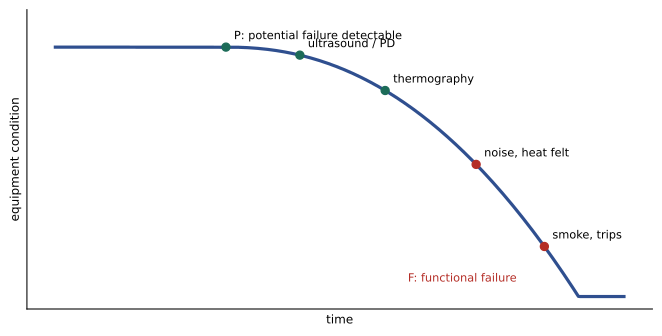
- Predictive (condition-based): monitor condition with tests and sensors and intervene when indicators show deterioration, reducing unnecessary work while catching problems early.
- Reliability-centered maintenance (RCM): analyze how each asset can fail, the consequences of failure and the most effective tasks to prevent or detect it, combining the other strategies according to criticality.
Most electrical maintenance programs combine preventive tasks for safety-critical functions, such as exercising breakers and testing protective relays, with predictive techniques such as thermography for detecting developing faults.
In the United States, NFPA 70B Standard for Electrical Equipment Maintenance, which became a mandatory standard in its 2023 edition, requires an electrical maintenance program with equipment condition assessments and intervals, and NFPA 70E links maintenance to arc flash risk, since poorly maintained protective devices may clear faults more slowly than the arc flash study assumes.
Electrical maintenance programs
An effective electrical maintenance program has several elements: an inventory of equipment with criticality ratings; a written plan specifying tasks and intervals for each type of equipment; qualified personnel and contractors; procedures that include safety requirements; records of all inspections, tests and repairs; and a process for acting on findings. Maintenance intervals depend on equipment condition, which standards assess using factors such as the physical condition of the equipment, its criticality and the operating environment. Equipment in poor condition, critical to operations or exposed to harsh environments (dust, moisture, corrosive atmospheres, high temperatures or vibration) needs more frequent attention. Short, frequent visual inspections, such as checking for signs of heating, damage, water, missing covers and unusual sounds or smells, catch many problems cheaply between formal maintenance visits.
Condition monitoring techniques
Predictive maintenance uses several condition monitoring techniques:
- Infrared thermography (Lesson 5): annual or more frequent scans of energized distribution equipment under load find loose connections, overloads and imbalances. Findings are prioritized by temperature rise and corrected, and rescanned to confirm.
- Airborne ultrasound: detects the high-frequency sound of arcing, tracking and corona in switchgear and on overhead lines, even inside enclosures, and helps find partial discharge in medium-voltage equipment.
- Partial discharge monitoring: online sensors in medium-voltage switchgear, cables and transformers detect discharges that precede insulation failure.
- Vibration analysis: for motors, generators and rotating equipment, detects bearing wear, misalignment, imbalance and looseness.
- Oil analysis and dissolved gas analysis for transformers (Lesson 11).
- Insulation resistance and polarization index trending for motors and cables (Lesson 3).
- Power monitoring: permanently installed meters trending currents, voltages, harmonics and events.
- Battery monitoring: internal resistance and float voltage trending for UPS and DC systems.
Online monitoring systems, increasingly connected to maintenance software, alert staff when values cross thresholds or trends change, so maintenance can be scheduled before failure.
Maintaining key equipment
Typical maintenance tasks for major equipment include:
- Switchgear and panelboards: inspect for heating, contamination, moisture and damage; clean; check and torque connections where indicated (preferably verified by thermography or resistance testing rather than routine retorquing, which can damage hardware); test insulation; check heaters, ventilation and interlocks.
- Circuit breakers: exercise (open and close) regularly, because mechanisms that sit for years can stick; clean and lubricate per the manufacturer; test trip units by primary or secondary injection at intervals; measure contact resistance.
- Protective relays: verify settings and test operation at intervals, and after any change.
- Transformers: thermography, oil analysis, insulation testing, cooling system checks, tap changer maintenance.
- Motors and drives: vibration and thermography, insulation resistance trending, cleaning of cooling paths and filters, checking drive fans and capacitors.
- UPS and batteries: battery testing and replacement at end of life, capacitor and fan replacement, transfer testing.
- Generators and transfer switches: monthly and annual load testing (ELEC-410 Lesson 12).
- GFCIs, AFCIs and GFPE: periodic testing.
| Equipment | Typical predictive tasks | Typical preventive tasks |
|---|---|---|
| Switchgear | Thermography, ultrasound, PD monitoring | Cleaning, inspection, IR testing |
| Breakers | Contact resistance trending | Exercise, lubrication, trip testing |
| Transformers | DGA, thermography, power factor | Cooling and tap changer service |
| Motors | Vibration, IR/PI trending, thermography | Lubrication, cleaning |
| Batteries | Internal resistance, float voltage | Capacity testing, replacement |
| Cables | PD and tan delta trending | Termination inspection |
Records and trending
Maintenance records are only useful if they are complete, accessible and used. A computerized maintenance management system (CMMS) schedules tasks, stores results and history, and generates work orders. The real value of records comes from trending: comparing each test with previous results for the same equipment, and with similar equipment, to see deterioration before it becomes failure. A motor whose insulation resistance has dropped by half each year, a breaker whose trip time is drifting toward the edge of its band, or a connection whose temperature rise increases at each scan all need action even if no single reading fails a limit. Records also support arc flash study updates, insurance and regulatory requirements, and investigations after incidents.
Worked problem
Trending motor insulation
A critical 600 V pump motor has annual temperature-corrected insulation resistance readings of 2,400 MΩ, 1,900 MΩ, 900 MΩ and 350 MΩ over four years, and PI values of 3.1, 2.8, 2.0 and 1.4. All readings are above a 100 MΩ minimum. What action is appropriate?
Show solution
- Insulation resistance has fallen steadily, dropping faster in recent years.
- PI has fallen from a healthy 3.1 to 1.4, below the 2.0 guideline.
- The trend indicates moisture, contamination or insulation deterioration, even though the absolute value still exceeds 100 MΩ.
- Plan to inspect the motor and terminal box, clean and dry the windings, and retest; consider a surge test.
- Prepare a spare or rewind before failure, because the trend suggests failure may occur within a year or two.
Answer: Act now: the declining trend and low PI signal deterioration; inspect, clean, dry, retest and plan replacement.
Capstone: troubleshooting and commissioning project
The capstone integrates the course. You are the lead electrician for a small manufacturing facility that has added a new production line: a 600 A distribution panel fed from the main switchboard, a motor control center with several VFD-driven motors, a PLC-controlled conveyor with guard interlocks, a rooftop exhaust fan and new lighting with occupancy controls. Prepare:
- A commissioning plan: scope, roles, pre-functional checklists for the panel, MCC, motors and controls, an energization plan with sequence and safety measures, and functional test scripts for the conveyor sequence, interlocks, VFD settings and lighting controls.
- Test records: insulation resistance and continuity results, torque records, breaker settings checked against the coordination study, phase rotation and motor rotation checks, and GFPE testing if applicable.
- An arc flash and safety review: confirm labels are current for the new equipment, list the PPE and approach boundaries for energized tasks, and write the lockout procedure for the conveyor.
- Three troubleshooting scenarios from start-up, each documented with the seven-step method: a VFD tripping on overcurrent during acceleration, a conveyor that will not start because of a misadjusted guard switch, and nuisance tripping of a GFCI on a washdown receptacle caused by moisture.
- A maintenance plan for the new equipment, with predictive and preventive tasks and intervals, and a baseline thermographic survey once the line is running at normal load.
The finished package should allow the owner to operate and maintain the line safely, demonstrate that it was built and tested correctly, and give the next troubleshooter the information they need.
Maintenance and arc flash studies
Maintenance and arc flash safety are closely linked. Arc flash studies calculate incident energy assuming protective devices clear faults within their published times, but a poorly maintained breaker with dried lubricant, contaminated contacts or a drifting trip unit may operate much more slowly, or not at all, allowing the arc to burn longer and releasing far more energy than the label indicates. For this reason, safety standards require that equipment be maintained in accordance with the manufacturer's instructions or industry consensus standards, and that the condition of maintenance be considered in arc flash risk assessments. Arc flash studies should be reviewed at least every five years and whenever the system changes, including changes in utility fault current, transformer replacements, new generators and changes to protective device settings.
Spare parts and obsolescence
A maintenance program also plans for failures that will eventually occur. Critical spares, such as breakers, trip units, contactors, drive modules, fuses and transformers for key loads, should be identified and stocked or available on short notice, because lead times for electrical equipment can be months. Obsolete equipment, for which spare parts and manufacturer support are no longer available, poses a growing risk; a plan to replace it before failure, often combined with upgrades in arc flash mitigation and monitoring, is part of responsible asset management. Records of equipment age, condition and support status help prioritize capital spending.
Training and competence
Maintenance and testing are only as good as the people performing them. Technicians need training in the specific equipment, test methods and safety procedures, and refresher training as standards and equipment change. Documenting qualifications, supervising new technicians on complex tasks, and reviewing test results with experienced engineers maintain quality. Many organizations combine in-house staff for routine tasks with specialized contractors for tasks such as relay testing, transformer diagnostics and medium-voltage cable testing.
Continuous improvement
Finally, a maintenance program should improve over time. Reviewing failures and near misses, comparing actual failure rates with expectations, adjusting intervals based on condition data, and adopting new monitoring technologies where they pay off turn maintenance from a fixed routine into a learning system. The same seven-step thinking from Lesson 1, gather information, form hypotheses, test, act and document, applies to the program as a whole: each failure is a symptom of something the program can learn from.
Maintenance documentation for the next technician
Good maintenance records serve the next technician as much as the program manager. Each record should state what was done, the readings, the as-found and as-left condition, any parts replaced and any concerns noted for follow-up, written so someone unfamiliar with the equipment can understand them. Photos of equipment condition, thermal images and nameplate data attached to records add context. When a fault occurs years later, these records often provide the crucial clue, such as a connection that was repaired once before, a motor that was rewound, or a breaker whose trip time was already drifting.
Planning outages for maintenance
Many maintenance tasks require equipment to be de-energized, which in busy facilities means planned outages. Effective programs group tasks so that each outage accomplishes as much as possible, coordinate with operations well in advance, prepare procedures, tools and spare parts beforehand, and include contingency plans if problems are found. Temporary power or redundant supplies can keep critical loads running during outages. Outages are also opportunities for tests that cannot be done energized, such as insulation testing, breaker primary injection and transformer diagnostics.
Common mistakes
MistakeRunning critical electrical equipment to failure.
InsteadUse preventive and predictive maintenance by criticality.
MistakeNever exercising breakers.
InsteadOperate and test breakers at regular intervals.
MistakeRetorquing all connections routinely.
InsteadVerify with thermography or resistance testing and follow manufacturer guidance.
MistakeFiling test results without comparing them.
InsteadTrend results to detect deterioration early.
MistakeIgnoring maintenance in arc flash studies.
InsteadPoor maintenance can lengthen clearing times and raise incident energy.
Summary and key terms
- Maintenance strategies range from reactive to preventive, predictive and RCM.
- Electrical maintenance programs need inventories, plans, procedures and records.
- CSA Z463 and NFPA 70B guide electrical maintenance programs.
- Thermography, ultrasound, PD, vibration and oil analysis detect developing faults.
- Exercise breakers, test relays and trend insulation and connection results.
- Trends reveal deterioration before limits are exceeded.
- The capstone combines commissioning, safety, troubleshooting and maintenance planning.
- Reactive maintenance
- Repair after failure.
- Preventive maintenance
- Time-based servicing and testing.
- Predictive maintenance
- Condition-based intervention.
- RCM
- Reliability-centered maintenance.
- Condition monitoring
- Measuring equipment health indicators.
- Airborne ultrasound
- Detecting arcing and corona by sound.
- P–F interval
- Time between detectable and functional failure.
- CMMS
- Computerized maintenance management system.
- Trending
- Comparing results over time.
- Equipment condition assessment
- Rating condition to set maintenance intervals.
Practice problems
Work each problem on paper first, then reveal the answer to check.
When is run-to-failure acceptable?
Show answer
For cheap, non-critical equipment.
What does predictive maintenance rely on?
Show answer
Condition monitoring indicators.
Which standard guides electrical maintenance in your jurisdiction?
Show answer
CSA Z463 in Canada; NFPA 70B in the United States.
What does airborne ultrasound detect?
Show answer
Arcing, tracking and corona.
Why exercise breakers?
Show answer
Mechanisms can stick if never operated.
Why avoid routine retorquing?
Show answer
It can damage hardware; verify condition instead.
What is the P–F interval?
Show answer
Time from detectable potential failure to functional failure.
Why trend results?
Show answer
Deterioration shows before limits are exceeded.
How can poor maintenance raise arc flash energy?
Show answer
Slower device clearing times.
Name three capstone deliverables.
Show answer
Commissioning plan, test records, troubleshooting reports, maintenance plan.
Lesson quiz · 5 questions
Score 60% or more to complete this lesson.
Create a free account to save your progress, take quizzes and earn a certificate.