
ELEC-130 · Lesson 1 of 12 · 27 min
Load calculations for dwellings
Before an electrician sizes a service, picks a panel or applies for a permit for a new house or a major renovation, someone has to answer one question: how much current will this dwelling draw? Adding up every nameplate in the house would give a huge number, because the range, dryer, heaters, air conditioner, car charger and every light are never all on at full power together. The electrical code therefore provides a calculation method that applies demand factors reflecting how homes are actually used. The result, the calculated load, sets the minimum size of the service and feeder conductors and the main overcurrent device.
This course follows the wiring of a dwelling from the service to the receptacle. This lesson covers load calculations; the section at the end of this lesson maps the rest of the course. It builds on the code navigation, conductor sizing and grounding rules of ELEC-120.
In the US the method is Article 220 of the National Electrical Code, Part III for the standard calculation and Part IV (220.82) for the optional calculation for dwelling units. Always use the edition of the NEC adopted by the state or local jurisdiction where the work is done; states adopt editions years apart.
Why demand factors
Demand is the load actually drawn over a period, usually averaged over 15 or 30 minutes by utility meters. Connected load is the sum of every nameplate. The ratio of maximum demand to connected load, the demand factor, is well below 1 in homes: lights are on mostly in the evening, the range runs at full power only briefly, heating and air conditioning do not run together, and thermostats cycle heaters on and off. The code's demand factors are based on long experience of dwelling loads and are deliberately conservative. They are not optional: the code method must be followed even if the designer believes the real load will be lower, and loads that run continuously at full power, such as electric vehicle chargers, are counted at or near 100%.
Worked problem
Connected load versus demand
A house has 2 kW of lighting, a 12 kW range, a 5 kW dryer, a 4.5 kW water heater, 15 kW of electric heat and a 7.2 kW car charger. What is the connected load in kW and amperes at 240 V?
Show solution
- Connected load: \(2 + 12 + 5 + 4.5 + 15 + 7.2 = 45.7\) kW.
- Current at 240 V: \(45{,}700/240 = 190\) A.
Answer: About 46 kW, or 190 A if everything ran at once. The code calculation that follows typically gives a much smaller figure for the general loads, but the heating and charger, which can run for hours, are counted nearly in full.
The NEC standard method
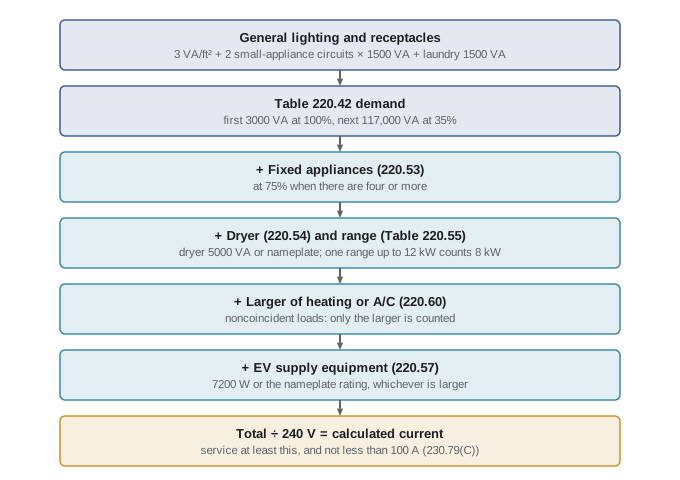
The standard method (Article 220, Part III) starts from general lighting and receptacle loads based on floor area, applies demand factors, and adds fixed appliances, the dryer, cooking equipment, heating or cooling and other specific loads. The steps for a single-family dwelling are summarized below.
1. General lighting, small-appliance and laundry loads
General lighting is calculated at 3 volt-amperes per square foot of floor area (Table 220.12), using the outside dimensions of the dwelling and excluding open porches, garages and unused or unfinished spaces not adaptable for future use. Add 1500 VA for each of the two (or more) 20-ampere small-appliance branch circuits required for the kitchen and dining areas, and 1500 VA for the laundry circuit.
2. Demand factors for general loads
The sum of the general lighting, small-appliance and laundry loads takes the demand factors of Table 220.42: the first 3000 VA at 100%, the next 117,000 VA (from 3001 to 120,000 VA) at 35%, and the remainder at 25%.
3. Fixed appliances, dryer and cooking
Four or more appliances fastened in place (other than ranges, dryers, space heating and air conditioning), such as a water heater, dishwasher, waste disposer and built-in microwave, may be taken at 75% of their nameplate total (220.53); fewer than four are taken at 100%. An electric dryer is counted at 5000 W or its nameplate rating, whichever is larger (220.54). Household cooking appliances over 1¾ kW use the demand values of Table 220.55: a single range not over 12 kW is counted as 8 kW (Column C), with increases for larger ranges.
4. Heating or air conditioning and other loads
Heating and air-conditioning loads are non-coincident: include only the larger of the two (220.60). Electric vehicle supply equipment is counted at the larger of 7200 W or its nameplate rating (220.57). Motors and other specific loads are added as the code requires.
5. Calculated load and minimum service size
The total, in volt-amperes, divided by 240 V gives the calculated current. The service disconnect for a one-family dwelling must be rated at least 100 A (230.79(C)), and the service must be at least as large as the calculated load.
Worked problem
Calculating a single dwelling
A 2400 ft² house has a 12 kW range, a 5 kW dryer, a 4.5 kW water heater, a 1.2 kW dishwasher, a 0.9 kW waste disposer, a 1.5 kW built-in microwave, 10 kW of electric heat, a 5 kVA air conditioner and a 7.2 kW electric vehicle charger. Find the calculated load, the current and the minimum service size.
Show solution
- General loads: \(3 \times 2400 = 7200\) VA lighting, plus \(2 \times 1500 = 3000\) VA small-appliance and 1500 VA laundry: 11,700 VA.
- Demand: \(3000 + 0.35 \times 8700 = 6045\) VA.
- Fixed appliances (four): \(4500 + 1200 + 900 + 1500 = 8100\) VA × 0.75 = 6075 VA.
- Dryer: 5000 VA. Range (12 kW): 8000 VA.
- Heating (10 kW) is larger than air conditioning (5 kVA): 10,000 VA. EVSE: 7200 VA.
- Total: \(6045 + 6075 + 5000 + 8000 + 10{,}000 + 7200 = 42{,}320\) VA.
- Current: \(42{,}320/240 = 176\) A.
Answer: A calculated load of about 42 kVA (176 A), so a 200 A service is needed. Without the EV charger the load would be 146 A, and a 150 A service would suffice.
The optional method
For one-family dwellings with a service of 100 A or more, 220.82 provides a simpler optional calculation that usually gives a lower result. The general load, including 3 VA/ft² lighting, 1500 VA per small-appliance and laundry circuit, and the nameplate ratings of all fastened-in-place appliances, ranges, dryers and water heaters, is taken at 100% for the first 10 kVA and 40% for the remainder. The heating or cooling load is then added according to 220.82(C): for example, 100% of air conditioning and cooling equipment, or 65% of central electric space heating, or 40% of four or more separately controlled space heating units, using the largest applicable value.
Additions to existing dwellings
When a heat pump, spa or EV charger is added to an existing house, 220.83 lets the existing load be calculated with the optional method, and 220.87 allows the maximum demand measured over a one-year period (or 30 days of continuous recording, under conditions) to be used as the existing load, with 125% of that demand plus the new load required to be within the service rating. Load management under the energy management system provisions of the NEC (Article 750 and 220.70) can also cap a load such as an EV charger so that it is not counted at its full rating.
Worked problem
Adding an EV charger to an existing service
An existing 100 A service supplies a house whose maximum demand over the past year was 14.4 kW. The owner wants a 40 A (9.6 kW) charger. Can it be added under 220.87? What charger current would fit?
Show solution
- Existing load at 125%: \(1.25 \times 14{,}400 = 18{,}000\) W, or 75 A at 240 V.
- Adding 40 A gives 115 A, over the 100 A rating. Available: \(100 - 75 = 25\) A, so a charger set to 24 A (5.8 kW, a common setting) would fit.
Answer: Not at 40 A. Options are a charger set to 24 A, an energy management system that reduces charging current when the house load is high, or a service upgrade.
Multi-unit buildings
For multi-family dwellings, the standard method applies the demand factors of Table 220.42 to the combined general loads and Table 220.55 to the ranges, which falls per unit as the number of units grows, and 220.84 provides an optional method for buildings with three or more units, using demand factors from Table 220.84 that fall from 45% for three to five units to 23% for 62 or more units. House loads are added in full. The result sizes the building's service and the feeders.
How this course is organized
Lesson 1 covers load calculations and Lesson 2 planning the layout and circuits of a dwelling. Lesson 3 covers the service entrance and panelboard, and Lesson 4 installing cable, boxes and devices. Lesson 5 covers branch circuits and receptacles, and Lesson 6 the circuits for major appliances. Lesson 7 covers ground-fault and arc-fault protection, and Lesson 8 heating, cooling and ventilation. Lesson 9 covers inspection and testing, Lesson 10 EV charging, solar, storage and backup power, and Lesson 11 renovations and older homes. Lesson 12 covers alarms, communications and smart homes, and ends with a complete house project.
Common mistakes
MistakeAdding nameplates and sizing the service to the connected load.
InsteadUse the code calculation with its demand factors; it gives the legal minimum and avoids oversizing.
MistakeIncluding garages and open porches in the 3 VA/ft² area.
InsteadUse the dwelling's outside dimensions, excluding garages, open porches and unused unfinished spaces.
MistakeCounting both heating and air conditioning when they cannot run together.
InsteadHeating and cooling are non-coincident: include only the larger (220.60).
MistakeApplying demand factors to an EV charger.
InsteadCount EVSE at the larger of 7200 W or nameplate unless an energy management system limits it.
MistakeRounding the calculated current down to the nearest service size.
InsteadThe service must be at least the calculated current; choose the next standard size up.
Summary and key terms
- The calculated load, using the code's demand factors, sets the minimum service and feeder size.
- Demand factors reflect that household loads do not all run at full power together; continuous loads like EV chargers count fully.
- NEC standard method: 3 VA/ft² lighting plus 1500 VA per small-appliance and laundry circuit, with Table 220.42 demand factors (3000 VA at 100%, the next 117,000 VA at 35%).
- Add four or more fixed appliances at 75%, dryer at 5000 VA minimum, range per Table 220.55 (8 kW for ≤ 12 kW), the larger of heating or cooling.
- EVSE at the larger of 7200 W or nameplate; the optional method (220.82) takes 10 kVA at 100% and the rest at 40%, plus HVAC.
- Minimum 100 A service disconnect for a one-family dwelling.
- Additions to existing services can use recalculation, measured demand data or load management.
- Multi-family buildings use Tables 220.42 and 220.55 or the optional method of 220.84.
- Connected load
- The sum of the ratings of all equipment connected to a system.
- Demand
- The load actually drawn, averaged over a short interval.
- Demand factor
- The ratio of maximum demand to connected load.
- Calculated load
- The load determined by the code method, used to size services and feeders.
- Continuous load
- A load expected to run at maximum current for three hours or more.
- Non-coincident loads
- Loads that are unlikely to operate at the same time, such as heating and air conditioning.
- Living area
- The occupied floor area of a dwelling, measured to the outside dimensions for the general lighting load.
- Basic load
- The general lighting and receptacle load derived from floor area.
- Small-appliance branch circuit
- A 20 A circuit serving kitchen and dining receptacles.
- Electric vehicle energy management system
- Controls that limit EV charging current to keep total load within a set value.
- Service
- The conductors and equipment that deliver energy from the utility to the building's wiring.
Practice problems
Work each problem on paper first, then reveal the answer to check.
Find the general lighting load for a 1800 ft² dwelling.
Show answer
3 × 1800 = 5400 VA.
For the 1800 ft² dwelling, add the small-appliance and laundry loads and apply the demand factors.
Show answer
5400 + 3000 + 1500 = 9900 VA; demand 3000 + 0.35 × 6900 = 5415 VA.
What demand load does a single 14 kW range contribute under Table 220.55 Column C, given an increase of 5% for each kW over 12?
Show answer
8 kW × (1 + 0.05 × 2) = 8.8 kW.
Three fastened-in-place appliances total 6200 VA. What demand applies?
Show answer
Fewer than four, so 100%: 6200 VA.
A dryer has a 4.2 kW nameplate. What load is used in the calculation?
Show answer
5000 VA, the minimum.
A house has 12 kW of electric heat and a 6 kVA heat pump compressor for cooling. Under the standard method, what heating/cooling load is used?
Show answer
The larger of the non-coincident loads: 12 kVA.
A calculated load of 27,600 W at 240 V requires what current?
Show answer
115 A, so a 125 A service at least (or the next standard size available).
A small house has a calculated load of 52 A. What is the minimum service disconnect rating?
Show answer
100 A for a one-family dwelling.
Why are EV chargers counted at full rating rather than with a demand factor?
Show answer
They draw full current for hours at a time, often overnight when other loads also run, so diversity cannot be assumed.
Name two alternatives to a service upgrade when adding a large load.
Show answer
Reduce the new load's setting (e.g. a lower EV charging current); use a load management system; use measured demand data to show capacity; replace resistive heat with a heat pump.
Lesson quiz · 5 questions
Score 60% or more to complete this lesson.
Create a free account to save your progress, take quizzes and earn a certificate.