
ELEC-130 · Lesson 1 of 12 · 28 min
Load calculations for dwellings
Before an electrician sizes a service, picks a panel or applies for a permit for a new house or a major renovation, someone has to answer one question: how much current will this dwelling draw? Adding up every nameplate in the house would give a huge number, because the range, dryer, heaters, air conditioner, car charger and every light are never all on at full power together. The electrical code therefore provides a calculation method that applies demand factors reflecting how homes are actually used. The result, the calculated load, sets the minimum size of the service and feeder conductors and the main overcurrent device.
This course follows the wiring of a dwelling from the service to the receptacle. This lesson covers load calculations; the section at the end of this lesson maps the rest of the course. It builds on the code navigation, conductor sizing and grounding rules of ELEC-120.
In Canada the method is Rule 8-200 of the Canadian Electrical Code, Part I, for single dwellings (including each unit of a semi-detached house or row house), with Rule 8-202 covering apartment and similar multi-family buildings. Always use the edition of the code adopted in the province or territory where the work is done.
Why demand factors
Demand is the load actually drawn over a period, usually averaged over 15 or 30 minutes by utility meters. Connected load is the sum of every nameplate. The ratio of maximum demand to connected load, the demand factor, is well below 1 in homes: lights are on mostly in the evening, the range runs at full power only briefly, heating and air conditioning do not run together, and thermostats cycle heaters on and off. The code's demand factors are based on long experience of dwelling loads and are deliberately conservative. They are not optional: the code method must be followed even if the designer believes the real load will be lower, and loads that run continuously at full power, such as electric vehicle chargers, are counted at or near 100%.
Worked problem
Connected load versus demand
A house has 2 kW of lighting, a 12 kW range, a 5 kW dryer, a 4.5 kW water heater, 15 kW of electric heat and a 7.2 kW car charger. What is the connected load in kW and amperes at 240 V?
Show solution
- Connected load: \(2 + 12 + 5 + 4.5 + 15 + 7.2 = 45.7\) kW.
- Current at 240 V: \(45{,}700/240 = 190\) A.
Answer: About 46 kW, or 190 A if everything ran at once. The code calculation that follows typically gives a much smaller figure for the general loads, but the heating and charger, which can run for hours, are counted nearly in full.
The Rule 8-200 method
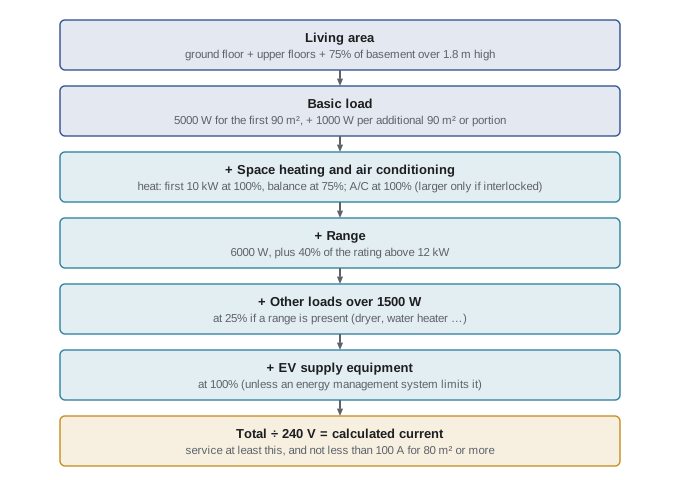
Rule 8-200 builds the calculated load from a basic load based on floor area plus specific additions for major appliances. The steps for a single dwelling are summarized below; check the adopted edition for exact wording.
1. Living area and basic load
The living area is the area of the ground floor (measured to the inside of the exterior walls) plus the areas of any upper floors, plus 75% of the area of a basement with a height of 1.8 m or more. The basic load is 5000 W for the first 90 m² of living area, plus 1000 W for each additional 90 m² or portion of it.
2. Space heating and air conditioning
Electric space heating is added with the demand factors of Section 62: the first 10 kW at 100% and the balance at 75%. Air conditioning is added at 100%. Where the heating and air conditioning are interlocked so they cannot operate at the same time, only the larger of the two is included. Heat pumps are counted according to the code's provisions for combined heating and cooling equipment, including any supplementary heaters.
3. Cooking
An electric range is counted as 6000 W for a single range, plus 40% of the amount by which its rating exceeds 12 kW. Separate cooking units (a cooktop and wall ovens) are treated together as a single range.
4. Other loads over 1500 W
Any other loads rated over 1500 W, such as a water heater, dryer or hot tub, are added at 25% of their rating if an electric range is provided, or at 100% of the combined rating up to 6000 W plus 25% of the remainder if there is no electric range. Tankless water heaters and steamers are added at 100%. Electric vehicle supply equipment is added at 100% of its rating, unless an electric vehicle energy management system limits the load (the code allows the managed value to be used).
5. Minimum service size
The calculated load in watts is divided by 240 V to give amperes. The service conductors and service equipment must be rated at least for this current, and in any case not less than 100 A where the living area is 80 m² or more (60 A for a smaller dwelling).
Worked problem
Calculating a single dwelling
A house has a 150 m² ground floor, a 100 m² basement with 2.3 m ceilings, 15 kW of electric baseboard heat, no air conditioning, a 12 kW range, a 5 kW dryer, a 3 kW storage water heater and a 7.2 kW electric vehicle charger. Find the calculated load, the current and the minimum service size.
Show solution
- Living area: \(150 + 0.75 \times 100 = 225\) m².
- Basic load: 5000 W (first 90 m²) + 1000 W (90 to 180 m²) + 1000 W (180 to 225 m², a portion) = 7000 W.
- Heating: \(10{,}000 + 0.75 \times 5000 = 13{,}750\) W.
- Range (12 kW, no excess over 12 kW): 6000 W.
- Dryer and water heater, with a range present: \(0.25 \times (5000 + 3000) = 2000\) W.
- EV charger: 7200 W.
- Total: \(7000 + 13{,}750 + 6000 + 2000 + 7200 = 35{,}950\) W; current \(35{,}950/240 = 149.8\) A.
Answer: A calculated load of about 36 kW (149.8 A). A 150 A service meets the minimum with almost no margin, so most electricians would install 200 A to allow for future loads. Without the EV charger the load would be 120 A and a 125 A or 150 A service could suffice; with an EV energy management system the charger's contribution could be reduced.
Heating and cooling details
Space heating usually dominates Canadian calculations. Points to watch: thermostatically controlled heaters use the Section 62 demand factors, but heaters without automatic control are counted at 100%; a heat pump with electric back-up heat must include both the compressor and the back-up elements that can run with it; and air conditioning counts at 100% unless interlocked with the heating. Where a heat pump replaces baseboard heat in a retrofit, the calculation often falls, freeing capacity for an electric vehicle charger.
Additions to existing dwellings
When a heat pump, hot tub or EV charger is added to an existing house, the electrician must show that the existing service can carry the new calculated load. The Rule 8-200 calculation can be repeated with the new load included. Alternatively, Canadian practice allows the use of actual measured maximum demand data (for example, a year of utility demand records) as the basis for adding load to an existing service, where the inspection authority accepts it. Load management devices that shed the EV charger or the hot tub heater when the house load approaches the service rating are a common, economical alternative to a service upgrade.
Worked problem
Adding an EV charger to an existing service
An existing 100 A service supplies a house whose Rule 8-200 calculated load is 78 A. The owner wants a 40 A (9.6 kW) charger. Can it be added at 100%? What charger current would fit?
Show solution
- New load: \(78 + 9600/240 = 78 + 40 = 118\) A, which exceeds 100 A.
- Available capacity: \(100 - 78 = 22\) A, so a charger set to 22 A or less (about 5.3 kW, or a standard 20 A setting) would fit at 100%.
Answer: Not at 40 A. Options are a charger set to about 20 A, an EV energy management system that limits charging when the house load is high, or a service upgrade to 200 A.
Multi-unit buildings
For apartment buildings, Rule 8-202 calculates each unit (with its own basic load for its floor area, plus heating, air conditioning and appliance loads) and then applies further demand factors to the total across units, because peak loads in different apartments do not coincide: the first unit at 100%, the next two at 65%, the next two at 40%, the next 15 at 25% and the remainder at 10%, with heating and air conditioning handled separately. House loads (corridor lighting, elevators, parking garage ventilation) are added in full. The result sizes the building's service and the feeders.
How this course is organized
Lesson 1 covers load calculations and Lesson 2 planning the layout and circuits of a dwelling. Lesson 3 covers the service entrance and panelboard, and Lesson 4 installing cable, boxes and devices. Lesson 5 covers branch circuits and receptacles, and Lesson 6 the circuits for major appliances. Lesson 7 covers ground-fault and arc-fault protection, and Lesson 8 heating, cooling and ventilation. Lesson 9 covers inspection and testing, Lesson 10 EV charging, solar, storage and backup power, and Lesson 11 renovations and older homes. Lesson 12 covers alarms, communications and smart homes, and ends with a complete house project.
Common mistakes
MistakeAdding nameplates and sizing the service to the connected load.
InsteadUse the code calculation with its demand factors; it gives the legal minimum and avoids oversizing.
MistakeForgetting to count 75% of a basement over 1.8 m high in the living area.
InsteadLiving area includes upper floors and 75% of a basement with at least 1.8 m headroom.
MistakeCounting both heating and air conditioning when they cannot run together.
InsteadWhere interlocked, include only the larger.
MistakeApplying demand factors to an EV charger.
InsteadCount EV supply equipment at 100% unless an EV energy management system limits it.
MistakeRounding the calculated current down to the nearest service size.
InsteadThe service must be at least the calculated current; choose the next standard size up.
Summary and key terms
- The calculated load, using the code's demand factors, sets the minimum service and feeder size.
- Demand factors reflect that household loads do not all run at full power together; continuous loads like EV chargers count fully.
- Rule 8-200: basic load 5000 W for the first 90 m² of living area plus 1000 W per additional 90 m² or portion.
- Add heating (first 10 kW at 100%, balance 75%), air conditioning at 100% (larger only if interlocked), range 6000 W plus 40% over 12 kW.
- Other loads over 1500 W at 25% with a range; tankless heaters and EVSE at 100%.
- Minimum 100 A service for living areas of 80 m² or more.
- Additions to existing services can use recalculation, measured demand data or load management.
- Apartment buildings use Rule 8-202 with demand factors across units.
- Connected load
- The sum of the ratings of all equipment connected to a system.
- Demand
- The load actually drawn, averaged over a short interval.
- Demand factor
- The ratio of maximum demand to connected load.
- Calculated load
- The load determined by the code method, used to size services and feeders.
- Continuous load
- A load expected to run at maximum current for three hours or more.
- Non-coincident loads
- Loads that are unlikely to operate at the same time, such as heating and air conditioning.
- Living area
- In Rule 8-200, the floor area of a dwelling used for the basic load, including 75% of a qualifying basement.
- Basic load
- The area-based load in Rule 8-200: 5000 W for the first 90 m² plus 1000 W per additional 90 m².
- Small-appliance branch circuit
- A 20 A circuit serving kitchen and dining receptacles.
- Electric vehicle energy management system
- Controls that limit EV charging current to keep total load within a set value.
- Service
- The conductors and equipment that deliver energy from the utility to the building's wiring.
Practice problems
Work each problem on paper first, then reveal the answer to check.
Find the basic load for a dwelling with 120 m² of living area.
Show answer
5000 W + 1000 W (the portion beyond 90 m²) = 6000 W.
A house has a 110 m² ground floor, a 60 m² upper floor and a 110 m² basement with 2.1 m headroom. Find the living area and basic load.
Show answer
110 + 60 + 82.5 = 252.5 m²; 5000 + 1000 × 2 (two more full 90 m² steps reach 270 m², covering 252.5) = 7000 W.
Apply the heating demand factor to 22 kW of thermostatically controlled baseboard heat.
Show answer
10 kW + 0.75 × 12 = 19 kW.
What load does a 14 kW range contribute?
Show answer
6000 + 0.40 × 2000 = 6800 W.
A house with an electric range also has a 4.5 kW water heater and a 6 kW hot tub. What do they add?
Show answer
25% × 10.5 kW = 2625 W.
The same house has no electric range. What do the water heater and hot tub add?
Show answer
Combined 10.5 kW: 6000 W at 100% + 25% of 4500 W = 7125 W.
A calculated load of 27,600 W at 240 V requires what current?
Show answer
115 A, so a 125 A service at least (or the next standard size available).
A 70 m² cottage has a calculated load of 38 A. What is the minimum service size?
Show answer
60 A (living area under 80 m²).
Why are EV chargers counted at full rating rather than with a demand factor?
Show answer
They draw full current for hours at a time, often overnight when other loads also run, so diversity cannot be assumed.
Name two alternatives to a service upgrade when adding a large load.
Show answer
Reduce the new load's setting (e.g. a lower EV charging current); use a load management system; use measured demand data to show capacity; replace resistive heat with a heat pump.
Lesson quiz · 5 questions
Score 60% or more to complete this lesson.
Create a free account to save your progress, take quizzes and earn a certificate.