
ELEC-130 · Lesson 10 of 12 · 31 min
EV charging, solar, storage and backup power
Houses are no longer only consumers of electricity. Electric vehicles add the largest new load most homes have ever seen; rooftop solar panels generate power that flows back to the grid; home batteries store it; and standby generators and portable generators supply the house during outages. Each must connect safely to a service designed for one-way power flow, without overloading it and without ever sending power back onto utility lines being repaired. This lesson covers EV charging equipment and circuits, energy management systems, solar photovoltaic (PV) systems and their interconnection, battery storage, generators and transfer equipment, and planning these together.
Electric vehicle charging
Charging levels are defined by the supply:
| Level | Supply | Typical power | Range added per hour |
|---|---|---|---|
| Level 1 | 120 V, 12 A from a receptacle | 1.4 kW | about 6–8 km (4–5 mi) |
| Level 2 | 240 V (or 208 V), 16–80 A | 3.8–19.2 kW (7.7 kW at 32 A is common) | about 30–60 km (20–40 mi) |
| DC fast charging | 400–1,000 V DC from a public station | 50–350 kW | hundreds of km |
Home charging is almost always Level 2. The charger (electric vehicle supply equipment, EVSE) is a continuous load, so its circuit is rated at 125% of its output: a 32 A charger needs a 40 A circuit, a 48 A charger a 60 A circuit. It may be hard-wired or plugged into a 240 V receptacle (commonly a NEMA 14-50R or 6-50R), in which case the receptacle needs ground-fault protection in many editions and should be a heavy-duty type rated for repeated insertion and continuous load.
Worked problem
Overnight charging
A driver uses 40 km per day; the car uses 18 kWh per 100 km, and charging is 90% efficient. How long does a 7.7 kW Level 2 charger take to replace a day's energy, and what about a Level 1 (1.4 kW) cord?
Show solution
- Energy to the battery: \(40 \times 0.18 = 7.2\) kWh; from the wall: \(7.2/0.9 = 8.0\) kWh.
- Level 2: \(8.0/7.7 = 1.0\) h. Level 1: \(8.0/1.4 = 5.7\) h.
Answer: About 1 hour at Level 2 and almost 6 hours at Level 1. For many households, a modest 16 A to 24 A Level 2 charger, or even Level 1, covers daily driving overnight; this matters when the service has little spare capacity.
In the US, NEC Article 625 covers EV charging: each charger needs an individual branch circuit (625.40) sized at 125% of its rating, receptacles for EV charging need GFCI protection (625.54), and an energy management system may limit the load used in calculations (625.42 and 220.70). The service calculation counts EVSE at the larger of 7,200 W or nameplate (220.57). Many jurisdictions require EV-ready new homes.
Energy management and load control
An EV, a heat pump with backup heat, an induction range, a dryer and a water heater can together demand more than a 100 A or even 200 A service. Rather than upgrading the service, which can cost thousands and may require utility work, homeowners can manage loads:
- EV energy management systems measure the service current and reduce or pause EV charging when other loads are high.
- Load shedding relays switch off a non-essential load (such as a water heater) while another large load (such as a dryer or backup heat) runs.
- Smart panels and smart breakers monitor every circuit and can switch or limit loads automatically, with a smartphone interface.
- Circuit sharing devices allow two 240 V loads (for example a dryer and an EV charger) to share one circuit, giving priority to one.
Load management devices must be listed for the purpose, and the code allows the service calculation to reflect the managed (lower) load only when the device is approved for that use.
Worked problem
Managing an EV on a 100 A service
A house on a 100 A, 240 V service has a calculated load of 78 A. The owner wants a 48 A EV charger. Without management, what is the total? With an EVEMS limiting the service to 80% of 100 A, how much charging current is available when the house draws 50 A?
Show solution
- Unmanaged: \(78 + 48 = 126\) A, well above 100 A.
- Managed: limit \(0.8 \times 100 = 80\) A; available \(80 - 50 = 30\) A of charging when the house uses 50 A.
Answer: Unmanaged, the service would be overloaded; with management the car charges at 30 A (about 7 kW) at typical times, more at night, and pauses during peaks. A service upgrade is avoided.
Solar photovoltaic systems
A residential PV system has solar modules on the roof or ground, an inverter (or microinverters on each module) that converts their DC output to AC synchronized with the grid, disconnects, and an interconnection to the house's electrical system. Grid-tied inverters shut down automatically when the grid fails (anti-islanding), so they cannot energize utility lines during an outage, which also means a basic grid-tied system provides no backup power.
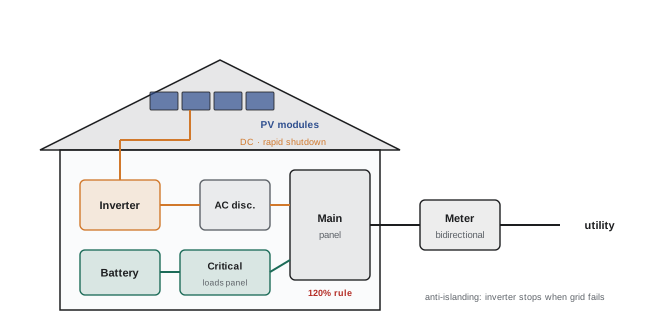
Key electrical requirements:
- DC circuits: modules in series produce high DC voltages (up to 600 V in houses in many jurisdictions); conductors, connectors and disconnects must be rated for DC, and rapid shutdown equipment reduces voltages on roof conductors when firefighters shut the system down.
- Interconnection: the inverter output connects to the house either on the load side of the service (usually a backfed breaker in the panel) or on the supply side (a tap ahead of the main breaker).
- Busbar limit: a backfed breaker adds current to the panel's busbar from a second source. The codes limit the total, commonly through the 120% rule.
Worked problem
The 120% rule
A house has a 200 A busbar with a 200 A main breaker. What is the largest inverter output current that can be backfed through a breaker at the opposite end of the busbar from the main?
Show solution
- Allowed total: \(1.2 \times 200 = 240\) A.
- Inverter breaker allowance: \(240 - 200 = 40\) A, so \(1.25 \times I_{inv} \le 40\), \(I_{inv} \le 32\) A.
- At 240 V: \(32 \times 240 = 7.7\) kW of inverter output.
Answer: About 32 A (7.7 kW AC) through a 40 A backfed breaker. Larger systems use a supply-side connection, a smaller main breaker (for example 175 A, giving 65 A of allowance), or a panel with a higher busbar rating.
In the US, NEC Article 690 covers PV systems (including rapid shutdown, 690.12), and Article 705 covers interconnected sources, including the 120% busbar rule (705.12); the utility also requires an interconnection agreement before the system may operate.
Utilities require an interconnection application and, in many places, a visible, lockable disconnect accessible to utility workers, and they install a bidirectional (net) meter that records energy both imported and exported.
Battery storage
Home batteries (typically lithium-ion, 10 kWh to 20 kWh per unit) store solar energy for evening use, shift consumption to cheaper times, and provide backup during outages. For backup, the system includes a transfer function that disconnects the house (or a critical-loads panel) from the grid during an outage and supplies it from the battery and inverter, and reconnects when the grid returns.
Batteries are installed according to their listing and the fire and electrical codes, which limit locations (for example, not in habitable rooms, with clearances and fire separations in garages), capacity per area, and require disconnects and signage. Most systems are pre-engineered, and the installer follows the manufacturer's requirements closely.
Worked problem
How long will the battery last?
During an outage, a critical-loads panel supplies the refrigerator (average 60 W), furnace blower and controls (400 W while running, 50% duty), lighting and electronics (300 W) and a sump pump (800 W, 10% duty). How long does a 13.5 kWh battery last at 90% usable capacity?
Show solution
- Average load: \(60 + 0.5 \times 400 + 300 + 0.1 \times 800 = 640\) W.
- Usable energy: \(0.9 \times 13.5 = 12.15\) kWh.
- Time: \(12.15/0.64 = 19\) h.
Answer: About 19 hours, longer with solar recharging during the day. Choosing which circuits are critical, and keeping large loads such as heat strips and dryers off the backup panel, is the main design decision.
Generators and transfer equipment
Generators are the traditional backup source. The essential rule is that a generator must never be connected so that it can feed the utility lines: backfeed can kill line workers repairing a "dead" line, damage the generator when power returns, and start fires. Connections are therefore made only through transfer equipment:
- A manual transfer switch or a listed interlock kit on the main panel, which mechanically prevents the main breaker and the generator breaker from being on at the same time.
- An automatic transfer switch (ATS) with a permanently installed standby generator, which starts the generator when utility power fails and transfers the load, then transfers back when power returns.
- A generator inlet (a flanged receptacle outside the house) for a portable generator, wired to the transfer switch or interlocked breaker.
Plugging a generator into a house receptacle with a male-to-male cord ("suicide cord") is dangerous and illegal.
Worked problem
Sizing a portable generator
A homeowner wants to run the furnace (600 W running, 1,200 W starting), refrigerator (150 W running, 900 W starting), sump pump (800 W running, 2,000 W starting) and some lights (200 W). What generator size is needed if only one motor starts at a time?
Show solution
- Running total: \(600 + 150 + 800 + 200 = 1{,}750\) W.
- Worst start: all running, then the largest starting surge added: \(1{,}750 - 800 + 2{,}000 = 2{,}950\) W.
Answer: A generator rated about 3,000 W continuous (with a higher surge rating) runs these loads, if the motors start one at a time. Large loads such as heat strips, ranges and dryers would need a much larger standby unit.
Standby generators need a fuel supply, exhaust clearances from windows and doors (carbon monoxide kills), a pad, and a dedicated circuit for their battery charger and block heater. Portable generators must be run outdoors, well away from openings.
Planning it together
Many homeowners now combine these systems: solar panels, a battery, an EV charger, a heat pump, and sometimes a generator. Their interactions need planning:
- Service and busbar capacity, with load management to avoid upgrades where possible.
- Which loads are backed up, and whether the battery or generator can start them.
- Bidirectional EV charging (vehicle-to-home), now offered by some vehicles and chargers, which turns the car into a home battery; it requires transfer equipment just like any other backup source.
- Utility programs that pay for managed charging or battery dispatch.
- Clear labeling of every source and disconnect, so that firefighters and utility workers can de-energize the house.
Common mistakes
MistakeSizing an EV circuit at the charger's output current.
InsteadSize it at 125% of output as a continuous load.
MistakeUpgrading the service automatically for an EV.
InsteadConsider listed load management or a lower charging current.
MistakeBackfeeding solar into a panel without checking the busbar.
InsteadApply the 120% rule or use a supply-side connection.
MistakeExpecting grid-tied solar to provide power in an outage.
InsteadAnti-islanding shuts it down; backup needs a battery and transfer equipment.
MistakeConnecting a generator without transfer equipment.
InsteadUse a transfer switch or listed interlock, never a cord into a receptacle.
Summary and key terms
- Home EV charging is Level 2, sized at 125% of charger output on a dedicated circuit.
- Energy management can add EVs and other loads without service upgrades.
- Grid-tied PV uses inverters with anti-islanding; backfed breakers are limited by the 120% busbar rule.
- Batteries provide storage and backup through transfer functions and critical-loads panels.
- Generators connect only through transfer switches or interlocks to prevent backfeed.
- Plan sources, loads, busbar capacity, labeling and utility requirements together.
- EVSE
- Electric vehicle supply equipment, the charger.
- Level 2 charging
- Charging at 208 or 240 V AC.
- EVEMS
- Electric vehicle energy management system.
- Load shedding
- Switching off a load to keep total demand within limits.
- Inverter
- Equipment converting DC to grid-synchronized AC.
- Anti-islanding
- Automatic shutdown of an inverter when the grid fails.
- Backfed breaker
- A breaker through which a source feeds a panel busbar.
- Rapid shutdown
- Reducing PV conductor voltage on a roof for firefighter safety.
- Transfer switch
- A switch that connects loads to either the utility or a backup source, never both.
- Critical-loads panel
- A subpanel of circuits supplied during outages.
Practice problems
Work each problem on paper first, then reveal the answer to check.
Circuit for a 40 A EV charger?
Show answer
50 A.
Power of a 32 A charger at 208 V?
Show answer
6.7 kW.
Time to add 12 kWh at 7.7 kW and 90% efficiency?
Show answer
12/0.9/7.7 = 1.7 h.
Inverter current allowed on a 225 A busbar with 200 A main (120% rule)?
Show answer
(270 − 200)/1.25 = 56 A.
Why does grid-tied solar shut down in an outage?
Show answer
Anti-islanding protects utility workers.
Battery time for 10 kWh usable at 500 W average?
Show answer
20 h.
What prevents a generator from backfeeding the utility?
Show answer
A transfer switch or listed interlock.
Generator for 2,000 W running loads plus a 1,500 W surge beyond running?
Show answer
About 3,500 W surge capability.
What does an EVEMS do?
Show answer
Limits EV charging to keep the service within its rating.
Why label all sources and disconnects?
Show answer
So firefighters and utility workers can de-energize the house.
Lesson quiz · 5 questions
Score 60% or more to complete this lesson.
Create a free account to save your progress, take quizzes and earn a certificate.