
ELEC-130 · Lesson 8 of 12 · 32 min
Heating, cooling and ventilation circuits
Heating and cooling equipment is the largest load in many houses, and in cold climates such as most of Canada and the northern United States it decides the service size. As houses move from gas furnaces to heat pumps and electric heat, electricians wire more of this equipment, and its rules differ from ordinary appliances: heating is a continuous load, air conditioners and heat pumps are sized from motor-compressor data, thermostats must disconnect safely, and outdoor units need their own disconnects. This lesson covers electric baseboard and fan heaters, electric furnaces, gas furnaces and boilers, heat pumps and air conditioners, heated floors and snow-melting cables, and ventilation equipment.
Electric resistance heating
Baseboard heaters, wall fan heaters and radiant panels convert electricity to heat at 100% efficiency at the point of use. They are simple and cheap to install, but expensive to run compared with heat pumps, which deliver two to four units of heat per unit of electricity. Most are 240 V units rated from 500 W to 2,500 W, sized by room heat loss.
Fixed electric space heating is treated as a continuous load: a heater can run at full output for many hours on a cold night. Branch circuits are therefore loaded to no more than 80% of their rating.
Worked problem
Grouping baseboard heaters
Three bedrooms need 1,000 W, 1,250 W and 1,500 W of baseboard heat at 240 V. Can they share one 20 A circuit?
Show solution
- Total: \(1{,}000 + 1{,}250 + 1{,}500 = 3{,}750\) W; current \(3{,}750/240 = 15.6\) A.
- Continuous limit: \(0.8 \times 20 = 16\) A, or 3,840 W.
Answer: Yes, just: 15.6 A is within 16 A on a 20 A, 240 V circuit with 12 AWG copper. Adding any more heat would need a second circuit. Many electricians plan heating circuits with margin rather than at the limit.
Thermostats
Line-voltage thermostats switch the full heater current directly; they are rated for the load (for example 16 A or 22 A at 240 V) and are often double-pole, so that their "off" position opens both ungrounded conductors. Where a thermostat has an off position, the codes generally require it to open all ungrounded conductors, since a user who turns the thermostat off may assume the heater is dead. Low-voltage thermostats control relays or contactors and are used with central systems and with many electronic heaters, allowing smart thermostats and better comfort.
In the US, NEC Article 424 covers fixed electric space-heating equipment, requiring branch circuits of at least 125% of the load (424.4(B)), disconnecting means, thermostats that open all ungrounded conductors in their off position (424.20), and ground-fault protection for heating cables in certain floors.
Electric furnaces and air handlers with heat strips
An electric furnace, or the backup heat strips in a heat pump's air handler, contains several resistance elements (often 5 kW to 20 kW in total) staged by relays, plus a blower. They are supplied by one or more 240 V circuits sized from the nameplate's minimum circuit ampacity.
Worked problem
Heat strip current
An air handler has 15 kW of heat strips and a 0.5 hp blower drawing 4 A, all at 240 V. What is the total current, and what minimum circuit ampacity would the manufacturer likely list?
Show solution
- Heat strips: \(15{,}000/240 = 62.5\) A.
- Total with blower: 66.5 A.
- At 125% as a continuous load: about 83 A.
Answer: About 66.5 A of load and a minimum circuit ampacity of about 83 A, often split by the manufacturer into two circuits (for example 60 A and 30 A). Heat strips are one of the main reasons all-electric homes need large services or load management.
Gas furnaces and boilers
Gas-fired furnaces and boilers need electricity only for their controls, igniter, inducer fan, blower and pumps, typically a few amperes at 120 V. They are nevertheless critical: without power, there is no heat. Codes and manufacturers require:
- An individual branch circuit, so that faults elsewhere do not leave the house without heat.
- A disconnecting means (a service switch) within sight of the equipment, often a switch at the furnace or at the entrance to the furnace room, clearly labeled.
- Correct polarity: many furnace controls use flame rectification, which detects the flame by a tiny current through it to ground, and fails if line and neutral are reversed or the bonding is poor.
In the US, central heating equipment other than fixed electric space heating must be supplied by an individual branch circuit (422.12), with a disconnecting means within sight or lockable.
Air conditioners and heat pumps
Air conditioners and heat pumps contain a hermetic motor-compressor and fan motors. Their nameplates give two numbers that determine the circuit:
- Minimum circuit ampacity (MCA): the smallest conductor ampacity allowed, already including 125% of the largest motor plus the other loads.
- Maximum overcurrent protection (MOCP, or maximum fuse/breaker size): the largest breaker or fuse allowed. Motor-compressors draw high starting current, so the breaker may be larger than the conductor ampacity would normally allow.
Worked problem
Sizing a heat pump circuit
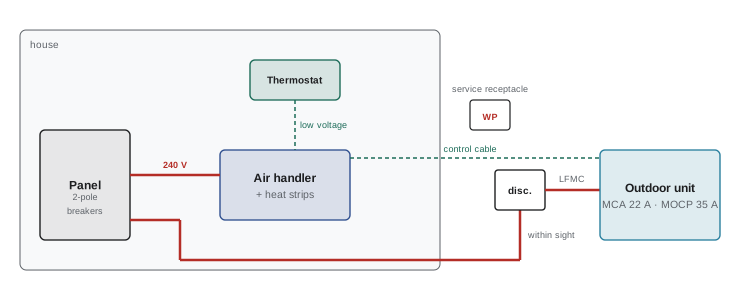
A heat pump nameplate shows MCA 22 A and MOCP 35 A at 240 V. Choose the copper conductor (60 °C cable) and the breaker.
Show solution
- Conductor: at least 22 A: 12 AWG (rated 20 A at 60 °C) is too small; 10 AWG (30 A) is the minimum.
- Breaker: any standard size up to 35 A that does not trip on start-up; the nameplate maximum, 35 A, is common, and the conductor is protected because motor-compressor circuits are allowed this exception.
Answer: 10 AWG copper and a 35 A (or 30 A) two-pole breaker. Exceeding the MOCP voids the listing and is a common inspection deficiency; so is using the MOCP to size the wire.
- Disconnect: an outdoor disconnect within sight of the outdoor unit and readily accessible, often a fused or non-fused pull-out switch on the wall beside it.
- Receptacle: a service receptacle within a set distance of the outdoor equipment so that technicians do not run cords from inside.
- Wiring outdoors: liquidtight flexible conduit or other wet-location wiring from the disconnect to the unit, with conductors rated for wet locations (ELEC-120).
- Control wiring: low-voltage cable from the thermostat to the indoor unit and outdoor unit, kept separate from power (ELEC-120, Class 2).
Cold-climate heat pumps keep delivering useful heat well below −20 °C, reducing or eliminating backup resistance heat; their inverter-driven compressors also start softly, drawing far less inrush current than older units. Ductless mini-split systems have one outdoor unit serving one or several indoor heads, with power usually supplied to the outdoor unit and carried to the heads in the interconnecting cable specified by the manufacturer.
Heated floors and snow-melting
Electric floor heating cables and mats are popular in bathrooms and basements. They are installed under tile or flooring, connected to a thermostat with a floor sensor, and supplied at 120 V or 240 V. Because they lie under wet floors, the codes require ground-fault protection for heating cables in bathroom and similar floors, often built into the thermostat (a Class A GFCI or equipment ground-fault protection).
Outdoor snow-melting cables in driveways and walkways, roof and gutter de-icing cables, and pipe heat-tracing cables are larger loads, often several kilowatts, with ground-fault equipment protection (typically 30 mA) because their long runs have higher leakage currents than a 5 mA GFCI could tolerate.
Worked problem
Floor heating load
A 4 m² bathroom floor uses heating mat rated 150 W/m² at 120 V. What current does it draw, and can it share a 20 A bathroom receptacle circuit?
Show solution
- Power: \(4 \times 150 = 600\) W; current \(600/120 = 5\) A.
- As a continuous load it uses 5 A of the circuit; a hair dryer on the bathroom receptacle can draw 12.5 A.
- Total possible: 17.5 A on a 20 A circuit.
Answer: 5 A. Sharing is often permitted, but a separate circuit avoids nuisance trips and is recommended by many manufacturers, especially for larger floors.
Ventilation
Ventilation equipment is small electrically but required by building codes for air quality and moisture control:
- Bathroom exhaust fans, often required where a window does not provide ventilation, switched or controlled by humidity sensors or timers.
- Range hoods, sized by the cooking appliance, some requiring make-up air systems with interlocked dampers or heaters when exhaust exceeds a threshold.
- Whole-house ventilation, such as heat recovery ventilators (HRVs) and energy recovery ventilators (ERVs), which are required in many new energy-efficient houses because airtight construction does not leak enough fresh air.
- Attic and garage fans, radon mitigation fans, and dehumidifiers.
Many of these run continuously, and their controls interact with the building's heating and cooling. Coordinating with the HVAC contractor before rough-in avoids missing circuits and control wiring.
Heating loads and the service
Heating and cooling dominate the service calculation (Lesson 1). Because a house rarely heats and cools at the same time, both codes count only the larger of heating and cooling (with demand factors for large heating loads). When converting from gas to electric heat, the service must be recalculated: a 100 A service that suited a gas-heated house may not support a heat pump with backup strips plus an EV charger. Options include upgrading the service, choosing a cold-climate heat pump that needs little or no backup heat, or using load management to prevent backup heat and EV charging from running at the same time (Lesson 10).
Commissioning heating and cooling circuits
Before handing over heating and cooling equipment, the electrician and HVAC technician verify its electrical installation together:
- Supply voltage at the equipment under load, compared with its nameplate range (typically ±10%); low voltage at a heat pump compressor shortens its life.
- Running current of compressors, fans and heat strips, compared with the nameplate; a heat strip stage that draws no current has a failed element or relay.
- Operation of each heating stage and of the defrost cycle in heat pumps, which briefly runs backup heat.
- Control wiring: thermostat calls for heat, cooling, fan and auxiliary heat reach the right equipment; the C wire powers the thermostat.
- Disconnects, labels and the panel directory, which should name each piece of equipment clearly ("Heat pump outdoor unit", "Air handler heat strips 1").
Worked problem
Checking a heat strip stage
An air handler has two 5 kW heat strip stages at 240 V. With the thermostat calling for full auxiliary heat, a clamp meter on the heat strip circuit reads 21 A. What does this suggest?
Show solution
- Expected: two stages of 5 kW each: \(10{,}000/240 = 41.7\) A (plus the blower on its own circuit).
- Measured: 21 A, about one stage.
Answer: Only one stage is running: a failed element, an open thermal limit, a relay not closing, or a control wiring fault for stage 2. Measuring current at commissioning finds faults that otherwise appear only on the coldest night.
Common mistakes
MistakeLoading heating circuits to 100% of the breaker rating.
InsteadTreat fixed heating as continuous: load circuits to 80% at most.
MistakeUsing a single-pole line-voltage thermostat with an off position on 240 V heat.
InsteadUse a thermostat whose off position opens all ungrounded conductors.
MistakeSizing heat pump conductors from the MOCP.
InsteadSize conductors from the MCA and the breaker no larger than the MOCP.
MistakeOmitting the disconnect and service receptacle at outdoor units.
InsteadProvide a disconnect within sight and a nearby service receptacle.
MistakeInstalling floor heating without ground-fault protection.
InsteadUse the required GFCI or ground-fault equipment protection.
Summary and key terms
- Fixed electric heating is continuous: circuits loaded to 80%.
- Line-voltage thermostats must open all ungrounded conductors when set to off.
- Electric furnaces and heat strips draw tens of amperes and often need multiple circuits.
- Gas furnaces need individual circuits, disconnects and correct polarity.
- Heat pumps and air conditioners use MCA for conductors and MOCP for the maximum breaker, with outdoor disconnects.
- Heated floors and snow-melting need ground-fault protection; ventilation equipment needs planning with HVAC trades.
- Baseboard heater
- A wall-mounted resistance heater along the floor line.
- Line-voltage thermostat
- A thermostat that switches heater current directly.
- Heat strips
- Resistance elements in an air handler for backup heat.
- Flame rectification
- Flame sensing by a small current through the flame.
- MCA
- Minimum circuit ampacity from an equipment nameplate.
- MOCP
- Maximum overcurrent protection from an equipment nameplate.
- Cold-climate heat pump
- A heat pump that delivers useful heat at very low outdoor temperatures.
- Mini-split
- A ductless heat pump with indoor heads and an outdoor unit.
- HRV/ERV
- Heat or energy recovery ventilator.
- Equipment ground-fault protection
- Ground-fault protection at higher trip levels for equipment such as heating cables.
Practice problems
Work each problem on paper first, then reveal the answer to check.
Maximum continuous heating load on a 15 A, 240 V circuit?
Show answer
12 A, 2,880 W.
Current of 2,000 W of baseboard at 240 V?
Show answer
8.33 A.
Why must a thermostat's off position open all ungrounded conductors?
Show answer
Users assume the heater is dead when off.
Current of 10 kW heat strips at 240 V?
Show answer
41.7 A.
Why do gas furnaces need correct polarity?
Show answer
Flame rectification sensing depends on it.
MCA 28 A, MOCP 45 A: conductor and maximum breaker?
Show answer
10 AWG (30 A); up to 45 A.
What must be near an outdoor heat pump?
Show answer
A disconnect within sight and a service receptacle.
Current of a 900 W floor mat at 120 V?
Show answer
7.5 A.
Why do snow-melt cables use 30 mA ground-fault protection rather than 5 mA?
Show answer
Long cables have leakage that would trip 5 mA devices.
Why are HRVs required in many new houses?
Show answer
Airtight construction needs mechanical fresh air.
Lesson quiz · 5 questions
Score 60% or more to complete this lesson.
Create a free account to save your progress, take quizzes and earn a certificate.