
ELEC-130 · Lesson 7 of 12 · 34 min
GFCI and AFCI protection
An ordinary breaker protects the wiring: it opens when current exceeds the circuit rating long enough to overheat the conductors. It does nothing for a person who touches a live conductor while standing on a wet floor, because a current that can stop a human heart is a tiny fraction of an ampere, far below any breaker rating. Nor does it reliably detect the arcing of a damaged cord or a loose connection, which can start a fire while drawing less current than the circuit rating. Two devices fill these gaps: the ground-fault circuit interrupter (GFCI), which protects people from shock, and the arc-fault circuit interrupter (AFCI), which protects buildings from fires caused by arcing. Together with tamper-resistant receptacles and smoke alarms, they are among the most effective safety improvements in residential wiring of the past fifty years.
Electric shock
The effect of current on the body depends on its magnitude, path and duration. Approximate thresholds for 60 Hz alternating current flowing hand to foot are:
| Current | Typical effect |
|---|---|
| about 1 mA | Threshold of perception: a tingle |
| 5 mA | Painful; the level GFCIs are designed around |
| 10 to 20 mA | Let-go threshold: muscles clamp and the person may be unable to release the conductor |
| 20 to 50 mA | Severe pain, breathing difficulty |
| 50 to 100 mA and above | Ventricular fibrillation likely if it lasts a fraction of a second or more: usually fatal without defibrillation |
The current is set by the voltage and the body's resistance, which is dominated by the skin. Dry skin may present tens of thousands of ohms; wet or broken skin, a few hundred to a thousand. At 120 V, a wet body path of 1000 Ω passes 120 mA, which can kill. The danger rises sharply in bathrooms, kitchens, outdoors, basements and anywhere a person may be wet or in contact with earth.
Worked problem
Shock current and breaker protection
A person with wet hands touches a live 120 V conductor while standing barefoot on a concrete basement floor. The body and contact resistance totals 1200 Ω. What current flows, and will the 15 A breaker trip?
Show solution
- \(I = 120/1200 = 0.1\) A = 100 mA.
- The breaker needs at least 15 A, and in practice several times that to trip quickly. 0.1 A is less than 1% of its rating.
Answer: About 100 mA flows, enough to cause ventricular fibrillation, and the breaker will never trip. Only a device that detects the leakage itself, a GFCI, can protect the person.
How a GFCI works
In a healthy circuit, all the current that leaves on the hot conductor returns on the neutral. A GFCI passes both conductors through a small current transformer (a toroidal core). As long as the currents are equal and opposite, their magnetic fields cancel and the transformer's sense winding sees nothing. If some current leaks to ground, through a person or through damaged insulation, the outgoing and returning currents differ, the core sees a net field, and the electronics trip a set of contacts that open the circuit.
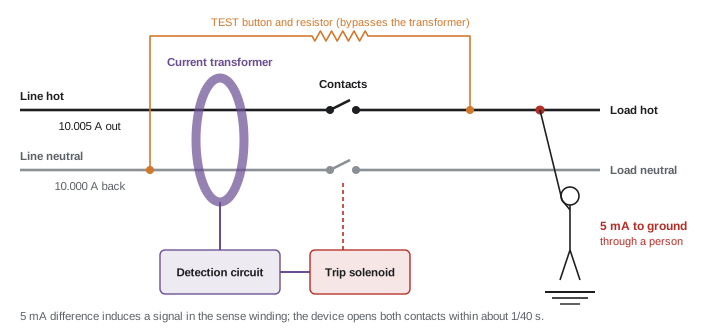
Class A GFCIs, the type required for personnel protection in the US, are listed to UL 943 and trip at a ground-fault current of 6 mA or less (and must not trip below 4 mA), within times defined by an inverse time-current curve: the higher the fault current, the faster the trip, typically within about 25 milliseconds for large faults.
A GFCI does not limit the current that flows through the person at the instant of contact; it limits the duration, which is what determines whether the heart fibrillates. It also cannot protect against a shock between hot and neutral, since that current returns on the neutral and causes no imbalance; for that reason GFCIs complement, rather than replace, insulation and enclosures. A GFCI works without an equipment grounding conductor, so a GFCI is an accepted way to protect old two-wire circuits where a ground cannot be added (the receptacles are then marked "No Equipment Ground" and "GFCI Protected").
Types of GFCI
- GFCI receptacle: protects its own outlets and, if wired from its LOAD terminals, every receptacle downstream on the circuit. Line and load must not be reversed; modern devices will not reset if they are.
- GFCI breaker: protects the whole circuit from the panel, useful where the first receptacle is hard to reach or the circuit supplies a hard-wired load such as a hot tub.
- Portable and cord-mounted GFCIs, for temporary power and tools.
- Deadfront GFCIs: a GFCI without receptacle slots, mounted in a wall box to protect downstream outlets from a convenient location.
GFCIs made since about 2015 must monitor themselves automatically and either trip or signal at end of life. All GFCIs should still be tested with the TEST button regularly (monthly is the classic advice) and after installation.
Worked problem
Leakage and nuisance trips
A GFCI breaker protects a garage circuit that supplies a freezer (leakage 1.5 mA), a battery charger (1.2 mA), a dehumidifier (1.0 mA) and a block heater cord (1.8 mA when wet). Will the GFCI trip without any fault?
Show solution
- Normal leakage from appliance insulation and electromagnetic interference filters adds up on one circuit: \(1.5 + 1.2 + 1.0 + 1.8 = 5.5\) mA.
- That is within the 4 to 6 mA trip band of a Class A GFCI.
Answer: Yes, probably, especially when the heater cord is wet. Nuisance tripping from accumulated leakage is common on circuits with many motors and electronic loads; the fix is to split the loads across circuits or replace a deteriorating appliance, never to remove the protection. A freezer on a GFCI circuit should be checked regularly, or supplied from a location the code allows without GFCI protection.
Where GFCI protection is required
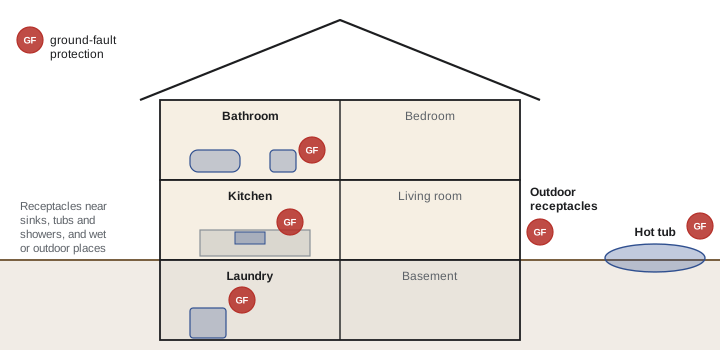
In US dwellings, NEC 210.8(A) (2023 edition) requires GFCI protection for 125 V through 250 V receptacles supplied by single-phase branch circuits of 150 V or less to ground in: bathrooms; garages and accessory buildings; outdoors; crawl spaces; basements; kitchens (all receptacles, not only countertop); areas with sinks, within 6 ft of the bowl edge; boathouses; within 6 ft of bathtubs and showers; laundry areas; and indoor damp and wet locations. Specific appliances, such as dishwashers, also require GFCI protection (210.8(D) and 422.5), and outdoor outlets such as those for heat pumps were added in 2020–2023 (210.8(F)).
Arc faults and AFCIs
An arc fault is an unintended electric arc in wiring or cords. Arcs reach thousands of degrees and can ignite insulation, wood framing and dust, and many residential electrical fires start this way. Two kinds matter:
- Series arcs occur within one conductor, at a loose terminal, a broken strand in a cord that has been pinched under furniture, or a nail through a cable that has nicked a conductor. The arc is in series with the load, so the current is no more than the load current, sometimes only a few amperes, and an ordinary breaker cannot see it.
- Parallel arcs occur between conductors (hot to neutral or hot to ground) through damaged insulation. The current can be high but intermittent, in short bursts that may not last long enough to trip a thermal-magnetic breaker.
An AFCI monitors the current waveform with electronics that recognize the signature of arcing: the irregular, high-frequency noise and the characteristic shoulders and gaps in the current each half-cycle as the arc strikes and extinguishes. It must distinguish these from normal waveforms of motors with brushes, dimmers and switching power supplies, which also produce noise; manufacturers' detection algorithms are proprietary and are tested against standard arc and masking-load tests (UL 1699 in the US, CSA C22.2 No. 270 in Canada). A combination-type AFCI detects both series arcs (down to about 5 A) and parallel arcs, and is the type required for most residential use.
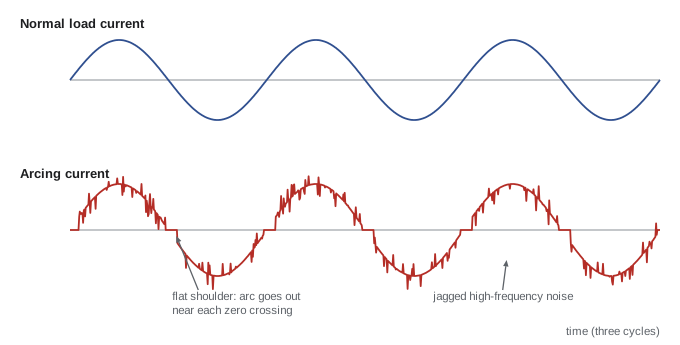
NEC 210.12(A) requires AFCI protection for all 120 V, single-phase, 15 and 20 A branch circuits supplying outlets or devices in dwelling unit kitchens, family rooms, dining rooms, living rooms, parlors, libraries, dens, bedrooms, sunrooms, recreation rooms, closets, hallways, laundry areas and similar rooms or areas. Protection is normally a combination-type AFCI breaker; an outlet-branch-circuit AFCI at the first outlet is allowed under conditions, for example where the wiring from the panel to that outlet is in metal raceway or armored cable. Extensions and modifications of existing circuits in those areas must also be protected (210.12(D)).
Worked problem
Why a breaker misses a series arc
A lamp cord is crushed under a bed leg, breaking most strands of one conductor. The 100 W lamp draws 0.83 A, and the damaged spot arcs intermittently. The circuit has a 15 A breaker. What protects against fire?
Show solution
- The arc is in series with the lamp, so the current cannot exceed the lamp's 0.83 A, about 5% of the breaker rating: the breaker never responds.
- The arc concentrates power in a tiny volume: even 10 V across the arc at 0.83 A is about 8 W in a spot a millimeter across, enough to char and ignite insulation.
- A combination-type AFCI recognizes the arcing signature and opens the circuit.
Answer: Only an AFCI (or someone noticing the smell of burning). Series arcing in damaged cords and loose connections is the type of fire AFCIs were developed to prevent.
Installing and troubleshooting
Combination AFCI and dual-function (AFCI and GFCI in one device) breakers have a pigtail neutral that connects to the panel's neutral bar, and the circuit neutral lands on the breaker, not on the bar. Because the device monitors the circuit's neutral, two practical rules follow:
- Neutrals must not be shared between circuits. A neutral that carries current from another circuit, or a neutral that has been connected to a different circuit's neutral in a junction box, makes the currents appear unbalanced and trips GFCI and dual-function devices. Multiwire branch circuits need two-pole AFCI or GFCI breakers designed for them.
- Neutral-to-ground contact downstream of the device, such as a neutral touching a metal box or a bare bonding conductor, gives the return current a path that bypasses the sensor and causes trips (and is a wiring fault in its own right).
When an AFCI trips repeatedly, the cause is usually real: a loose terminal, a staple driven through a cable, a damaged cord or appliance, or a shared or grounded neutral. Many AFCI breakers display or blink a code identifying the type of trip (arc, ground fault, overcurrent), which speeds diagnosis. Some loads, such as older treadmills and vacuum cleaners with worn brushes, genuinely produce arc-like noise; replacing the appliance, not removing the protection, is the remedy.
Worked problem
Tracing a nuisance trip
After a basement renovation, a new dual-function breaker trips as soon as any load is turned on, but an ordinary breaker on the same circuit holds. An insulation test between the circuit's neutral and ground, with the breaker off and the neutral lifted from the breaker, reads 0.2 Ω. What is wrong?
Show solution
- A near-zero resistance between neutral and ground means they are connected somewhere downstream: a neutral pinched against a metal box, or neutral and ground joined at a device.
- Load current then splits between the neutral and the bonding conductor; the part on the bonding path bypasses the breaker's sensor, so the device sees an imbalance and trips as a ground fault.
- Find the fault by opening boxes along the circuit and splitting it in halves, re-testing each section.
Answer: A neutral-to-ground fault downstream. The ordinary breaker ignores it, but it is a genuine wiring error: it puts neutral current on the bonding conductors. The dual-function breaker revealed it.
Related protection
Several other devices round out residential protection:
- Tamper-resistant receptacles prevent children from inserting objects into a single slot (Lesson 5).
- Surge protective devices limit transient overvoltages from lightning and switching.
- Smoke alarms and carbon monoxide alarms are required by the residential building code, usually hard-wired and interconnected; the NEC allows them on AFCI-protected circuits, and many jurisdictions require their circuit to be one that is regularly used (such as a lighting circuit) so that a tripped breaker is noticed.
- Since the 2020 NEC, a surge protective device is required at the service of every dwelling unit (230.67).
- Equipment ground-fault protection (GFP), typically tripping at hundreds of amperes, protects large services from destructive arcing ground faults; it is not personnel protection and is not used in houses.
Lesson 11 shows how GFCI protection allows three-slot receptacles on older ungrounded circuits, and when extending old circuits triggers current AFCI requirements.
Common mistakes
MistakeAssuming a breaker protects people from shock.
InsteadBreakers protect wiring; only a GFCI responds to the milliampere currents that kill.
MistakeReversing LINE and LOAD on a GFCI receptacle.
InsteadSupply goes to LINE; downstream receptacles to LOAD. Modern devices will not reset if reversed.
MistakeSharing a neutral between two GFCI- or AFCI-protected circuits.
InsteadGive each protected circuit its own neutral, or use a two-pole device designed for multiwire circuits.
MistakeLanding the circuit neutral on the neutral bar when using an AFCI or dual-function breaker.
InsteadLand it on the breaker's neutral terminal and connect the pigtail to the bar.
MistakeReplacing a frequently tripping AFCI or GFCI with an ordinary breaker.
InsteadFind the cause: loose connections, damaged cables, shared or grounded neutrals, or faulty appliances.
MistakeNever testing GFCIs after installation.
InsteadTest with the TEST button at installation and regularly afterwards.
Summary and key terms
- Currents of 50 to 100 mA through the body can cause fibrillation; breakers cannot detect them.
- GFCIs compare hot and neutral current in a current transformer and trip on an imbalance of about 5 mA, within milliseconds.
- Class A GFCIs (UL 943) trip at 4–6 mA.
- GFCIs work without a grounding conductor and protect downstream receptacles from their LOAD terminals; they cannot detect hot-to-neutral contact.
- GFCIs (210.8) are required in bathrooms, garages, outdoors, crawl spaces, basements, kitchens, near sinks, laundry areas and more.
- Arc faults (series and parallel) cause fires at currents breakers may ignore; combination-type AFCIs recognize arcing waveforms.
- AFCI protection (210.12) covers 120 V 15/20 A circuits in nearly all living areas of a dwelling.
- Shared or grounded neutrals cause trips; repeated trips usually indicate real wiring or appliance faults.
- Ground-fault circuit interrupter (GFCI)
- A device that opens a circuit when current leaking to ground exceeds a few milliamperes.
- Class A GFCI
- A GFCI for personnel protection, tripping at about 5 mA.
- Current transformer
- A toroidal core that senses the net current of the conductors passing through it.
- LINE and LOAD terminals
- The supply and downstream connections of a GFCI receptacle.
- Let-go threshold
- The current above which a person cannot release a gripped conductor.
- Ventricular fibrillation
- Chaotic heart rhythm that stops effective pumping.
- Arc fault
- An unintended arc in wiring or cords.
- Series arc
- An arc within one conductor, in series with the load.
- Parallel arc
- An arc between conductors through damaged insulation.
- Arc-fault circuit interrupter (AFCI)
- A device that opens a circuit when it detects the waveform of an arc fault.
- Combination-type AFCI
- An AFCI that detects both series and parallel arcs.
- Dual-function breaker
- A breaker providing both AFCI and GFCI protection.
- Nuisance tripping
- Tripping without a hazardous fault, often from accumulated leakage or electrical noise.
Practice problems
Work each problem on paper first, then reveal the answer to check.
A person's body path is 2000 Ω. What current flows from a 120 V conductor? Is it dangerous?
Show answer
60 mA: above the let-go threshold and in the range that can cause fibrillation.
Why does a GFCI not need an equipment grounding conductor to work?
Show answer
It measures the difference between hot and neutral current; any leakage path, including through a person, creates the imbalance.
A GFCI receptacle is the first outlet on a circuit of five receptacles fed from its LOAD terminals. Which are protected?
Show answer
All five.
A person touches hot and neutral with one hand on each, standing on a dry wooden floor. Will a GFCI trip?
Show answer
No: the current returns on the neutral, so there is no imbalance.
Four appliances leak 1.2, 0.8, 1.5 and 1.0 mA on one GFCI circuit. Are trips likely?
Show answer
Total 4.5 mA, within the 4–6 mA band: nuisance trips are likely; split the loads.
Why can a 15 A breaker not detect a series arc in a lamp cord?
Show answer
The arc current cannot exceed the load current, far below the breaker's trip level.
What two features of an arcing current waveform do AFCIs look for?
Show answer
Flat shoulders near the zero crossings and irregular high-frequency noise.
A new dual-function breaker trips whenever a light is switched on. Name two likely wiring causes.
Show answer
A shared neutral with another circuit; a neutral touching ground (a box or bare conductor) downstream; the circuit neutral landed on the bar instead of the breaker.
How should old two-wire receptacle circuits without a ground be upgraded when a ground cannot be run?
Show answer
Protect them with a GFCI and mark the receptacles "No Equipment Ground" and "GFCI Protected".
What is the difference between a Class A GFCI and equipment ground-fault protection?
Show answer
Class A trips at about 5 mA to protect people; equipment GFP trips at hundreds of amperes to protect large services from arcing faults.
Lesson quiz · 5 questions
Score 60% or more to complete this lesson.
Create a free account to save your progress, take quizzes and earn a certificate.