
BAS-120 · Lesson 5 of 12 · 23 min
Carbon dioxide, occupancy and air quality sensors
▶ Video coming soon A video version of this lesson is on the way.
On Thursday, October 22, Callie and Prakash went back to lecture hall T-120 in Tilden Hall with a new carbon dioxide sensor in a box. Two days earlier, in BAS-110's lesson 8, they had found that the hall's only CO2 sensor, in the return duct, was reading about 330 ppm low, so the demand-controlled ventilation had been starving a full lecture of outdoor air. The return sensor had been recalibrated, and Sophie Aubertin had changed the sequence to use the higher of two readings. Now the second sensor had to be mounted in the room, wired, configured and checked before the next morning's chemistry lecture.
This lesson covers the sensors that tell a building how many people are present and how good the air is: carbon dioxide sensors, occupancy and vacancy sensors, and the newer sensors for volatile organic compounds and fine particles. It explains how each works, what its readings mean and do not mean, where it should be mounted and how it fails.
Why buildings measure carbon dioxide
People breathe out carbon dioxide at a fairly steady rate for a given activity, so the CO2 level in a room rises with the number of people and falls with the amount of outdoor air brought in. A CO2 reading is therefore a rough measure of how much outdoor air each person is getting. It is not, by itself, a measure of air quality: CO2 at the levels found in buildings is not a contaminant of concern, but it tracks the odors and other substances that people produce. Demand-controlled ventilation (DCV) uses CO2 readings to reduce outdoor air when a space is partly occupied and increase it when the space fills, saving the energy of heating or cooling outdoor air nobody needs.
Outdoor air is the baseline. Global background CO2 measured at Mauna Loa averaged about 427 ppm in 2025, and the forecast for 2026 is just under 430 ppm; city air near traffic is often higher. Indoor readings are best read as the difference above outdoors. In a steady state, the difference depends on the outdoor air supplied per person.
Worked problem
What CO2 level does a given ventilation rate produce?
An adult doing office or classroom work breathes out about 0.011 cfm of CO2 (a typical value). If each person receives 15 cfm of outdoor air, about how far above outdoors will the room's CO2 settle, and what will it read if outdoors is 430 ppm?
Show solution
- Difference: 0.011 ÷ 15 = 0.000733, which is 733 parts per million.
- Room reading: 430 + 733 = about 1,160 ppm.
Answer: About 1,160 ppm at steady state. Real rooms take time to reach steady state, and people's CO2 output varies with age and activity, so DCV setpoints come from the design engineer and the ventilation standard, not from a single rule.
BAS-110 explained that T-120's DCV sequence raised outdoor air between 700 and 1,000 ppm. Those numbers are the design engineer's choices for that hall. A controls technician's job is to make sure the sensor reports the truth, the sequence uses it as designed, and the minimum ventilation the design calls for is always provided.
How CO2 sensors work
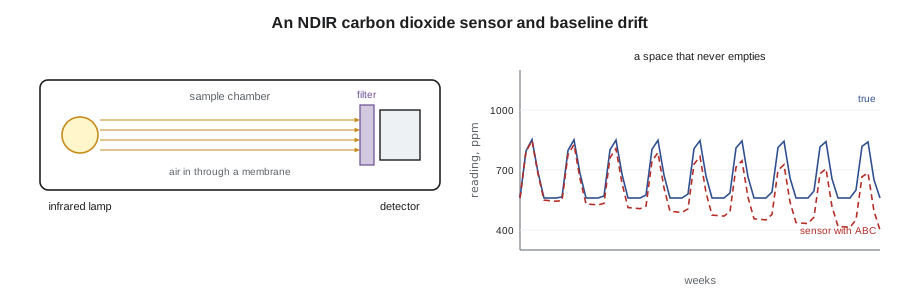
Building CO2 sensors are almost all nondispersive infrared (NDIR) sensors. A small lamp shines infrared light through a chamber of sampled air onto a detector with a filter that passes only the wavelength CO2 absorbs. The more CO2 in the chamber, the less light reaches the detector. Electronics convert the result into a reading in parts per million, usually across 0 to 2,000 ppm, and output it as 0 to 10 V, 4 to 20 mA or a network value.
The lamp and detector age, so NDIR sensors drift. Many single-beam sensors correct themselves with automatic baseline calibration, often sold under names such as ABC. The sensor remembers the lowest reading it sees over a period of days, assumes that reading was outdoor air, and shifts its calibration so that the lowest reading becomes about 400 ppm. That works well in offices that empty every night and are flushed with outdoor air. It fails in spaces that never fall to outdoor levels, such as buildings occupied around the clock, rooms with low night ventilation, or sensors in return ducts that never see unoccupied air. In those places the sensor slowly calibrates its real minimum down to 400 ppm and reads low, which is exactly what had happened to T-120's return sensor. Dual-beam and dual-wavelength sensors have a reference channel that corrects for drift without assuming the space empties, and are preferred where automatic baseline calibration is doubtful.
Installing the new T-120 sensor
The design called for the room sensor on the side wall of the hall at about 5 ft, where it would sample the breathing zone of the seated audience and not the air near a supply diffuser, a door or the instructor's desk. Callie checked the wall with a cheap tracer: a puff of smoke from a pen near the proposed position drifted slowly toward the return grille, away from the supply slots, which suggested the spot saw mixed room air. People breathing directly onto a sensor raise its reading, so it should not be within arm's reach of a seat.
She mounted the sensor, ran shielded cable back to the AHU-2 controller as the drawings showed and landed it on a 0 to 10 V input. The sensor's label gave its range as 0 to 2,000 ppm and its output as 0 to 10 V. Before configuring the input, she checked the sensor's settings menu and found automatic baseline calibration enabled, the factory default. The hall was empty most nights and the AHU ran a morning purge, so Prakash judged that ABC would work here, but he asked her to note the setting on the point list so that anyone reviewing the sensor later would know.
Worked problem
Checking the sensor output
The new sensor is ranged 0 to 2,000 ppm with a 0 to 10 V output. With the hall empty and the AHU running on outdoor air, Callie measures 2.2 V. What CO2 level does that represent, and is it sensible?
Show solution
- Fraction of span: 2.2 ÷ 10 = 0.22.
- CO2: 0.22 × 2,000 = 440 ppm.
- An empty hall supplied with outdoor air should read close to outdoor levels, about 430 ppm, so 440 ppm is sensible.
Answer: 440 ppm, consistent with outdoor air.
The next morning, Callie watched the trend during the 8:30 lecture. Both sensors climbed together as students arrived, the room sensor about 60 ppm above the return, and the outdoor air damper opened as the higher reading crossed 700 ppm. By the middle of the lecture the room sensor held near 950 ppm. The sequence was doing what the engineer intended.
Occupancy and vacancy sensors
Occupancy sensors detect whether people are present. Passive infrared (PIR) sensors detect the movement of warm bodies across zones in their lens; they need a clear line of sight and see large movements, such as walking, much better than small ones, such as typing. Ultrasonic sensors fill the room with inaudible sound and detect the Doppler shift from movement; they can see around partitions and detect small movements but can be fooled by moving air from diffusers. Microphonic sensors listen for the sounds of occupancy. Dual-technology sensors combine two methods, usually PIR with ultrasonic or microphonic, turning on when both agree and staying on while either detects someone. BAS-110 described Ninefield's sixth floor, where PIR sensors that could not see over partitions were replaced with dual-technology sensors.
An occupancy sensor turns lights or HVAC on automatically when someone enters and off after a time delay. A vacancy sensor needs someone to turn the lights on manually and turns them off automatically; energy codes often require vacancy operation in some rooms because people often do not need the lights at all. For HVAC, the occupancy signal usually comes from the lighting system over a network or from a relay contact, and the BAS uses it to put a zone into an occupied-standby mode with wider setpoints and lower airflow. The time delay must be long enough that a still occupant is not plunged into the dark or into a reduced ventilation rate.
| Technology | Detects | Strengths | Weaknesses |
|---|---|---|---|
| Passive infrared (PIR) | Movement of warm bodies across lens zones | Cheap, few false triggers | Needs line of sight; misses small movements |
| Ultrasonic | Doppler shift from movement | Sees around obstacles; detects small movements | Can be triggered by air movement |
| Microphonic | Sounds of occupancy | Keeps lights on for quiet occupants | Needs another technology to switch on |
| Dual technology | Two of the above | Fewer false on and off events | Costs more; needs careful setup |
Air quality sensors beyond CO2
Sensors for other indoor air quality measures are now common in commercial buildings, often packaged with CO2, temperature and humidity in one device. Volatile organic compound (VOC) sensors, usually metal-oxide semiconductor elements, respond to a broad mix of gases from cleaning products, furnishings, cooking and people. They give a useful relative signal that something has changed, but not a measurement of any particular chemical, and different brands read differently in the same room. Particulate matter (PM) sensors use a small fan and a laser to count particles and estimate concentrations of fine particles such as PM2.5, which matter for health, especially during wildfire smoke events. They are good at showing trends and comparing indoor with outdoor air, but low-cost sensors are less accurate than reference instruments, and their readings are affected by humidity.
These sensors can improve control, for example by flushing a space after cleaning or by reducing outdoor air and running filtration harder when outdoor PM2.5 is high. They should be used with an understanding of their limits: as indicators that trigger a response or a closer look, not as precise measurements to be compared with health guidelines without a reference check.
Common faults
- CO2 reading low and flat during occupied hours: automatic baseline calibration in a space that never empties, or a sensor in a dead corner. Check against a calibrated portable meter.
- CO2 reading spiking when someone sits nearby: the sensor is too close to people or to a desk; move it.
- CO2 reading high with the space empty: a combustion source, a stale corner, or a failed lamp or detector. Compare with outdoors.
- Lights or HVAC switching off on still occupants: PIR without line of sight, or a time delay that is too short.
- Lights or HVAC switching on in empty rooms: ultrasonic sensor seeing air movement or a corridor through an open door; reduce sensitivity or re-aim.
- VOC or PM readings that differ between brands: normal for low-cost sensors; compare trends rather than absolute values.
Checking and calibrating CO2 sensors
A CO2 sensor is checked in one of two ways. The quick field check compares it with a calibrated portable NDIR meter held beside it for several minutes, long enough for both to settle, with nobody breathing near either. The two should agree within the accuracy both manufacturers state, typically about 30 to 50 ppm plus a few in 100 of the reading for commercial sensors. A larger difference means the wall sensor needs recalibrating or replacing.
Calibration itself uses a gas of known concentration. A small cylinder of certified calibration gas, often around 1,000 ppm, is fed through a hood or adapter over the sensor's inlet at the flow the manufacturer specifies, and the sensor's span is adjusted until it reads the cylinder's value. A zero check uses nitrogen or a gas with no CO2. Some sensors can only be calibrated by returning them to the manufacturer or swapping a cartridge. Whatever the method, the date and the result belong on the point list or in the maintenance records, so that the next technician knows how old the calibration is.
On T-120, Callie compared both sensors with Quillon's portable meter at the end of the morning lecture. The room sensor read 960 ppm against the meter's 945 ppm, and the recalibrated return sensor read 890 ppm against 880 ppm at the return grille. Both were well within their stated accuracy, and she recorded the readings and the date on the point list.
Demand-controlled ventilation never reduces outdoor air below what the design requires for the building itself and for the minimum number of people the design assumes. A CO2 sensor that fails low must not be able to shut the outdoor air damper. Good sequences enforce a minimum outdoor airflow regardless of the CO2 reading and alarm when a sensor reads implausibly low, such as below outdoor levels during occupied hours.
Common mistakes
MistakeTreating CO2 as a direct measure of air quality.
InsteadTreat it as an indicator of outdoor air per person, with the design setpoints.
MistakeLeaving automatic baseline calibration on in a space occupied around the clock.
InsteadUse a dual-beam sensor or turn ABC off and calibrate manually.
MistakeMounting a CO2 sensor beside a desk or a supply diffuser.
InsteadMount it in the breathing zone, away from people's faces, supply air and doors.
MistakeUsing a single return-duct sensor for a large, densely occupied room.
InsteadAdd an in-room sensor and use the higher reading, as the design requires.
MistakeSetting an occupancy time delay of a minute or two.
InsteadUse a delay long enough for still occupants, often 15 to 30 minutes.
MistakeComparing a low-cost PM sensor's reading directly with a health guideline.
InsteadUse it for trends and triggers, and check against a reference when it matters.
Summary and key terms
- CO2 rises with people and falls with outdoor air; the difference above outdoors indicates outdoor air per person.
- Outdoor CO2 was about 427 ppm in 2025 and is forecast just under 430 ppm in 2026.
- NDIR sensors drift; automatic baseline calibration corrects drift only where the space regularly falls to outdoor levels.
- Dual-beam sensors correct drift without assuming the space empties.
- PIR, ultrasonic, microphonic and dual-technology sensors detect occupancy in different ways with different weaknesses.
- VOC and PM sensors are useful indicators, not precise measurements of particular pollutants.
- Demand-controlled ventilation (DCV)
- Varying outdoor air with a measure of occupancy, usually CO2.
- NDIR
- Nondispersive infrared: CO2 sensing by absorption of a specific infrared wavelength.
- Automatic baseline calibration
- Self-correction of a CO2 sensor by assuming its lowest reading over several days is outdoor air.
- Dual-beam sensor
- A CO2 sensor with a reference channel that corrects for drift.
- Passive infrared (PIR)
- Occupancy sensing by detecting warm bodies moving across lens zones.
- Dual-technology sensor
- An occupancy sensor that combines two detection methods.
- Vacancy sensor
- A sensor that turns lights off automatically but needs them turned on manually.
- PM2.5
- Fine particles 2.5 micrometers across or smaller.
Practice problems
Work each problem on paper first, then reveal the answer to check.
A room's CO2 reads 1,100 ppm with outdoors at 430 ppm. How far above outdoors is it?
Show answer
670 ppm.
Why did automatic baseline calibration make T-120's return sensor read low?
Show answer
The return duct never saw outdoor-level air, so the sensor shifted its real minimum down to 400 ppm.
Name two places a CO2 sensor should not be mounted.
Show answer
Beside a desk or seat where people breathe on it, and near a supply diffuser or door.
Which occupancy technology needs a clear line of sight?
Show answer
Passive infrared.
What is a VOC sensor's reading best used for?
Show answer
As a relative indicator that the air has changed, triggering a response or a closer look.
Lesson quiz · 5 questions
Score 60% or more to complete this lesson.
Create a free account to save your progress, take quizzes and earn a certificate.