
BAS-120 · Lesson 11 of 12 · 23 min
Safeties: freezestats, high-limit and smoke detection interlocks
▶ Video coming soon A video version of this lesson is on the way.
On Wednesday, October 7, before the first hard frost, Nell Nakagawa asked Quillon to test the safeties on every Tilden Hall air handler. It was a yearly job, and Prakash used it to teach Callie the difference between a control and a safety. "A control does what the program tells it," he said, standing in front of AHU-1's mixing box. "A safety stops the equipment when something has gone wrong, whatever the program thinks. If the controller locks up, crashes or gets reprogrammed by someone who doesn't know what they're doing, the safety still has to work. That's why we wire them so the controller can't override them."
This lesson covers the safety devices a controls technician installs, wires and tests on air systems: freezestats, which protect water coils from freezing; high and low static pressure limits, which protect ducts and equipment from overpressure; and the interlocks between smoke detectors, the fire alarm system and the HVAC equipment. It explains how each is wired so that it fails safe, how it is tested, and where the controls technician's responsibility ends and the fire alarm contractor's begins.
Controls and safeties
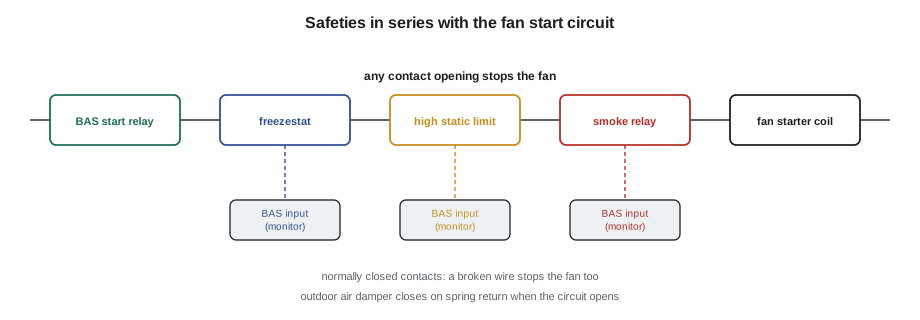
A control holds a variable at a setpoint; a safety, or limit, stops equipment or drives it to a safe state when a variable goes outside safe bounds. Controls are software in the controller. Safeties should be hard-wired: their contacts sit directly in the circuits that start fans or open dampers, so that they act even if the controller has failed. The controller also monitors each safety through a separate binary input, so that it knows the safety has tripped, raises an alarm and puts its own outputs in a matching state. But the safety acts by itself; the controller's job is to report it, not to make it work.
Safeties are wired so that they fail safe. Their contacts are closed when conditions are normal and open on a fault, and they sit in series with the fan's start circuit or the equipment's enable. A broken wire, a failed device or a lost power supply then has the same effect as a real trip: the equipment stops. Most safeties are also manual reset: once tripped, they stay tripped until someone resets them at the device or the panel, so that a fault that comes and goes cannot cycle the equipment on and off without anyone looking at it.
Freezestats
A freezestat, or low-limit thermostat, protects a hot water or chilled water coil from freezing when air below freezing reaches it. The most common type has a long capillary tube filled with a vapor-charged fluid. If any short section of the capillary, often about 12 in, falls below the setpoint, the vapor in that section condenses, the pressure in the bulb drops and the switch opens. This makes the freezestat respond to the coldest spot along its length rather than to an average, which is exactly what is needed: freezing air often arrives in a stratified layer along the bottom of a coil or through one corner of a damper.
Freezestats are typically set at about 38 to 40 °F, which is cold enough not to trip in normal operation and warm enough to act before water in the tubes freezes. The design documents give the setpoint. When the freezestat trips, the fan stops, the outdoor air damper closes under spring return, and the heating valve opens fully to send hot water through the coil; many sequences also start the hot water pump. The controller sees the trip through the monitoring contact and holds its own outputs in the freeze protection state until the freezestat is manually reset.
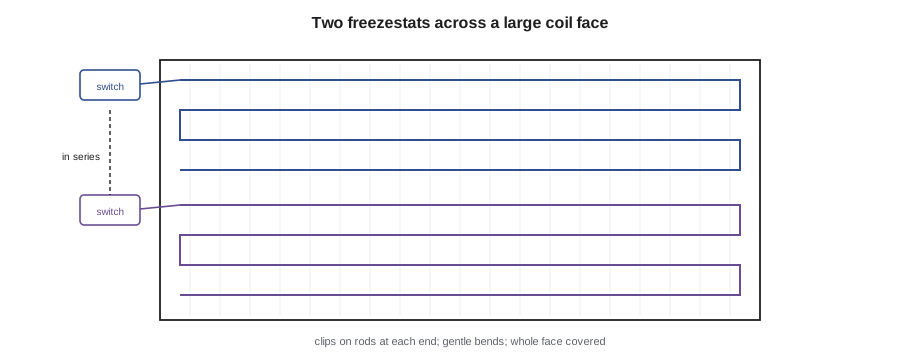
The capillary must be strung across the face of the coil it protects, usually on the leaving-air side of the first water coil the air meets, in a serpentine pattern that covers the whole face. A common rule of thumb is about 1 ft of capillary for every square foot of coil face. Where the coil is larger than one freezestat can cover, two or more are used, wired in series so that any one of them trips the unit. The capillary should be supported with clips, not tied tightly, kept clear of sharp edges and never kinked, and the bend radius must stay above the manufacturer's minimum.
Worked problem
How much freezestat capillary does a coil need?
Tilden AHU-1's preheat coil face is 8 ft wide by 5 ft high. Freezestats are available with 20 ft capillaries. Using about 1 ft of capillary per square foot of face, how many are needed?
Show solution
- Face area: 8 × 5 = 40 ft².
- Capillary needed: 40 × 1 = 40 ft.
- Freezestats: 40 ÷ 20 = 2, wired in series.
Answer: Two freezestats with 20 ft capillaries, strung in serpentine across the upper and lower halves of the coil and wired in series. AHU-1 had exactly that arrangement.
Some systems use electronic low-limit devices instead: an averaging thermistor or a string of sensors whose readings are compared with a setpoint, by the controller or by a dedicated safety relay. They are easier to test and trend, but unless they have their own hard-wired relay output they depend on the controller, and many codes and owners still require the capillary type as the hard-wired safety, with the electronic sensor added for monitoring and preheat control.
Testing AHU-1's freezestats
Testing a freezestat means cooling a short section of the capillary below the setpoint and watching the equipment respond. Callie did it with a bag of ice and salt pressed against about 12 in of each capillary, with the unit running. Within a minute the first freezestat opened: the supply fan stopped, the outdoor air damper closed, the heating valve drove fully open and the front end showed the freeze alarm. She removed the ice, let the capillary warm, pressed the reset button and restarted the unit from the front end, then repeated the test on the second freezestat. Some technicians use a can of spray coolant designed for the purpose; either way, the test must cool the capillary, not the switch body.
Both freezestats on AHU-1 passed. On AHU-2, the older lecture wing unit, the test found a problem: the freezestat tripped and the front end showed the alarm, but the fan kept running. Callie traced the wiring and found that the freezestat's contacts had been wired only to the controller's binary input, not into the fan's start circuit. When the freezestat opened, the controller's program was supposed to stop the fan, and it did, but only after a time delay someone had added years before to stop nuisance trips, set to fifteen minutes. A coil can freeze in less time than that. The safety had been turned into a control. Prakash wrote it up as an urgent deficiency, and Quillon rewired the freezestat into the start circuit that afternoon, with Gus's approval, leaving the monitoring contact on the controller.
High and low static pressure limits
Air handlers with dampers that can close, or VAV systems whose boxes can all close at once, can build up dangerous duct pressure if a damper sticks shut or a controller fails. Ducts are built for a pressure class, and a supply fan running against closed dampers can exceed it, splitting seams or collapsing return ducts. A high static pressure limit is a pressure switch on the supply duct near the fan discharge, set below the duct's pressure rating and well above the normal operating pressure. A low static limit on the return or mixed air side protects against collapse when return or outdoor dampers close. Like freezestats, these switches are wired in series with the fan start circuit, are manual reset, and are monitored by the controller.
Worked problem
Setting a high static limit
AHU-1's supply duct is built for a 4 in. w.c. pressure class. The duct static setpoint is 1.5 in. w.c., and the highest pressure seen at the fan discharge in normal operation is about 2.4 in. w.c. The engineer specifies a high static limit at 3.0 in. w.c. Does that sit sensibly between normal operation and the duct rating, and what is it in pascals?
Show solution
- Margin above normal: 3.0 − 2.4 = 0.6 in. w.c., enough to avoid nuisance trips.
- Margin below the rating: 4.0 − 3.0 = 1.0 in. w.c., so it trips before the duct is at risk.
- In pascals: 3.0 × 249 = about 750 Pa.
Answer: Yes. The setpoint is chosen by the engineer; the technician sets it, tests it and records it.
The high static switch is tested by raising the duct pressure above its setpoint, for example by commanding a fire or isolation damper closed or by restricting the duct with the system under careful observation, or by applying a known pressure to the switch's port with a hand pump and manometer. The safer method is usually the hand pump, because it does not stress the ductwork. Callie tested AHU-1's switch that way: it opened at 3.0 in. w.c., within its tolerance, and stopped the fan.
Smoke detectors and the fire alarm system
Duct smoke detectors sample air in a duct and shut down the air handler when they detect smoke, so that the HVAC system does not spread smoke through the building. Building and fire codes require them on many air handling systems. The International Mechanical Code and NFPA 90A require duct smoke detectors on many air handling systems above about 2,000 cfm, with additional detectors on larger systems, and NFPA 72 sets how they are installed and connected. Where the building has a fire alarm system, the detectors must be connected to it. The exact requirements depend on the code edition the building was built under and the authority having jurisdiction.
In buildings with a fire alarm system, the duct detectors are fire alarm devices. They are supplied, installed, verified and maintained by the fire alarm contractor and tested on the fire code's schedule, tested and inspected under NFPA 72. The controls contractor's work is on the HVAC side of the interface: the fire alarm panel provides a relay contact, often through a control module, that opens when smoke is detected or the system is in alarm, and that contact is wired into the fan shutdown circuit and to a BAS input. Smoke control systems, which use fans and dampers to manage smoke in an emergency, have their own design, listed equipment and testing, and the BAS may only operate them as the smoke control design and the fire alarm system permit.
| Safety | Trips on | Wired | Reset | Tested by |
|---|---|---|---|---|
| Freezestat | Any short section of capillary below setpoint | In series with fan start; monitored by BAS | Manual | Cooling a section of capillary |
| High static limit | Supply duct pressure above setpoint | In series with fan start; monitored by BAS | Manual | Hand pump and manometer |
| Low static limit | Return or mixed air pressure below setpoint | In series with fan start; monitored by BAS | Manual | Hand pump and manometer |
| Duct smoke detector | Smoke in the duct | Through the fire alarm system relay to fan shutdown; monitored by BAS | At the fire alarm panel | By the fire alarm contractor, on the fire code's schedule |
At Tilden, the fire alarm contractor had tested the duct detectors in September. Prakash asked Callie only to confirm, with Nell watching from the fire alarm panel, that when the panel's relay for AHU-1 was operated in a test, the fan stopped and the BAS showed the shutdown. That test was coordinated with the fire alarm contractor's records and with the college, because operating any part of a fire alarm system without notice can call the fire department or alarm the occupants.
General rules for safeties
- Never jumper out a safety to keep equipment running. If a safety trips repeatedly, find out why.
- Never add a time delay or software condition that stops a hard-wired safety from acting.
- Wire safeties normally closed, in series with the equipment they protect, and monitor them separately.
- Test every safety at least yearly, or as the owner and code require, and record the results.
- Coordinate any test that involves the fire alarm system with the fire alarm contractor and the building.
Common mistakes
MistakeWiring a freezestat only to a controller input.
InsteadWire it in series with the fan start circuit; the controller monitors it.
MistakeAdding a time delay to stop nuisance freezestat trips.
InsteadFind the cause, such as stratified air or a failed preheat valve, and fix it.
MistakeStringing a freezestat capillary in one straight line across the bottom of a coil.
InsteadSerpentine it across the whole face and add freezestats in series for large coils.
MistakeTesting a high static switch by closing dampers on a fragile duct.
InsteadUse a hand pump and manometer at the switch where possible.
MistakeOperating a fire alarm relay without telling anyone.
InsteadCoordinate with the fire alarm contractor and building staff first.
MistakeJumpering out a safety to finish a job.
InsteadNever; if it must be bypassed for testing, someone must stand by and it must be restored and checked.
Summary and key terms
- Controls hold setpoints; safeties stop equipment when something goes wrong, independent of the controller.
- Safeties are wired normally closed, in series with the equipment they protect, manual reset, and monitored by the BAS.
- Capillary freezestats trip on the coldest short section; they are strung across the whole coil face, set about 38 to 40 °F.
- High and low static limits protect ducts from overpressure and collapse.
- Duct smoke detectors are fire alarm devices; the controls contractor wires the HVAC side of the interface.
- Test safeties yearly, record the results, and never bypass them.
- Safety (limit)
- A device that stops equipment or drives it to a safe state when a variable goes outside safe bounds.
- Fail safe
- Arranged so that a broken wire or failed device has the same effect as a real trip.
- Freezestat
- A low-limit thermostat that trips when any short section of its capillary falls below setpoint.
- Capillary
- A long, fine tube filled with a temperature-sensitive fluid, used as a freezestat's sensing element.
- High static limit
- A pressure switch that stops a fan when duct pressure exceeds a safe setpoint.
- Manual reset
- A device that stays tripped until someone resets it by hand.
- Duct smoke detector
- A detector that samples air in a duct and shuts down the air handler on smoke.
- Fire alarm interface
- The relay connection between the fire alarm system and the HVAC controls.
Practice problems
Work each problem on paper first, then reveal the answer to check.
A coil face is 6 ft by 4 ft. About how much freezestat capillary does it need?
Show answer
6 × 4 = 24 ft², so about 24 ft.
Why are freezestats manual reset?
Show answer
So that a fault that comes and goes cannot cycle the equipment without someone investigating.
What should happen when a freezestat trips?
Show answer
The fan stops, the outdoor air damper closes and the heating valve opens fully.
Who installs and maintains duct smoke detectors in a building with a fire alarm system?
Show answer
The fire alarm contractor; the controls contractor wires the HVAC interface.
Why must a safety act even if the controller fails?
Show answer
Because a failed or misprogrammed controller cannot be relied on to protect the equipment.
Lesson quiz · 5 questions
Score 60% or more to complete this lesson.
Create a free account to save your progress, take quizzes and earn a certificate.