
BAR-252 · Lesson 9 of 12 · 23 min
Guam torts and claims against the government
▶ Video coming soon A video version of this lesson is on the way.
Tasi Point Law Office handles a steady stream of injury cases: car accidents on Marine Corps Drive, slip-and-fall claims at hotels in Tumon, and now and then a claim against a government agency. In November 2026 Quinata gave Josefa a new file to read. A client had been hurt when a government vehicle backed into her car in a public parking lot in Hagåtña, and she wanted to know whether she could sue. 'Before you think about negligence,' Quinata said, 'think about the calendar. Claims against the government have their own clock, and missing it ends the case.'
This lesson covers two pieces of Guam law that every new lawyer uses: the general rules of negligence liability in Title 18 of the Guam Code Annotated and the Government Claims Act, which governs tort and contract claims against the Government of Guam.
Negligence under Title 18
Guam's general tort provisions are in Chapter 90 of Title 18, titled Obligations Imposed by Law. The chapter begins with the duty to avoid injuring the person or property of another and includes provisions on fraudulent deceit, the restoration of property wrongfully acquired and, most importantly for practice, liability for negligence in section 90107 and the effect of the plaintiff's own negligence in section 90108. Like much of Guam's code, these provisions descend from the California Civil Code adopted in 1953. Guam's negligence law otherwise follows the familiar common law elements: duty, breach, causation and damages.
Modified comparative negligence
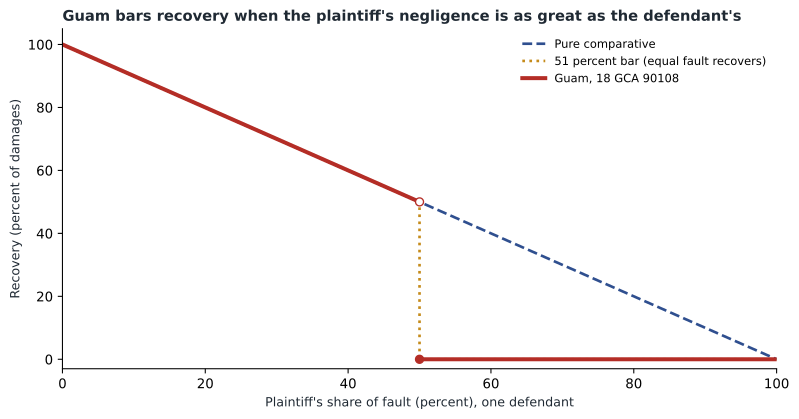
Section 90108 is titled When Recovery Barred by Contributory Negligence. It provides that contributory negligence does not bar recovery for death or injury if the plaintiff's negligence was not as great as the negligence of the person against whom recovery is sought, and that damages are diminished in proportion to the plaintiff's share of the negligence. The result is a version of modified comparative negligence. A plaintiff who is less at fault than the defendant recovers, with damages reduced by the plaintiff's percentage. A plaintiff whose negligence is as great as the defendant's, whether equal or greater, recovers nothing.
This is sometimes called the 49 percent rule, because a plaintiff can be up to 49 percent at fault and still recover against a single defendant, but a plaintiff at 50 percent is barred. It differs from the 51 percent rule used in many states, under which a plaintiff at exactly 50 percent still recovers half the damages. It differs even more from pure comparative negligence, under which a plaintiff 80 percent at fault still recovers 20 percent of the damages. The wording of section 90108 compares the plaintiff with the person against whom recovery is sought, so cases with several defendants call for close reading of the statute and the Guam cases applying it.
Worked problem
How much does the plaintiff recover?
A jury awards 100,000 dollars in damages in a Guam negligence case with one defendant. Consider three findings: the plaintiff 30 percent at fault; the plaintiff 50 percent at fault; the plaintiff 60 percent at fault.
Show solution
- Rule: recovery only if the plaintiff's negligence was not as great as the defendant's; damages reduced by the plaintiff's share.
- 30 percent: less than the defendant's 70 percent, so the plaintiff recovers 70,000 dollars.
- 50 percent: as great as the defendant's 50 percent, so recovery is barred.
- 60 percent: greater than the defendant's 40 percent, so recovery is barred.
Answer: Recoveries of 70,000 dollars, nothing and nothing. In a pure comparative jurisdiction the second and third would be 50,000 and 40,000 dollars.
Other provisions in Chapter 90
Chapter 90 contains several provisions that are specific to Guam and that a local question could test. Section 90109 addresses assumption of risk by moped operators. Section 90110 imposes strict liability on firearm owners in defined circumstances. Section 90113 makes a parent or guardian jointly and severally liable with a minor for damages caused by the minor's willful misconduct, up to 25,000 dollars per tort, with personal injury recovery further limited to medical, dental and hospital expenses and certain attorney fees. The same limit applies to willful defacement of property with paint or similar substances. An insurer's liability for conduct imputed to a parent is capped at 10,000 dollars, and foster parents are not liable under the section unless they were themselves negligent.
| Section of 18 GCA | Subject | Key point |
|---|---|---|
| 90101 | General duty | Duty to avoid injuring the person or property of another |
| 90107 | Negligence | Liability for negligence |
| 90108 | Contributory negligence | Recovery barred if the plaintiff's negligence is as great as the defendant's; otherwise reduced |
| 90110 | Firearms | Strict liability of firearm owners in defined circumstances |
| 90113 | Parental liability | Joint and several liability for a minor's willful misconduct, up to 25,000 dollars per tort |
The Government Claims Act
The Government of Guam, like any government, is immune from suit unless it consents. Its consent is given in the Government Claims Act, codified at 5 GCA 6101 and following sections. The Act waives immunity for claims in tort arising from the negligent acts of government employees acting for and at the direction of the Government of Guam, and, under section 6105(a), for expenses incurred in reliance on a contract to which the Government of Guam is a party. Because the waiver is a statutory condition on the government's consent, a claimant must follow the Act exactly.
Filing the administrative claim
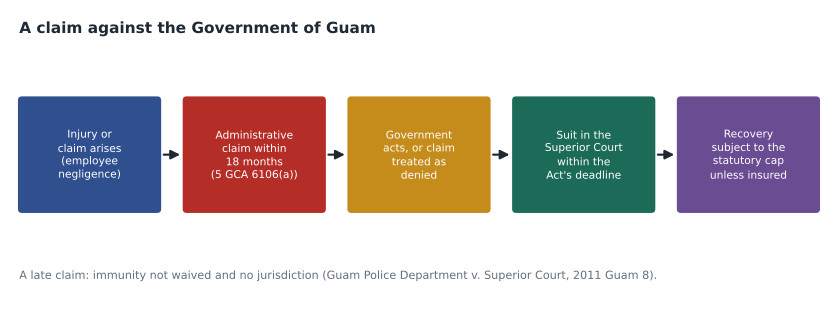
Before suing, a claimant must present an administrative claim. Section 6106(a) provides that all claims under the Act must be filed within eighteen months from the date the claim arose. In Guam Police Department v. Superior Court, 2011 Guam 8, the Supreme Court of Guam applied that limit to a claim under an unwritten services agreement. The claim arose when the services ended in March 2006, the claim was not filed with the Attorney General's office until June 2008, and the claim was therefore untimely. The Court held that because the claim was late, immunity was not waived and the Superior Court lacked jurisdiction to hear the case. Following earlier Guam authority, it treated a timely claim as a condition of the court's jurisdiction, not a mere defense the government could waive.
The Act also governs what happens after the claim is filed, including the government's time to act on it and when a claim not acted upon is treated as denied, opening the way to suit. In the 2011 case, the trial court had reasoned that where the Attorney General did not reject a claim, the claim period expired six months later under the statute. A lawyer handling a claim should read the current sections on presentment, denial and the deadline to sue, and calendar each date when the claim is filed.
Limits on recovery
The Act limits what a claimant can recover. A national survey of government immunity statutes by the Institute for Justice reports that Guam's Act caps recovery at 500,000 dollars, with the limit waived to the extent the government has purchased insurance covering the claim. The same survey notes that a judgment or settlement against the government bars a separate suit against the employee whose conduct gave rise to the claim, unless the court certifies that the employee acted outside the scope of employment or that it would have awarded more but for the statutory limit. Before advising a client on the value of a claim, a lawyer should confirm the current cap and its exceptions in the text of the Act.
Worked problem
The parking lot claim
Josefa's client was injured on September 3, 2026, when a Government of Guam vehicle driven by an employee on duty backed into her car. It is November 2026. What should the firm do first?
Show solution
- Identify the defendant: the Government of Guam, through the Government Claims Act, because the employee was acting for the government.
- Calculate the claim deadline: eighteen months from September 3, 2026, or early March 2028, under 5 GCA 6106(a).
- File the administrative claim well before the deadline, following the Act's requirements for content and the office where claims are filed.
- Calendar the government's time to act and the deadline to sue after denial or deemed denial.
- Evaluate damages with the statutory cap and any insurance in mind.
Answer: File a complete administrative claim promptly; a late claim would leave the court without jurisdiction under 2011 Guam 8.
Claims against the federal government
Guam is home to large U.S. military installations, so a Guam lawyer will also see claims involving federal employees. Those are governed by federal law, chiefly the Federal Tort Claims Act, which has its own administrative claim requirement and deadlines, and they are heard in the District Court of Guam. The first question in any claim against a government in Guam is which government is responsible.
Common mistakes
MistakeGuam follows pure comparative negligence like California.
InsteadUnder 18 GCA 90108, recovery is barred if the plaintiff's negligence is as great as the defendant's.
MistakeA plaintiff 50 percent at fault recovers half in Guam.
InsteadEqual fault bars recovery under section 90108.
MistakeI can sue the Government of Guam directly and raise the claim later.
InsteadAn administrative claim must be filed within eighteen months; a late claim leaves the court without jurisdiction.
MistakeThe government can waive a late filing.
Instead2011 Guam 8 treats timely filing as a condition of jurisdiction.
MistakeParental liability for a minor's willful acts is unlimited.
InsteadSection 90113 caps it at 25,000 dollars per tort, with further limits for personal injury.
Comparing Guam with other approaches
The NextGen portion tests general principles of tort law, and it may ask about the main comparative fault systems. Josefa built a chart to keep Guam's rule distinct from the others.
| System | Plaintiff 30 percent at fault | Plaintiff 50 percent at fault | Plaintiff 60 percent at fault |
|---|---|---|---|
| Pure comparative negligence | Recovers 70 percent | Recovers 50 percent | Recovers 40 percent |
| Modified, 51 percent bar | Recovers 70 percent | Recovers 50 percent | Recovers nothing |
| Guam, 18 GCA 90108 (as great as) | Recovers 70 percent | Recovers nothing | Recovers nothing |
| Contributory negligence | Recovers nothing | Recovers nothing | Recovers nothing |
The only difference between Guam and a 51 percent state is the case of equal fault, but that is exactly the kind of difference a local question can test. Marchetti told Josefa to say the words of the statute to herself when she reached a comparative fault issue: recovery only if the plaintiff's negligence was not as great as the defendant's.
Investigating fault early
Because equal fault bars recovery entirely, the allocation of fault matters even more in Guam than in a pure comparative jurisdiction. A plaintiff's lawyer should investigate the facts that bear on the plaintiff's own conduct at the start of a case: phone records, vehicle data, witness statements, photographs of the scene and any video. A defense lawyer will do the same. Quinata told Josefa that many Guam injury cases settle once both sides have a realistic view of how a factfinder would divide the fault.
Worked problem
A government claim with comparative fault
A pedestrian crossing outside a crosswalk is struck by a Government of Guam vehicle whose driver was speeding. The pedestrian files a timely administrative claim and later sues. A factfinder assigns 35 percent of the fault to the pedestrian and 65 percent to the driver, and finds damages of 400,000 dollars. What is the likely recovery?
Show solution
- Jurisdiction: the claim was filed within eighteen months, so the Government Claims Act's waiver applies.
- Comparative fault: 35 percent is not as great as 65 percent, so the pedestrian recovers, reduced by 35 percent, to 260,000 dollars.
- Cap: the reduced award is below the Act's reported 500,000 dollar limit.
Answer: About 260,000 dollars, subject to the Act's procedures and the current text of its limits.
Calendaring
Josefa added a line to her personal checklist for practice after admission: every new injury file gets three dates on the calendar at intake. The general limitations period under Title 7 for the claim, the Government Claims Act deadline if a government entity may be involved and, if a federal employee may be involved, the Federal Tort Claims Act administrative deadline. 'Most malpractice in injury practice is a calendar failure,' Quinata told her. 'Not a legal mistake. A date.'
Summary and key terms
- Guam's negligence provisions are in Chapter 90 of Title 18, descended from the California Civil Code.
- Section 90108 bars a plaintiff whose negligence is as great as the defendant's and otherwise reduces damages proportionally.
- Section 90113 makes parents jointly and severally liable for a minor's willful misconduct up to 25,000 dollars per tort.
- The Government Claims Act (5 GCA 6101 and following) waives immunity for negligence of government employees and for contract reliance expenses.
- Claims must be filed within eighteen months; a late claim leaves the court without jurisdiction (2011 Guam 8); recovery is capped unless insurance applies.
- 0
- Modified comparative negligence
- 1
- 18 GCA 90108
- 2
- Parental liability
- 3
- Sovereign immunity
- 4
- Government Claims Act
- 5
- Administrative claim
- 6
- Deemed denial
- 7
- Federal Tort Claims Act
Practice problems
Work each problem on paper first, then reveal the answer to check.
A plaintiff is 45 percent at fault and the single defendant 55 percent. Damages are 200,000 dollars. What does the plaintiff recover in Guam?
Show answer
110,000 dollars, because the plaintiff's negligence was not as great as the defendant's and damages are reduced by 45 percent.
Within what time must a claim under the Government Claims Act be filed?
Show answer
Within eighteen months from the date the claim arose, under 5 GCA 6106(a).
What did the Supreme Court of Guam hold in 2011 Guam 8?
Show answer
A claim filed after the eighteen-month limit meant immunity was not waived and the Superior Court lacked jurisdiction.
What federal statute governs negligence claims against federal employees in Guam?
Show answer
The Federal Tort Claims Act, in the District Court of Guam.
Lesson quiz · 5 questions
Score 60% or more to complete this lesson.
Create a free account to save your progress, take quizzes and earn a certificate.