
BAR-252 · Lesson 1 of 12 · 19 min
Becoming a lawyer in Guam
▶ Video coming soon A video version of this lesson is on the way.
Josefa Tenorio grew up in Dededo, the most populous village on Guam, where her grandmother still keeps a small garden of donne' peppers behind the house. She left the island after high school, finished college in Washington State and earned her J.D. at an ABA-approved law school in California in May 2026. Like most Guam lawyers, she had to leave home to study law, because there is no law school on the island. She came back in June 2026 and took a job as a law clerk at Tasi Point Law Office, a four-lawyer general practice firm in Hagåtña run by Rosalind Quinata. Quinata hired her on one condition: that she sit for the February 2027 Guam Bar Examination and treat it as her main job until then.
Josefa joined Hollis Marchetti's online study group in September 2026. The group meets on Tuesday evenings Ohio time, which is Wednesday morning in Guam, so Josefa logged in from the firm's small conference room with a cup of coffee while the rest of the group was finishing dinner. At her first one-on-one session, Marchetti asked what she already knew about getting admitted at home. Josefa knew that Guam had switched to the NextGen bar exam in July 2026 and that there was some kind of local question. She was not sure who ran the exam, how many people could sit for it or whether her California law school mattered. 'Start with who decides,' Marchetti said. 'Every deadline and every form follows from that.'
This lesson maps the institutions that control admission in Guam, the routes into practice and the requirements an applicant by examination must meet. Later lessons take each requirement in turn.
The Supreme Court of Guam controls admission
Guam is an unincorporated territory of the United States, not a state, but the basic principle of lawyer regulation is the same as in the states: the judiciary decides who may practice law. In Guam that authority belongs to the Supreme Court of Guam, the territory's highest court. The Court exercises it through a set of court rules called the Guam Rules Governing Admission to the Practice of Law. Lawyers and applicants usually shorten the name to the admission rules, and the current version is published on the Judiciary of Guam's website.
The rules have changed substantially in the last two years. In February 2024 the Supreme Court adopted the NextGen bar exam by administrative order, effective with the July 2026 exam. It then adopted revised admission rules by Promulgation Order No. 06-007-16 in December 2025 and amended several of them again by Promulgation Order No. 06-007-17, signed March 13, 2026 and fully effective March 15, 2026. A commercial outline or an older lawyer's memory of how the Guam bar worked can therefore be out of date. Before relying on any rule, an applicant should read the current text.
The Board of Law Examiners
The Guam Board of Law Examiners carries out the Court's admission rules. Its composition is unusual. Under Rule 1.01, the Board is made up of the Chief Justice and the Associate Justices of the Supreme Court, with the Presiding Judge of the Superior Court and the President of the Guam Bar Association serving ex officio. The Chief Justice, or a designee, chairs it, and the Clerk of the Supreme Court serves as its secretary-treasurer. In most states, a board of practicing lawyers examines applicants and the court then admits them. In Guam, the justices sit on the examining board themselves.
Rule 1.02 gives the Board power to investigate and examine applicants, to issue subpoenas and to administer oaths. Rule 1.03 requires it to meet at least twice a year, with three members forming a quorum. Rule 1.04 lets the chair act alone when the Board is not in session and time is short, subject to later confirmation. Applicant records are generally confidential, and the rules direct all communication through the Board. An applicant may not contact individual members or graders about results.
The other bodies involved
Three other bodies matter to an applicant. The Clerk of the Supreme Court and the Clerk's office handle the day-to-day work: they receive registration forms and fees, answer questions and keep the admission records. The National Conference of Bar Examiners, usually called NCBE, writes the NextGen bar exam and the Multistate Professional Responsibility Examination, transfers scores among jurisdictions and, in Guam, conducts the character and fitness investigation that the Board then reviews. The Guam Bar Association is an integrated bar: Rule 7.01(g) provides that no one may practice law in Guam without being a member in good standing of the Guam Bar Association. The Association also administers the mandatory continuing legal education rule.
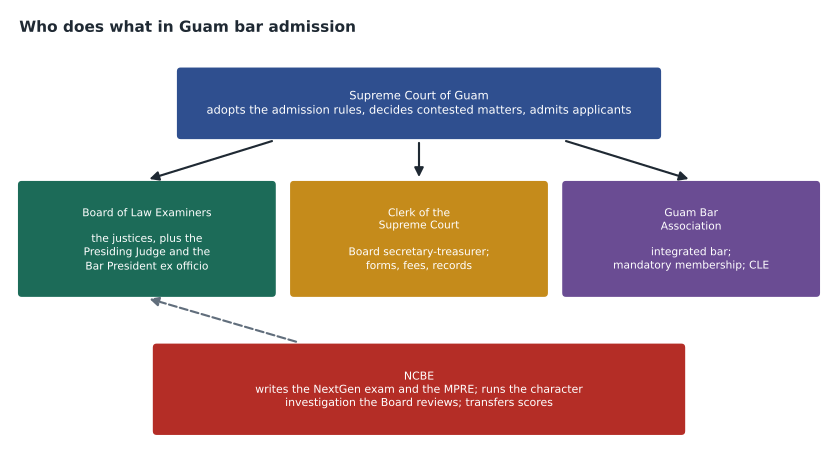
| Body | Main role for an applicant |
|---|---|
| Supreme Court of Guam | Adopts the admission rules, decides contested matters and admits applicants |
| Board of Law Examiners | Justices plus the Presiding Judge and the Bar President; examines applicants and reviews character and fitness |
| Clerk of the Supreme Court | Secretary-treasurer of the Board; receives registration forms and fees |
| NCBE | Writes the NextGen exam and the MPRE; investigates character and fitness; transfers scores |
| Guam Bar Association | Integrated bar; mandatory membership; administers continuing legal education |
Routes into Guam practice
There are only a few ways to practice law in Guam. The main route, the one Josefa is taking, is admission after passing the Guam Bar Examination. Since July 2026 that exam has two parts: the NextGen bar exam written by NCBE, on which Guam requires a score of at least 612, and a separate local question on Guam law written by the Board, on which Guam requires a score of at least 70.
The second route is admission on a transferred score. Under Rule 3.09, an applicant may bring in a NextGen score of 612 or higher, or a score of 262 or higher on the older Uniform Bar Examination, earned within the past three years. A transfer applicant still has to register, pass the character and fitness review, meet the MPRE requirement and pass Guam's local question. Guam does not accept a Multistate Bar Examination score transferred on its own.
There is no admission on motion. Rule 3.01(e) states plainly that Guam has no admission by comity or reciprocity, so an experienced lawyer from a state cannot simply apply on the strength of years in practice. The rules provide a few narrower options instead: temporary practice for lawyers working full time for the Government of Guam or listed legal services organizations, a temporary license for military spouses, reciprocal admission for lawyers admitted by examination in the Commonwealth of the Northern Mariana Islands, and pro hac vice appearances in a single case. Lesson 11 covers these routes.
What an applicant by examination needs
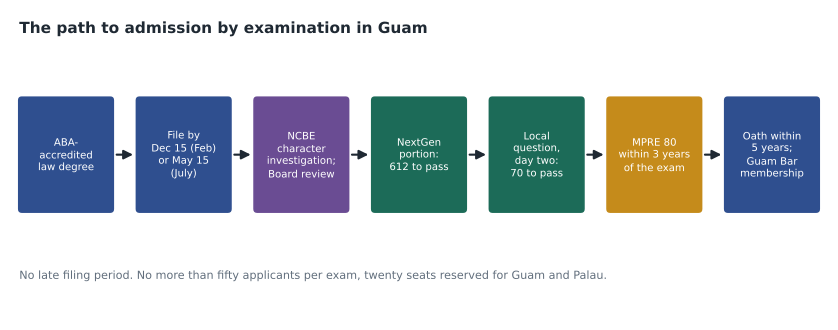
Rule 2.01(b) lists the qualifications. An applicant must prove to the Board that he or she is at least eighteen years old, is of good moral character and fitness, has not been convicted of a felony or a crime of moral turpitude committed against someone to whom the applicant owed a fiduciary duty, graduated from a law school accredited by the American Bar Association at the time of graduation, filed an application under the rules, passed the Guam Bar Examination with a score of at least 612 and passed the MPRE with a scaled score of at least 80. Once the Board certifies the applicant, he or she takes the oath, receives a certificate of admission signed by the Chief Justice and joins the Guam Bar Association.
The order of events
The requirements are tied to dates. The registration form, the NCBE character and fitness application and the fees must be filed by December 15 for the February exam and by May 15 for the July exam. Official transcripts must arrive directly from the law school before the exam begins. The MPRE can be taken before or after the bar exam, but Rule 3.08 requires the passing score within three years before or after the Guam exam date. The oath must be taken within five years of the last day of the exam the applicant passed.
Worked problem
Mapping Josefa's year
Josefa graduated in May 2026, took the MPRE in August 2026 and scored 96, filed her registration form and NCBE application on November 9, 2026, and plans to sit the Guam Bar Examination in late February 2027. Put her remaining requirements in order.
Show solution
- Filing: November 9 is before the December 15 deadline for the February exam, and her fee is paid.
- Transcript: her California law school must send it directly to the Board; she asked the registrar in October and confirmed receipt.
- MPRE: 96 exceeds 80, and August 2026 is within three years of a February 2027 exam.
- Character and fitness: NCBE investigates and the Board reviews; certification remains tentative until admission.
- Exam: the NextGen exam (612 needed) and, on the second day, the local question (70 needed).
- Oath and membership: after certification, within five years of the exam, then Guam Bar Association membership.
Answer: Josefa is on track. The only open items are the exam itself and the Board's character and fitness decision.
A small bar with a few hard limits
Guam's bar is small, and the admission rules reflect that. Rule 3.11(c) limits each administration of the Guam Bar Examination to no more than fifty applicants and reserves twenty of those seats for applicants from Guam and Palau, opening any unused reserved seats to others if fewer than twenty such applicants file by the regular deadline. An applicant from elsewhere who files late in the window may find the exam full. Josefa filed early partly for that reason.
Marchetti's advice to Josefa was the same she gives every candidate. 'Most failed admissions are not failures of the exam,' she said. 'People miss a filing deadline, forget about a transcript, answer a character question carelessly or let an MPRE score expire. In Guam there is no late filing period and only fifty seats. Put the dates on one page and look at it every week.' Josefa built the page that afternoon and taped it to the inside cover of her binder.
Common mistakes
MistakeThe Guam Bar Association admits new lawyers.
InsteadThe Supreme Court of Guam admits lawyers; the Bar Association is the integrated bar new lawyers must join.
MistakeAn experienced state lawyer can be admitted in Guam on motion.
InsteadRule 3.01(e) says Guam has no admission by comity or reciprocity; only narrow temporary and CNMI routes exist.
MistakeA transferred NextGen score is enough by itself.
InsteadTransfer applicants must still pass Guam's local question and meet every other requirement.
MistakeAny law degree will do.
InsteadRule 2.01(b) requires graduation from a law school accredited by the ABA at the time of graduation.
Reading the rules yourself
Marchetti asked Josefa to read the admission rules from start to finish before their next session, with a highlighter in one hand and her requirements page in the other. Josefa found them longer than she expected, because the current version includes the Board's appendices and its handbook on testing accommodations, but the core rules were short and precise. Rule 1 described the Board. Rule 2 listed the qualifications. Rule 3 covered applications, deadlines, fees, the exam itself, the MPRE, score transfer, laptops, accommodations and exam misconduct. Rules 5 and 6 covered character and fitness and hearings. Rule 7 covered the oath and admission, and Rules 8 and 9 covered pro hac vice, foreign lawyers, military spouses and lawyers from the Northern Mariana Islands.
'When someone in a study group or on a message board tells you something about the Guam bar,' Marchetti said, 'go to the rule. If the rule and the rumor disagree, the rule wins. If the rule is unclear, write to the Clerk's office and keep the answer.' Josefa started a folder for exactly that purpose. Its first item was an email confirming that her transcript had arrived.
Josefa also noticed how much the rules said about communication. Applicants talk to the Board through its secretary, not to individual justices or graders. For an island where lawyers, judges and their families often know each other, that rule protects both the applicant and the Board. Quinata, who had served on Bar Association committees for years, told Josefa that the best way to stay out of trouble was simple: ask the Clerk's office, in writing, and nobody else.
Summary and key terms
- The Supreme Court of Guam controls admission through the Guam Rules Governing Admission to the Practice of Law, most recently amended in March 2026.
- The Board of Law Examiners is made up of the justices, with the Presiding Judge of the Superior Court and the Guam Bar Association President ex officio.
- NCBE writes the NextGen exam and the MPRE and runs the character investigation; the Guam Bar Association is the integrated bar.
- An applicant by examination needs an ABA-accredited law degree, a 612 on the NextGen portion, a 70 on the local question and an MPRE score of 80.
- Guam has no admission on motion and limits each exam to fifty applicants.
- 0
- Guam Rules Governing Admission to the Practice of Law
- 1
- Board of Law Examiners
- 2
- Promulgation order
- 3
- Integrated bar
- 4
- Local question
- 5
- Admission by comity
- 6
- NCBE
Practice problems
Work each problem on paper first, then reveal the answer to check.
Who sits on the Guam Board of Law Examiners?
Show answer
The Chief Justice and Associate Justices of the Supreme Court of Guam, with the Presiding Judge of the Superior Court and the President of the Guam Bar Association ex officio.
What two scores must an applicant reach on the Guam Bar Examination?
Show answer
At least 612 on the NextGen portion and at least 70 on the local question.
Can a lawyer with ten years of practice in Hawaii be admitted in Guam on motion?
Show answer
No. Guam has no admission by comity or reciprocity; the lawyer must pass the exam or transfer a qualifying score and pass the local question, unless a narrow temporary route applies.
How many applicants may sit for one administration of the Guam Bar Examination?
Show answer
No more than fifty, with twenty seats reserved for applicants from Guam and Palau.
Lesson quiz · 5 questions
Score 60% or more to complete this lesson.
Create a free account to save your progress, take quizzes and earn a certificate.