
BAR-252 · Lesson 4 of 12 · 21 min
The Guam Bar Examination: the NextGen exam, the local question and the 612 passing score
▶ Video coming soon A video version of this lesson is on the way.
Josefa's law school classmates in California had studied for a bar exam built around the Multistate Bar Examination, essays and a performance test. Most of them took California's exam in July 2026. Josefa's exam would look different. When she opened NCBE's NextGen materials for the first time, she found integrated question sets, longer performance tasks and multiple-choice questions mixed in the same sessions. 'It doesn't look like anything my friends took,' she told Marchetti. 'Good,' Marchetti said. 'Then nobody can tell you the wrong way to study for it. Learn the format from the source.'
This lesson explains the structure of the Guam Bar Examination since July 2026, how each part is scored and what an applicant must reach to pass.
Two parts, two days
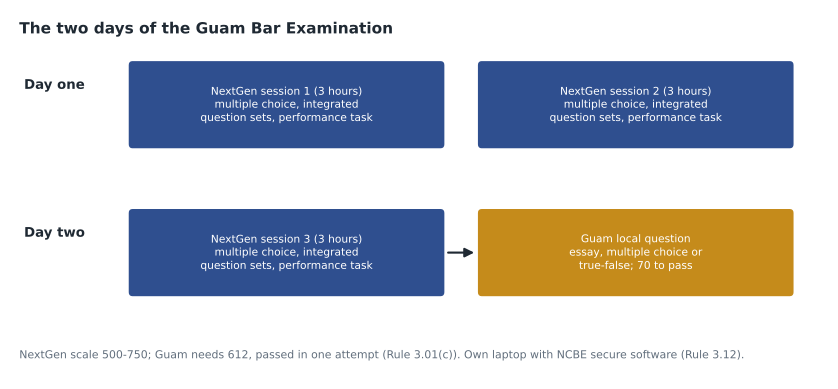
Rule 3.06 of the Guam admission rules describes the exam. It has two parts. The first is the NextGen bar exam developed by NCBE. The second is a stand-alone local question on Guam law developed by the Board of Law Examiners. Rule 3.10 requires the Board to hold two exams each year over two successive days, scheduled to coincide with NCBE's national NextGen administration, at the Guam Judicial Education Center at 120 West O'Brien Drive in Hagåtña or another location the Board designates. The local question is given on the second day, after the NextGen portion.
NCBE has announced the national NextGen dates for the next administrations: February 23 and 24, 2027, July 27 and 28, 2027, and February 22 and 23, 2028. Because Guam is many time zones ahead of the mainland, applicants should rely on the Board's notice for local start times rather than converting mainland times themselves.
The NextGen portion
NCBE built the NextGen exam to test a smaller set of legal concepts more deeply, together with practical lawyering skills. NCBE's blueprint divides the exam into three sessions of three hours each, two on the first day and one on the second. Each session mixes three kinds of items: stand-alone multiple-choice questions, integrated question sets built around a shared fact pattern and documents, and a performance task in which the examinee works from a file and a library of legal materials to produce a written product. Examinees may answer the items within a session in any order.
What the NextGen exam tests
Through February 2028, the NextGen exam tests eight foundational concepts and principles: business associations, civil procedure, constitutional law, contracts, criminal law and constitutional protections of the accused, evidence, real property and torts. Family law is added as a foundational subject from July 2028. NCBE's materials also state that family law and trusts and estates can appear before then in skills questions, with the needed legal resources supplied, so examinees are not expected to know those subjects from memory during the transition. The exam also tests seven foundational skills, including legal research, legal writing, issue spotting and analysis, investigation and evaluation, client counseling and advising, negotiation and dispute resolution, and client relationship and management.
| Item type | What it asks | Practical point |
|---|---|---|
| Multiple-choice question | A short fact pattern with four to six answer options | Early questions resemble MBE questions; budget about two minutes each |
| Integrated question set | Several questions on one shared set of facts and documents | Read the documents once, carefully, and keep notes |
| Performance task | A written product from a file and a library of materials | The law you need is supplied; follow the instructions exactly |
| Pretest items | Unscored items mixed in with scored ones | You cannot tell which they are; treat every item as scored |
Scoring
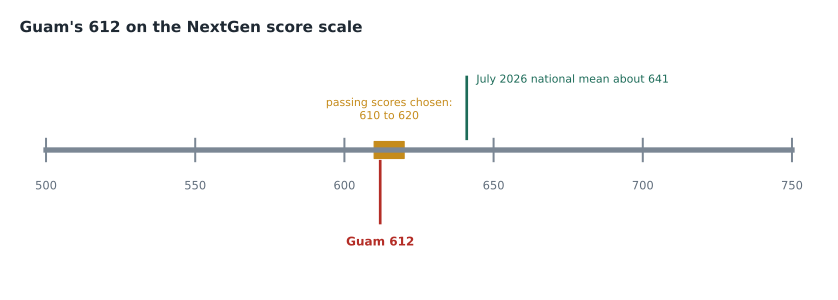
NCBE reports a single NextGen score on a scale from 500 to 750. The score is scaled and equated so that a given score means the same level of performance on every administration; it is not curved against the other examinees. NCBE scores the multiple-choice items, and graders using NCBE's rubrics score the written answers. NCBE's published blueprint weights the components at about 49 percent for multiple-choice questions, 21 percent for integrated question sets and 30 percent for performance tasks, although the weighting is built into the scaled score rather than reported separately.
Each jurisdiction sets its own passing score on that scale. NCBE recommended a range of 610 to 620, and most jurisdictions chose a number in that range. Guam chose 612. Rule 2.01(b)(6) requires an applicant to pass the Guam Bar Examination with a score of at least 612 points, and NCBE's list of minimum passing scores shows 612 for Guam and for Palau. Missouri, Iowa, New Mexico, North Dakota and Washington chose 610, and a large group of jurisdictions chose 620.
One attempt, no carryover
Rule 3.01(c) adds an important condition: the NextGen portion of the Guam Bar Examination must be taken and passed in one attempt. Guam does not allow partial exams, and it does not let an applicant carry forward part of a score from an earlier administration. An applicant who fails the NextGen portion retakes the whole of it. Applicants who fail one part but pass another should ask the Board in writing how their next attempt will be treated rather than assume any part carries over.
The local question
The local question is Guam's own component. Under Rule 3.06(a), it may be in essay, multiple-choice or true-false format, and the Board provides a list of local authorities for preparation. Applicants may study those authorities but may not consult them during the exam. Rule 3.06(b) sets the passing standard: an applicant must receive a score of 70.00 or higher on the local question. Lesson 6 covers what the local question tests and how to prepare for it.
Two hurdles, not one total
The Guam exam therefore has two separate hurdles. An applicant must reach 612 on the NextGen portion and 70 on the local question. A very high NextGen score does not make up for a failing local question, and a perfect local question does not rescue a NextGen score of 605.
Worked problem
Who passes?
Three applicants sit the February 2027 Guam Bar Examination. Ana scores 618 on NextGen and 74 on the local question. Dionisio scores 655 on NextGen and 66 on the local question. Rita scores 609 on NextGen and 92 on the local question. Who passes?
Show solution
- Each applicant needs at least 612 on NextGen and at least 70 on the local question.
- Ana: 618 and 74 meet both; she passes.
- Dionisio: 655 is well above 612, but 66 is below 70; he fails the local question.
- Rita: 92 on the local question, but 609 is below 612; she fails the NextGen portion.
Answer: Only Ana passes. The two scores are separate requirements, not a combined total.
What changed from the old exam
Before July 2026, Guam gave the legacy combination of the Multistate Bar Examination, the Multistate Essay Examination and the Multistate Performance Test, plus a local question. Under the old rules, an applicant needed a combined score of 132.50 on the essay, performance test and MBE portions, passed in a single sitting. NCBE's older summaries and some commercial guides still describe that standard. It no longer applies to anyone sitting in Guam. Lesson 5 explains the change.
How the national results looked
NCBE released the first national NextGen results in September 2026. About 2,630 examinees sat the July 2026 exam across the ten jurisdictions that gave it, with a mean score of about 641 and an overall pass rate of about 73 percent, rising to about 85 percent for first-time takers. Those figures are national; NCBE's release did not break out each small jurisdiction, and Guam's applicant group is too small for its own pass rate to say much from one sitting. Marchetti's point to Josefa was narrower. 'A 612 is not a high bar on a scale where the average was 641,' she said. 'Prepare properly and the NextGen portion is very passable. The local question is where people who study only national materials get caught.'
Exam-day conditions
Rule 3.12 requires applicants to bring their own laptop, or a borrowed one, unless an accommodation provides otherwise, and NCBE's software runs in a secure mode. The Board's room rules bar eating and drinking in the examination room and bar books, notes and other materials unless the Board directs otherwise. Applicants should read the Board's admission notice for the exam, which sets reporting times, identification requirements and what may be brought into the building.
Common mistakes
MistakeGuam still uses a combined 132.50 score on the MBE, MEE and MPT.
InsteadSince July 2026 Guam uses the NextGen exam with a 612 passing score plus a separate local question.
MistakeA high NextGen score can make up for a weak local question.
InsteadThe two parts are separate hurdles: 612 on NextGen and 70 on the local question.
MistakeNextGen scores are curved against the other examinees.
InsteadScores are scaled and equated, not curved.
MistakeI need to memorize family law for the 2027 NextGen exam.
InsteadBefore July 2028 family law appears only in skills questions with resources supplied.
MistakeI can carry forward part of my NextGen score.
InsteadRule 3.01(c) requires the NextGen portion to be passed in one attempt, with no partial carryover.
Pacing the NextGen sessions
Each NextGen session is three hours, and examinees may answer the items within a session in any order. That freedom helps only with a plan. NCBE's published guidance suggests that a stand-alone multiple-choice question should take under two minutes, an integrated question set about twenty-four minutes and a standard performance task about an hour. Marchetti taught Josefa to divide each session into blocks: the performance task first, while she was fresh, then the integrated question sets, then the multiple-choice questions, with a ten-minute cushion at the end. Josefa tried that order and two others in practice sets and kept the one that gave her the best scores. 'There is no right order,' Marchetti said. 'There is your order. Find it before February.'
| Session block | Josefa's target time | Notes |
|---|---|---|
| Performance task | About 60 minutes | Read the instructions and the task memo first; then the file and library |
| Integrated question sets | About 24 minutes each | Read the shared documents once and annotate them |
| Multiple-choice questions | About 1.8 minutes each | Flag hard questions and return to them |
| Cushion | 10 minutes | Flagged items and a final check |
How the written answers are graded
The constructed responses on NextGen, including short written answers in integrated question sets and the performance task products, are graded by graders using NCBE's rubrics. Rubrics reward what the task asks for: the right format, the right audience, accurate use of the facts in the file and correct use of the law in the library. Examinees lose points for ignoring instructions, such as writing a persuasive brief when the task asks for an objective memo, or for relying on remembered law when the library supplies different law. Marchetti's advice was to read the instructions twice, once at the start and once before writing, and to cite the file and library materials by name.
Using practice scores
Josefa's first full practice session in September produced a score that Marchetti estimated would place her below 612. By November she was comfortably above it. Marchetti warned her not to read too much into any single practice score. Practice materials are not equated the way the real exam is, and a practice score is only a rough guide. The trend across several sessions, and the types of items she missed, mattered more than any one number. Josefa kept a log of every missed item with the concept or skill it tested, and every Sunday she reviewed the categories that appeared most often.
Worked problem
Reading a practice log
After six practice sessions, Josefa's log shows that most of her missed items involve evidence hearsay exceptions, integrated question sets on contracts and the counseling items in performance tasks. How should she adjust?
Show solution
- Group the misses by concept and skill: evidence, contracts in integrated sets, client counseling.
- Review the rules behind the evidence misses using NCBE's content scope and a sourcebook.
- Practice integrated sets on contracts, reading the documents more slowly.
- For counseling items, practice identifying the client's goals and the options before choosing an answer.
Answer: Josefa should spend the next two weeks on those three areas while keeping one full practice session a week to maintain pacing.
Summary and key terms
- The Guam Bar Examination has two parts over two days: the NextGen exam and a local question on Guam law given after it on day two.
- The NextGen portion has three three-hour sessions mixing multiple-choice questions, integrated question sets and performance tasks.
- NextGen scores run from 500 to 750; Guam requires 612, and the NextGen portion must be passed in one attempt.
- The local question may be essay, multiple-choice or true-false, and requires 70 to pass.
- The old combined 132.50 standard no longer applies.
- 0
- NextGen
- 1
- Integrated question set
- 2
- Performance task
- 3
- Scaled score
- 4
- Equating
- 5
- Local question
- 6
- Passing score
- 7
- Rule 3.06
Practice problems
Work each problem on paper first, then reveal the answer to check.
What are the two parts of the Guam Bar Examination?
Show answer
The NCBE NextGen exam and a stand-alone local question on Guam law developed by the Board.
What score must an applicant reach on each part?
Show answer
At least 612 on the NextGen portion and at least 70 on the local question.
Name the three kinds of items on the NextGen portion.
Show answer
Multiple-choice questions, integrated question sets and performance tasks.
Which subjects appear only in skills questions with resources supplied before July 2028?
Show answer
Family law and trusts and estates.
Lesson quiz · 5 questions
Score 60% or more to complete this lesson.
Create a free account to save your progress, take quizzes and earn a certificate.