
BAR-252 · Lesson 10 of 12 · 21 min
Guam land, family law and estates: the CHamoru Land Trust, divorce and probate
▶ Video coming soon A video version of this lesson is on the way.
Josefa's grandmother has held a residential lease from the CHamoru Land Trust Commission for as long as Josefa can remember. The house in Dededo sits on it. When Josefa mentioned to Quinata that her grandmother was thinking about who should take over the lease someday, Quinata pulled a statute book off the shelf. 'Half the families on this island have a question like that,' she said. 'Land, marriage and inheritance. That's most of a small-firm practice in Guam.'
This lesson covers three areas of Guam law that new lawyers meet early: the CHamoru Land Trust and the land history behind it, divorce and the division of property, and the basics of probate.
Land and history
Land is central to Guam law and politics. After American forces retook the island in 1944, the federal government acquired large areas for military use, much of it from families who had farmed or lived on it for generations. Questions about the return of excess federal land, compensation for land taken and access to land for the island's people run through Guam's statutes and its politics to this day. Guam has created several programs to address them, including an Ancestral Lands Commission for returning certain lands to original landowners and their heirs, and the CHamoru Land Trust. A lawyer should know which program a client's question involves before giving advice.
The CHamoru Land Trust Act
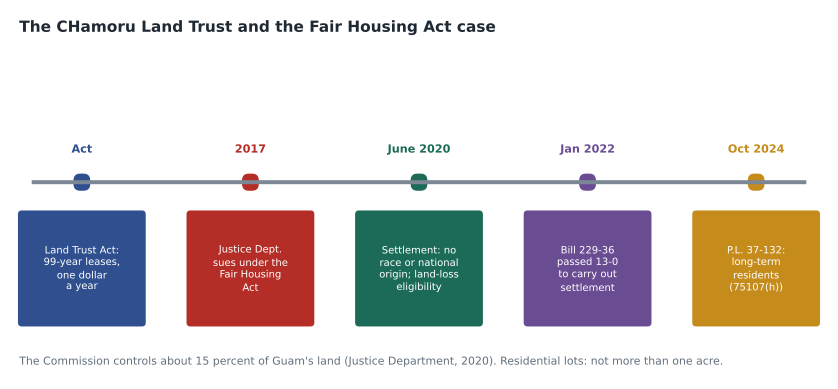
The CHamoru Land Trust Act is codified in Chapter 75 of Title 21 of the Guam Code Annotated. Its official text still uses the spelling Chamorro, while the agency that administers it, the CHamoru Land Trust Commission, uses the current spelling. The Act sets aside certain government lands, designated as available lands, to be leased for homes, farming and grazing. The Commission controls a large share of the island: the U.S. Department of Justice described it in 2020 as controlling approximately 15 percent of Guam's total land area.
Leases
Under section 75108(b), a lessee pays a rent of one dollar a year, and the lease runs for ninety-nine years, with the full term's rent due within a year of the lease's effective date. Section 75107(a) sets acreage limits by use: not more than one acre for a residential lot, a quarter to half an acre for subsistence farming, half an acre to twenty acres for commercial agriculture or aquaculture and one to twenty acres for grazing. Under section 75108(c), the lessee must occupy and begin using the tract within one year after the lease is made. Section 75109 governs successors to a lessee, which is the question Josefa's grandmother is asking, and it requires the successor to be qualified to hold a lease. Section 75110 governs cancellation.
| Feature | Rule in 21 GCA Chapter 75 |
|---|---|
| Rent | One dollar a year (75108(b)) |
| Term | Ninety-nine years (75108(b)) |
| Residential lot | Not more than one acre (75107(a)) |
| Grazing | One to twenty acres (75107(a)) |
| Occupancy | Within one year after the lease is made (75108(c)) |
| Successors | Must be qualified to be a lessee (75109) |
| Long-term residents | No eviction notices to eligible people continuously residing on Trust land since before July 12, 1995 (75107(h)) |
Eligibility and the Fair Housing Act case
The Act originally limited leases to native Chamorros, defined in section 75101(d) as persons who became U.S. citizens by virtue of the Organic Act of Guam and their descendants. In 2017 the U.S. Department of Justice sued the Government of Guam and the Commission under the federal Fair Housing Act, alleging that awarding leases only to native Chamorros discriminated on the basis of race and national origin. The case was resolved by a settlement announced on June 4, 2020. Under the settlement, Guam agreed to stop considering race and national origin in awarding leases, to amend the Act so that leases are awarded based on whether people lost land or the use of land, including during World War II and its aftermath, to verify eligibility under the new criteria, and to provide fair housing training and reports to the Justice Department.
The Legislature then took up legislation to carry out the settlement. In January 2022 it passed Bill 229-36 by a vote of 13 to 0, which press reports described as expanding eligibility to people who had lived on, ranched or farmed land later taken by the federal government. Because the code's definitions and eligibility rules have been revised in stages since then, a lawyer advising a client on eligibility or succession should read the current text of Chapter 75 and any related chapter added to Title 21, not an older summary.
The case connects to Davis v. Guam, discussed in Lesson 7. Both concerned definitions tied to who became a citizen under the Organic Act. In Davis, the Ninth Circuit held that using that definition to limit voting violated the Fifteenth Amendment; in the land trust case, the federal government challenged a similar definition under the Fair Housing Act.
Worked problem
A succession question
Josefa's grandmother wants her lease to pass to one of her grandchildren. One lives in Dededo; one lives in California and does not plan to return. What should a lawyer review before advising?
Show solution
- Read section 75109 on successors: a successor must be qualified to be a lessee under the current Act.
- Check the current eligibility rules in Chapter 75 as amended after the 2020 settlement.
- Check the occupancy and use conditions in section 75108, which a non-resident successor may not be able to meet.
- Review the lease document itself and any Commission rules on designating successors.
Answer: The lawyer should confirm current eligibility and occupancy requirements before the grandmother designates anyone. The grandchild who lives on Guam is likely to be in a stronger position to meet them.
Divorce in Guam
Guam's divorce law is in Title 19 of the Guam Code Annotated, and it has some features that surprise lawyers from elsewhere.
Residence
Section 8318 sets the residence requirement. For a contested divorce, either spouse must have been physically present in Guam for ninety days immediately before filing; members of the military may qualify if assigned to a unit or ship homeported in Guam for at least ninety days. When both spouses agree to the divorce in writing, either spouse need only have resided in Guam for seven days immediately before filing. That short period has made Guam a place where some couples from elsewhere obtain uncontested divorces. A lawyer handling such a case should consider whether the divorce will be recognized where the spouses actually live.
Grounds
Guam allows divorce on the no-fault ground of irreconcilable differences, defined in section 8219 as substantial reasons for not continuing the marriage. It also keeps a list of fault grounds inherited from older California law, including adultery, extreme cruelty, willful desertion for at least one year, willful neglect and habitual intemperance. Some of the older provisions are written in gendered terms; a modern court applying them would have to consider equal protection.
| Matter | Guam rule |
|---|---|
| Residence (contested) | Ninety days' physical presence before filing (19 GCA 8318(a)) |
| Residence (agreed in writing) | Seven days' residence before filing (19 GCA 8318(b)) |
| No-fault ground | Irreconcilable differences (19 GCA 8219) |
| Fault grounds | Including adultery, extreme cruelty and desertion for a year |
| Support | Temporary and permanent support (19 GCA 8402) |
Property and support
Guam's family property law follows the California model on which it was built, distinguishing community property, acquired during the marriage, from separate property. In Sablan v. Sablan, 2017 Guam 3, the trial court had characterized each of the spouses' properties as community or separate, and the Supreme Court of Guam explained that it reviews the characterization of property de novo and the distribution of community property after a divorce granted for adultery or extreme cruelty for abuse of discretion. In practice, characterization is the first and often decisive step in a Guam property case. Section 8402 authorizes temporary support during the case and permanent support after judgment, and a spouse may seek permanent maintenance and support in some circumstances even without a divorce.
Same-sex marriage
Guam was the first U.S. territory to recognize same-sex marriage. After the District Court of Guam ruled in June 2015 that Guam's marriage law could not exclude same-sex couples, marriage licenses were issued, and the U.S. Supreme Court's decision in Obergefell v. Hodges the same month confirmed the result nationally.
Estates and probate
Guam's probate law is in Title 15 of the Guam Code Annotated, descended from the California probate code adopted in 1953 and amended since. The Superior Court handles probate, guardianship and conservatorship matters. A new Guam lawyer will see small estates, estates that include real property with family history and estates in which the deceased held a CHamoru Land Trust lease, which is governed by the Act's own rules on successors. Before drafting a will or handling an estate, a lawyer should read Title 15 on the formalities for a valid will, the rules of intestate succession and the procedures for administration, and should check whether any land involved is subject to a land trust lease, an ancestral land claim or other special rules.
Common mistakes
MistakeA CHamoru Land Trust lease passes like any other property by will.
InsteadSection 75109 governs successors, who must be qualified under the Act.
MistakeEligibility for a land trust lease still depends on Chamorro ancestry.
InsteadThe 2020 settlement required eligibility based on loss of land or its use; read the current Act.
MistakeEvery Guam divorce requires ninety days of residence.
InsteadIf both spouses agree in writing, seven days' residence is enough under 19 GCA 8318(b).
MistakeGuam divides marital property under an equitable distribution statute like most states.
InsteadGuam distinguishes community and separate property, following its California-derived law.
Advising on land questions
Land questions in Guam often involve several layers at once: a family's history with a parcel, a government program, a federal acquisition after the war and sometimes a modern lease or sale. Quinata gave Josefa a sequence for any new land file. First, identify the current legal status of the land: private fee simple, government land, CHamoru Land Trust land leased to the client, land subject to an ancestral land claim or federal land. Second, find the documents: deeds, leases, survey maps, Commission records. Third, identify the program or statute that governs the client's question. Only then should the lawyer give advice. 'People come in with a story,' Quinata said. 'The story matters, but the documents decide.'
Leases and the conditions on them
A land trust lease is not ownership. The lessee holds a long lease subject to conditions in the Act and the lease itself, including the occupancy requirement in section 75108(c), the conditions on successors in section 75109 and the grounds for cancellation in section 75110. Section 75122 separately governs commercial leases and licenses, and the Act includes a home loan fund to help lessees build. A client who wants to sell, mortgage or transfer an interest in land trust property needs advice on what the Act and the Commission's rules allow before signing anything.
Divorce for couples who live elsewhere
Because an agreed divorce in Guam needs only seven days' residence, Guam lawyers sometimes represent couples who live elsewhere. That work raises questions that go beyond Guam law. Will the courts of the couple's home country or state recognize a divorce granted on seven days' residence? Does the agreement properly deal with property located elsewhere and with children who live elsewhere? Courts deciding custody generally look to where a child actually lives, under the jurisdiction rules that apply there. A careful Guam lawyer advises such clients to get advice at home as well and documents that the advice was given.
Worked problem
Characterizing property
Spouses married in Guam in 2012. The wife owned a condominium in Tamuning before the marriage. During the marriage the husband's salary paid down the mortgage on a house they bought together in 2015. Both contributed to retirement accounts during the marriage. How should a lawyer start the property analysis?
Show solution
- Characterize each asset first, as the trial court did in Sablan v. Sablan.
- The condominium owned before marriage is presumptively the wife's separate property, subject to any claims arising from community contributions.
- The house bought in 2015 with earnings during the marriage is presumptively community property.
- Retirement contributions from earnings during the marriage are generally community property to that extent.
- Then address division under Guam's statutes and the court's discretion, which Sablan reviewed for abuse of discretion in a fault-based divorce.
Answer: Characterization comes first; the division follows from it.
Probate and family property together
Death and divorce raise the same characterization questions. When a married person dies in Guam, the first step in the estate is often to identify which property was community and which was separate, because that affects what passes under a will or by intestacy. A lawyer drafting a will for a married client should ask the same questions at the start and keep notes on the answers, which may save the family a dispute later.
Summary and key terms
- The CHamoru Land Trust Act (21 GCA Chapter 75) provides ninety-nine-year leases at one dollar a year, with acreage limits by use and an occupancy requirement.
- A 2017 Fair Housing Act suit ended in a June 2020 settlement replacing ancestry-based eligibility with eligibility based on loss of land or its use.
- Divorce requires ninety days' presence, or seven days' residence if both spouses agree in writing; irreconcilable differences is the no-fault ground.
- Guam distinguishes community and separate property (Sablan v. Sablan, 2017 Guam 3).
- Probate is governed by Title 15 and handled in the Superior Court; land trust leases follow the Act's succession rules.
- 0
- CHamoru Land Trust
- 1
- Available lands
- 2
- Native Chamorro
- 3
- Fair Housing Act
- 4
- Irreconcilable differences
- 5
- Community property
- 6
- Separate property
- 7
- Probate
Practice problems
Work each problem on paper first, then reveal the answer to check.
What are the rent and term of a CHamoru Land Trust lease?
Show answer
One dollar a year for ninety-nine years.
What did the 2020 settlement require Guam to change?
Show answer
Stop considering race and national origin and base eligibility on loss of land or the use of land, including during World War II and its aftermath.
How long must a spouse reside in Guam before filing an agreed divorce?
Show answer
Seven days, if both spouses agree in writing.
What standard of review did Sablan v. Sablan apply to the characterization of property?
Show answer
De novo.
Lesson quiz · 5 questions
Score 60% or more to complete this lesson.
Create a free account to save your progress, take quizzes and earn a certificate.