
BAR-252 · Lesson 7 of 12 · 21 min
Guam's legal system: territorial status, the Organic Act and the Guam Code Annotated
▶ Video coming soon A video version of this lesson is on the way.
When Josefa told her law school classmates in California that she was going home to practice, one of them asked whether Guam had its own constitution. Josefa started to say yes and then stopped. She knew Guam had a governor and a legislature, but she was not sure what legal document created them. 'That,' Marchetti said when Josefa told her the story, 'is exactly the kind of question that shows up on a local question. Start at the top.'
This lesson explains where Guam fits in the American legal system, the federal statute that organizes its government and how its own statutes are organized. It is background for every other Guam law topic.
An unincorporated territory
Spain ceded Guam to the United States in the Treaty of Paris in 1898, at the end of the Spanish-American War. For the first half of the twentieth century the island was governed by the U.S. Navy. Japan occupied Guam from December 1941 until American forces retook it in July 1944, and the occupation and the war that followed shaped much of the island's later legal history, including the land issues discussed in Lesson 10.
Guam is an unincorporated territory of the United States. The term comes from a series of Supreme Court decisions at the start of the twentieth century, usually called the Insular Cases, which held that the Constitution does not apply in full to territories that Congress has not incorporated into the United States as part of the path to statehood. In an unincorporated territory, fundamental constitutional rights apply, and Congress decides by statute how much else applies. In practice, Congress has extended most of the Bill of Rights to Guam by statute, and Guam residents have been U.S. citizens by statute since 1950. They cannot vote in presidential elections, and they elect a delegate to the House of Representatives who may serve on committees but may not vote on final passage of legislation.
The Organic Act of Guam
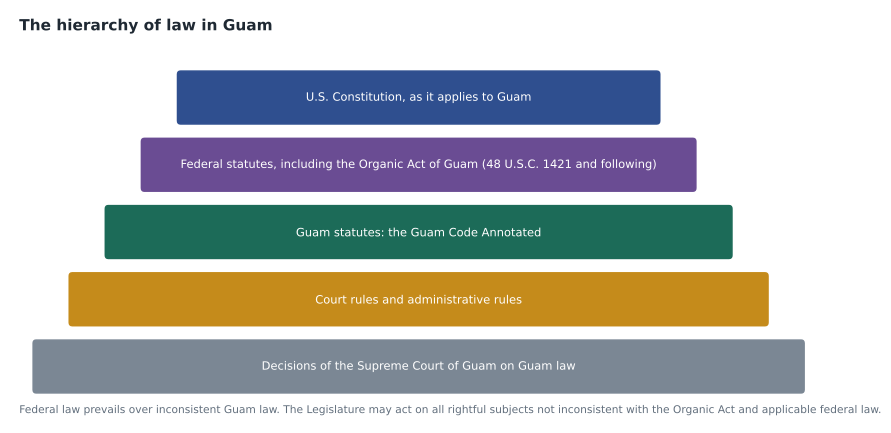
Guam has no state constitution. Its government rests on the Organic Act of Guam, a federal statute enacted in 1950 and codified at 48 U.S.C. 1421 and following sections. The Organic Act did four things that every Guam lawyer should be able to name. It made Guam an unincorporated territory under civilian rather than naval administration. It conferred U.S. citizenship on the people of Guam. It established three branches of local government: an executive headed by a governor, a legislature and a local judiciary. And it included a bill of rights, now found in 48 U.S.C. 1421b, protecting many of the same individual rights as the federal Bill of Rights.
Congress has amended the Organic Act many times. Changes in the late 1960s allowed the people of Guam to elect their own governor, a right first exercised in 1970, and extended additional provisions of the federal Constitution to Guam. Guam's own effort to write a local constitution in the late 1970s ended when voters did not approve the draft, so the Organic Act still serves as the island's basic charter. Because it is a federal statute, Congress can amend it, and Guam cannot amend it on its own.
The branches of Guam's government
The Governor of Guam is elected to a four-year term and heads the executive branch, which includes the Attorney General of Guam, the chief legal officer of the government. The Legislature of Guam, known in CHamoru as I Liheslaturan Guåhan, is a unicameral body of fifteen senators elected island-wide for two-year terms. Its legislative power under the Organic Act extends to all rightful subjects of legislation not inconsistent with the Organic Act and the laws of the United States applicable to Guam. Guam's public laws are numbered by legislature: Public Law 38-133, for example, is the 133rd law of the 38th Guam Legislature. The judiciary is the subject of Lesson 8.
| Branch | Head or body | Source of authority |
|---|---|---|
| Executive | Governor of Guam, elected for four years; Attorney General as chief legal officer | Organic Act and Guam statutes |
| Legislative | Legislature of Guam (I Liheslaturan Guåhan), fifteen senators, unicameral | Organic Act |
| Judicial | Unified Judiciary of Guam: Supreme Court of Guam and Superior Court of Guam | Organic Act as amended in 2004 and Guam statutes |
| Federal presence | District Court of Guam, federal agencies, military installations | Federal law |
Federal law in Guam
Federal law applies in Guam to the extent Congress makes it apply, and many federal statutes treat Guam as a state for their purposes. When a Guam statute conflicts with a federal statute that applies to Guam, the federal statute prevails. The relationship produces some of Guam's most important cases.
A recent example is Davis v. Guam, decided by the Ninth Circuit in July 2019. Guam had enacted a law providing for a plebiscite on the island's future political status, to be voted on only by Guam's native inhabitants, defined by reference to who became citizens under the Organic Act and their descendants. A resident who did not qualify challenged the restriction. The Ninth Circuit held that the law violated the Fifteenth Amendment, which bars denying the right to vote on account of race, because the definition of native inhabitants served as a proxy for race. The decision shows that constitutional limits apply to Guam's own legislation, even on questions of self-determination that matter deeply to the island's people.
Worked problem
Can the Legislature do this?
A hypothetical bill in the Legislature of Guam would create a local tax credit available only to residents who are descendants of persons who became U.S. citizens under the Organic Act. A resident who moved to Guam from Hawaii in 2010 asks whether the bill is valid. How should Josefa frame the analysis?
Show solution
- Start with the Legislature's power: all rightful subjects of legislation not inconsistent with the Organic Act and applicable federal law.
- Identify the constitutional limits that apply in Guam, including equal protection, which Congress has extended to Guam.
- Consider Davis v. Guam: an ancestry-based classification tied to the Organic Act was treated as a racial proxy in the voting context.
- Ask whether the same reasoning applies outside voting and whether the classification could survive the scrutiny that applies to racial classifications.
Answer: The bill faces serious constitutional problems. Davis concerned the Fifteenth Amendment, but the same ancestry-based definition would draw close scrutiny under equal protection.
The Guam Code Annotated
Guam's statutes are collected in the Guam Code Annotated, cited GCA, which is organized into numbered titles by subject. Much of the code has a California origin. In 1953 the Legislature adopted a set of codes modeled on California's codes of the time, including a civil code, a code of civil procedure, a penal code, a probate code and a government code. Those codes were later reorganized into the titles of the Guam Code Annotated, and many sections carry source notes showing where they came from.
The California connection has a practical consequence. When a Guam statute was borrowed from California, Guam courts often look to California decisions interpreting the same language as persuasive authority, especially decisions from the period before Guam adopted the statute. California authority is not binding, however, and Guam has amended many borrowed provisions since 1953. The Supreme Court of Guam has the final word on what a Guam statute means. A careful answer on a local question cites the Guam statute and, if useful, notes its California origin, not the other way around.
| GCA title (examples) | Subject |
|---|---|
| Title 5 | Government operations, including the Government Claims Act |
| Title 7 | Courts and civil procedure |
| Title 15 | Probate |
| Title 18 | Civil obligations, including negligence |
| Title 19 | Personal relations, including marriage and divorce |
| Title 21 | Real property, including the CHamoru Land Trust |
Finding the current law
The Compiler of Laws, an office within the Judiciary of Guam, maintains the official online version of the Guam Code Annotated. In June 2026 the online code showed that it was updated through Public Law 38-133. Commercial databases also carry the code, but they can lag behind. When a question turns on the current wording of a statute, use the Compiler's version and check for public laws enacted after its update date.
The CHamoru language in the law
Guam's law increasingly uses CHamoru place names and spellings. The Legislature has replaced older spellings with CHamoru ones in many statutes, for example changing the name of a village in a 2021 public law. The CHamoru Land Trust Act, discussed in Lesson 10, uses the older spelling Chamorro in its official text, while the agency and many current documents use CHamoru. Lawyers should cite statutes as they appear in the code and use current names when writing for clients.
Common mistakes
MistakeGuam has its own constitution like a state.
InsteadGuam's government rests on the Organic Act of Guam, a federal statute; a local draft constitution was not approved.
MistakeThe Constitution applies in full to Guam.
InsteadGuam is unincorporated; fundamental rights apply, and Congress has extended most other provisions by statute.
MistakeCalifornia cases are binding in Guam because Guam copied California codes.
InsteadCalifornia decisions can be persuasive for borrowed statutes, but the Supreme Court of Guam decides what Guam law means.
MistakeThe Legislature of Guam can amend the Organic Act.
InsteadOnly Congress can amend the Organic Act.
Guam's neighbors
Guam sits at the southern end of the Mariana Islands. The islands to its north form the Commonwealth of the Northern Mariana Islands, a separate U.S. territory with its own covenant with the United States, its own constitution, its own courts and its own bar. Palau, to the southwest, is an independent nation in free association with the United States. The three jurisdictions have close family, economic and legal ties, which the admission rules reflect: Rule 9.04 provides reciprocal admission for lawyers admitted by examination in the Northern Mariana Islands, and Rule 3.11(c) reserves exam seats for applicants from Guam and Palau. A Guam lawyer should not assume that the law of the Northern Mariana Islands is the same as Guam's. It often is not.
Reading the Organic Act
Marchetti asked Josefa to read the Organic Act's bill of rights in 48 U.S.C. 1421b in full. Josefa found that it reads much like the federal Bill of Rights, protecting free speech, religion and assembly, guarding against unreasonable searches and seizures and guaranteeing due process and equal protection. It also contains provisions specific to Guam's history. Congress later added a subsection extending many provisions of the federal Constitution to Guam directly, so many questions can be answered either by the Organic Act or by the Constitution as extended. For a local question, citing the Organic Act provision is the more precise answer.
Federal agencies and military bases
A large part of Guam is occupied by U.S. military installations, and federal agencies play a large role in the island's economy. Federal law governs activities on federal land, and federal agencies apply federal statutes in Guam as they do elsewhere. A client's problem may therefore involve federal law even when it looks local: an employment dispute with a federal contractor, a land question involving former military property, an environmental issue near a base. The first question in any such case is which law applies and which court has jurisdiction, the subject of Lesson 8.
Worked problem
Which law governs?
A client was injured on a road inside a U.S. Navy base by a vehicle driven by a Navy civilian employee on duty. Another client was injured on a public road in Tamuning by a Government of Guam employee on duty. Which law governs each claim?
Show solution
- First client: a federal employee acting within the scope of employment; the Federal Tort Claims Act governs, with its own administrative claim and the District Court of Guam as the forum.
- Second client: a Government of Guam employee; the Government Claims Act in Title 5 of the Guam Code Annotated governs, with an eighteen-month claim period and the Superior Court as the forum.
Answer: Different governments, different statutes, different courts. Identifying the employer is the first step.
Why the history matters on the exam
Local questions sometimes test a history point directly, such as the year of the Organic Act or the effect of the 2004 amendments. More often the history matters because it explains a rule. The ancestry-based definitions in Guam statutes, the land programs and the debate over political status all trace back to the events of 1898, 1944 and 1950. An answer that places a rule in that context, briefly, shows the grader that the examinee understands why Guam's law looks the way it does.
Summary and key terms
- Guam is an unincorporated U.S. territory, ceded by Spain in 1898; its people have been U.S. citizens by statute since 1950.
- The Organic Act of Guam (48 U.S.C. 1421 and following) organizes the government and contains a bill of rights.
- The Legislature of Guam is a fifteen-member unicameral body with power over all rightful subjects not inconsistent with federal law.
- Davis v. Guam (9th Cir. 2019) held that a plebiscite limited to native inhabitants violated the Fifteenth Amendment.
- Guam's statutes are in the Guam Code Annotated, much of it derived from California codes adopted in 1953; the Compiler of Laws keeps the official version.
- 0
- Unincorporated territory
- 1
- Insular Cases
- 2
- Organic Act of Guam
- 3
- Delegate
- 4
- I Liheslaturan Guåhan
- 5
- Guam Code Annotated
- 6
- Compiler of Laws
- 7
- Davis v. Guam
Practice problems
Work each problem on paper first, then reveal the answer to check.
What federal statute serves as Guam's basic charter?
Show answer
The Organic Act of Guam of 1950, codified at 48 U.S.C. 1421 and following sections.
What is the scope of the Legislature of Guam's power?
Show answer
All rightful subjects of legislation not inconsistent with the Organic Act and the federal laws that apply to Guam.
What did Davis v. Guam decide?
Show answer
A plebiscite limited to Guam's native inhabitants violated the Fifteenth Amendment because the definition worked as a racial proxy.
How should a Guam lawyer use California case law?
Show answer
As persuasive authority for statutes borrowed from California, subject to Guam amendments and to the Supreme Court of Guam's interpretations.
Lesson quiz · 5 questions
Score 60% or more to complete this lesson.
Create a free account to save your progress, take quizzes and earn a certificate.