
BAR-252 · Lesson 2 of 12 · 23 min
Eligibility, education, deadlines and fees
▶ Video coming soon A video version of this lesson is on the way.
Josefa's first homework assignment from Marchetti was to read Rule 2 and Rule 3 of the Guam admission rules and write down every requirement that had a date or a dollar amount attached. She came back the following Wednesday morning with a page and a half of notes and three questions. Did her law school's ABA status have to be current or only at graduation? What happened if the December 15 deadline fell on a weekend? And was the 1,000 dollar fee refundable if she got sick? Marchetti said those were the right kinds of questions, because the answers were all in the rules and none of them were in the commercial outline Josefa had bought.
This lesson covers who is eligible to sit for the Guam Bar Examination, what an application consists of, when it is due and what it costs.
Age and character
Rule 2.01(b) sets the basic qualifications. An applicant must be at least eighteen years old. Most states set the minimum at eighteen or twenty-one; Guam's lower age seldom matters in practice, because almost everyone who finishes a law degree is older. The applicant must also be of good moral character and fitness and must not have been convicted of a felony or a crime of moral turpitude committed against a person or entity to whom he or she owed a legally recognized fiduciary duty. That last condition is a fixed bar: a lawyer is a fiduciary, and Guam treats a past breach of fiduciary trust that rose to a crime as disqualifying. Lesson 3 covers character and fitness in detail.
Legal education
Guam requires a degree from a law school accredited by the American Bar Association. Rule 2.01(b)(4) and Rule 2.02(a) require graduation from an ABA-accredited law school in the United States, its territories or possessions, with the school accredited at the time of graduation. The rule accepts the J.D. and the older LL.B., and it also lists the LL.M., M.C.L. and S.J.D., but those degrees count only when they come from an ABA-accredited school and the applicant otherwise meets the education rule. The key question is the school's accreditation status on the date the applicant graduated, not today.
The admission rules do not provide a route to sit for the exam for graduates of foreign law schools. A lawyer trained and admitted only in another country may practice in Guam only in the limited temporary way allowed by Rules 9.01 and 9.02, which Lesson 11 describes. NCBE's published summary for Guam reflects the same rule: an ABA-approved J.D. is required, and foreign law graduates are not eligible to sit.
Transcripts
Rule 2.02(b) is strict about proof of education. The official transcript must come directly from the law school or an approved clearinghouse. The Board does not accept hand-delivered, faxed, emailed or unofficial transcripts. The Judiciary's application page adds that the transcript must be received before the first day of the bar examination. Josefa asked her California law school's registrar in October 2026 to send the transcript showing her degree conferred, and she called the Clerk's office two weeks later to confirm it had arrived.
Worked problem
An accreditation question
Teresita graduated in 2024 from a law school that held provisional ABA approval when she graduated. In 2026 the school lost its ABA approval. May she sit for the Guam Bar Examination?
Show solution
- Rule 2.01(b)(4): graduation from an ABA-accredited school, accredited at the time of graduation.
- The ABA treats provisionally approved schools as approved for bar admission purposes; check the Board's view in writing if in doubt.
- Her school was approved when she graduated in 2024; its later loss of approval does not change the status of her degree.
Answer: Teresita appears eligible on education. She should confirm with the Clerk before filing, because provisional status is the kind of detail the Board decides.
The application
Under Rule 3.02(b), the application has two parts: the Guam Bar Registration Form and NCBE's standard character and fitness application, which the rules call the Standard-07 Application. The Judiciary's application page lists the steps. The applicant completes the registration form, available from the Supreme Court's website or office, and attaches a current passport-size photograph. The applicant completes NCBE's application online, prints it and submits the original to the Board with a signed NCBE authorization and release form, keeping a copy. The applicant arranges for the official transcript. An applicant already admitted somewhere else adds a certificate of good standing from every jurisdiction where he or she is admitted, each dated within thirty days of the application.
| Item | Where it comes from | Key condition |
|---|---|---|
| Guam Bar Registration Form | Supreme Court website or office | Attach a passport-size photograph |
| NCBE character and fitness application | NCBE online system | Submit the printed original with the signed release |
| Official law school transcript | Law school or approved clearinghouse | Sent directly; received before the exam |
| Certificates of good standing | Every jurisdiction where admitted | Dated within thirty days of the application |
| Fees | Paid to the Supreme Court and to NCBE | Paid in full for the application to be complete |
Filing deadlines
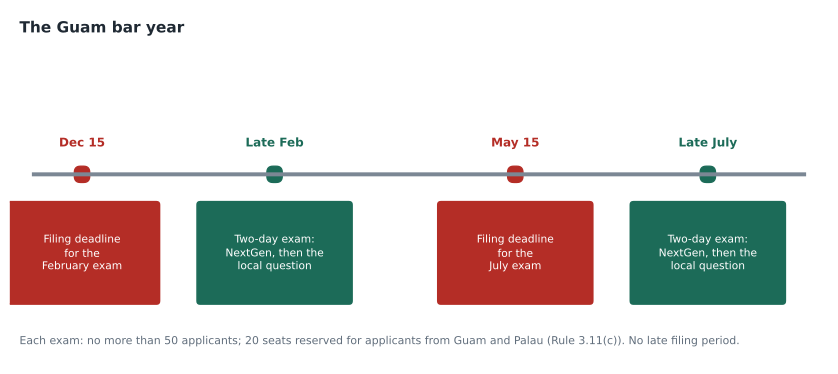
Guam has two exams a year, in February and July, held on the same dates as the national NextGen administration. Rule 3.03(a), as amended in March 2026, sets the filing deadlines: December 15 for the February exam and May 15 for the July exam. If the deadline falls on a weekend or holiday, it moves to the next business day. Rule 3.01(a) treats a timely postmark as meeting the deadline, but the application must be complete and the fee paid. There is no late filing period. Older versions of the rules used December 1 and May 1, and some secondary sources still show those dates, which is another reason to read the current rules.
Rule 3.03(a)(1) contains one small exception for repeat takers. If an unsuccessful applicant's results are announced within five days before the next filing deadline, the applicant gets ten days from the announcement to file for the next exam.
Capacity
Rule 3.11(c) limits each administration to fifty applicants and reserves twenty seats for applicants from Guam and Palau. Palau, an independent nation in free association with the United States, has no law school either, and many Palauan lawyers have long sat for exams in Guam. If fewer than twenty applicants from Guam and Palau file by the regular deadline, the unused reserved seats open to other applicants. The practical lesson is simple: file early. A complete application on file in November is safer than one mailed on December 14.
Fees
The Supreme Court sets the filing fee. The Judiciary's application page lists the current amounts: a Guam bar exam registration fee of 1,000 dollars, paid to the Supreme Court of Guam, and a separate NCBE technology fee of 149 dollars, paid directly to NCBE or its vendor. The page states that the two fees are separate. NCBE also charges its own fee for the character and fitness application, which the applicant pays through NCBE's system. Other Guam fees include a 650 dollar administrative fee for a score transfer under Rule 3.09(e) and a 600 dollar fee for the temporary practice routes for government lawyers and military spouses.
Rule 3.04 governs refunds. The filing fee is nonrefundable, except that an applicant who withdraws by NCBE's withdrawal deadline gets the fee back less 100 dollars. Any NCBE technology fee is refundable only as NCBE's own policy allows. Fees do not carry over to a later exam: an applicant who withdraws and files again pays again. Rule 3.04(d) also requires a repeat taker to file a new application and new fees for each exam and to resubmit current certificates of good standing.
| Fee | Amount | Paid to |
|---|---|---|
| Guam bar exam registration | 1,000 dollars | Supreme Court of Guam |
| NCBE technology fee | 149 dollars | NCBE or its vendor |
| Score transfer administrative fee | 650 dollars | Supreme Court of Guam |
| Temporary practice (government or military spouse) | 600 dollars | Supreme Court of Guam |
| Withdrawal by NCBE deadline | Refund less 100 dollars | Refunded by the Board |
No limit on attempts
Some jurisdictions cap the number of times an applicant may sit for the bar. Guam does not. Rule 3.04(d) states that there is no limit to the number of times an applicant may take the bar examination. Each attempt requires a new application and new fees, and the fifty-seat cap still applies.
Worked problem
Building the filing checklist
Josefa wants to sit in February 2027. It is October 2026. List what she must do and by when.
Show solution
- Request the official transcript from her law school now; it must arrive directly and before the exam.
- Complete the NCBE character and fitness application, print it and sign the release.
- Complete the Guam Bar Registration Form with a passport-size photograph.
- Pay the 1,000 dollar registration fee to the Supreme Court and the 149 dollar technology fee to NCBE.
- File the package well before December 15, 2026; a weekend deadline rolls to the next business day.
Answer: Josefa filed on November 9, 2026, five weeks early, and confirmed her transcript had arrived.
Accommodations
Rule 3.13 governs testing accommodations for applicants with disabilities. The request uses the form in Appendix B of the rules and is due with the application, although requests for nonstandard materials have a deadline of six weeks before the exam and other requests four weeks before. Supporting documentation is detailed, and the Board's handbook explains what it expects for different conditions. An applicant who may need an accommodation should start the paperwork when the application is filed, not when the exam is a month away.
Laptops
Rule 3.12 requires applicants to use their own laptop or one they borrow, unless an accommodation provides otherwise. The NextGen exam runs on NCBE's secure software, and NCBE publishes the technical requirements and a practice tutorial. Josefa planned to install the software and run the tutorial at least twice before February: once in December and once the week before the exam.
Common mistakes
MistakeThe filing deadline for the February exam is December 1.
InsteadThe March 2026 amendments set December 15 for February and May 15 for July.
MistakeI can file late for an extra fee.
InsteadGuam has no late filing period.
MistakeMy registrar can email my transcript.
InsteadTranscripts must come directly from the school or an approved clearinghouse; emailed copies are not accepted.
MistakeThe 1,000 dollar fee includes NCBE's technology fee.
InsteadThe 149 dollar NCBE technology fee is separate and paid to NCBE.
MistakeGuam limits applicants to five attempts.
InsteadRule 3.04(d) says there is no limit to the number of attempts.
Planning around the island calendar
Living in Guam adds practical wrinkles to every deadline. Mail between Guam and the mainland can take longer than applicants from the states expect, and a transcript sent by a mainland registrar may need extra time to arrive. Holidays on Guam's calendar can also move a deadline: under Rule 3.03(a), a deadline that falls on a weekend or holiday moves to the next business day, so an applicant should check the Judiciary's holiday schedule, not a mainland calendar. And because Guam is a day ahead of the continental United States, an email sent from California on the afternoon of December 15 may arrive in Hagåtña on December 16. Josefa's rule was to treat every deadline as falling a week earlier than it actually did.
Applicants from Palau face the same issues at a greater distance, which is one reason Rule 3.11(c) reserves seats for applicants from Guam and Palau. An applicant traveling from elsewhere for the exam should book flights and lodging as soon as the application is accepted, because the exam weeks can coincide with busy travel periods.
Worked problem
A weekend deadline
In a future year, December 15 falls on a Saturday. Remedios mails her complete application, with fees, on Monday, December 17. Is it timely?
Show solution
- Rule 3.03(a): a deadline on a weekend or holiday moves to the next business day.
- Saturday, December 15 moves to Monday, December 17, unless that day is a holiday.
- Rule 3.01(a): a timely postmark meets the deadline if the application is complete and the fee paid.
Answer: Remedios's application is timely if it is complete and postmarked December 17. Filing on the last day is still a needless risk with only fifty seats.
Keeping the application current
Filing is not the end of the paperwork. An applicant who changes address, job or name, or who has any new contact with the legal system, must update the application, as Lesson 3 explains. An applicant admitted in another jurisdiction during the process must add a certificate of good standing from that jurisdiction. Josefa set a reminder on the first day of each month to ask herself whether anything on her application had changed.
Summary and key terms
- Applicants must be at least eighteen, of good character, and graduates of an ABA-accredited law school (accredited when they graduated).
- Foreign law graduates cannot sit for the Guam exam; only limited temporary practice is available to foreign lawyers.
- The application is the Guam Bar Registration Form plus NCBE's character and fitness application, with an official transcript and any certificates of good standing.
- Deadlines are December 15 (February exam) and May 15 (July exam), with no late filing period.
- Fees are 1,000 dollars to the Supreme Court plus a 149 dollar NCBE technology fee; there is no limit on attempts.
- 0
- Rule 2.01(b)
- 1
- Rule 2.02
- 2
- Registration Form
- 3
- Standard-07 Application
- 4
- Certificate of good standing
- 5
- Rule 3.03
- 6
- Rule 3.11(c)
- 7
- Technology fee
Practice problems
Work each problem on paper first, then reveal the answer to check.
What two documents make up the application under Rule 3.02(b)?
Show answer
The Guam Bar Registration Form and NCBE's standard character and fitness application.
When must a certificate of good standing be dated?
Show answer
Within thirty days of the application.
An applicant withdraws before NCBE's withdrawal deadline. What happens to the 1,000 dollar fee?
Show answer
It is refunded less 100 dollars; the NCBE technology fee follows NCBE's refund policy.
Why should applicants from outside Guam and Palau file early?
Show answer
Each exam is limited to fifty applicants, with twenty seats reserved for Guam and Palau applicants.
Lesson quiz · 5 questions
Score 60% or more to complete this lesson.
Create a free account to save your progress, take quizzes and earn a certificate.