
BAR-252 · Lesson 3 of 12 · 23 min
Character and fitness and the MPRE
▶ Video coming soon A video version of this lesson is on the way.
The NCBE character and fitness application took Josefa longer than she expected. It asked for every address since she turned eighteen, every job, every school and every traffic citation. She had lived in four apartments in Washington State and California and had held six jobs, including a summer at a tour company in Tumon and a semester as a research assistant. One question stopped her: had she ever been charged with any offense? In 2019, during her first year of college, she had received a citation for having an open container at a beach park. She had paid the fine and forgotten about it.
She asked Marchetti whether she needed to mention it. 'Yes,' Marchetti said. 'Disclose it fully and accurately, attach the paperwork if you can find it, and move on. A small citation almost never keeps anyone out of the bar. Failing to disclose it can.' Josefa found the court record online, ordered a certified copy and attached it.
This lesson explains how Guam evaluates character and fitness and what it requires on the Multistate Professional Responsibility Examination.
The standard
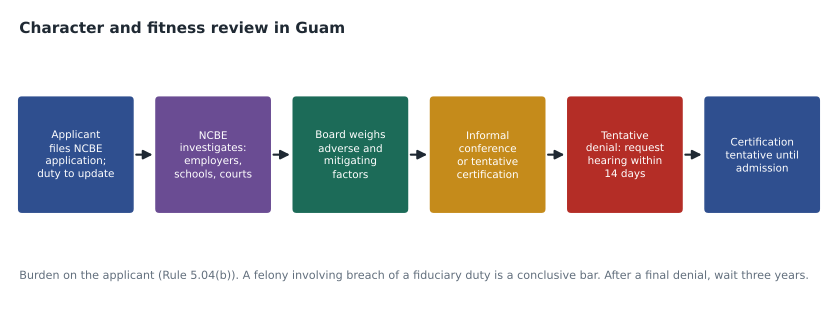
Rule 5.02 of the Guam admission rules requires an applicant to show good moral character, emotional stability and good standing in every jurisdiction where he or she is admitted. Rule 2.01(b)(2) describes the goal in terms that most jurisdictions share: a record of conduct that justifies the trust of clients, adversaries, courts and others. The burden is on the applicant. Rule 5.04(b) places the burden of proof on the person seeking admission, and Rule 5.04(e) imposes a continuing duty to report changes in the information on the application until admission.
Who investigates
Guam uses NCBE's character and fitness investigation. Rule 5.01 and Rule 5.03(a) provide that NCBE conducts the investigation and the Board reviews the results. That is one reason the application consists of NCBE's standard form: NCBE contacts employers, schools, references and courts, collects records and sends a report to the Board. The Board then decides whether the applicant has shown the necessary character and fitness.
Adverse and mitigating factors
Rule 5.03(c) lists conduct that may weigh against an applicant. The list is long and follows the model used in most jurisdictions. It names unlawful conduct, acts of dishonesty and neglect of financial responsibilities, and it reaches the other kinds of conduct that bar examiners everywhere treat as warning signs, such as false statements or omissions in the application itself and failures to meet legal or professional obligations. Applicants should read the full text of the rule rather than rely on a summary.
Rule 5.03(d) lists mitigating factors that the Board weighs against the adverse ones. Factors of this kind, common to most jurisdictions' rules, include the applicant's age at the time of the conduct, how recent it was, how serious it was and the circumstances that led to it, evidence of rehabilitation, positive contributions since and, above all, the applicant's candor in the admission process.
| Adverse factors (Rule 5.03(c)) | Mitigating factors (Rule 5.03(d)) |
|---|---|
| Unlawful conduct | Age at the time of the conduct |
| False statements or omissions | How recent the conduct was |
| Failure to meet legal obligations | Seriousness and circumstances |
| Dishonesty or fraud | Evidence of rehabilitation |
| Neglect of financial responsibilities | Positive social contributions since |
| Neglect of professional obligations | Candor in the admission process |
Felonies and fiduciary crimes
Guam treats criminal convictions in two tiers. Under Rule 5.03(e), a felony conviction is not an automatic bar to admission, but the applicant carries a heavy burden to show rehabilitation and present fitness. A felony involving breach of a fiduciary duty is different: it is a conclusive bar. Rule 2.01(b)(3) makes the same point in the list of qualifications, excluding anyone convicted of a felony or a crime of moral turpitude committed against a person or entity to whom the applicant owed a legally recognized fiduciary duty. A former trustee who embezzled from a trust or a former employee convicted of stealing client funds cannot be admitted, whatever the evidence of rehabilitation.
Worked problem
Two applicants with records
Applicant A was convicted of felony drug possession at nineteen, completed probation and has had a clean record for twelve years. Applicant B, a former bookkeeper, pleaded guilty to theft of funds from the small business that employed her, where she managed the accounts. How does Guam treat each?
Show solution
- Applicant A: a felony is not an automatic bar under Rule 5.03(e); A carries a heavy burden to show rehabilitation.
- Mitigating factors help A: young age at the time, twelve years without incident and, if true, candor and positive contributions.
- Applicant B: theft from an employer she served as bookkeeper may be a crime against someone to whom she owed a fiduciary duty.
- If the Board finds the fiduciary relationship, Rule 2.01(b)(3) and Rule 5.03(e) make it a conclusive bar.
Answer: A may be admitted with a strong showing of rehabilitation. B faces a conclusive bar if the crime was against someone to whom she owed a fiduciary duty.
Conferences, denials and hearings
The Board does not have to approve or deny on the papers alone. Rule 5.05 allows an informal conference with an applicant whose file raises concerns. A conference may end with the applicant withdrawing the application and agreeing to a period of rehabilitation of up to three years before reapplying. If the Board tentatively denies certification, Rule 6.01 gives the applicant the right to contest it at a hearing, but the applicant must request the hearing within fourteen days. After a final denial, Rule 5.06 requires a wait of three years before the applicant may apply again.
Certification is not final until admission. Under Rules 5.07 and 5.08, a certification of character and fitness is tentative until the applicant is admitted, and the Board may suspend it for further review if new information comes to light. That is why the continuing duty to update the application matters: a new arrest, lawsuit or bankruptcy after filing must be reported promptly.
Honesty in the exam itself
Rule 3.14 covers misconduct connected with the exam: bringing prohibited materials, communicating during the exam, continuing to write after time is called, misrepresenting identity and similar conduct. Penalties include forfeiture of fees and disqualification. The exam room rules on the Board's website add that eating and drinking are not allowed in the examination room and that books, notes and other materials are not permitted unless the Board directs otherwise.
The MPRE
Like almost every jurisdiction, Guam requires a passing score on the Multistate Professional Responsibility Examination, NCBE's two-hour multiple-choice test on the rules of professional conduct and the law governing lawyers. The MPRE is given several times a year at testing centers and is separate from the two-day bar exam. It has sixty questions, fifty of them scored, and results are reported on a scaled score from 50 to 150.
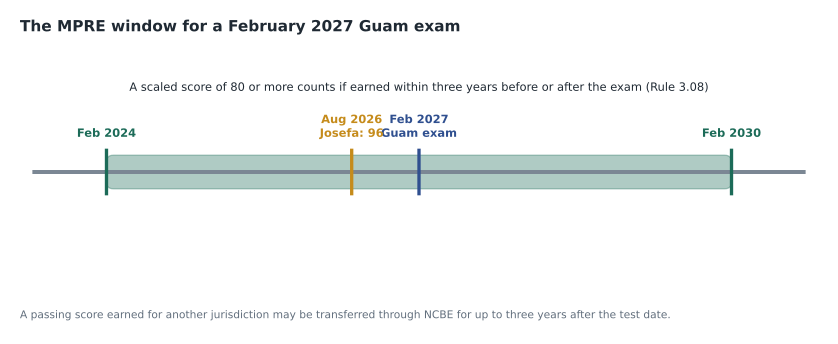
Guam requires a scaled score of at least 80. Rule 3.08(a) sets the score, and Rule 3.08(b) sets the timing: the applicant must pass the MPRE within three years before or after the date of the Guam Bar Examination. Rule 3.01(c) confirms that the MPRE can be taken before or after the two-day exam. A passing score of 80 or higher earned for another jurisdiction may be transferred for up to three years after the test date. The transfer request goes directly to NCBE, under Rule 3.09(c).
How Guam compares
Guam's 80 sits in the middle of the range used across the country. Several states require 85, a few require 75 or 77, and a large group uses 80. The number matters when an applicant has an older score from a jurisdiction with a lower requirement: a 78 that was good enough elsewhere will not satisfy Guam.
Worked problem
Will the MPRE score count?
Vicente scored 82 on the MPRE in March 2023 and sits the Guam Bar Examination in February 2027. Remedios scored 79 in November 2025 and sits in February 2027. Do their scores satisfy Guam?
Show solution
- Guam needs 80 or higher, earned within three years before or after the Guam exam date.
- Vicente: 82 is high enough, but March 2023 is almost four years before February 2027, so the score is outside the window.
- Vicente must retake the MPRE; he can do so before or within three years after the February 2027 exam.
- Remedios: November 2025 is inside the window, but 79 is below 80.
Answer: Neither score counts. Both must sit the MPRE again and score at least 80.
Preparing for the MPRE
The MPRE tests the ABA Model Rules of Professional Conduct, the ABA Model Code of Judicial Conduct and generally accepted principles of the law governing lawyers, not Guam's own rules. Guam's Rules of Professional Conduct follow the structure of the ABA Model Rules, so MPRE study is also a good start on Guam practice, but a Guam lawyer must still read Guam's text. Marchetti's advice was to give the MPRE three or four focused weeks, take it well before the bar exam if possible and treat it as a separate project. Josefa had done exactly that, sitting in August 2026 before her bar study began in earnest.
Common mistakes
MistakeA small citation I paid years ago does not need to be disclosed.
InsteadDisclose it fully; concealment is itself an adverse factor and can be far more serious than the citation.
MistakeAny felony conviction permanently bars admission in Guam.
InsteadOnly a felony involving breach of a fiduciary duty is a conclusive bar; other felonies impose a heavy burden.
MistakeOnce the Board certifies me, my character review is over.
InsteadCertification is tentative until admission and may be suspended if new information appears.
MistakeA 78 on the MPRE that passed in another state is fine for Guam.
InsteadGuam requires a scaled score of 80.
MistakeI have unlimited time to request a hearing after a tentative denial.
InsteadRule 6.01 requires the request within fourteen days.
Writing the explanations
Many character and fitness questions are not about the event itself but about the applicant's explanation. Marchetti gave Josefa four rules for writing one. First, state the facts plainly and completely, including dates, places and outcomes. Second, attach the documents: a court record, a dismissal, a payment receipt. Third, take responsibility without minimizing or over-explaining; a reviewer can tell the difference between candor and excuse-making. Fourth, describe what has changed since, if anything did. Josefa's explanation of her 2019 open-container citation ran four sentences and attached the certified record. 'That's the right length,' Marchetti said. 'Short, complete, documented.'
Financial history
Financial problems are among the most common issues in character review everywhere. Debt by itself is not disqualifying; what reviewers look for is neglect: accounts ignored, judgments unpaid, promises broken. An applicant with student loans in good standing has nothing to explain. An applicant with an account in collection should show what happened and what he or she has done about it, such as a payment plan or a payoff letter. An applicant who is behind should start dealing with it before filing, not after the Board asks.
Mental health
Applicants sometimes worry that seeking counseling or treatment will count against them. The national trend in bar admissions has been to focus on conduct rather than diagnosis or treatment, and Guam's rules frame the question in terms of conduct that bears on fitness to practice. Seeking help is not misconduct. An applicant with a specific concern can ask the Board's secretary how a question on the application is applied, and many law schools offer confidential advice on the process.
Worked problem
An omission discovered
After filing, Dionisio realizes he left off a part-time job from which he was fired in 2021 for repeated lateness. What should he do?
Show solution
- Rule 5.04(e) imposes a continuing duty to update the application until admission.
- An omission that the investigation later uncovers looks like concealment, an adverse factor in its own right.
- He should amend the application promptly, disclose the job and the reason for leaving and attach any documents.
Answer: Dionisio should amend now. A late firing for lateness is a minor matter; an undisclosed one can become a serious question of candor.
The MPRE and the bar exam calendar
Because the MPRE can be taken before or after the bar exam, applicants have a choice about timing. Taking it during law school or soon after graduation, as Josefa did, keeps it out of the way during bar study. Taking it after the bar exam is allowed, but it delays admission until the score arrives and leaves a risk that a low score will require another sitting. Marchetti's advice was to avoid scheduling the MPRE in the last two months before the bar exam, when every hour belongs to the bar.
Summary and key terms
- Applicants must prove good moral character, emotional stability and good standing elsewhere; the burden is on the applicant and the duty to update continues until admission.
- NCBE investigates and the Board reviews, weighing adverse factors against mitigating ones.
- A felony is not an automatic bar, but a felony involving breach of a fiduciary duty is a conclusive bar.
- Tentative denials can be contested at a hearing requested within fourteen days; a final denial means a three-year wait.
- Guam requires an MPRE scaled score of 80, earned within three years before or after the Guam exam date.
- 0
- Character and fitness
- 1
- Rule 5.03
- 2
- Mitigating factors
- 3
- Fiduciary duty
- 4
- Tentative certification
- 5
- Informal conference
- 6
- MPRE
- 7
- Scaled score
Practice problems
Work each problem on paper first, then reveal the answer to check.
Who carries the burden of proof in Guam character and fitness review?
Show answer
The applicant, under Rule 5.04(b).
Which kind of conviction is a conclusive bar to admission in Guam?
Show answer
A felony or crime of moral turpitude committed against a person or entity to whom the applicant owed a fiduciary duty.
How long does an applicant have to request a hearing after a tentative denial?
Show answer
Fourteen days, under Rule 6.01.
What MPRE score and timing does Guam require?
Show answer
A scaled score of at least 80, within three years before or after the Guam Bar Examination date.
Lesson quiz · 5 questions
Score 60% or more to complete this lesson.
Create a free account to save your progress, take quizzes and earn a certificate.