
BAR-252 · Lesson 8 of 12 · 21 min
Guam's courts: the Supreme Court, the Superior Court and the District Court of Guam
▶ Video coming soon A video version of this lesson is on the way.
Josefa's first assignment at Tasi Point Law Office was to pull the file on an appeal the firm had won years before in the Supreme Court of Guam. The file was thick, and the first document in it was a motion arguing about which court had jurisdiction. Quinata explained that when she started practicing, Guam lawyers argued about that constantly. 'The courts here have been rebuilt three times in my lifetime,' she said. 'If you don't know the history, the old cases won't make sense.'
This lesson describes the two court systems that operate in Guam, the local Judiciary of Guam and the federal District Court of Guam, and the history that explains how they fit together.
Two court systems
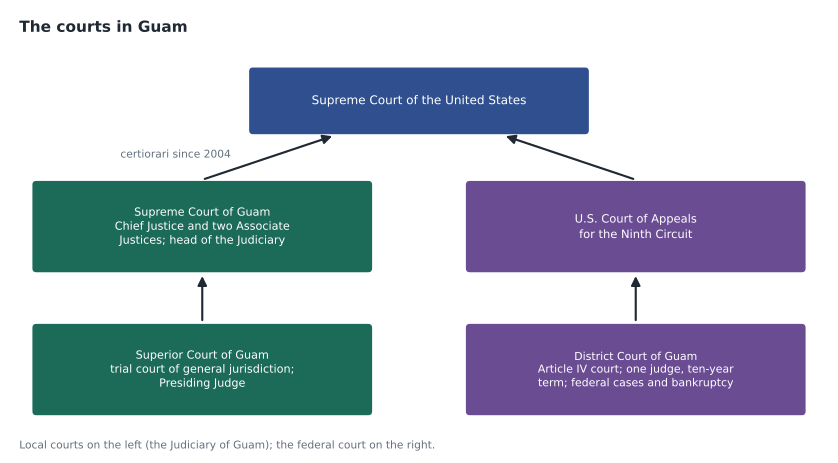
Like every state, Guam has both local courts and a federal court. The local courts make up the Judiciary of Guam: the Superior Court of Guam, the trial court of general jurisdiction, and the Supreme Court of Guam, the highest local court. The federal court is the District Court of Guam, which hears federal cases and serves as the bankruptcy court. Appeals from the District Court go to the U.S. Court of Appeals for the Ninth Circuit. Decisions of the Supreme Court of Guam can be reviewed by the U.S. Supreme Court by writ of certiorari, the same way decisions of a state's highest court can.
The Superior Court of Guam
The Superior Court is the trial court for almost all local matters: civil cases, criminal prosecutions under Guam law, family law, probate, juvenile matters and small claims. It has a Presiding Judge, who also sits ex officio on the Board of Law Examiners, and several divisions. Civil cases in the Superior Court follow the Guam Rules of Civil Procedure, which the Supreme Court of Guam adopts and which follow the structure of the Federal Rules of Civil Procedure. A lawyer who knows the federal rules will recognize most of the Guam rules, but should read the Guam text, because some provisions and deadlines differ.
The Supreme Court of Guam
The Supreme Court of Guam is the court of last resort for Guam law. It sits as a panel of three justices: a Chief Justice and two Associate Justices. The chief justiceship rotates among the justices; the order adopting Guam's NextGen exam in 2024 was signed by Chief Justice Robert J. Torres, and the March 2026 order amending the admission rules was signed by Chief Justice Katherine A. Maraman. The Court hears appeals from the Superior Court, answers certified questions and, as Lesson 1 explained, regulates admission to the bar and the practice of law. Its opinions are cited by year and number, such as 2011 Guam 8.
The Supreme Court of Guam is also the head of a unified judicial branch. In 2004 Congress amended the Organic Act to establish the Judiciary of Guam as a separate and independent branch of the Government of Guam, with the Supreme Court as its highest court and with supervisory authority over the Superior Court. That amendment ended a long period in which the status of the local courts depended on ordinary Guam statutes.
How the courts were built
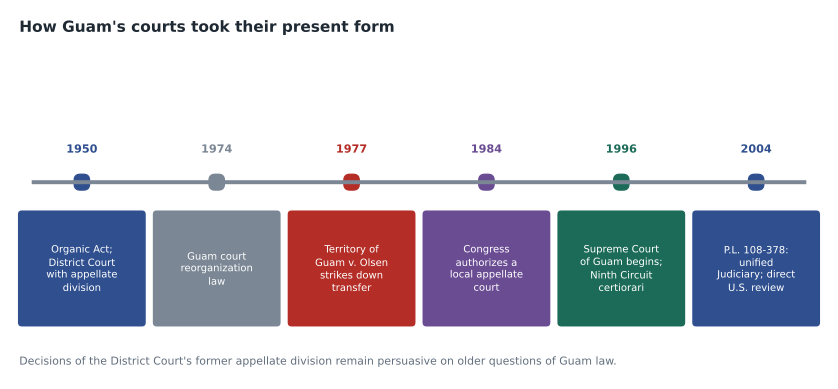
The history explains many older cases. When Congress enacted the Organic Act in 1950, it created the District Court of Guam and gave it both federal jurisdiction and, through an appellate division, jurisdiction to hear appeals from Guam's local trial courts. Local appeals went to that appellate division, then to the Ninth Circuit.
In 1974 the Guam Legislature passed a court reorganization law that created a local Supreme Court and tried to move local appeals there. The U.S. Supreme Court struck the arrangement down in Territory of Guam v. Olsen, decided in 1977, holding that the Organic Act as then written did not allow the Legislature to take appellate jurisdiction away from the District Court's appellate division. Congress responded by amending the Organic Act in 1984 to authorize the Legislature to create a local appellate court. The Legislature did so, and the present Supreme Court of Guam began hearing appeals in 1996.
Even then, review of the new court's decisions did not go directly to the U.S. Supreme Court. Under the 1984 amendment, the Ninth Circuit had certiorari jurisdiction to review final decisions of Guam's highest court for its first fifteen years, with the Ninth Circuit's Judicial Council reporting periodically on whether Guam's courts had developed institutional traditions that justified direct review. Congress ended that arrangement in 2004, in Public Law 108-378, which removed the Ninth Circuit's certiorari jurisdiction. Since then, final decisions of the Supreme Court of Guam are reviewed by the U.S. Supreme Court under the same framework that governs review of state supreme courts, set out in 48 U.S.C. 1424-2.
Worked problem
Where does the appeal go?
A client lost a contract case in the Superior Court of Guam in 2026 and wants to appeal. Later, if she loses again on a question of federal constitutional law, she wants to go further. Trace the route.
Show solution
- First appeal: from the Superior Court of Guam to the Supreme Court of Guam.
- Further review on the federal question: a petition for a writ of certiorari to the U.S. Supreme Court, as from a state supreme court.
- The Ninth Circuit plays no part: its certiorari jurisdiction over the Supreme Court of Guam ended in 2004.
Answer: Superior Court, then Supreme Court of Guam, then a certiorari petition to the U.S. Supreme Court on the federal question.
The District Court of Guam
The District Court of Guam is a federal court, but it is not an Article III court like the federal district courts in the states. Congress created it under its power over territories, Article IV of the Constitution, and its judge is appointed by the President with the Senate's consent for a ten-year term rather than for life. The court has the jurisdiction of a federal district court, including federal question and diversity cases, federal criminal prosecutions and bankruptcy matters. Appeals go to the Ninth Circuit and from there to the U.S. Supreme Court.
The court's dual role in Guam's history, first as a local appellate court and then as a purely federal court, explains why older Guam cases sometimes cite decisions of the District Court's appellate division on questions of local law. Those decisions can still be useful, but on questions of Guam law decided after 1996, the Supreme Court of Guam's opinions control.
| Court | Kind | Judges and terms | Appeals go to |
|---|---|---|---|
| Superior Court of Guam | Local trial court of general jurisdiction | Judges led by a Presiding Judge | Supreme Court of Guam |
| Supreme Court of Guam | Local court of last resort | Chief Justice and two Associate Justices | U.S. Supreme Court by certiorari |
| District Court of Guam | Federal territorial court (Article IV) | One judge, appointed for ten years | Ninth Circuit |
Guam in the U.S. Supreme Court
Guam's cases occasionally reach the U.S. Supreme Court. A recent example is Guam v. United States, decided in 2021. Guam sought contribution from the United States for the cost of cleaning up the Ordot Dump, a landfill the U.S. Navy had used. The question was whether a 2004 consent decree between Guam and the federal government under the Clean Water Act had started the three-year limitations period for a contribution claim under the federal Superfund statute, CERCLA. The Court unanimously held that it had not, because a contribution claim of that kind requires a settlement that resolves liability under CERCLA itself. Guam's claim could go forward.
Practical points for new lawyers
A new Guam lawyer will practice mostly in the Superior Court and will need to know the Guam Rules of Civil Procedure and the Superior Court's local practices. Admission to the Guam bar does not by itself admit a lawyer to practice in the District Court of Guam, which has its own admission procedure under its local rules. Quinata told Josefa to apply for District Court admission soon after she was sworn in, because the firm's clients sometimes had bankruptcy matters and federal claims.
Common mistakes
MistakeAppeals from the Supreme Court of Guam go to the Ninth Circuit.
InsteadSince 2004 they go directly to the U.S. Supreme Court by certiorari.
MistakeThe District Court of Guam is an Article III court with a life-tenured judge.
InsteadIt is an Article IV territorial court; its judge serves a ten-year term.
MistakeThe Supreme Court of Guam was created in 1974.
InsteadThe 1974 court was struck down in Territory of Guam v. Olsen (1977); the present court began hearing appeals in 1996.
MistakeAdmission to the Guam bar admits me to the District Court of Guam.
InsteadThe District Court has its own admission procedure.
Reading older Guam cases
Because of the history in this lesson, a Guam lawyer researching a question of local law may find authority from several courts. Josefa built a short guide for herself.
| Source of the decision | Period | Weight on Guam law today |
|---|---|---|
| Supreme Court of Guam | 1996 to the present | Binding |
| Ninth Circuit reviewing the Supreme Court of Guam by certiorari | Before 2004 | Binding unless overruled or superseded; check later Guam cases |
| District Court of Guam, Appellate Division | Before 1996 | Persuasive; useful where the Supreme Court of Guam has not spoken |
| California courts interpreting borrowed statutes | Any period | Persuasive only |
| U.S. Supreme Court | Any period | Binding on federal questions |
Marchetti told Josefa that the table was a starting point, not a rule, and that the best way to learn the weight of older authority was to see how the Supreme Court of Guam itself treats it in recent opinions. Josefa read three recent opinions in areas on her local list and noted how each one cited older decisions. Two cited Appellate Division decisions as persuasive authority, and one cited a California case on a borrowed statute.
Practicing in the Superior Court
Most of a new Guam lawyer's work is in the Superior Court. The Guam Rules of Civil Procedure follow the structure of the federal rules, so pleading, discovery and motion practice will be familiar. But the Superior Court also has its own administrative rules and practices on filing, scheduling and courtroom procedure, and the Judiciary has its own systems for electronic filing and records. Quinata's advice to Josefa was to read the rules once, then learn the practice by watching. 'Sit in the back of a courtroom for a morning,' she said. 'You'll learn more about how a calendar call works here than from any book.'
Certified questions
The Supreme Court of Guam can answer questions of Guam law certified to it by other courts, including the District Court of Guam and the Ninth Circuit, when a federal case turns on an unsettled point of local law. The procedure lets the court with final authority over Guam law decide the question rather than leaving a federal court to predict the answer. A lawyer litigating in federal court on a Guam law issue should consider whether certification is available and useful.
Worked problem
Choosing the forum
A Guam business wants to sue a California company for breach of a supply contract worth 300,000 dollars. The contract is governed by Guam law. May it sue in the District Court of Guam, the Superior Court of Guam or both?
Show solution
- Superior Court: the trial court of general jurisdiction for local claims; a contract claim under Guam law belongs there.
- District Court: has the jurisdiction of a federal district court, including diversity jurisdiction if the parties are of diverse citizenship and the amount in controversy is met.
- If the case is filed in the Superior Court, the defendant may consider removal under the federal rules that govern removal from state courts, which apply to Guam's courts by 48 U.S.C. 1424-2.
Answer: Either court may be available. The choice depends on strategy, speed and the client's preferences, and the firm should consider removal risk.
Summary and key terms
- Guam has a local Judiciary (Superior Court and Supreme Court of Guam) and a federal District Court of Guam.
- The Supreme Court of Guam has three justices, a rotating chief justiceship, and heads a unified Judiciary established by Congress in 2004.
- Territory of Guam v. Olsen (1977) blocked an earlier local supreme court; Congress authorized one in 1984 and the present court began in 1996.
- Public Law 108-378 (2004) ended Ninth Circuit certiorari; Supreme Court of Guam decisions go to the U.S. Supreme Court.
- The District Court of Guam is an Article IV court whose judge serves ten years; appeals go to the Ninth Circuit.
- 0
- Judiciary of Guam
- 1
- Superior Court of Guam
- 2
- Supreme Court of Guam
- 3
- District Court of Guam
- 4
- Article IV court
- 5
- Territory of Guam v. Olsen
- 6
- Certiorari
- 7
- Guam Rules of Civil Procedure
Practice problems
Work each problem on paper first, then reveal the answer to check.
Which court reviews final decisions of the Supreme Court of Guam?
Show answer
The U.S. Supreme Court, by writ of certiorari.
What did Territory of Guam v. Olsen hold?
Show answer
That the Organic Act as then written did not allow the Guam Legislature to transfer appellate jurisdiction from the District Court's appellate division to a local supreme court.
What did Public Law 108-378 change?
Show answer
It ended the Ninth Circuit's certiorari review of the Supreme Court of Guam and established the Judiciary of Guam as a unified branch headed by the Supreme Court.
What did Guam v. United States (2021) decide?
Show answer
That a Clean Water Act consent decree did not trigger CERCLA's limitations period for contribution, because the settlement did not resolve CERCLA liability.
Lesson quiz · 5 questions
Score 60% or more to complete this lesson.
Create a free account to save your progress, take quizzes and earn a certificate.