
BAR-252 · Lesson 11 of 12 · 21 min
Score transfer, temporary admission, the Guam Bar and practice after admission
▶ Video coming soon A video version of this lesson is on the way.
At one of Josefa's sessions, Marcus Bell joined as a guest. Marcus had passed Missouri's first NextGen exam in July 2026 with a 648, and he was curious. 'Could I practice in Guam with my score?' he asked. Marchetti turned the question over to Josefa. 'You tell him,' she said. Josefa walked through Rule 3.09 and found she knew it well enough to explain it without notes, which Marchetti said was the point of the exercise.
This lesson covers the ways a lawyer or applicant can come into Guam practice other than by sitting the full Guam Bar Examination, the obligations that begin after admission and the system that regulates Guam lawyers.
Score transfer under Rule 3.09
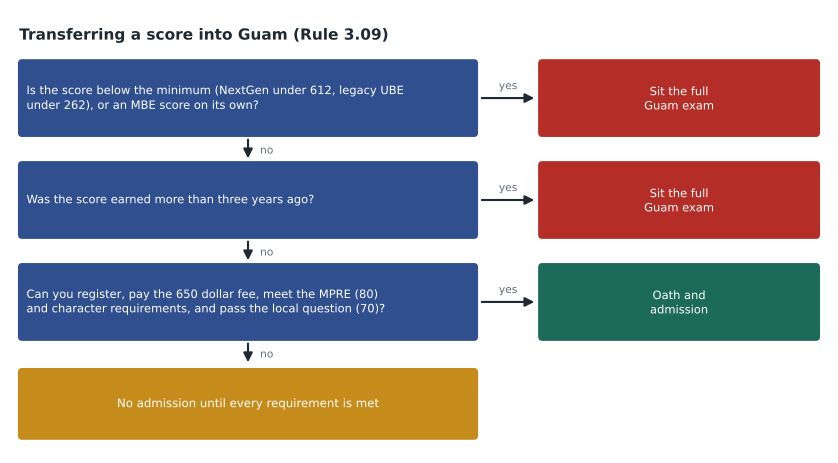
Rule 3.09 allows an applicant to be admitted on a score earned elsewhere. Two kinds of scores qualify. A NextGen score must be 612 or higher, and a legacy Uniform Bar Examination score must be 262 or higher. In each case the score must have been earned within three years, under the windows the rule sets out. A transferred score alone is not enough. Under Rule 3.09(d), the transfer applicant must also register, satisfy the education, application, deadline, MPRE and character and fitness requirements, and take and pass Guam's local question with a score of at least 70. Rule 3.09(e) sets a 650 dollar administrative fee, part of which may be refunded if the applicant already has a recent NCBE character report. Guam does not accept an MBE score transferred on its own.
Worked problem
Marcus's question
Marcus scored 648 on the NextGen exam in Missouri in July 2026 and took the MPRE in 2025. Could he be admitted in Guam on that score?
Show solution
- Score: 648 is above Guam's 612 transfer minimum.
- Age of score: July 2026 is well within three years; he must apply before the window closes.
- MPRE: he must confirm that his 2025 score is at least 80 and falls within Guam's three-year window.
- Other requirements: registration, the 650 dollar fee, an NCBE character report and certificates of good standing.
- Local question: he must sit and pass Guam's local question with at least 70, so he must travel to Guam for an exam date and study Guam law.
Answer: Marcus can transfer his score, but only by also passing the local question and meeting every other requirement. There is no shortcut around the local exam.
No admission on motion
Most states allow experienced lawyers from other jurisdictions to be admitted on motion after a set number of years in practice. Guam does not. Rule 3.01(e) states that Guam has no admission by comity or reciprocity. NCBE's summary for Guam agrees. The older attorney examination for lawyers with five years of practice has also been omitted from the rules, as Lesson 5 explained. An experienced lawyer from a state who wants to join the Guam bar must pass the full Guam Bar Examination or transfer a qualifying score and pass the local question.
Limited and temporary routes
The rules provide a few narrower routes, each with strict limits.
Government and legal services lawyers
Under Rule 3.01(e), a lawyer admitted and in good standing in another U.S. jurisdiction may practice in Guam temporarily, for up to five years, while employed full time by Government of Guam entities or by the legal services organizations the rule lists. The lawyer files NCBE's character application, a certificate of good standing dated within thirty days and a 600 dollar fee. Extensions of up to three years are possible, with a cumulative maximum of eight years. The practice is limited to the lawyer's government or legal services work.
Military spouses
Rule 9.03 allows the spouse of an active-duty servicemember stationed in Guam under military orders to obtain a temporary license. The applicant must meet the education and character requirements of Rules 2.01 and 2.02 and pay a 600 dollar fee. The license runs for three years, with one-year renewals, and the licensee must meet continuing legal education requirements. Given the size of the military presence in Guam, this route matters in practice.
Lawyers from the Northern Mariana Islands
Rule 9.04 provides reciprocal admission for lawyers admitted by examination in the Commonwealth of the Northern Mariana Islands and in good standing there, with a 50 dollar fee and the required certificates. The Supreme Court decides each application. The rule reflects the close ties between Guam and its nearest neighbor in the Marianas.
Pro hac vice and foreign lawyers
Rules 8.01 and 8.02 allow a lawyer from elsewhere to appear in a particular case pro hac vice, with a verified application, a fee and a sponsoring member of the Guam bar. This is permission to appear in one matter, not admission. Rules 9.01 and 9.02 allow limited temporary practice by lawyers admitted only outside the United States, under conditions the rules set.
| Route | Rule | Key conditions |
|---|---|---|
| Score transfer | 3.09 | NextGen 612 or legacy UBE 262 within three years; local question; 650 dollar fee |
| Government or legal services | 3.01(e) | Full-time employment; up to five years, extendable to eight; 600 dollar fee |
| Military spouse | 9.03 | Servicemember on orders in Guam; three years, one-year renewals; 600 dollar fee |
| CNMI lawyer | 9.04 | Admitted by examination in the CNMI and in good standing; 50 dollar fee |
| Pro hac vice | 8.01, 8.02 | One case; Guam sponsor; not admission |
| Foreign lawyer | 9.01, 9.02 | Limited temporary practice only |
Taking the oath
Once the Board certifies an applicant, the applicant takes the oath. Under Rule 7.01(a)(1), the oath must be taken within five years of the last day of the exam the applicant passed, unless the Board extends the period for good cause shown by clear and convincing evidence. The oath may be administered by a justice of the Supreme Court, a judge of the Superior Court or the Clerk of the Supreme Court, or, with the Court's approval, by a judge of another jurisdiction, and an affirmation may replace an oath. The oath includes pledges to support the Constitution of the United States, to maintain the respect due to the courts of justice and to abide by the Guam Rules of Professional Conduct. The new lawyer receives a certificate of admission issued in the Supreme Court's name and signed by the Chief Justice.
The Guam Bar Association
Rule 7.01(g) provides that no one may practice law in Guam without being a member in good standing of the Guam Bar Association, which it describes as an integrated bar association. Membership, dues and the Association's programs follow admission. The Association also administers continuing legal education and, as part of the lawyer regulation system, runs a Lawyer Assistance Program for lawyers facing substance use or mental health problems.
Continuing legal education
Guam's mandatory continuing legal education rule requires each active member to complete ten hours of approved courses each year, including at least two hours in legal ethics or professionalism. The reporting year runs from January 1 to December 31, and the member must certify compliance on or before January 31 of the following year. Up to six hours above the annual requirement, including up to two ethics hours, may be carried forward one year. Members active for only part of a year receive a prorated requirement. A newly admitted member is exempt for the reporting period in which he or she is first admitted, and no credit is given for hours earned before admission.
The rule is enforced. The Guam Bar Association audits at least 15 percent of active members after each deadline. A member found out of compliance receives a notice of delinquency and has ninety days to cure, paying a 300 dollar fee for each year of delinquency. If the member does not cure, the Association notifies the Supreme Court, and failure to act within ninety days of that notice results in automatic suspension. Reinstatement requires a petition, a 300 dollar reinstatement fee, the delinquency fees and proof of the missing hours.
The Guam Rules of Professional Conduct
Guam lawyers are governed by the Guam Rules of Professional Conduct, adopted by the Supreme Court and organized like the ABA Model Rules of Professional Conduct. The familiar duties of competence, diligence, communication, confidentiality, loyalty in conflicts of interest, candor to the tribunal and fairness to others all apply. A lawyer who studied the Model Rules for the MPRE starts with a good map, but should read the Guam text on any rule that matters to a client, especially on fees, trust accounts, advertising and the exceptions to confidentiality, where jurisdictions often vary.
Lawyer regulation
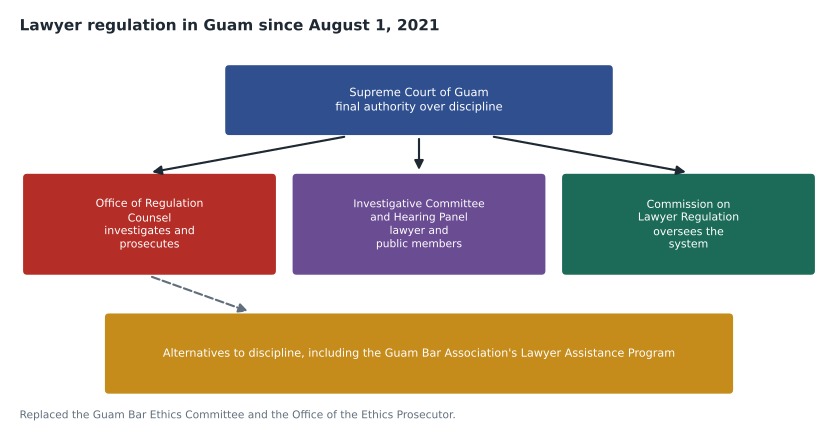
Guam rebuilt its lawyer discipline system in 2021. The Guam Rules for Lawyer Disciplinary Enforcement and Disability Proceedings took effect August 1, 2021, modeled on the ABA Model Rules for Lawyer Disciplinary Enforcement. They created a comprehensive lawyer regulatory system made up of the Office of Regulation Counsel, which investigates and prosecutes alleged misconduct, a Commission on Lawyer Regulation, an Investigative Committee and a Hearing Panel, with public members as well as lawyers. The new system replaced the Guam Bar Ethics Committee and the Office of the Ethics Prosecutor, whose pending matters were transferred. Regulation Counsel can also resolve some matters through alternatives to discipline, including referral to the Lawyer Assistance Program. The Supreme Court retains final authority over discipline.
Common mistakes
MistakeA transferred NextGen score of 640 admits me in Guam without more.
InsteadTransfer applicants must also pass the local question and meet every other requirement.
MistakeAfter five years of practice in a state I can be admitted in Guam on motion.
InsteadGuam has no admission by comity or reciprocity.
MistakeMy first year of practice requires ten CLE hours.
InsteadA new member is exempt for the reporting period of first admission.
MistakeEthics complaints go to the Guam Bar Ethics Committee.
InsteadSince August 1, 2021, the Office of Regulation Counsel and the lawyer regulatory system handle them.
MistakeI can wait as long as I like to be sworn in after passing.
InsteadThe oath must be taken within five years of the last day of the exam passed, absent an extension.
The first year of practice
After admission, a new Guam lawyer's calendar fills with obligations that did not exist before. Josefa made a list with Quinata's help. Join the Guam Bar Association and pay dues. Apply for admission to the District Court of Guam if the firm's work requires it. Set up the firm's trust account procedures for her own matters, following the Guam Rules of Professional Conduct on safekeeping client property. Plan CLE for her first full reporting year, remembering that the year of admission is exempt and that hours earned before admission do not count. Register with the courts' electronic filing systems. And find a mentor outside the firm, a lawyer she could call with a question she did not want to ask her own supervisor.
Worked problem
Planning CLE
Josefa is admitted in May 2027. When must she first complete CLE, and how many hours?
Show solution
- A newly admitted member is exempt for the reporting period in which first admitted, here calendar year 2027.
- No credit is given for hours earned before admission.
- For 2028 she must complete ten hours, including two in ethics or professionalism, between January 1 and December 31, 2028.
- She must certify compliance by January 31, 2029.
Answer: Her first CLE year is 2028: ten hours, two in ethics, certified by January 31, 2029.
When a complaint arrives
Every lawyer eventually receives a complaint or a letter from a regulator. Under the 2021 rules, the Office of Regulation Counsel reviews complaints, investigates where warranted and may resolve some matters through alternatives to discipline. Marchetti, who had seen many young lawyers panic over a first complaint, gave Josefa practical advice. Respond on time. Be accurate and complete. Do not contact the complainant to argue about the complaint. Consider asking an experienced lawyer for advice before responding. Most complaints are resolved without discipline, and a careful, honest response is the best way to keep it that way.
Supervising others
In a small Guam firm, a new lawyer soon supervises others: paralegals, law clerks, sometimes newer lawyers. The Guam Rules of Professional Conduct, like the Model Rules, make lawyers responsible for supervising nonlawyer assistants and, for partners and supervising lawyers, for reasonable efforts to ensure that the lawyers they supervise follow the rules. Quinata had supervised Josefa carefully all fall, reviewing her drafts and limiting her to work a law clerk may do. Josefa noticed and planned to do the same for the clerks who would come after her.
Summary and key terms
- Rule 3.09 accepts NextGen scores of 612 and legacy UBE scores of 262 within three years, but transfer applicants must pass the local question and pay a 650 dollar fee.
- Guam has no admission on motion; limited routes exist for government and legal services lawyers, military spouses, CNMI lawyers and pro hac vice appearances.
- The oath must be taken within five years of passing; membership in the integrated Guam Bar Association is mandatory.
- CLE is ten hours a year, including two in ethics, reported by January 31; new members are exempt in the year of admission.
- Since August 1, 2021, the Office of Regulation Counsel and a comprehensive regulatory system handle lawyer discipline.
- 0
- Score transfer
- 1
- Rule 3.09
- 2
- Admission by comity
- 3
- Military spouse license
- 4
- Pro hac vice
- 5
- Integrated bar
- 6
- MCLE
- 7
- Office of Regulation Counsel
Practice problems
Work each problem on paper first, then reveal the answer to check.
What must a transfer applicant pass in Guam besides having a qualifying score?
Show answer
The Guam local question, with at least 70, plus every other admission requirement.
How long may a government lawyer from a state practice in Guam under Rule 3.01(e)?
Show answer
Up to five years, extendable to a cumulative maximum of eight years.
How many CLE hours must an active Guam lawyer complete each year, and by when must compliance be certified?
Show answer
Ten hours, including two in ethics or professionalism, certified by January 31 of the following year.
Which office investigates lawyer misconduct in Guam?
Show answer
The Office of Regulation Counsel, under the rules effective August 1, 2021.
Lesson quiz · 5 questions
Score 60% or more to complete this lesson.
Create a free account to save your progress, take quizzes and earn a certificate.