
BAR-222 · Lesson 9 of 12 · 18 min
Consumer protection under Chapter 93A: unfair practices, demand letters and multiple damages
▶ Video coming soon A video version of this lesson is on the way.
Declan's consumer law clinic had taught him the shape of chapter 93A, but his firm taught him how often it comes up. In his first month, he saw it in a used car case, a home contractor dispute, a landlord's counterclaim, an insurance claim that had stalled for a year and a fight between two small businesses over a supply contract. 'In Massachusetts,' Maureen Tobin told him, 'you ask about 93A in every case. Sometimes the answer is no. But if you forget to ask, someone else will remember for you, and it will not be in your client's favor.'
This lesson covers the Massachusetts Consumer Protection Act, G.L. c. 93A: what it prohibits, who may sue, the 30-day demand letter that most consumer claims require, the reasonable tender of settlement, multiple damages and attorney fees, and the separate rules for disputes between businesses.
What chapter 93A prohibits
Section 2 of chapter 93A declares unlawful unfair methods of competition and unfair or deceptive acts or practices in the conduct of any trade or commerce. The statute does not list the forbidden practices. Instead, it directs Massachusetts courts to be guided by the interpretations given by the Federal Trade Commission and the federal courts to the parallel provision of the Federal Trade Commission Act, and it authorizes the Attorney General to issue regulations defining unfair or deceptive practices. Those regulations, in the Code of Massachusetts Regulations at 940 CMR, cover general practices and specific industries, such as motor vehicle sales, home improvement contracts and debt collection.
Whether conduct is unfair or deceptive is decided case by case. A practice is deceptive if it could reasonably be found to have caused a person to act differently from the way they otherwise would have acted. A practice is unfair if it falls within some established concept of unfairness, is immoral, unethical, oppressive or unscrupulous, or causes substantial injury. Courts look at the nature, purpose and effect of the conduct as a whole. An ordinary breach of contract, without more, is generally not a chapter 93A violation, but a breach accompanied by deception, coercion or a calculated effort to extract an unwarranted advantage may be.
The statute reaches only conduct in trade or commerce. A private individual selling their own house, outside any business, is not engaged in trade or commerce; the Supreme Judicial Court so held in Lantner v. Carson, 374 Mass. 606 (1978). Disputes purely within a single business, such as between partners about their own enterprise, are also generally outside the statute.
Chapter 93A also works as a vehicle for other statutes. Many Massachusetts statutes and regulations declare that a violation is also a violation of chapter 93A, and the insurance unfair claims settlement practices statute, chapter 176D, is enforced by consumers through section 9. An insurer that fails to make a prompt, fair settlement offer once liability has become reasonably clear may face chapter 93A liability on top of the underlying claim.
Who may sue
Chapter 93A provides two private rights of action, in section 9 and section 11, and an enforcement power for the Attorney General in section 4.
Section 9 allows a person injured by a violation to sue, other than a person entitled to sue under section 11. In practice, section 9 is the consumer remedy. Section 9 claims may be brought as class actions on behalf of similarly injured persons.
Section 11 allows a person engaged in trade or commerce who suffers a loss of money or property because of another business's unfair method of competition or unfair or deceptive act to sue. Section 11 is the business remedy.
Section 4 allows the Attorney General to sue in the name of the Commonwealth for injunctions, restitution and civil penalties. The Attorney General's office also runs consumer assistance programs that mediate many complaints without litigation.
| Feature | Section 9 (consumers) | Section 11 (businesses) |
|---|---|---|
| Who sues | Persons injured by a violation, other than section 11 claimants | Persons engaged in trade or commerce who lose money or property |
| Demand letter | Required at least 30 days before suit, with exceptions | Not required |
| Basic damages | Actual damages or 25 dollars, whichever is greater | Actual damages |
| Multiple damages | Two to three times, for willful or knowing violation or bad-faith refusal to settle | Two to three times, for willful or knowing violation |
| Attorney fees | Reasonable fees and costs to a prevailing plaintiff | Reasonable fees and costs to a prevailing plaintiff |
| Where conduct occurred | Trade or commerce | Primarily and substantially in Massachusetts, a point on which the defendant bears the burden |
The 30-day demand letter
Section 9 requires a consumer to send a written demand for relief to the prospective respondent at least 30 days before filing suit. The letter must identify the claimant and reasonably describe the unfair or deceptive act or practice relied on and the injury suffered. The Commonwealth's consumer guidance advises that the letter include the claimant's name and address, a description of the practice with dates and other important facts, the injury, and the relief demanded, including a dollar amount. Certified mail with a return receipt is not legally required but is strongly recommended, along with a copy by regular mail.
The demand letter is a precondition to suit, not a formality. A section 9 complaint filed without a proper demand letter, when one was required, is subject to dismissal. And because the letter defines the claim, a practice or injury left out of the letter may be harder to pursue later.
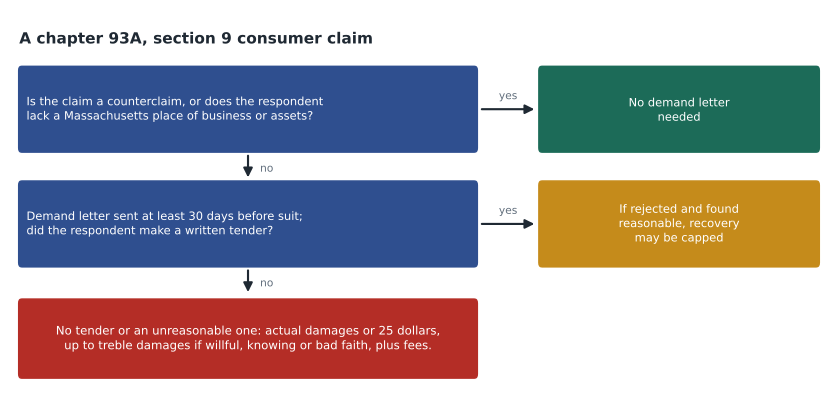
There are two main exceptions. No demand letter is required if the claim is asserted as a counterclaim or cross-claim, for example when a tenant sued for possession raises chapter 93A against the landlord. Nor is it required if the prospective respondent does not maintain a place of business or keep assets in Massachusetts. Even in those situations, many lawyers send a letter anyway, because it starts the settlement clock and frames the dispute.
The reasonable tender
The respondent has 30 days after receiving the demand letter to make a written tender of settlement. The tender is the heart of the section 9 structure, because it shifts risk.
If the respondent makes a written tender and the claimant rejects it, and the court later finds that the tender was reasonable in relation to the injury actually suffered, the court may limit the claimant's recovery to the amount of the tender. The Commonwealth's guidance also notes that a court may deny attorney fees for work after a reasonable offer was rejected.
If the respondent makes no tender, or makes one that the court finds unreasonable, the respondent is exposed to the full range of chapter 93A remedies, including multiple damages if the refusal to grant relief was made in bad faith with knowledge or reason to know that the act complained of violated the statute.
The tender gives a well-advised business a way to cap its exposure and gives a consumer a reason to take a fair offer seriously. Lawyers on both sides spend real effort on the demand and the response, because the letters often decide the case.
Damages, multiple damages and fees
A successful section 9 claimant recovers actual damages or 25 dollars, whichever is greater. The minimum matters in cases where the deception is clear but the provable loss is small.
The court must award up to three, but not less than two, times actual damages if it finds that the violation was willful or knowing, or that the respondent's refusal to grant relief on demand was made in bad faith with knowledge or reason to know that the conduct violated the statute. The second ground, bad-faith refusal to settle, is distinctive. It means that a business can face multiple damages not only for the original conduct but for its response to the demand letter.
A successful claimant is also entitled to reasonable attorney fees and costs. Fee-shifting is what makes many small chapter 93A claims practical to bring, because the fees can exceed the damages.
Section 11 business claims follow a similar pattern, with actual damages and double or treble damages for willful or knowing violations, plus fees, but without the demand letter, the 25 dollar minimum or the bad-faith-refusal ground for multiplication.
The limitation period
Chapter 93A claims are governed by a four-year limitation period under G.L. c. 260, section 5A, longer than the three years that applies to most tort claims. Massachusetts courts apply a discovery rule to accrual in appropriate cases. A lawyer evaluating an old tort or contract dispute should ask whether a chapter 93A claim survives after other claims are time-barred.
Declan's used car case
The first chapter 93A matter Declan worked on from start to finish was a used car case. His client, a nursing student, bought a seven-year-old sedan from a small dealer for 9,800 dollars. The dealer's advertisement and the sales representative both described the car as accident-free. Three weeks later, a mechanic told her the frame had been repaired after a serious collision, and a vehicle history report confirmed a prior accident. She wanted to return the car.
Declan's analysis followed the statute. The dealer was in trade or commerce. Describing a car as accident-free when it had been in a serious collision was a deceptive practice, and the Attorney General's motor vehicle regulations specifically address misrepresentations about a vehicle's condition and history. The client's injury was the difference between what she paid and what the car was worth, plus repair and inspection costs.
He drafted the demand letter for Tobin's review. It gave the client's name and address; described the advertisement, the oral statements, the purchase date and the mechanic's findings; attached the history report and the mechanic's written estimate; stated the injury; and demanded rescission, a full refund on return of the car and reimbursement of 450 dollars in inspection costs. It went by certified mail and regular mail on a date the firm recorded.
Twenty-six days later, the dealer's lawyer sent a written tender offering to take the car back and refund 8,500 dollars. Declan and Tobin discussed it with the client. The offer was 1,750 dollars short of a full refund and costs, so they explained the risk: if a court later found the offer reasonable, her recovery could be limited to it. They also explained the other side: if the court found the offer unreasonable and the dealer's conduct knowing, the dealer could owe double or treble damages plus attorney fees. The client decided to make a counteroffer, and the dealer accepted a full refund of the purchase price plus costs within a week.
Tobin's comment afterward was short. 'That is what the demand letter is for. Most 93A cases are won or lost before anyone files a complaint.'
Common mistakes
MistakeFiling a consumer 93A complaint without a demand letter.
InsteadSection 9 requires a written demand at least 30 days before suit, unless an exception applies.
MistakeIgnoring a written tender of settlement.
InsteadIf the court later finds a rejected tender reasonable, recovery may be limited to the tender.
MistakeTreating every breach of contract as a 93A violation.
InsteadOrdinary breach, without deception or similar unfair conduct, is generally not enough.
MistakeApplying 93A to a private homeowner selling a house.
InsteadThe statute reaches only conduct in trade or commerce, as Lantner v. Carson held.
MistakeUsing the three-year tort period.
InsteadChapter 93A claims have a four-year limitation period under c. 260, section 5A.
Practice problems
Work each problem on paper first, then reveal the answer to check.
How long before filing suit must a section 9 demand letter be sent?
Show answer
At least 30 days.
Name the two main exceptions to the demand letter requirement.
Show answer
A counterclaim or cross-claim, and a respondent with no place of business or assets in Massachusetts.
When must a court award multiple damages under section 9?
Show answer
When the violation was willful or knowing, or the refusal to grant relief on demand was in bad faith with knowledge or reason to know of the violation; the award is two to three times actual damages.
What is the minimum recovery under section 9?
Show answer
25 dollars, if actual damages are less.
Responding to a demand letter
Declan also saw chapter 93A from the other side when a small business client, a heating oil company, received a demand letter from a customer who claimed she had been overcharged. Tobin walked him through the response. First, calendar the 30-day deadline from the date of receipt. Second, investigate quickly: pull the delivery records, the price terms and the customer's account history. Third, decide whether there is any merit to the claim. If there is, make a written tender that is reasonable in relation to the actual injury, because a reasonable tender limits exposure even if the customer rejects it. If there is not, say so in a measured written response that explains why, since a refusal made in good faith on a reasonable view of the facts is not a bad-faith refusal.
In the heating oil case, the records showed that the customer had been billed at the wrong price for two deliveries, a total overcharge of 186 dollars. The company tendered a refund of the overcharge plus a modest amount for the customer's time and a corrected account statement within three weeks. The customer accepted. 'A business that answers a demand letter carefully almost never ends up paying treble damages,' Tobin said.
Summary and key terms
- Chapter 93A, section 2 prohibits unfair or deceptive acts in trade or commerce, guided by FTC Act interpretations and the Attorney General's 940 CMR regulations.
- Section 9 gives consumers a claim; section 11 gives businesses one; section 4 empowers the Attorney General.
- Consumers must send a 30-day demand letter before most suits; the respondent may make a written tender of settlement within 30 days.
- A rejected reasonable tender can cap recovery; willful or knowing violations or bad-faith refusals bring two to three times damages, plus attorney fees.
- The limitation period is four years under c. 260, section 5A.
- Chapter 93A
- The Massachusetts Consumer Protection Act, G.L. c. 93A.
- Demand letter
- The written demand for relief that section 9 requires at least 30 days before suit.
- Tender of settlement
- The respondent's written settlement offer within 30 days of the demand.
- Multiple damages
- Double or treble actual damages for willful or knowing violations or bad-faith refusals.
- 940 CMR
- The Attorney General's consumer protection regulations.
- Chapter 176D
- The insurance unfair claims settlement practices statute, enforced by consumers through chapter 93A.
Lesson quiz · 5 questions
Score 60% or more to complete this lesson.
Create a free account to save your progress, take quizzes and earn a certificate.