
BAR-222 · Lesson 2 of 12 · 17 min
Eligibility, education, deadlines and fees
▶ Video coming soon A video version of this lesson is on the way.
Declan's first real task in the study group was not a practice essay. It was a checklist. Marchetti asked him to show, line by line, that he met every eligibility requirement in Rule 3:01, to find the filing window for the February 2027 exam, and to price the whole process. 'Nobody fails the bar exam because of a missing transcript,' she said, 'but people do miss the exam because of one.'
This lesson covers the education rules, the petition and its filing periods, the recommendation letters, the fees and the practical arrangements for exam day.
The education requirement
Section 3 of Rule 3:01 sets the education requirement for admission by examination. A petitioner must have a bachelor's degree, or its equivalent, and a law degree, either a Juris Doctor or a Bachelor of Laws, from a law school that is approved by the American Bar Association or authorized by statute of the Commonwealth to grant a law degree.
Two points deserve attention. First, the bachelor's degree is a separate requirement. Most American law students have one, but a candidate who entered law school through an unusual route should confirm that the board will treat their prior education as equivalent. Second, the statutory authorization clause means that a graduate of a Massachusetts law school that is not ABA-approved but holds degree-granting authority under Massachusetts law may sit for the exam in Massachusetts. That route matters for a small number of graduates each year. Such a graduate should know that other jurisdictions may not accept the same degree, and that the Massachusetts eligibility page for UBE score transfer, discussed in Lesson 11, refers to graduation from an ABA-accredited law school.
Massachusetts does not offer a law office study route. A candidate cannot qualify by reading law in a lawyer's office instead of attending law school.
Foreign-educated lawyers
A petitioner whose legal education was completed outside the United States must show the board that the education is the equivalent of the education the rule requires. The board decides that question case by case, on the petitioner's transcripts and other records, before the petitioner may file for the exam. The process takes months, not weeks, and the board's guidance warns foreign-educated petitioners to begin well before the filing period for the exam they want to take. Many foreign-educated lawyers complete an LLM at an ABA-approved law school, but an LLM alone does not guarantee eligibility; the board's determination does.
Marchetti mentioned Ngozi Adeyemi, a member of the Tuesday group who qualified in Nigeria and is sitting for the New York exam. 'Every state handles foreign education differently,' she said. 'New York has its own rule. Massachusetts has its own determination. Never assume that a degree accepted in one state will be accepted in another.'
The petition for admission
In Massachusetts, a candidate asks to sit for the exam and to be admitted in a single filing, the petition for admission. Petitions are filed online through the board's system. The petition asks about education, residence and employment history, prior bar admissions, academic and professional discipline, criminal and traffic matters, civil litigation, financial obligations and other matters bearing on character and fitness, which Lesson 3 covers.
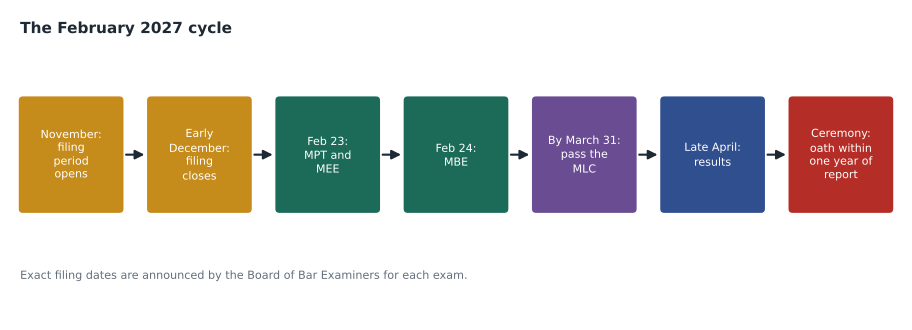
The petition must be filed at least 75 days before the exam, and only during the filing period the board announces for that exam. In recent cycles the filing period for the July exam has run from about mid-March to early May, and the period for the February exam from November to early December. The board publishes the exact opening and closing dates for each exam on its website. A petition filed outside the period is not accepted for that exam.
Declan noticed a practical consequence. The February filing period opens after the July results come out in late October. A July taker who does not pass has only a few weeks to decide whether to retake in February and to file a new petition. Massachusetts places no limit on the number of times a candidate may sit, but each sitting requires its own timely petition and fee.
Recommendation letters
An exam petition must be supported by letters of recommendation, two for admission by examination. The petition instructions say who may write them and how they must be submitted. The letters are part of the character and fitness file, so the writers should know the petitioner well and be willing to say so in concrete terms. Petitions on motion require more, three letters, which reflects the longer professional record of an experienced lawyer.
Declan chose his clinic supervisor, who watched him handle consumer intake interviews for a year, and his managing partner, who has seen his work since May. Marchetti approved both choices and gave one piece of advice: ask early, give the writer a short summary of your history, and follow up politely. A letter submitted late can hold up an otherwise complete file.
Fees
Massachusetts fees are set by the board and change from time to time. As of November 2026, the main fees are these.
| Item | Fee (dollars) | Notes |
|---|---|---|
| Petition for admission by examination | 815 | Paid with each petition, including retakes |
| Laptop use on the written portion | 175 | Optional; for candidates who type the MEE and MPT |
| Petition for admission by UBE or NextGen score transfer | 815 | Score must be 270 UBE or 620 NextGen, earned within five years |
| Petition for admission on motion | 1,015 | Experienced lawyers; see Lesson 11 |
| Massachusetts Law Component | No fee | Online; may be retaken |
| MPRE | Paid to NCBE | Separate registration and fee |
Fees are generally nonrefundable. A candidate who withdraws after filing usually forfeits the fee and must file again for a later exam. Marchetti suggested that Declan budget for one retake, not because she expected him to need it, but because a budget that assumes success can turn a disappointing result into a financial crisis as well.
Accommodations and health
A candidate with a disability may request testing accommodations, such as extra time, a separate room or assistive technology. The request requires its own application with supporting documentation and has its own deadline, set well before the exam so that the board can review it and arrange space. For the current cycle, the board's deadlines are April 1 for the July exam and November 1 for the February exam. A candidate who expects to need accommodations should start gathering documentation before the filing period opens. A candidate who develops a temporary condition close to the exam should contact the board at once rather than wait for exam day.
Exam day logistics
Massachusetts gives the bar exam over two days in late February and late July. The first day, a Tuesday, is the written day: two Multistate Performance Test tasks in the morning and six Multistate Essay Examination questions in the afternoon. The second day, a Wednesday, is the Multistate Bar Examination: 200 multiple-choice questions in two sessions of 100. The board assigns each candidate to a test site; recent exams have used sites in Boston and Springfield.
Candidates who use a laptop for the written portion run the ExamSoft Examplify software, register the laptop by the board's deadline, pay the laptop fee and complete a mock exam beforehand. A candidate who does not register a laptop writes by hand. The MBE is answered on paper answer sheets.
| Exam | Dates | Format |
|---|---|---|
| February 2027 | February 23 and 24, 2027 | Legacy UBE |
| July 2027 | July 27 and 28, 2027 | Legacy UBE |
| February 2028 | February 22 and 23, 2028 | Last legacy UBE |
| July 2028 | July 25 and 26, 2028 | First NextGen exam in Massachusetts |
Results and what comes next
The board releases results in late April for the February exam and late October for the July exam, generally by posting a list of successful candidates and notifying each candidate directly. An unsuccessful candidate receives score information and may obtain copies of their essay answers for a small fee, 25 dollars in the current schedule. Reading the essays next to the released NCBE analyses is one of the most useful things a retaker can do.
A successful candidate who has also completed the Massachusetts Law Component, passed the MPRE and cleared character and fitness review is reported by the board to the Supreme Judicial Court. The court holds admission ceremonies, usually in June and November, in Boston and other locations. Under Rule 3:01, a petitioner must take the oath within one year after the board reports them for admission; a petitioner who lets that year run out must begin again.
Declan's checklist
By the end of the session, Declan's single page read like this. Bachelor's degree, 2023, confirmed. Juris Doctor, May 2026, ABA-approved law school, confirmed with his registrar's certification. Petition for the February 2027 exam filed November 9, 2026, inside the filing period, with the 815 dollar fee. Laptop registered, 175 dollars, mock exam on the calendar for January. Two recommendation letters requested in October and submitted. MPRE score of 98, transferred to Massachusetts. No accommodation request needed. Exam February 23 and 24, 2027, at the site the board assigns. Massachusetts Law Component after the exam, deadline March 31. Results expected late April.
Marchetti added the budget line: 990 dollars to the board so far, plus the MPRE fee already paid to NCBE, travel to the test site, and a cushion for a possible July 2027 petition. 'Now you know what it costs and when it is due,' she said. 'That is half the anxiety gone.'
Common mistakes
MistakeAssuming any law degree will do.
InsteadRule 3:01 requires a JD or LLB from an ABA-approved school or a school authorized by Massachusetts statute, plus a bachelor's degree.
MistakeFiling a petition on the last day without checking that the letters have arrived.
InsteadFile early in the window and confirm that both recommendation letters are in the file.
MistakeAssuming a foreign LLM makes a candidate eligible.
InsteadThe board must find the foreign education equivalent before the candidate can file, and the review takes months.
MistakeLetting the oath deadline slip.
InsteadA reported petitioner must be sworn in within one year or begin again.
Practice problems
Work each problem on paper first, then reveal the answer to check.
How many days before the exam must a Massachusetts petition be filed?
Show answer
At least 75 days, during the filing period the board announces.
What is the petition fee for admission by examination?
Show answer
815 dollars, as of November 2026.
On what days of the week is the Massachusetts exam given, and what is on each?
Show answer
Tuesday: MPT and MEE. Wednesday: MBE.
Is there a limit on the number of times a candidate may sit in Massachusetts?
Show answer
No, but each sitting requires a new timely petition and fee.
Special situations
A few candidates each cycle face a situation the ordinary checklist does not cover. Marchetti walked Declan through the common ones so that he would recognize them in friends and, later, in clients.
A candidate who changes exams. A petitioner who files for the February exam and then cannot sit, because of illness, a family emergency or a job change, should contact the board before the exam rather than simply fail to appear. The board's rules and announcements govern whether a fee can be applied to a later exam. A candidate who does not appear without arranging anything is treated as having withdrawn and generally must file a new petition and pay again.
A candidate admitted elsewhere who chooses to sit. A lawyer admitted in another state who does not qualify for admission on motion, perhaps because of too few years in practice, may sit for the Massachusetts exam on the same terms as a new graduate. Such a lawyer also discloses the prior admission and any discipline on the petition and arranges for certificates of good standing.
A candidate with a pending criminal or disciplinary matter. A petitioner who is facing a criminal charge, a school disciplinary proceeding or a professional complaint while the petition is pending must disclose it and update the board as it develops. The board may defer action until the matter is resolved.
A candidate who needs to finish a degree. A petitioner must meet the education requirement before admission; a petition filed in the final semester of law school depends on the school certifying graduation. A candidate whose graduation slips should tell the board at once.
Building a calendar backward
Marchetti's favorite planning exercise is to start at the oath and work backward. For Declan, a November 2027 admission ceremony would require the board's report to the court beforehand, which requires the exam result in late April, the MLC by March 31, the MPRE score on file, and character and fitness clearance, which requires a current petition and prompt answers to the board's questions. Each of those dates depends on something earlier. Working backward shows which steps have slack and which do not. In Declan's case the only step with no slack at all was the filing period itself: miss it, and the whole timeline moves by six months.
She added one more practical tip. Put every deadline in two places, a paper calendar and a phone reminder set a week early, and tell one other person about the dates that matter most. 'The point is not that you will forget,' she said. 'The point is that you will be tired, and tired people need help remembering.'
Summary and key terms
- Rule 3:01 requires a bachelor's degree and a JD or LLB from an ABA-approved school or a school authorized by Massachusetts statute.
- Foreign-educated candidates need the board's equivalency determination before filing.
- Petitions are filed online at least 75 days before the exam, during the announced filing period, with two letters of recommendation.
- The exam petition fee is 815 dollars and the laptop fee 175 dollars; the MLC is free.
- Results come in late April and late October; reported petitioners must be sworn in within one year.
- Filing period
- The window announced by the board during which petitions for a given exam may be filed.
- Letters of recommendation
- Statements supporting a petition; two for examination, three for motion.
- Equivalency determination
- The board's finding that a foreign legal education satisfies Rule 3:01.
- Examplify
- The ExamSoft software used by candidates who type the written portion.
- Admission ceremony
- The court session at which reported petitioners take the oath.
Lesson quiz · 5 questions
Score 60% or more to complete this lesson.
Create a free account to save your progress, take quizzes and earn a certificate.