
BAR-222 · Lesson 1 of 12 · 18 min
Becoming a lawyer in Massachusetts
▶ Video coming soon A video version of this lesson is on the way.
Declan Sweeney joined Hollis Marchetti's Tuesday study group in the fall of 2026 with a Worcester accent, a law clerk job at a three-lawyer firm in Springfield and one firm goal: pass the Massachusetts bar exam in February 2027 and be sworn in before the end of the year. On their first call, Marchetti asked him to list every step between that day and his first day as a licensed lawyer. Declan wrote three: file, pass, swear in. Marchetti added five more. 'The exam is the loud part,' she said. 'The petition, the letters, the MPRE, the Massachusetts Law Component and the swearing-in deadline are the quiet parts. Candidates trip over the quiet parts.'
This course follows the whole path to a Massachusetts license and then works through the Massachusetts law a new lawyer meets most often. This first lesson maps the institutions and the steps. Later lessons fill in each one.
Who admits lawyers in Massachusetts
In Massachusetts, the power to admit lawyers belongs to the Supreme Judicial Court, the oldest appellate court in continuous existence in the Western Hemisphere and the highest court of the Commonwealth. The court exercises that power through its own rules. The central one for this course is Supreme Judicial Court Rule 3:01, titled Attorneys, which sets out who may be admitted, by what routes, and on what conditions. The court amended Rule 3:01 most recently by an order dated May 27, 2026, effective July 1, 2026, so any summary printed before mid-2026 should be checked against the current text.
The court does not examine candidates itself. It acts through the Board of Bar Examiners, a body the court appoints. The board writes and administers the exam process in Massachusetts, receives petitions for admission, investigates each petitioner's character and fitness, and reports to the court on whether each petitioner should be admitted. The board's office is in the John Adams Courthouse in Boston, the same building that houses the Supreme Judicial Court. The board also publishes its own rules, which fill in the procedures that Rule 3:01 states in general terms.
After admission, a different body takes over. The Board of Bar Overseers registers lawyers every year and, through the Office of Bar Counsel, investigates and prosecutes complaints of misconduct, with the Supreme Judicial Court deciding the most serious cases. Massachusetts does not have a unified or mandatory bar association. The Massachusetts Bar Association, the Boston Bar Association and many county and specialty bar associations are voluntary organizations. A Massachusetts lawyer must register with the Board of Bar Overseers but need not join any bar association.
The routes to admission
Rule 3:01 describes three main routes into the Massachusetts bar. They share some requirements, such as good character, a passing MPRE score and the Massachusetts Law Component, and differ in how the candidate proves competence.
Admission by examination is the ordinary route for new graduates. The petitioner meets the education requirements, files a petition with the board, passes the bar exam in Massachusetts, passes the MPRE, completes the Massachusetts Law Component and satisfies the board's character and fitness review.
Admission by transfer of a Uniform Bar Examination score lets a candidate who earned a qualifying UBE score in another jurisdiction petition in Massachusetts without sitting again. The score must be 270 or higher and must have been earned within five years, and since the July 2026 exam Massachusetts also accepts transferred NextGen scores of 620 or higher.
Admission on motion is for experienced lawyers. A lawyer admitted elsewhere for at least five years who has practiced or taught law for five of the past seven years may petition for admission without examination. Massachusetts does not require the other jurisdiction to offer reciprocity to Massachusetts lawyers.
Lesson 11 covers transfer and motion in detail, along with the practice rules that apply once a lawyer is admitted.
| Route | Who it is for | Key requirements |
|---|---|---|
| Examination | New graduates and others who sit in Massachusetts | Passing score of 270 on the UBE (620 on NextGen from July 2028), MPRE 85, MLC, character and fitness |
| UBE or NextGen score transfer | Candidates who passed elsewhere | UBE 270 or NextGen 620, earned within five years; MPRE 85; MLC; character and fitness |
| Admission on motion | Lawyers admitted elsewhere for five or more years | Practice or teaching in five of the past seven years; MPRE 85; MLC; character and fitness |
The steps in order
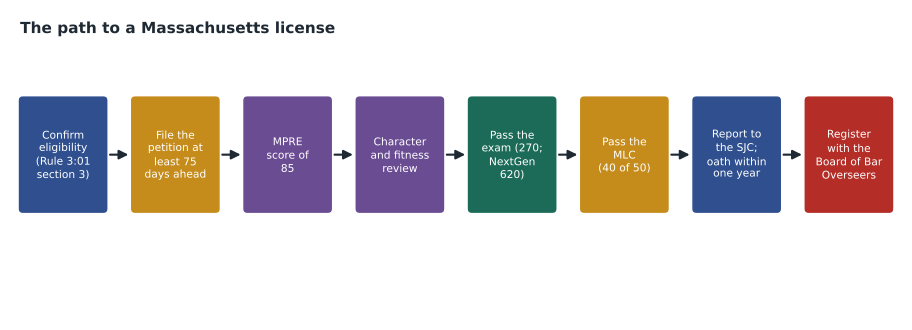
For a candidate taking the exam, the steps fall into a predictable order. Marchetti had Declan write them on one page.
First, confirm eligibility. Massachusetts requires a bachelor's degree and a law degree from a law school approved by the American Bar Association or authorized by statute of the Commonwealth to grant a law degree. Lesson 2 explains these rules and the separate path for foreign-educated lawyers.
Second, file the petition for admission during the filing period for the exam you plan to take. Massachusetts petitions are filed online and must be filed at least 75 days before the exam. The board publishes the exact filing window for each exam, typically from mid-March to early May for July and from November to early December for February. Each petition needs letters of recommendation and the fee.
Third, pass the MPRE with a scaled score of 85 or higher. Massachusetts lets candidates take the MPRE before or after the bar exam, but the score must be in hand before the board reports the petitioner to the court for admission. Lesson 3 covers the timing.
Fourth, go through character and fitness review, which begins when the petition is filed and continues until admission.
Fifth, sit for and pass the bar exam. Massachusetts gives the Uniform Bar Examination through February 2028 and switches to the NextGen bar exam in July 2028. Lessons 4 and 5 cover both.
Sixth, pass the Massachusetts Law Component, a free online test of Massachusetts law. For February examinees the completion deadline is March 31. Lesson 6 explains it.
Seventh, be reported to the court and take the oath. Massachusetts holds admission ceremonies, and a petitioner who has been reported for admission must be sworn in within one year.
Finally, register with the Board of Bar Overseers and begin practice. Massachusetts has no mandatory continuing legal education, and since August 14, 2024 it no longer requires newly admitted lawyers to complete the Practicing with Professionalism course.
Declan's timeline
Declan took the MPRE in March 2026 and scored 98, comfortably above Massachusetts's 85. He filed his petition for the February 2027 exam on November 9, 2026, near the start of the filing period, with two letters of recommendation, one from a professor who supervised his consumer law clinic and one from the managing partner of his Springfield firm. His character and fitness review was under way by the end of November. He will sit for the UBE on February 23 and 24, 2027. If all goes to plan, he will take the Massachusetts Law Component after the exam, well before March 31, receive results in late April and be sworn in at a ceremony later in 2027.
Marchetti pointed out what Declan's plan has going for it. February 2027 is not the last legacy UBE in Massachusetts. If he does not pass in February, he has two more chances to sit for the format he has prepared for, in July 2027 and February 2028, before the switch to NextGen. 'That is a cushion,' Marchetti said, 'not a plan. Prepare as if February is the only date.'
What Massachusetts law will matter
The Massachusetts bar exam is a national exam, so Massachusetts law is not tested on it directly. The essays and multiple-choice questions test general principles of American law, not the Massachusetts version. But Massachusetts law matters in three ways. It is the subject of the Massachusetts Law Component. It is the law a new Massachusetts lawyer must actually practice, and it differs from the general rules the UBE tests in places that trap the unwary. And it is the law Massachusetts clients and judges expect a Massachusetts lawyer to know on day one.
The second half of this course is organized around the differences that matter most in early practice.
Courts and civil procedure. Massachusetts has a single Trial Court with seven departments, an intermediate Appeals Court and the Supreme Judicial Court. The Massachusetts Rules of Civil Procedure track the federal rules closely, but Superior Court motion practice runs on its own Rule 9A, and Massachusetts has no codified rules of evidence. Lesson 7.
Torts. Massachusetts uses modified comparative negligence under General Laws chapter 231, section 85: a plaintiff whose negligence is greater than the defendants' combined negligence recovers nothing. Claims against public employers run through the Massachusetts Tort Claims Act, chapter 258, with its presentment requirement and a 100,000 dollar cap. Lesson 8.
Consumer protection. Chapter 93A, the Massachusetts Consumer Protection Act, prohibits unfair and deceptive acts in trade or commerce, requires a 30-day demand letter before most consumer suits, and allows double or treble damages and attorney fees. It reaches into almost every area of Massachusetts practice. Lesson 9.
Property, family and estates. Massachusetts tenancy by the entirety, the Alimony Reform Act of 2011, equitable division of all property of either spouse, and the Massachusetts Uniform Probate Code. Lesson 10.
Professional conduct. The Massachusetts Rules of Professional Conduct follow the ABA Model Rules in structure but differ in places a new lawyer feels at once, such as written fee terms and contingent fee agreements. Lesson 11.
A note on reading the rules yourself
Marchetti's first assignment for every new member is the same: find the jurisdiction's admission rule and read it. For Massachusetts, that means Supreme Judicial Court Rule 3:01 and the Rules of the Board of Bar Examiners, both published on the Commonwealth's website, together with the board's announcements. Bar-prep summaries, law school handouts and the national charts compiled by NCBE are useful starting points, but they lag behind the rules, and the rules control.
She also taught Declan to read an amendment the way a lawyer reads a statute. Start with the date the court entered the order and the date it takes effect, which are often different. The May 27, 2026 amendment to Rule 3:01, for example, took effect July 1, 2026. Then find each section it changes and compare the new text with the old. Finally, check whether a later announcement has changed the same rule again. When Declan found one board web page that described the age limit for a transferred UBE score as 36 months while the board's eligibility page and the rule itself said five years, Marchetti told him to treat the rule as controlling and to ask the board in writing if the difference ever mattered to him.
Keeping records
Every step on the path generates paper, and the board expects petitioners to keep track of it. Declan set up one folder with his petition confirmation, his MPRE score report, his fee receipts, copies of his recommendation letters and every message from the board. Marchetti added one habit: when a rule or deadline matters, save a copy of the page as it read on the day you relied on it. A dated copy is far more persuasive than a memory of what a website once said.
Petitioners must also keep their petitions current. A change of address, a new job, a new traffic citation or any other event that would change an answer on the petition must be reported to the board while the petition is pending. The same discipline carries into practice: the Board of Bar Overseers expects every registered lawyer to keep contact details current and to register on time each year.
Where help comes from
Declan's law school runs a bar support program for graduates, and the board's staff answer procedural questions by phone and email. Lawyers Concerned for Lawyers, the Massachusetts lawyer assistance program, offers confidential help with stress, mental health and substance use to law students, bar applicants and lawyers. Marchetti's view is that asking a procedural question early costs nothing, while guessing wrong about a deadline can cost a full exam cycle.
Common mistakes
MistakeAssuming the Massachusetts Bar Association admits lawyers.
InsteadThe Supreme Judicial Court admits lawyers; the Board of Bar Examiners handles petitions, the exam and character review; the Massachusetts Bar Association is voluntary.
MistakeAssuming the MPRE must be passed before the bar exam.
InsteadMassachusetts accepts the MPRE before or after the bar exam, but the score of 85 must be in hand before the board reports the petitioner for admission.
MistakeTreating the exam result as the last step.
InsteadThe Massachusetts Law Component, character and fitness clearance and the oath all remain, and a reported petitioner must be sworn in within one year.
MistakePlanning around a Practicing with Professionalism course.
InsteadThe Supreme Judicial Court repealed Rule 3:16 effective August 14, 2024; Massachusetts has no mandatory CLE or new-lawyer course.
Practice problems
Work each problem on paper first, then reveal the answer to check.
Which body has the final authority to admit lawyers in Massachusetts?
Show answer
The Supreme Judicial Court, acting on reports from the Board of Bar Examiners.
Which court rule governs admission, and when did its latest amendment take effect?
Show answer
SJC Rule 3:01; the amendment dated May 27, 2026 took effect July 1, 2026.
Which body registers and disciplines lawyers after admission?
Show answer
The Board of Bar Overseers, with the Office of Bar Counsel prosecuting complaints.
When is the last legacy UBE in Massachusetts?
Show answer
February 2028; NextGen begins in July 2028.
How this course fits with national bar preparation
Most of Declan's study hours go to the national subjects, and that is right: the UBE is a national exam, and a commercial course or a self-study plan built on released NCBE materials covers what it tests. This course does not repeat that work. It supplies the Massachusetts layer that national preparation leaves out: the admission rules, the deadlines, the Massachusetts Law Component and the local law that a Springfield or Boston client will expect a new lawyer to know. Marchetti suggested that Declan spend about one evening a week on the Massachusetts material through the fall and winter, then set it aside in the final three weeks before the exam, when every hour belongs to the MBE, the MEE and the MPT. After the exam, the Massachusetts material returns to the front, first for the Massachusetts Law Component and then for practice itself.
Summary and key terms
- The Supreme Judicial Court controls admission through SJC Rule 3:01; the Board of Bar Examiners administers petitions, the exam and character and fitness review.
- There are three main routes: examination, UBE or NextGen score transfer, and admission on motion.
- Every route requires an MPRE score of 85, the Massachusetts Law Component and character and fitness clearance.
- Massachusetts gives the UBE through February 2028 and NextGen from July 2028.
- After admission, lawyers register with the Board of Bar Overseers; there is no mandatory bar association and no mandatory CLE.
- Supreme Judicial Court
- The highest court of Massachusetts, which admits and disciplines lawyers.
- SJC Rule 3:01
- The Supreme Judicial Court rule that governs admission to the Massachusetts bar.
- Board of Bar Examiners
- The court-appointed board that handles petitions for admission, the bar exam and character and fitness review.
- Board of Bar Overseers
- The body that registers Massachusetts lawyers and, through the Office of Bar Counsel, handles discipline.
- Petition for admission
- The filing by which a candidate asks to be admitted by examination, score transfer or motion.
Lesson quiz · 5 questions
Score 60% or more to complete this lesson.
Create a free account to save your progress, take quizzes and earn a certificate.