
BAR-222 · Lesson 5 of 12 · 23 min
Exam changes ahead: the last legacy UBE in February 2028 and NextGen in July 2028
▶ Video coming soon A video version of this lesson is on the way.
Marcus Bell, the Missouri member of the Tuesday group, took the first NextGen bar exam in July 2026 and passed. When Declan asked him what it was like, Marcus described a test that felt closer to a day at work than any exam he had taken in law school: fewer pure memory questions, more documents to read, more questions that asked what a lawyer should do next. Declan's own exam, in February 2027, will be the legacy UBE. But he is planning to practice in Massachusetts for a long time, and some of the lawyers he will supervise one day will be admitted on the new exam. Marchetti thought he should understand both.
This lesson explains Massachusetts's move from the legacy UBE to the NextGen bar exam: the dates, the new passing score, what the new exam tests, how candidates near the change should plan, and what does not change.
The decision and the dates
NCBE has been developing the NextGen bar exam since its Testing Task Force recommended a new exam in 2021. The new exam debuted nationally in July 2026, and NCBE plans to retire the legacy UBE components after the transition years.
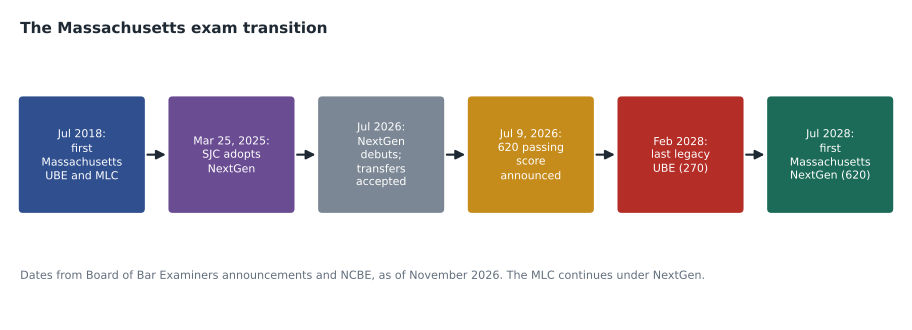
Massachusetts announced its decision on March 25, 2025: the Supreme Judicial Court adopted the NextGen bar exam effective with the July 2028 administration. The announcement said that Massachusetts would continue to require a Massachusetts-specific law component and that scores from the new exam would be portable to other jurisdictions, as UBE scores are now.
That gives Massachusetts candidates a clear timeline. The legacy UBE continues through the February 2028 exam. The first NextGen exam in Massachusetts will be given in July 2028. Massachusetts accepts transferred NextGen scores from other jurisdictions already, beginning with scores from the July 2026 exam.
The new passing score
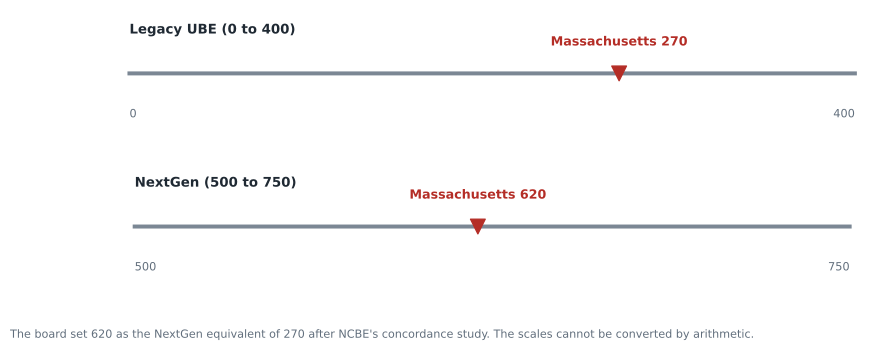
On July 9, 2026, the Massachusetts Board of Bar Examiners announced the passing score for the NextGen exam: 620. NextGen scores are reported on a new scale that runs from 500 to 750, so 620 is not comparable to 270 by simple arithmetic. NCBE conducted a concordance study linking performance on the two exams, and the board explained that 620 on the NextGen scale represents performance equivalent to 270 on the legacy UBE. In other words, Massachusetts intends the new exam to demand the same level of competence as the old one.
The same 620 applies to NextGen scores transferred from other jurisdictions. A candidate who earned 620 or more on NextGen elsewhere, within the five-year window, may petition for admission by score transfer in Massachusetts, subject to the other requirements discussed in Lesson 11.
What NextGen tests
The NextGen exam is built around two kinds of content, which NCBE calls foundational concepts and principles and foundational skills.
The foundational concepts and principles are the legal knowledge a newly licensed lawyer needs. The subjects are business associations, civil procedure, constitutional law, contract law, criminal law and constitutional protections of the accused, evidence, family law, real property and torts. Compared with the legacy UBE, the list adds family law to the subjects tested in a structured way and drops several subjects that the MEE can test now, including conflict of laws, secured transactions, and trusts and estates. NCBE also narrowed the depth at which some topics are tested, aiming at what a new lawyer must know without looking it up.
The foundational skills are the lawyering abilities the exam tests directly: legal research, legal writing, issue spotting and analysis, investigation and evaluation, client counseling and advising, negotiation and dispute resolution, and client relationship and management. The legacy MPT tests some of these skills. NextGen tests them more widely, and it tests them together with the law rather than in a separate component.
The question formats
NextGen uses three main formats, all delivered on computer.
Standalone multiple-choice questions look somewhat like MBE questions. Some have one correct answer among four choices; others ask the candidate to select two or more correct answers.
Integrated question sets present a common fact pattern, often with documents such as a contract, an email or a police report, followed by several questions. The questions may be multiple choice or short written answers, and they may test both law and skills, for example asking which fact a lawyer should investigate next, or how a lawyer should answer a client's question.
Performance tasks are longer written exercises, in the tradition of the MPT, in which the candidate works with a file and a library and produces a piece of legal writing. NextGen performance tasks also test legal research skills by asking candidates to find and use the relevant authority within the materials.
The exam is shorter overall than the legacy UBE and is scored as a single exam rather than as three separately scaled components. Each candidate receives one scaled score.
| Feature | Legacy UBE (through February 2028) | NextGen (from July 2028) |
|---|---|---|
| Components | MBE, MEE, MPT | Single integrated exam |
| Question types | Multiple choice, essays, performance tests | Multiple choice, integrated sets with short answers, performance tasks |
| Delivery | Paper MBE; laptop or handwritten essays | Computer-based |
| Subjects | Seven MBE subjects plus five additional MEE subjects | Nine foundational subjects, including family law |
| Score scale | 0 to 400 | 500 to 750 |
| Massachusetts passing score | 270 | 620 |
| Massachusetts Law Component | Required | Required |
What does not change
Several things stay the same across the transition. The Supreme Judicial Court still admits lawyers, and the Board of Bar Examiners still administers the process. Candidates still file a petition during the announced filing period, still need an MPRE score of 85, and still go through character and fitness review. The Massachusetts Law Component continues. NCBE's comprehensive guide charts list Massachusetts among the jurisdictions that will keep a jurisdiction-specific component with NextGen, and the board's announcements say the same.
Scores remain portable. A NextGen score earned in Massachusetts can be transferred to other jurisdictions that accept NextGen scores, subject to their own passing scores and time limits, just as UBE scores can now.
Planning near the change
The Massachusetts schedule gives candidates more room than some other jurisdictions. Declan, sitting in February 2027, has two further legacy chances, in July 2027 and February 2028, before NextGen arrives. A candidate who graduates in May 2027 has the July 2027 and February 2028 legacy exams available. A candidate graduating in May 2028 will most likely sit for NextGen in July 2028.
Marchetti's advice for candidates near the change is built on three ideas.
Prepare for the exam you will actually take. A candidate sitting for the legacy UBE in 2027 should not spend time on NextGen formats. A candidate sitting for NextGen in July 2028 should use NCBE's NextGen study aids and sample questions, not old MEE outlines for subjects the new exam does not test.
Think about the second attempt. A candidate who plans to sit in February 2028, the last legacy exam, should know that a retake would be on NextGen. Such a candidate might choose to sit earlier, in July 2027, so that a second legacy attempt remains available. Or the candidate might decide that sitting for NextGen first is the better option. There is no universal answer, but there should be a deliberate one.
Use the transferable skills. The legal knowledge tested on both exams overlaps heavily. Rule statements in civil procedure, contracts, evidence, real property and torts carry over, and the skills the MPT rewards, such as reading a file carefully and organizing a memo, are exactly the skills NextGen performance tasks test.
Lessons from the first NextGen administrations
Marcus told the group what he took from his July 2026 experience. Reading speed mattered more than he expected, because the integrated sets came with documents to read. The multiple-select questions rewarded precision, since a partly right answer could earn less credit than a fully right one. And the performance tasks rewarded the same habits the MPT does: read the call, read the file, find the law in the library, and write what was asked for, in the form asked for. He thought his law school's clinic work had helped more than any outline.
Marchetti added a caution. Early administrations of a new exam always come with unknowns: how the scales settle, how much time candidates need, how quickly preparation materials mature. Massachusetts candidates have the advantage of watching two years of NextGen administrations in other jurisdictions before the exam arrives in July 2028. They should use those two years by reading NCBE's reports and the sample materials as they are released, rather than relying on rumors.
Common mistakes
MistakeComparing 620 and 270 by arithmetic.
InsteadThe scales are different; 620 on NextGen is the Massachusetts equivalent of 270 on the UBE, set through a concordance study.
MistakeAssuming the MLC ends with NextGen.
InsteadMassachusetts will continue to require its Massachusetts-specific law component.
MistakeStudying old MEE topics for a NextGen exam.
InsteadNextGen drops several MEE subjects, including conflict of laws, secured transactions, and trusts and estates.
MistakePlanning a February 2028 first attempt without thinking about a retake.
InsteadA retake after February 2028 would be on NextGen.
Practice problems
Work each problem on paper first, then reveal the answer to check.
When did the Supreme Judicial Court announce its adoption of NextGen?
Show answer
March 25, 2025.
When is the last legacy UBE in Massachusetts?
Show answer
February 2028.
What is the Massachusetts NextGen passing score, and when was it announced?
Show answer
620, announced July 9, 2026.
From which exam does Massachusetts accept transferred NextGen scores?
Show answer
Beginning with the July 2026 exam, at 620 or higher.
Three candidates near the change
Marchetti likes to make planning concrete with hypothetical candidates. She gave the group three.
Worked problem
Ana, graduating May 2027
Ana will graduate from law school in May 2027 and wants to practice in Massachusetts. Which exam should she plan for?
Show solution
- Her first natural exam is July 2027, a legacy UBE.
- If she does not pass, she can retake in February 2028, also a legacy UBE.
- A third attempt, if ever needed, would be NextGen in July 2028.
Answer: Ana should prepare for the legacy UBE in July 2027, knowing that she has one legacy retake available.
Worked problem
Ben, graduating December 2027
Ben will finish law school in December 2027. Which exam should he plan for?
Show solution
- His first available exam is February 2028, the last legacy UBE.
- A retake would be on NextGen in July 2028, with different formats.
- He could instead wait and take NextGen first in July 2028.
Answer: Ben has a real choice. If he sits in February 2028, he should prepare as if there is no second chance on that format. If he prefers to prepare once for the format he would retake on, July 2028 NextGen is a reasonable plan.
Worked problem
Cal, a transfer candidate
Cal earned 625 on NextGen in another state in July 2026. Can he transfer the score into Massachusetts?
Show solution
- Massachusetts accepts transferred NextGen scores beginning with the July 2026 exam.
- The score must be 620 or more and earned within five years.
- He must also meet the MPRE, MLC, education and character requirements.
Answer: Yes, if he petitions within five years and meets the other requirements.
Resources to watch
The most reliable sources on the transition are the board's announcements on the Commonwealth's website, NCBE's NextGen pages and its annual comprehensive guide to bar admission requirements, and the text of Rule 3:01 itself. Commercial courses will update their materials as the date approaches, but the official sources come first.
How NextGen changes study habits
The biggest practical change for future Massachusetts candidates is the way they will study. Legacy preparation leans on memorizing long outlines for twelve subjects and then practicing essays and multiple-choice questions. NextGen preparation still requires rule knowledge, but the narrower subject list and the emphasis on skills shift the balance. Candidates will spend more time reading realistic documents under time pressure, choosing the next step in a client matter, and writing short, precise answers to focused questions. Law school courses that involve drafting, client interviewing and research, such as clinics, externships and legal writing, become more directly useful.
Marcus put it in terms Declan understood. 'On the old exam, you show that you know the rule. On the new exam, you show that you know what to do with it, often before anyone tells you which rule is in play.' Marchetti added that the habits are not opposites. A candidate who has practiced issue spotting on MEE questions and organizing MPT answers has already built many NextGen skills.
What employers should know
Massachusetts employers will hire lawyers admitted on both formats for several years. A score of 270 on the UBE and a score of 620 on NextGen are intended to represent the same standard, so a hiring partner should not treat one as stronger than the other. What may differ is experience with particular tasks: a NextGen-admitted lawyer will have been tested directly on skills such as client counseling and research, while a UBE-admitted lawyer will have written more full essays. Both still need the Massachusetts-specific training this course describes, starting with the MLC.
Summary and key terms
- Massachusetts adopted NextGen on March 25, 2025, effective July 2028; the legacy UBE runs through February 2028.
- The NextGen passing score is 620 on a 500 to 750 scale, announced July 9, 2026 as the equivalent of 270.
- NextGen tests nine foundational subjects, including family law, and seven foundational skills, using standalone questions, integrated sets and performance tasks.
- The MLC, the MPRE requirement and character and fitness continue unchanged.
- Candidates near the change should prepare for the exam they will take and plan for where a retake would fall.
- NextGen
- NCBE's new bar exam, first given nationally in July 2026 and in Massachusetts from July 2028.
- Concordance study
- NCBE's study linking performance on the legacy UBE and NextGen scales.
- Foundational concepts and principles
- The legal knowledge NextGen tests.
- Foundational skills
- The lawyering skills NextGen tests, such as research, writing and counseling.
- Integrated question set
- A NextGen format with a common fact pattern and documents followed by several questions.
Lesson quiz · 5 questions
Score 60% or more to complete this lesson.
Create a free account to save your progress, take quizzes and earn a certificate.