
BAR-222 · Lesson 7 of 12 · 20 min
Massachusetts courts and the Massachusetts Rules of Civil Procedure
▶ Video coming soon A video version of this lesson is on the way.
In his first week at the Springfield firm, Declan was handed a file and asked a question that sounded simple: which court? A client had been hurt when a contractor's ladder fell on her in a hardware store parking lot. Her medical bills were around 18,000 dollars, and she had missed two months of work. The managing partner, Maureen Tobin, wanted to know whether the case belonged in the District Court or the Superior Court, and how the choice would change the way the case was litigated. Declan's civil procedure course had been almost entirely federal. He had some reading to do.
This lesson maps the Massachusetts court system, then covers the Massachusetts Rules of Civil Procedure and the places where Massachusetts practice departs from the federal model, ending with a short tour of Massachusetts evidence law.
The structure of the courts
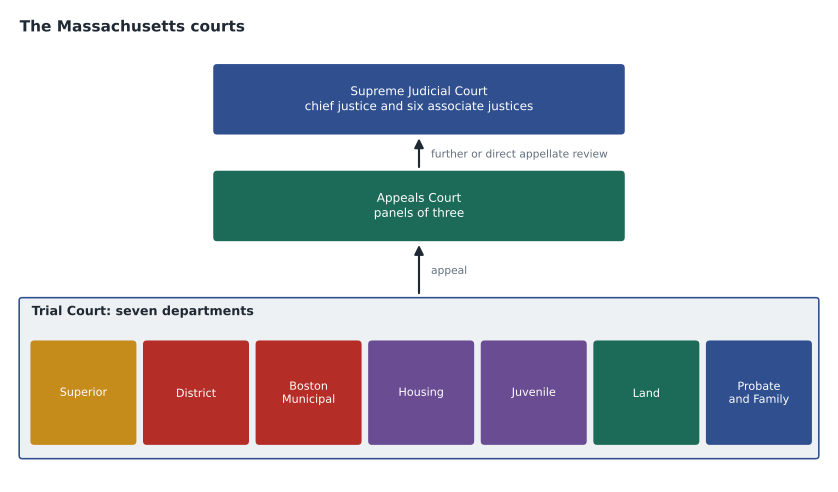
Massachusetts has three levels of courts. At the top is the Supreme Judicial Court, with a chief justice and six associate justices. In the middle is the Appeals Court, an intermediate appellate court whose justices sit in panels of three. At the base is a single Trial Court, organized into seven departments.
The seven Trial Court departments are the Superior Court, the District Court, the Boston Municipal Court, the Housing Court, the Juvenile Court, the Land Court and the Probate and Family Court. Each has its own jurisdiction, judges and rules, though all operate under the administrative leadership of the Trial Court.
| Department | Main work |
|---|---|
| Superior Court | Civil cases where recovery is reasonably likely to exceed 50,000 dollars; felonies; equitable and complex matters |
| District Court | Civil cases up to 50,000 dollars, small claims up to 7,000 dollars, misdemeanors and many felonies, in about 60 divisions |
| Boston Municipal Court | District-Court-level jurisdiction for parts of Boston |
| Housing Court | Residential landlord and tenant matters, code enforcement; statewide since 2017 |
| Juvenile Court | Delinquency, care and protection, youthful offenders |
| Land Court | Registered land, title, zoning appeals and many real property disputes |
| Probate and Family Court | Divorce, custody, support, wills, estates, guardianships |
Choosing between District Court and Superior Court
For civil damages cases, the line between the District Court and the Superior Court is a dollar amount. Since January 1, 2020, the District Court and the Boston Municipal Court have handled civil actions in which there is no reasonable likelihood that recovery will exceed 50,000 dollars, and the Superior Court has handled those in which there is. The test is the likely recovery, not the amount demanded. A plaintiff filing in Superior Court must complete a civil action cover sheet with a statement of damages that supports the claim that more than 50,000 dollars is at stake. Small claims, up to 7,000 dollars, go to the small claims session of the District Court or Boston Municipal Court, with simplified procedures.
Declan's client had 18,000 dollars in medical bills plus lost wages, pain and suffering and possibly future treatment. Tobin told him that the realistic value of the case, not the bills alone, would decide where to file, and that the firm would want a medical opinion on future care before deciding. 'If it is worth more than 50,000 dollars, we file in Superior Court. If it is not, the District Court is cheaper and faster.'
Appeals
Most civil and criminal appeals from the Trial Court go first to the Appeals Court. A party who loses in the Appeals Court may apply to the Supreme Judicial Court for further appellate review, which the court grants in a minority of cases, typically those raising important questions of law or the interests of justice. A party may also apply for direct appellate review, asking the Supreme Judicial Court to take the case directly from the Trial Court, bypassing the Appeals Court. The court grants direct review in cases raising new questions of law, constitutional questions or questions of such public interest that justice requires a final determination by the full court.
The Supreme Judicial Court also has a single justice session, often called the county court, in which one justice hears certain matters, such as bar admission and discipline matters and petitions under the court's general superintendence power. First-degree murder convictions go directly to the Supreme Judicial Court, which reviews the whole case under a special statute.
The Massachusetts Rules of Civil Procedure
The Massachusetts Rules of Civil Procedure took effect on July 1, 1974. They are modeled on the Federal Rules of Civil Procedure and use the same numbering for most rules, so a lawyer trained on the federal rules will find much that is familiar. Massachusetts courts often look to federal decisions interpreting a federal rule when the Massachusetts rule uses the same words. But the Massachusetts rules have not tracked every federal amendment, and several differences matter in practice.
Pleading. In Iannacchino v. Ford Motor Co., 451 Mass. 623 (2008), the Supreme Judicial Court adopted the plausibility standard of Bell Atlantic Corp. v. Twombly for motions to dismiss under Massachusetts Rule 12(b)(6). A complaint must allege facts that plausibly suggest, not merely are consistent with, an entitlement to relief. Iannacchino retired the older Massachusetts standard, under which a complaint survived unless the plaintiff could prove no set of facts in support of the claim.
Service. Rule 4(j) requires service within 90 days after the complaint is filed, unless the plaintiff shows good cause for the delay. The period matches the current federal rule, but the important point for a new lawyer is that Massachusetts courts enforce it, and a case can be dismissed for late service.
Answer. A defendant generally has 20 days after service to serve an answer, as under the federal rules.
Summary judgment. In Kourouvacilis v. General Motors Corp., 410 Mass. 706 (1991), the Supreme Judicial Court adopted the approach of Celotex Corp. v. Catrett: a moving party who will not bear the burden of proof at trial may win summary judgment by showing that the opposing party has no reasonable expectation of proving an essential element of its case.
Discovery. Massachusetts discovery rules resemble the federal rules, with interrogatories, document requests, requests for admission and depositions. Massachusetts limits the number of interrogatories a party may serve without leave of court, and the Superior Court requires parties to confer in good faith before bringing a discovery motion. Massachusetts has not adopted every element of the federal initial-disclosure regime.
Superior Court Rule 9A
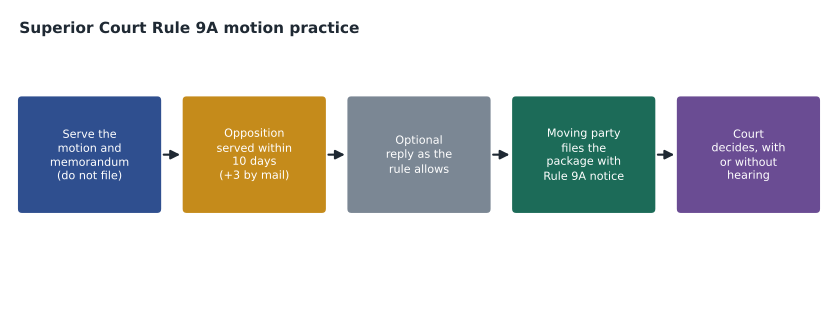
The rule that surprises new lawyers most is Superior Court Rule 9A, which governs motion practice in the Superior Court. Under Rule 9A, most motions are not filed when they are made. Instead, the moving party serves the motion and supporting papers on the other parties. The opposing party then has ten days after service, extended by three days if service is by mail, to serve an opposition. Only after the opposition period has run does the moving party file the whole package with the court: the motion, the supporting memorandum, the opposition and any reply, with a Rule 9A notice of filing listing the papers.
Rule 9A also limits the length of memoranda, requires a statement of undisputed facts in a specific format for summary judgment motions, and governs requests for hearings. The rule's purpose is to have the judge receive a complete set of papers at once. Its effect on a new lawyer is that filing a motion directly with the clerk, as one would in federal court, is usually the wrong move.
Juries
Massachusetts preserves the right to a civil jury in most actions at law. Superior Court civil juries usually have twelve members; District Court civil juries have six. In civil cases a verdict may be returned by five-sixths of the jurors rather than a unanimous jury, a Massachusetts rule that new lawyers coming from federal practice often overlook. Criminal verdicts must be unanimous.
Massachusetts evidence law
Massachusetts is one of the few states that has never adopted a code of evidence. The Massachusetts Guide to Evidence, prepared by a committee appointed by the Supreme Judicial Court and updated regularly, collects the law from statutes, rules and cases and arranges it in a format that follows the Federal Rules of Evidence. The Guide is the starting point for any Massachusetts evidence question, and its section numbers track the federal rules, which makes comparison easier.
Several Massachusetts rules differ from the federal rules on points that come up early in practice.
Character for truthfulness. Massachusetts generally permits a witness's character for truthfulness to be shown by reputation evidence, not by opinion, and it does not allow cross-examination about specific instances of untruthful conduct that did not result in a conviction to the extent federal Rule 608(b) does.
Statements of a deceased person. Under a Massachusetts statute, G.L. c. 233, section 65, a declaration of a deceased person is not excluded as hearsay if the judge finds that it was made in good faith before the action began and on the declarant's personal knowledge. There is no general federal equivalent.
Prior inconsistent statements. The federal rules admit some prior inconsistent statements as substantive evidence. Massachusetts does so more narrowly, chiefly for statements made under oath before a grand jury or at a prior proceeding under conditions the Supreme Judicial Court has set out.
Learned treatises. Massachusetts does not have a general learned-treatise exception like federal Rule 803(18), though a statute allows medical treatises to be used in medical malpractice cases under conditions.
Marchetti told Declan to treat evidence the way the MLC does: learn the federal rule for the UBE, then learn the Massachusetts differences from the Guide, and never assume that the two are the same.
Back to the ladder case
Within two weeks, Declan had a memo for Tobin. Liability looked reasonable: the contractor had left a ladder unsecured in a parking area. Damages, including a surgeon's opinion that the client might need a second procedure, made a recovery over 50,000 dollars reasonably likely, so the case should be filed in the Hampden County Superior Court. Service within 90 days would be calendared. Any motion would follow Rule 9A. And the client's own conduct, she had walked under the ladder while looking at her phone, raised a comparative negligence question that Lesson 8 takes up.
Common mistakes
MistakeChoosing the court by the amount demanded.
InsteadThe test is whether recovery is reasonably likely to exceed 50,000 dollars.
MistakeFiling a Superior Court motion directly with the clerk.
InsteadUnder Rule 9A, serve it first and file the full package after the opposition period.
MistakeAssuming the old no-set-of-facts pleading standard.
InsteadIannacchino (2008) adopted Twombly plausibility.
MistakeAssuming the Federal Rules of Evidence apply in Massachusetts courts.
InsteadUse the Massachusetts Guide to Evidence and the cases and statutes it collects.
Practice problems
Work each problem on paper first, then reveal the answer to check.
What is the dollar line between the District Court and the Superior Court for civil damages actions?
Show answer
50,000 dollars of reasonably likely recovery, since January 1, 2020.
What is the small claims limit?
Show answer
7,000 dollars.
Which case adopted the Twombly plausibility standard in Massachusetts?
Show answer
Iannacchino v. Ford Motor Co., 451 Mass. 623 (2008).
Under Rule 9A, how long does an opposing party have to serve an opposition?
Show answer
Ten days after service, plus three days if served by mail.
The specialized departments in practice
A Massachusetts litigator soon learns that the specialized departments matter as much as the general ones. The Housing Court handles residential eviction cases, known in Massachusetts as summary process, along with code enforcement and many other housing disputes, and it runs its own mediation and tenancy preservation programs. Tenants in summary process cases often raise counterclaims under chapter 93A and under the Massachusetts security deposit statute, so a landlord's lawyer must be ready for consumer claims as well as possession.
The Land Court is a court of record for registered land, the Torrens system that Massachusetts adopted in 1898, and it also hears many title disputes, zoning appeals and other property cases. A lawyer handling a boundary or easement dispute should consider whether the Land Court's expertise makes it the better forum.
The Probate and Family Court handles divorce, custody, child support, guardianship and the administration of estates under the Massachusetts Uniform Probate Code. Its procedures, including mandatory financial statements and parent education programs, are covered in its own rules and standing orders.
A worked example
Worked problem
Where does the case go?
A tenant's lawyer receives a notice to quit for nonpayment. The landlord files a summary process case. The tenant has a claim that the apartment had serious code violations and that the landlord never returned interest on the security deposit. Where is the case likely to be heard, and what claims may the tenant raise?
Show solution
- Residential summary process cases may be brought in the Housing Court, which now covers the whole state, or in certain other Trial Court departments.
- The tenant may raise defenses and counterclaims, including claims based on code violations and the security deposit statute.
- Many such counterclaims are also framed under chapter 93A.
- The tenant's lawyer should consider the Housing Court's mediation program and its procedures for transfer.
Answer: The Housing Court is the natural forum, and the tenant may bring defenses and counterclaims, including consumer protection claims, within the summary process case.
Practice notes for new litigators
Marchetti collected three habits from Massachusetts litigators she knew. Read the standing orders of the department and session where the case is pending, because many procedures live there rather than in the rules. Calendar Rule 9A dates from the day of service, not the day of filing. And when a federal case and a Massachusetts case seem to say the same thing about a rule with the same number, check whether the Massachusetts rule actually has the same text.
Summary and key terms
- Massachusetts has the Supreme Judicial Court, the Appeals Court and a Trial Court with seven departments.
- Civil damages cases go to the District Court or BMC up to 50,000 dollars of likely recovery and to the Superior Court above it; small claims go up to 7,000 dollars.
- The Massachusetts Rules of Civil Procedure, effective 1974, follow the federal rules with differences; Iannacchino and Kourouvacilis adopted Twombly and Celotex.
- Superior Court Rule 9A requires service of motions first and filing of the full package later.
- Massachusetts evidence law is uncodified and collected in the Massachusetts Guide to Evidence, with differences from the federal rules.
- Trial Court
- The single Massachusetts trial court, organized into seven departments.
- Further appellate review
- Review by the Supreme Judicial Court after a decision of the Appeals Court.
- Direct appellate review
- Review by the Supreme Judicial Court of a case taken directly from the Trial Court.
- Rule 9A
- The Superior Court rule governing service and filing of motions.
- Iannacchino v. Ford Motor Co.
- The 2008 SJC decision adopting the plausibility pleading standard.
- Kourouvacilis v. General Motors Corp.
- The 1991 SJC decision adopting the Celotex summary judgment approach.
Lesson quiz · 5 questions
Score 60% or more to complete this lesson.
Create a free account to save your progress, take quizzes and earn a certificate.